
FINANCE
Kazakhstan Pays the Steepest Price in Someone Else’s Oil War
Ukrainian drone strikes on a Black Sea terminal have suspended most of Kazakhstan’s oil exports, a neutral nation bearing outsized costs as Brent tops $100.

Brent crude closed at $100.69 a barrel on Thursday, its highest price since May, after Houthi missiles struck the Saudi tankers Encelia and Layla in the Red Sea. It was the third oil chokepoint disrupted in a single month, following the Strait of Hormuz and a Russian Black Sea terminal that Kazakhstan depends on for most of its crude sales.
The most lopsided damage landed on the country least involved in either fight. Kazakhstan has no stake in the Russia-Ukraine war and none in the Middle East conflict, yet Ukrainian drones have hit its main oil export pipeline five times since November, most recently on July 19, just days before Thursday’s price spike.
Three Chokepoints Seize Up in a Single Month
Less than a month ago, tanker traffic through the Strait of Hormuz was recovering under a fragile ceasefire between the United States and Iran, and analysts were warning of a looming supply glut. The truce lasted only days. Missiles resumed over the Gulf, and the strait, which normally carries about 20 million barrels a day, slowed to a trickle.
The same ceasefire had briefly pushed Brent below $80 a barrel, reviving glut talk that inventory data never fully supported.
Kazakhstan’s pipeline went next. Ukrainian drones struck the Nordic Zenith, a tanker chartered by ExxonMobil, on July 17, then hit two more tankers, the ASIA and the NISSOS IOS, loading at the Caspian Pipeline Consortium (CPC) terminal near Novorossiysk two days later. One vessel caught fire. The consortium suspended loadings entirely, cutting off a route that normally moves roughly 1.58 million barrels a day from Kazakhstan’s Tengiz fields to the Black Sea.
By Thursday, a third route was closing too. The Houthis declared a naval blockade of Saudi Arabia on July 20, then struck the Encelia and Layla, the group’s first confirmed hit on commercial vessels since that announcement. Tankers already headed for the Bab el-Mandeb Strait began making U-turns toward longer, costlier routes around Africa.
Oil has surged 35.3% this month, from about $72 a barrel on July 1. That would be the third-largest monthly gain in a decade.
The three chokepoints now overlap for the first time in this conflict:
| Chokepoint | Normal Flow | Status This Week | Trigger |
|---|---|---|---|
| Strait of Hormuz | About 20 million barrels a day | Slowed to a trickle | Collapse of the U.S.-Iran ceasefire |
| CPC terminal, Novorossiysk | About 1.58 million barrels a day | Loadings suspended | Ukrainian drone strikes on tankers |
| Bab el-Mandeb Strait | 4 to 5 million barrels a day of Saudi crude | Largely blocked, tankers rerouting | Houthi naval blockade and tanker strikes |
Bab el-Mandeb’s closure carries extra weight because Saudi Arabia’s own bypass of the Strait of Hormuz, the 1,200-mile Petroline pipeline, ends at the Red Sea port of Yanbu. The Houthis have shown they can hit tankers leaving it, closing off the one workaround Saudi Arabia had left.
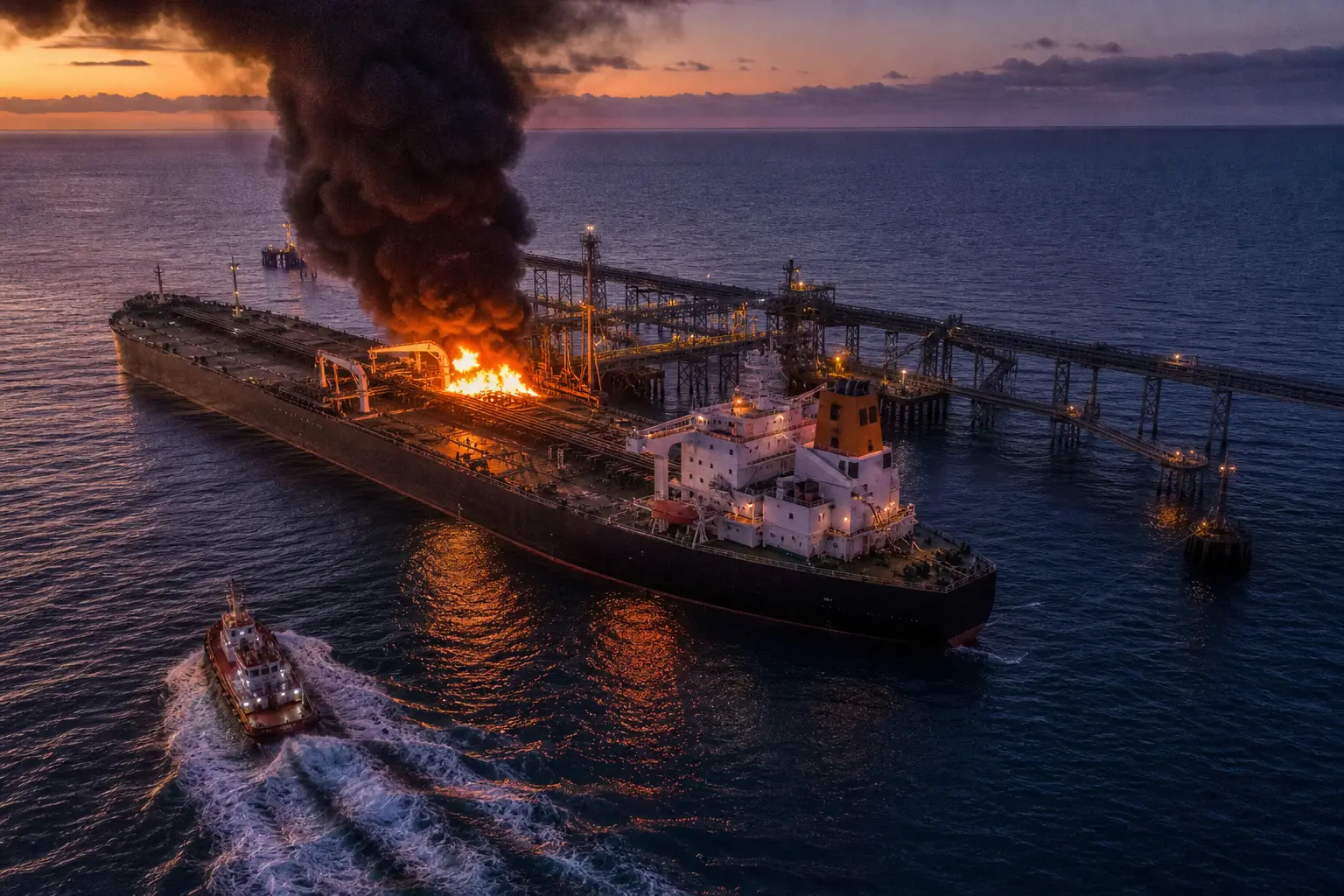
The Bystander Paying the Steepest Price
Kazakhstan has no stake in the Russia-Ukraine war and none in the Middle East conflict. Its economy is still absorbing one of the most disproportionate hits of the past year.
Hydrocarbons make up close to a fifth of Kazakhstan’s gross domestic product and more than 30% of government revenue. The Caspian Pipeline Consortium route alone carries about 80% of the country’s crude exports.
That single pipeline is worth roughly 6% of GDP and a quarter of state budget revenue on its own, according to the Kazakhstan’s economy caught between Russia and the U.S. assessment. Every drone strike on Novorossiysk lands, in effect, on Kazakhstan’s treasury too.
Kazakhstan had already been bleeding output before this week. Damage to CPC infrastructure earlier in the year cut the country’s oil production by 20% and its exports by 22% in the first quarter of 2026. Producers cut output again after the July 19 strikes, this time to keep storage tanks from overflowing once the terminal stopped taking new supply.
The country has few good alternatives. Small volumes move through the Caspian port of Aktau and onward via the Baku-Tbilisi-Ceyhan pipeline, but neither route can absorb anywhere near 1.58 million barrels a day on short notice, per Kazakhstan’s limited options to bypass Russian pipelines.
Who Owns a Piece of This Pipeline?
Russian companies hold close to 40% of the Caspian Pipeline Consortium, Kazakhstani state and private interests hold about 28%, and Western energy firms hold nearly a third. Every drone strike on the Novorossiysk terminal lands on foreign balance sheets as well as Kazakhstan’s.
That exposure showed up concretely on July 17, two days before the terminal shut down entirely, when a drone hit the Nordic Zenith, a tanker chartered by ExxonMobil.
The exposure runs wider than any single shareholder:
- Kazakhstan’s treasury – the CPC route alone accounts for roughly a quarter of state budget revenue.
- Western shareholders – foreign firms hold close to a third of the pipeline consortium, on top of direct tanker charters like ExxonMobil’s.
- Saudi Arabia – now rerouting crude around two blocked chokepoints instead of one, adding time and cost to every cargo.
- Global refiners – collecting record margins even as crude keeps moving, because diesel and gasoline capacity has not kept pace.
Saudi Arabia and Kazakhstan are absorbing costs. Refiners are collecting record profits instead.
Nine Months of Drone Strikes, One Pattern
The July strikes extend a pattern that started eight months earlier and has only accelerated.
- November 2025: A drone strike damages the CPC terminal’s offshore berthing facility, VPU-2, near Novorossiysk, forcing a loading suspension.
- January 2026: A second attack hits CPC infrastructure.
- April 6, 2026: Fixed-wing attack drones damage the pipeline and its loading pier, and four fuel storage tanks catch fire.
- July 17, 2026: A drone strikes the Nordic Zenith, a tanker chartered by ExxonMobil.
- July 19, 2026: Drones hit the tankers ASIA and NISSOS IOS at the terminal, one catches fire, and CPC suspends loadings entirely.
Two of the five strikes hit within 48 hours of each other this month. The gap between attacks has been shrinking for months.
Refiners Win While Diesel Runs Short
Crude oil is no longer the tightest part of the market. Refined products, especially diesel, face fewer fixes when supply gets cut.
Unlike crude oil, refined products face far fewer mitigation options. Several Middle Eastern refineries remain affected by the ongoing conflict while Russia’s diesel export restrictions continue to constrain global availability.
Ole Hansen, head of commodity strategy at Saxo Bank, wrote the assessment earlier this month. He added that global refining capacity remains too limited to quickly turn extra crude into more diesel and gasoline, even as barrels kept exiting the Strait of Hormuz before the ceasefire broke down.
Global refining margins have hit an all-time high as a result. Russia has separately imposed a temporary ban on diesel exports after Ukrainian strikes on its refineries, tightening the market further. Research on the Russian volatility hitting Central Asian fuel security points to the same structural gap: regional refining capacity was never built to absorb a shock this size.
Demand Is Already Buckling
High prices are already destroying demand. European diesel consumption fell 5.7% in May, according to International Energy Agency (IEA) data cited by Reuters. China’s diesel demand fell 10% the same month, and its gasoline demand fell 5%.
Global crude demand fell close to 5% in the second quarter of 2026, which IEA data attributes largely to the price shock from the Middle East war.
The safety net is thinner than it looks. Vortexa analyst Mick Strautmann said earlier in July, as quoted by the Wall Street Journal, that “the large strategic stock releases earlier in the conflict have meaningfully depleted the buffer available for any future disruption.”
IEA executive director Fatih Birol pushed back against the gloomiest reading in a statement this week. “IEA countries still hold a substantial volume of emergency stocks in reserve, including over 1 billion barrels of government-controlled stocks,” he said. He added that “there is no room for complacency on oil security amid the escalation in hostilities and a continued drawdown of available commercial inventories.”
The World Bank’s Math Just Got Worse
The macro forecasts are catching up to the oil numbers. World Bank chief economist Indermit Gill told Reuters the institution now expects the global economy to expand just 1.3% this year, down from 2.9% last year.
The pain already shows up in unrelated corners of the economy. In the United States, mortgage rates climbed to an 11-month high as oil fears fed through to borrowing costs. Wall Street has its own exposure, with the same price shock now colliding with Wall Street’s AI spending boom through higher bond yields.
Gill’s 1.3% forecast assumes the wars behind this squeeze wind down this year. Kazakhstan’s export terminal has been hit five times since November, and Thursday’s strikes came with no talks scheduled.


Shelby’s $42.9 million Daytona Coupe cashes the bet that beat Ferrari

AI forces Apple into third security drop in three weeks

Lamborghini banks 2027 revenue with sold-out Revuelto SV

Apple’s Labor Day Habit Locks iPhone 18 Pro September Dates

Frogwares Ships Sinking City 2 After Years of Air Raids

AirTag 2 Hits Near Lows Just as Travel Season Peaks

McLaren Pop Art F1 GTR Hits $34.6 Million and Resets the Tier

Spotify Playlist Notes Bring Back Liner Notes for Streaming

AirPods Max 2 hit $429 and finally close the value gap

Star Citizen private demo of Siege of Orison still wiped the devs

Guardians Rout Twins With Seven Homers, Leave Joe Ryan One Shy of Record

Rainout Gives Red Sox Two Shots at a Franchise-Record Win Streak

Caitlin Clark Skips the WNBA 3-Point Contest for a Third Straight Year

Double Fine Cuts 23 Jobs Weeks After Xbox Independence

John Hight Exits Wizards After Digital Reckoning Hits

Day-One Big Walk Lifts PS Plus August Beyond Recycled AAA

Curtis Mead’s Red Sox Debut Ends With Fractured Wrist

Moesch and Dressel Rewrite Night One at 2026 U.S. Nationals

Red Sox Squander Hot Streak Chance in 4-3 Loss to Athletics

Boutte’s Quiet Camp Takeover Forces Patriots Receiver Choices
-

 TECHNOLOGY3 years ago
How to Adjust a Bulova Watch Band – An Easy Guide
-

 News3 years ago
Fred Pentland: Athletic Bilbao’s English mentor who changed the essence of Spanish football
-

 FINANCE3 years ago
Tax Planning for Every Season: Guide to Maximizing Your Tax Benefits
-

 Education3 years ago
African Ministers New Education Plan
-

 BUSINESS3 years ago
What is Entrepreneurial Operating System? A Comprehensive Guide to EOS
-

 Education3 years ago
Innovate Your Learning Journey with Technology and Enhance Education
-

 News3 years ago
Russians formally out of World Athletics Championships
-

 BUSINESS3 years ago
Top 9 Most Expensive American Cities to Rent an Apartment