
FINANCE
SK Hynix’s $29B US IPO Lands as the Memory Crunch Hits Mac Buyers
SK Hynix filed to sell $29 billion in ADRs on Nasdaq starting July 10, as the AI memory crunch that lifted the stock also pushed Apple to raise Mac and iPad prices.

SK Hynix filed to sell about $29 billion of American depositary receipts on Nasdaq this week, kicking off one of the largest share sales in the chip industry’s history and giving US investors their first direct route to the world’s second-largest memory maker. The South Korean company plans to issue 17.79 million new shares at a value of 45.45 trillion won ($29.65 billion), with each ADR representing a tenth of a common share and trading expected to begin on July 10, a date the filing calls tentative. BofA Securities, Citigroup Global Markets, Goldman Sachs and JP Morgan Securities are managing the offering.
The filing lands inside the most powerful memory rally in two decades. Shares in SK Hynix have soared more than 280% this year, propelling the company’s market capitalization past $1 trillion on the strength of high-bandwidth memory, the chip category at the centre of every AI server build. Six weeks before the filing, the same supply squeeze forced Apple to raise prices on MacBooks, iPads, the HomePod and the Apple TV, citing memory and storage costs it said it had ‘never seen … this much, this quickly.’ Read together, those two events mark the AI memory crunch moving out of data centers and onto consumer hardware.
The Deal: $29 Billion of ADRs Hitting Nasdaq
SK Hynix filed the deal in South Korea and is laying it out for US investors through ADRs, certificates that let Americans buy a foreign stock without trading directly on the Seoul exchange. The company plans to issue 17.79 million new shares at a value of 45.45 trillion won ($29.65 billion), which works out to about $1,651.69 per common share at SK Hynix’s Tuesday Seoul closing price of 2.555 million won. Each ADR represents one tenth of a common share, so the per-ADR price will track that ratio.
In the regulatory filing, SK Hynix said the ADR listing is meant to ‘elevate our status as a global company by broadening our touchpoints in the United States, the epicenter of AI technological innovation.’ The company added that the listing will ‘ultimately allow its true corporate value to be properly evaluated.’ Major banks, including BofA Securities, Citigroup Global Markets, Goldman Sachs and JP Morgan Securities, are managing the deal, per the filing. Reuters separately reported SK Hynix is considering paying about 0.5% of the proceeds to the banks working the offering. Pricing is expected to be finalised Thursday after a bookbuild, with trading to follow on Friday if the schedule holds.
The size puts the deal in rarefied territory for chip industry listings. SK Hynix has been one of two Korean memory anchors, alongside Samsung, for decades, and now wants a US listing alongside its already-traded Seoul shares. The 0.5% fee pool being weighed is a small slice of a sale that could end up among the largest share placements of the past several years. Even at a typical IPO discount, the offering would push SK Hynix’s US presence to a level only a handful of foreign chipmakers have ever reached.
The Memory Crunch That Lifted the Stock
Shares in SK Hynix have soared more than 280% this year, propelling its market capitalization above $1 trillion as investors piled into companies seen as the key beneficiaries of the global scramble for high-bandwidth memory chips. Samsung Electronics and SK Hynix together account for more than 40% of South Korea’s benchmark Kospi, per the filing’s reporting, raising concerns that the index could become more exposed to risks including supply chain disruptions and a slowdown in global data center investment.
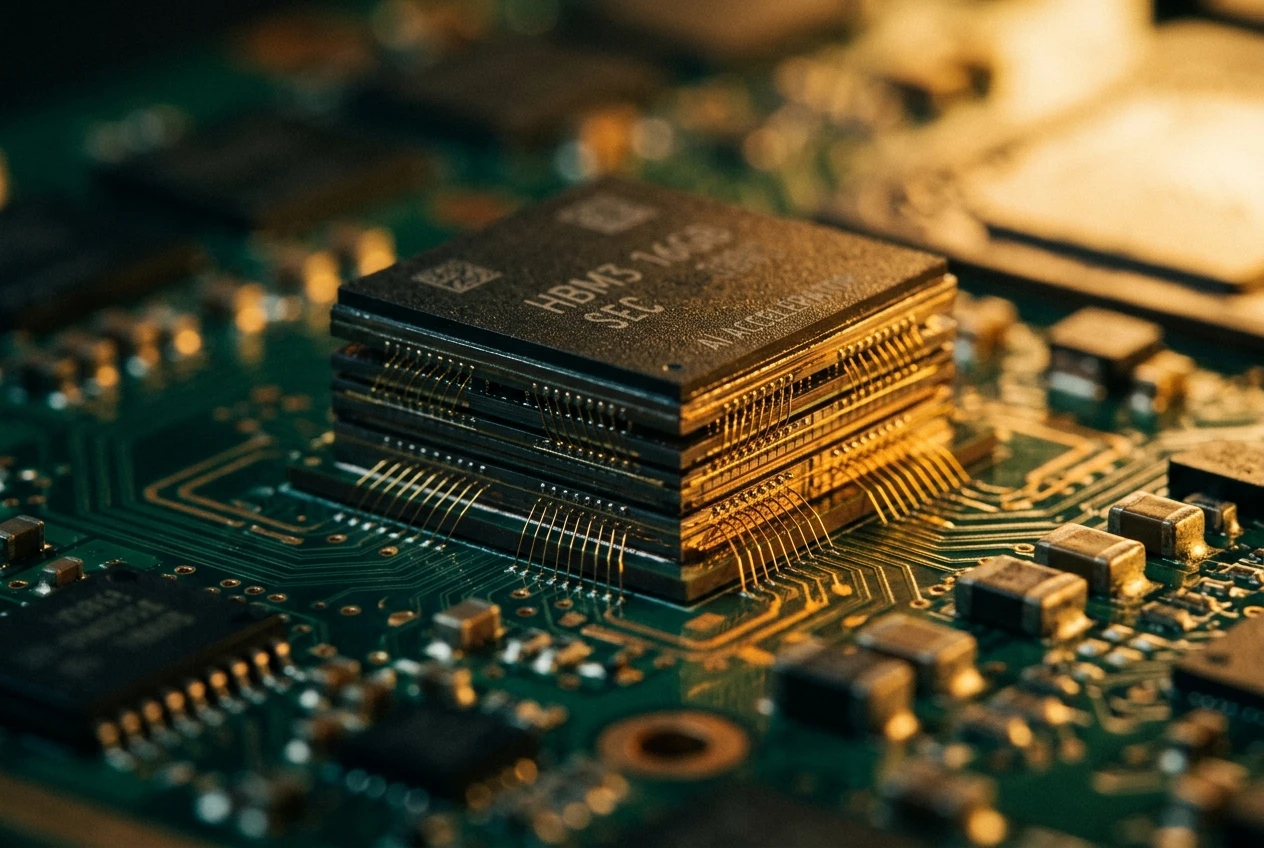
HBM, the chip category at the centre of the rally, is what ties SK Hynix’s stock chart to Apple’s sticker shock. These stacked memory chips sit next to AI processors and feed them data in real time, which is why the market has consolidated into three players capable of making HBM at scale: SK Hynix, Samsung and Micron. Counterpoint research director MS Hwang told CNBC in a June 17 interview that no other vendor matches SK Hynix on product or cost in HBM. The same HBM shortage is what pushed Apple’s price increase onto store shelves.
SK is definitely the top notch player in HBM … it has the best product, lowest cost. What do you need else?
On the US side, Micron’s first $1 trillion close in May came after UBS raised its price target on the chipmaker more than threefold to $1,625. The upgrade implied close to $1.8 trillion within 12 months and was the highest target of any of the 46 Wall Street firms covering Micron, with the FactSet consensus at $684.32. Micron is up 177% year to date and surged more than 800% over the past 12 months. For the wider chip trade, Samsung’s record Q2 profit that tripped the KOSPI circuit breaker earlier this summer shows how thin the air has become even for the names still posting record earnings.
Why SK Hynix Wants Wall Street Now
SK Hynix has been a public company in Seoul for years but wants a US listing now because the customers building AI data centers are based here, and so is much of the capital chasing them. The world’s biggest cloud buyers, including Amazon, Microsoft, Google and Oracle, are racing to construct ‘AI factories’ to train and serve large models, and memory is where demand has outrun supply. The filing’s stated rationale, ‘broadening our touchpoints in the United States,’ translates into two things: a closer institutional relationship with hyperscalers and a deeper pool of buyers for the company’s stock. SK Hynix’s lead in HBM gives it the most direct way to monetize that buildout; selling ADRs puts the revenue from that lead in front of the investors underwriting US data center capex.
The timing also lets SK Hynix tap a Wall Street already paying record multiples for AI memory exposure. UBS’s $1,625 price target on Micron, against the FactSet consensus of $684.32 across 46 covering firms, sets a range any new memory listing will be priced against. Nvidia remains the dominant AI stock; the SK Hynix offering is a direct test of whether US capital is willing to rotate into the bottleneck alongside the boards it already owns.
The Cost Has Already Landed at Apple
The clearest signal that the memory crunch has escaped the data center arrived June 25, 2026, when Apple raised prices on Macs, iPads and other hardware. Apple’s entry-level MacBook Neo moved from $599 to $699, the cheapest iPad from $349 to $449, and the iPad Mini got a $100 increase to $599. The Apple TV rose from $129 to $199, the Vision Pro headset to $3,699 (a $200 increase), and the HomePod speaker from $299 to $349. Prices for iPhones and AirPods, by contrast, remained unchanged.
The hikes landed the same day Apple shares dropped 6.1%, the stock’s worst session in more than a year, on a price increase that Apple’s own supply chain had warned about for weeks. Apple CEO Tim Cook told the Wall Street Journal that the increases were ‘unavoidable’ because of memory chip shortages, a warning Cook had carried into Apple earnings calls over the preceding months.
We’re doing our best to mitigate the huge increases that are being passed to us, and we’ve been trying to shield our customers from the increases, but the situation has become unsustainable.
In a statement, Apple said the growing number of AI data centers has ‘created an extraordinary surge in demand for memory and storage’ and that it has ‘never seen a component price increase this much, this quickly.’ The hikes are a major consumer-brand receipt for a supply imbalance already visible in HBM contract prices, where memory used in mobile and PC applications jumped 20-30% in the fourth quarter of 2025 alone. The crisis has acquired a nickname in industry coverage: ‘RAMageddon.’
| Product | New price | Increase |
|---|---|---|
| MacBook Neo | $699 | up from $599 |
| iPad (entry-level) | $449 | up from $349 |
| iPad Mini | $599 | $100 increase |
| Apple TV | $199 | up from $129 |
| Apple Vision Pro | $3,699 | $200 increase |
| HomePod | $349 | up from $299 |
The increases are the consumer side of the same supply-demand imbalance driving SK Hynix’s stock to records. Every product that depends on DRAM or NAND, from a smartphone to a budget PC, is being repriced into the same memory squeeze that lifted the chipmakers past $1 trillion.
Where the Smart Money Is Going
Hedge funds have been moving into the same trade SK Hynix is now selling. Billionaire David Tepper’s Appaloosa Management increased its bet on Micron by 11% this year, making the stock the firm’s second-largest holding at $562.5 million, per Forbes. Ray Dalio’s Bridgewater, the world’s largest hedge fund, increased its Micron position by nearly 66% and more than doubled the stock’s weight in its portfolio.
Bridgewater’s rotation also shed enterprise software names such as Salesforce and ServiceNow in favour of AI chip stocks including Nvidia, Broadcom and Micron. The shift mirrors the same move SK Hynix is making with its own IPO: rotate US capital toward memory exposure as the bottleneck of AI. Micron CEO Sanjay Mehrotra told investors on the most recent earnings call that the company had already sold out its entire 2026 supply of high-bandwidth memory chips. With that 2026 line spoken for, there is essentially no incremental HBM supply to add this year; every AI server ordered now is a memory allocation someone else has to give up. SK Hynix, with about 60% of the HBM market, sits at the same choke point.
For US investors who cannot buy SK Hynix directly until the ADR trade begins, Micron has been the available proxy. Micron’s market value crossed $1 trillion in May, and UBS’s $1,625 target on the stock implies close to $1.8 trillion within 12 months, well above the FactSet consensus of $684.32. Once SK Hynix ADRs trade on Nasdaq, that proxy shrinks: holders of either stock are effectively betting on the same HBM bottleneck from two directions. The price the SK Hynix ADRs clear at on Thursday’s bookbuild will be the first US-market signal of demand for fresh memory exposure.
The Supply Risk That Could End the Boom
South Korean tech companies, led by SK Hynix and Samsung, have vowed to spend over $550 billion on building out new memory manufacturing capacity. The build includes the Yongin Cluster in South Korea, set to begin coming online in 2027, plus a $4 billion packaging plant in Indiana, SK Hynix’s first US fab.
That response is also the risk. Memory is a famously cyclical industry: when supply catches up to demand, prices crash and profits evaporate, a pattern that has played out repeatedly in DRAM over the last three decades. By the time Yongin and the broader Korean fab build reach full output, the demand mix for AI memory may have shifted, leaving the industry with more capacity than the market wants. The same firms capitalizing on the boom today could be the ones absorbing a glut in 2028 or 2029, even though the build itself was the rational response to today’s shortage. Micron is hedging that risk in real time with a $2 billion expansion of its Manassas, Virginia factory, the US foot of a broader onshoring push.
What This Means for the Rest of the Stack
Apple’s June price hike is one of the most visible consumer receipts for the AI memory bill. Valve’s Steam Machine at $1,049 and $1,349 is another, with the company pointing to memory costs as the reason behind the pricing rethink; that launch is a downstream effect of the same HBM supply tightness lifting SK Hynix and Micron.
For investors, the SK Hynix ADR offering is also a test of whether the AI trade can widen out beyond a handful of names. Nvidia remains the dominant stock; SK Hynix now offers US investors a direct line to the other side of that bottleneck. The price the ADRs clear at, expected to be set Thursday, will be the first US-market signal of demand for memory outside the names already past $1 trillion. A clean book would argue the rally still has US capital behind it; a soft pricing would argue the trade is already full. Either outcome resets the bar for the next memory listing from the same region.
For Apple customers and every other buyer of consumer hardware, the SK Hynix IPO is less the start of a story than a marker of how far the AI build has already travelled. The cheapest MacBook now costs $699 and the cheapest iPad $449, both up from where they sat at the start of 2026. Until enough new memory fabs come online to relieve the squeeze, the prices set by SK Hynix and its three peers will keep showing up on receipts from Cupertino to Seoul.
Frequently Asked Questions
When does SK Hynix start trading on Nasdaq?
SK Hynix said in its regulatory filing that it expects trading to begin on July 10, 2026, with the date tentative and subject to change. Pricing of the ADRs is set after bookbuilding concludes, expected Thursday, per the filing.
How much is SK Hynix raising in the US listing?
SK Hynix plans to issue 17.79 million new shares with a target value of 45.45 trillion won, or about $29.65 billion, per its filing. Four lead banks (BofA Securities, Citigroup Global Markets, Goldman Sachs and JP Morgan Securities) are managing the deal.
What is high-bandwidth memory and why is it suddenly so valuable?
High-bandwidth memory, or HBM, is a category of stacked DRAM that AI servers use to feed processors data in real time. Counterpoint Research puts SK Hynix’s share of this market at about 60%, with Samsung and Micron making up most of the rest.
Why are Apple Mac and iPad prices going up?
Apple raised prices on June 25, 2026, the same day its shares fell 6.1%, the stock’s worst session in more than a year. The increases hit the MacBook Neo, cheapest iPad, iPad Mini, Apple TV, Vision Pro and HomePod, while iPhones and AirPods were not affected.
How risky is the memory boom?
Memory has been a famously cyclical industry, with prices often collapsing after major capacity builds. Korean chipmakers have committed over $550 billion in response; Micron is hedging the eventual bust risk with a $2 billion expansion of its Manassas, Virginia factory.
Disclaimer: This article is for informational purposes only and does not constitute financial advice. Investing in IPOs and ADRs carries substantial risk, including potential loss of principal. The figures and projections cited here are accurate as of July 7, 2026, and may change without notice. Consult a qualified financial professional before making any investment decision.






Spotify Running Mode hits Android and revives its old tempo experiment

Galaxy Tab S12 Ultra Renders Keep the Notch Fans Hate

Novato Spinning Round House Sells With Six Neighbors for $3.3 Million

Crop Tour Finds Indiana and Nebraska Corn Yields Lagging 2025

Best Buy 60th sale brings Android deals back to its roots

American Airlines reverses seatback screen bet years too late

Iran Hormuz Strikes Force Gulf Oil Onto Costlier Paths

Plague Tale Prequel Day One Joins Game Pass Wave 2 as Witcher Exits

NBA 2K27 opens The City to everyone and rewrites career eras

iOS 26.6.1 Patches 29 Flaws as AI Forces Faster Apple Updates

Caitlin Clark Skips the WNBA 3-Point Contest for a Third Straight Year

Rainout Gives Red Sox Two Shots at a Franchise-Record Win Streak

Double Fine Cuts 23 Jobs Weeks After Xbox Independence

Day-One Big Walk Lifts PS Plus August Beyond Recycled AAA

John Hight Exits Wizards After Digital Reckoning Hits

Curtis Mead’s Red Sox Debut Ends With Fractured Wrist

Moesch and Dressel Rewrite Night One at 2026 U.S. Nationals

Red Sox Squander Hot Streak Chance in 4-3 Loss to Athletics

Boutte’s Quiet Camp Takeover Forces Patriots Receiver Choices

Take-Two CEO Pushes Netflix Subs for GTA 6 Extended Look
-

 TECHNOLOGY3 years ago
How to Adjust a Bulova Watch Band – An Easy Guide
-

 News3 years ago
Fred Pentland: Athletic Bilbao’s English mentor who changed the essence of Spanish football
-

 FINANCE3 years ago
Tax Planning for Every Season: Guide to Maximizing Your Tax Benefits
-

 Education3 years ago
African Ministers New Education Plan
-

 BUSINESS3 years ago
What is Entrepreneurial Operating System? A Comprehensive Guide to EOS
-

 Education3 years ago
Innovate Your Learning Journey with Technology and Enhance Education
-

 News3 years ago
Russians formally out of World Athletics Championships
-

 BUSINESS3 years ago
Top 9 Most Expensive American Cities to Rent an Apartment