
FINANCE
America’s Social Security Trust Fund Is Running Out of Money
America’s Social Security trust fund is on track to run dry by 2032-2034, triggering an automatic benefit cut of roughly a quarter for retirees.

The Social Security trust fund is running out of money. When the program began in 1940, more than 150 workers paid in for every retiree drawing a check; that ratio has collapsed. Federal forecasters now expect the main retirement reserve to run dry between 2032 and 2034, by law triggering an automatic cut of about a quarter to nearly every benefit unless Congress acts.
The combined reserves held $2.72 trillion at the end of 2024, down $67 billion in a single year. Once that pile reaches zero, the law bars the program from borrowing to cover the difference. Payroll taxes keep flowing in, but on their own they cover only about three-quarters of what has been promised.
How a Cash Cow Turned Into a Cash Drain
The early arithmetic was almost comically favorable. Money poured in from a huge working population and trickled out to a small group of retirees, most of whom did not live long after 65. The fund parked the surplus in Treasury securities and grew fat for decades.
That arithmetic has inverted. By 1960 there were 5.1 workers behind every beneficiary, according to the program’s own historical ratio tables. Today there are about 2.8 workers per beneficiary, and the figure is on track to slide toward 2.3 by 2036. Three forces did the damage: Americans are having far fewer children, the baby-boom generation is retiring in a wave, and people who reach 65 now live years longer than their grandparents did.
The fertility numbers carry the story. A woman in 1960 had 3.6 children on average; by 2020 that was down to 1.6, well below the level needed to keep the workforce growing. That drop sits at the center of the program’s demographic shortfall as mapped by the Congressional Research Service (CRS, Congress’s nonpartisan research arm). Meanwhile a 65-year-old in 1960 could expect to reach about 80; today the same person is likely to see 85. Fewer people pay in while more collect for longer. The crossover already arrived in 2021, the first year the program’s costs outran its income.
| Year | Covered workers per beneficiary |
|---|---|
| 1940 | About 159 |
| 1960 | 5.1 |
| 2023 | 2.7 |
| 2036 (projected) | 2.3 |
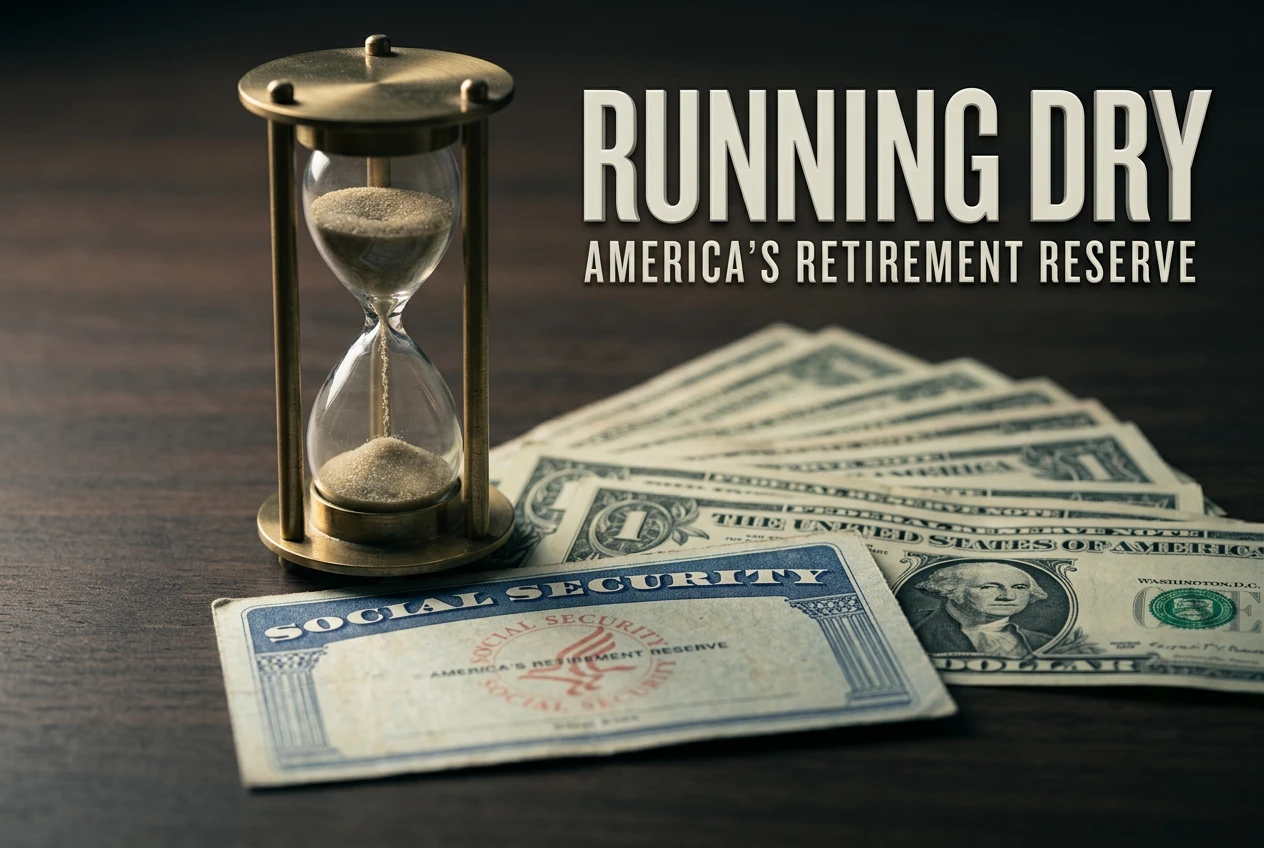
What Happens to Checks When the Reserve Runs Dry
“Insolvency” sounds like the checks stop. They don’t. Even with an empty reserve, payroll taxes from current workers keep arriving every payday, and that money still funds the large majority of benefits. The reserve is the buffer that tops up the difference between what comes in and what goes out, and it is the buffer that disappears.
Here is the hard part. Federal law does not let Social Security pay benefits it cannot fund, and it cannot borrow to plug the gap. So on the day the retirement reserve empties, every benefit gets trimmed at once, by the same percentage, automatically. The Social Security trustees’ 2025 projection put that immediate reduction at 23%, leaving 77% of scheduled benefits payable. The Congressional Budget Office (CBO, Congress’s nonpartisan scorekeeper) is gloomier, pegging the cut at 28% for the roughly 72 million people drawing old-age and survivors benefits.
- 77% of scheduled benefits still payable after the retirement fund empties, per the 2025 trustees’ report.
- 72 million Americans draw the old-age and survivors benefits that the cut would hit.
- $437 billion projected gap between the program’s cost and its income in 2034.
- $2.72 trillion in combined reserves at the end of 2024, falling every year.
Why Forecasters Split on the Exact Year
Pin down a single date and you will be wrong, because the two big official estimates do not agree. The trustees who oversee the program expect its retirement fund, formally the Old-Age and Survivors Insurance (OASI) trust fund, to empty in 2033, with the combined retirement and disability funds lasting one year longer. The CBO’s more recent read moved the retirement fund’s exhaustion up to 2032, a full year sooner.
The gap comes from different assumptions baked into each model: how fast wages and prices rise, how many immigrants join the workforce and pay in, how quickly the economy grows. Small changes in those inputs swing the date by a year or more, which is why you can open the CBO’s long-term Social Security projections in winter and see a number that did not exist the previous summer. The direction is the same in every credible forecast: down, and arriving in the early 2030s.
| Forecast | Retirement fund empties | Benefit still payable |
|---|---|---|
| 2025 Trustees Report (OASI) | 2033 | 77% |
| 2025 Trustees Report (combined) | 2034 | 81% |
| CBO 2026 Outlook | 2032 | About 72% |
The 1983 Rescue and Why Its Runway Ended
This is not the first time the fund stared at zero. By the early 1980s it was months away from being unable to pay full benefits, and Washington scrambled.
What the Greenspan Commission Did
A bipartisan panel led by Alan Greenspan, later the Federal Reserve chairman, produced the fix that President Reagan signed in April 1983. The Greenspan commission’s overhaul did three blunt things: it sped up scheduled payroll-tax increases, it began taxing benefits for higher-income retirees, and it gradually pushed the full retirement age up from 65 toward 67. Those moves poured more money in and slowed the payout, and the trustees soon certified the program solid for the better part of a century.
Why It Bought Less Time Than Promised
The rescue leaned on assumptions about birth rates, wage growth, and longevity that the following decades did not honor. Families kept shrinking, wage growth for most workers stayed soft, and retirees lived longer than the planners’ tables guessed. The full retirement age finished its slow climb to 67 only recently, so the last of that relief is landing just as the baby-boom retirement wave crests. It worked as designed. The demographics it assumed did not hold, and that is the bill now arriving.
Who Feels the Squeeze First
An across-the-board cut sounds even-handed, but it lands hardest where benefits are the main income. About four in ten older Americans rely on Social Security for most of what they live on, and for many of the poorest it is nearly everything.
- Low lifetime earners, who get a smaller check to begin with and have little savings to absorb a reduction.
- Workers retiring in the early 2030s, who could see the cut land in their first years of benefits with no time to adjust.
- Survivors and very old beneficiaries, often widows in their 80s and 90s living on a single payment.
- People in regions where federal support already stretches thin, the same communities now leaning on stretched local food banks as other safety-net programs tighten.
The anxiety is already visible at the retail level. A recent scare over whether a Social Security field office would stay open set off confusion and worry among local recipients long before any benefit math changes.
The Fixes Congress Keeps Putting Off
None of this is a surprise to anyone in Washington, and the menu of repairs is well worn. Every option is some mix of more money in or less money out, and each has a constituency that hates it.
- Lift or scrap the payroll-tax cap. Earnings above roughly $176,100 are not taxed for Social Security; taxing more of high earners’ wages closes a large share of the gap on its own.
- Raise the payroll-tax rate. A point or two on top of the 12.4% combined rate raises real money, paid by every worker and employer.
- Push the full retirement age past 67. It trims lifetime benefits, and it hits physically demanding jobs hardest.
- Slow the annual cost-of-living adjustment, so benefits grow less quickly with prices.
- Bring in revenue from outside payroll, an idea that breaks the program’s pay-as-you-go design.
The longer Congress waits, the steeper any of these has to be, because there are fewer years left to spread the pain. The program started with more than a hundred workers behind every retiree and a reserve that only grew; it now has fewer than three workers per retiree and a reserve counting down to zero in the early 2030s. The math will not fix itself.
Frequently Asked Questions
When Will the Social Security Trust Fund Run Out of Money?
The 2025 trustees’ report expects the retirement (OASI) fund to empty in 2033 and the combined funds in 2034. The CBO’s 2026 outlook moved the retirement fund’s exhaustion up to 2032. Every credible forecast points to the early 2030s.
Will Social Security Checks Stop When the Fund Is Depleted?
No. Payroll taxes keep coming in and would still cover most benefits. The 2025 trustees estimate that about 77% of scheduled benefits would stay payable, so the danger is a cut, not a shutoff.
How Much Would Benefits Be Cut?
Estimates run from roughly 23% (2025 trustees) to 28% (CBO) as an automatic, across-the-board reduction once the retirement reserve is gone. That would hit about 72 million old-age and survivors beneficiaries at once.
Why Is the Trust Fund Running Out?
The ratio of workers paying in to retirees drawing out fell from about 159 to 1 in 1940 to roughly 2.8 to 1 today. Lower birth rates, longer lifespans, and the retiring baby boom all pushed it down.
Can Congress Fix It?
Yes. Options include lifting the payroll-tax cap, raising the tax rate, nudging the retirement age higher, or slowing cost-of-living increases. Each closes part of the gap, and the longer lawmakers wait, the larger the required change becomes.
What Can I Do to Prepare?
Workers can build savings outside Social Security, and near-retirees can factor a possible reduction into their plans, though no individual action changes the program’s finances; that takes legislation. A qualified financial planner can help you stress-test your own retirement against a lower benefit.
Disclaimer: This article is for informational purposes only and is not financial or retirement-planning advice. Social Security projections rely on assumptions that change over time, and the figures cited are accurate as of publication. Consult a qualified financial professional before making decisions based on possible future changes to benefits.






Iowa Farmer Built Resilience for 16 Years Then Tariffs Hit Hard

HHS Adds FDA Tech and Drugs Deputies to Lock In AI and Review Power

Nvidia Earnings Carry a Built-In Sell-the-News Trap

HP Licenses Huawei Wi-Fi Patents Despite the Entity List

Poland Named in $131B F-15 Deal Echoes Apache Path

Sewer Scavengers Near Penn Station Repeat a Decades-Old NYC Pattern

Second Muni Fatigue Crash Exposes Surface Line Gaps

Chick-fil-A Chicken and Waffles Closes Its 80-Year Loop

Musk Data Centers Leave a Mississippi Family’s Historic Land Empty

OpenAI Data Center Chief Exits as Stargate Strategy Shifts

Double Fine Cuts 23 Jobs Weeks After Xbox Independence

Day-One Big Walk Lifts PS Plus August Beyond Recycled AAA

Curtis Mead’s Red Sox Debut Ends With Fractured Wrist

John Hight Exits Wizards After Digital Reckoning Hits

Moesch and Dressel Rewrite Night One at 2026 U.S. Nationals

Red Sox Squander Hot Streak Chance in 4-3 Loss to Athletics

Boutte’s Quiet Camp Takeover Forces Patriots Receiver Choices

Take-Two CEO Pushes Netflix Subs for GTA 6 Extended Look

Halo Campaign Evolved Skulls Meet Death Barriers That Kill the Hunt

Wildlands Free Update Hands Players the Tools They Already Invented
-

 TECHNOLOGY3 years ago
How to Adjust a Bulova Watch Band – An Easy Guide
-

 News3 years ago
Fred Pentland: Athletic Bilbao’s English mentor who changed the essence of Spanish football
-

 FINANCE3 years ago
Tax Planning for Every Season: Guide to Maximizing Your Tax Benefits
-

 Education3 years ago
African Ministers New Education Plan
-

 BUSINESS3 years ago
What is Entrepreneurial Operating System? A Comprehensive Guide to EOS
-

 Education3 years ago
Innovate Your Learning Journey with Technology and Enhance Education
-

 News3 years ago
Russians formally out of World Athletics Championships
-

 BUSINESS3 years ago
Top 9 Most Expensive American Cities to Rent an Apartment