
FINANCE
S&P 500 Rallies 1.2% Even as Trump Declares the Iran Truce Over
Stocks rose last week even after Trump called the Iran cease-fire over, the fourth such flare-up since February that markets have largely shrugged off.

The S&P 500 climbed 1.2% and the Nasdaq Composite jumped 1.7% last week, according to Barron’s, even after President Donald Trump told reporters the cease-fire with Iran is “over.” Stocks fell hard on the news Wednesday. By Friday, they had erased the loss and then some.
It is at least the fourth time since February that a cease-fire collapse has rattled markets for a day before Wall Street moved on. Each replay has drawn a smaller reaction than the one before it.
Stocks Post a Weekly Gain After a Wild Wednesday
The trouble started Tuesday night, when U.S. forces hit Iran with more than 80 strikes, retaliation for Iranian attacks on three commercial vessels crossing the Strait of Hormuz. By Wednesday morning, at a NATO summit in Ankara, Turkey, Trump made it official.
“I think it’s over. I don’t want to deal with them anymore. They’re scum,” Trump said alongside NATO Secretary General Mark Rutte. Hours later he added a threat: “We’re going to hit them hard tonight.”
Wall Street flinched, briefly. Energy and defense-linked names jumped while travel and consumer stocks slid, and the swing showed up across every major index by the closing bell.
The CBOE Volatility Index (VIX), Wall Street’s fear gauge, rose above 18. CNN’s Fear and Greed Index jumped from 30 to 43, into “Fear” territory, and the 10-year Treasury yield climbed to 4.57%, up from 4.38% a week earlier.
| Index | Wednesday’s Reaction | Friday’s Close |
|---|---|---|
| S&P 500 | Down 0.28% to 7,482.71 | Up 0.42% to 7,575.39 |
| Nasdaq Composite | Up 0.2% to 25,870.65 | Up 0.29% to 26,281.61 |
| Dow Jones Industrial Average | Down 576.76 points to 52,348.39 | Up 149.60 points to 52,637.01 |
The mood flipped Thursday, when Trump said Iran had called looking to make a deal. Qatar and Pakistan restarted shuttle diplomacy, and an administration official described the contacts as ongoing “technical talks.” Stocks kept climbing into Friday’s close.
The S&P 500 finished the week roughly half a percent below the record it set on June 2, and is now up 10.7% for the year, according to Seeking Alpha’s tracking of the index.
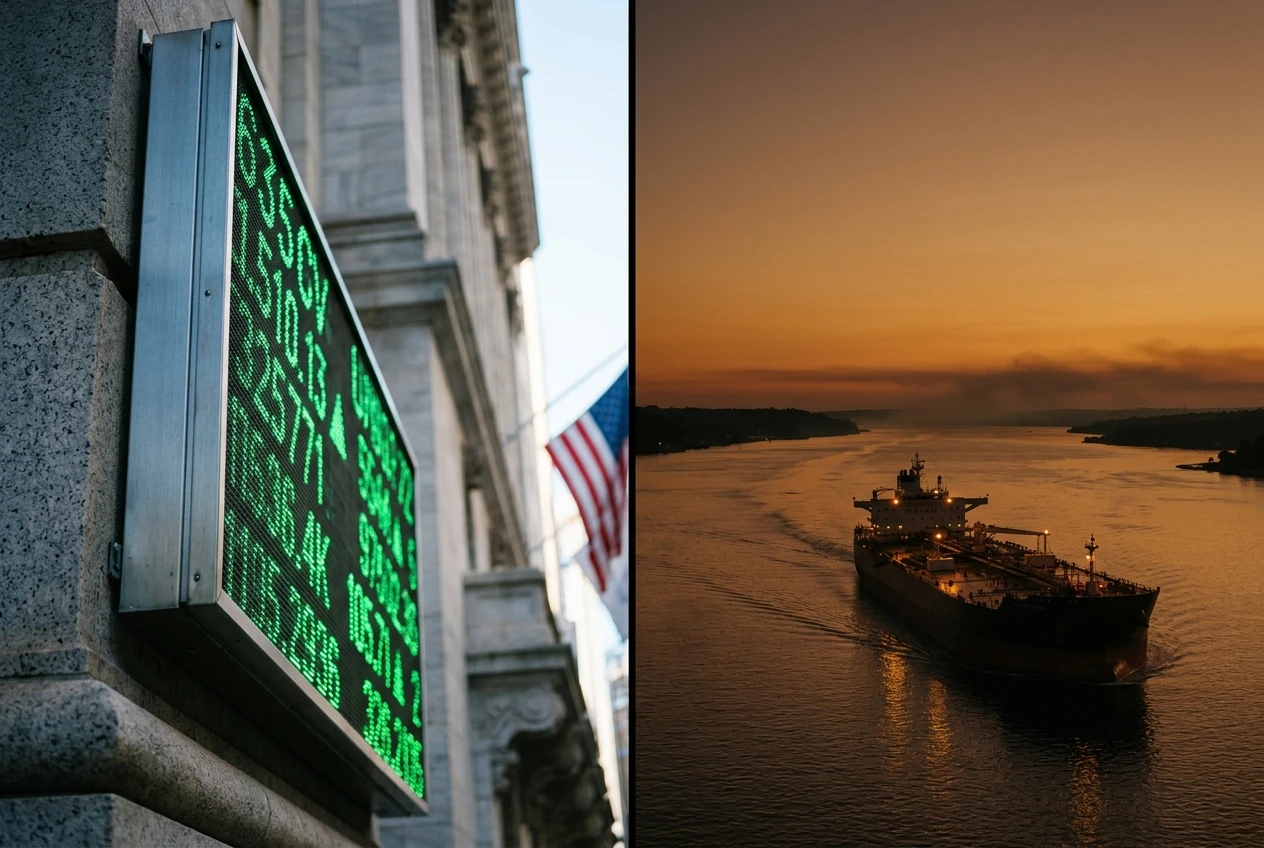
Energy Jumps, Airlines Slide as Strikes Hit the Strait
Wednesday’s selloff was not evenly distributed. Traders rotated into names that benefit from higher oil and away from anything that burns jet fuel.
- Energy stocks jumped in premarket trading. Diamondback Energy rose more than 3%, APA Corporation and Occidental Petroleum each gained more than 2.5%, Chevron added over 2%, and Exxon Mobil rose 1.5%.
- Airlines absorbed the other side of the trade. American Airlines fell nearly 4%, United Airlines dropped about 3%, and Delta Air Lines, Southwest Airlines and JetBlue Airways each lost roughly 2%.
- Cruise operators followed the same script. Carnival Corporation slid 3.5% and Norwegian Cruise Line tumbled 3% as fuel costs threatened margins.
South Korea’s SK Hynix felt both sides of the whiplash. The chipmaker’s Seoul-listed shares had already slumped when an earlier round of strikes hit Iran, before the same company priced its Nasdaq debut at $149 a share days later, opening near $170 and raising $26.5 billion, the largest U.S. listing ever by a foreign company.
The offering landed in the middle of a broader wave of AI-linked listings testing how much risk Wall Street still wants. Morgan Stanley’s wealth management arm points to one other group that could gain if the fighting drags on: drones, satellites and missile defense tied to military spending.
Why Isn’t the Market Panicking About Iran?
Because it has effectively been trained not to. Wall Street has absorbed six weeks of on-and-off strikes without a lasting selloff, and traders increasingly treat each new round of fighting as a short, containable event instead of the start of a wider war.
The desensitization shows up in the data. In March, the S&P 500 fell on 10 of the 12 days when U.S. crude jumped more than 3%, with an average decline of about 0.7%. From April through June, the index’s oil sensitivity shrank to a 0.2% average drop, Edward Jones found.
Oil spikes still matter. They just move stocks less than they used to.
It’s early to tell, because is it a flare-up or is it an escalation? We’ve had flare-ups on and off over the past, call it six weeks. But if it’s an escalation, I think then that’s something that could potentially be repriced in.
Brian Leonard, a portfolio manager at Keeley Gabelli Funds, said the market has essentially priced in the flare-up pattern rather than an actual war.
There is a fundamental argument behind the calm, too. Antonio Gabriel, a global economist at Bank of America Securities, has estimated the U.S. economy now needs roughly a third of the oil it did in the 1970s to produce the same output. A 10% oil price shock today, he figures, adds about a quarter of a percentage point to inflation, versus a 0.90 point hit in the 1970s.
Four Cease-Fires, Four Rallies Since February
This week’s script is not new. It is the latest lap in a cycle that has now repeated four times since the fighting began.
- Feb. 28, 2026: The U.S. and Israel launch their first strikes on Iran, opening a conflict that would eventually push oil above $112 a barrel and shut down much of the Strait of Hormuz.
- April 8, 2026: Trump announces a two-week cease-fire hours before his own deadline for Iran to comply or face destruction. The Dow surges more than 1,000 points that morning.
- June 15, 2026: The two sides confirm a broader deal to end hostilities and reopen the strait, and Nikkei climbs 5.5% while Kospi jumps 5.7% on the announcement.
- Late June 2026: A shadow war over Hormuz nearly unravels the truce. Trump threatens that Iran will “no longer exist” if he is forced to finish the job, but both sides step back and stocks surge after Trump cancels planned strikes, even with no deal ever signed.
- July 8, 2026: Trump declares the cease-fire over at the NATO summit in Ankara, hours after the fresh strikes on Iran.
- July 9 to 10, 2026: Trump says Iran wants to talk again, and the S&P 500 closes out the week with a gain.
In each case, the shock faded from stock prices within two to four trading sessions.
Wall Street’s Bulls and Bears Split on Iran Risk
Not everyone is comfortable with how little the market flinches anymore.
Amrita Sen, founder and director of market intelligence at Energy Aspect, has called the market’s reaction an “extremely misplaced euphoria,” warning economies could be “sleepwalking” into “a big recession” as investors underplay the energy squeeze from the war.
Equities have historically gained double digits during both Gulf Wars within six months of the opening strikes, Morgan Stanley’s research found, with the advances led by defense stocks. Its analysts still flag conflict duration as the one variable that actually matters. A drawn-out fight pushes up deficits, bond yields and the odds the Fed stays tighter for longer.
Earnings Season Arrives as the Next Test
The next stress test arrives fast. Big bank earnings open the second-quarter reporting season Wednesday, with Citigroup, Goldman Sachs, JPMorgan Chase, Wells Fargo and Bank of America all due to report.
The Producer Price Index lands the same day, followed by retail sales and housing data later in the week, a preview of how much of the oil spike is bleeding into broader prices.
Federal Reserve Chair Kevin Warsh is watching the same numbers. Investors now see better than a one-in-three chance the Fed raises interest rates this month, up from about one-in-four before Wednesday’s cease-fire collapse.
Charles Schwab’s trading desk issued a slightly bullish forecast that flags oil and yield risks for the week ahead. The International Monetary Fund has already trimmed its 2026 global growth forecast to 3%, from 3.5% last year, citing the same conflict.
Second-quarter earnings, due out over the next three weeks, are the next real test of whether the Qatar-mediated talks hold.
Disclaimer: This article is for informational purposes only and does not constitute investment advice. Stock prices, index levels and geopolitical developments can change quickly; figures cited are accurate as of publication on July 13, 2026. Consult a licensed financial advisor before making investment decisions.


Spotify Running Mode hits Android and revives its old tempo experiment

Galaxy Tab S12 Ultra Renders Keep the Notch Fans Hate

Novato Spinning Round House Sells With Six Neighbors for $3.3 Million

Crop Tour Finds Indiana and Nebraska Corn Yields Lagging 2025

Best Buy 60th sale brings Android deals back to its roots

American Airlines reverses seatback screen bet years too late

Iran Hormuz Strikes Force Gulf Oil Onto Costlier Paths

Plague Tale Prequel Day One Joins Game Pass Wave 2 as Witcher Exits

NBA 2K27 opens The City to everyone and rewrites career eras

iOS 26.6.1 Patches 29 Flaws as AI Forces Faster Apple Updates

Day-One Big Walk Lifts PS Plus August Beyond Recycled AAA

Double Fine Cuts 23 Jobs Weeks After Xbox Independence

John Hight Exits Wizards After Digital Reckoning Hits

Curtis Mead’s Red Sox Debut Ends With Fractured Wrist

Red Sox Squander Hot Streak Chance in 4-3 Loss to Athletics

Moesch and Dressel Rewrite Night One at 2026 U.S. Nationals

Boutte’s Quiet Camp Takeover Forces Patriots Receiver Choices

Take-Two CEO Pushes Netflix Subs for GTA 6 Extended Look

Halo Campaign Evolved Skulls Meet Death Barriers That Kill the Hunt

Wildlands Free Update Hands Players the Tools They Already Invented
-

 TECHNOLOGY3 years ago
How to Adjust a Bulova Watch Band – An Easy Guide
-

 News3 years ago
Fred Pentland: Athletic Bilbao’s English mentor who changed the essence of Spanish football
-

 FINANCE3 years ago
Tax Planning for Every Season: Guide to Maximizing Your Tax Benefits
-

 Education3 years ago
African Ministers New Education Plan
-

 BUSINESS3 years ago
What is Entrepreneurial Operating System? A Comprehensive Guide to EOS
-

 Education3 years ago
Innovate Your Learning Journey with Technology and Enhance Education
-

 News3 years ago
Russians formally out of World Athletics Championships
-

 BUSINESS3 years ago
Top 9 Most Expensive American Cities to Rent an Apartment