
News
T-Mobile’s Outage Knocked Out Mint Mobile and Google Fi Too
T-Mobile’s Monday outage pushed iPhones into SOS mode nationwide and also silenced Mint Mobile and Google Fi, brands riding its same network.

T-Mobile’s network buckled Monday afternoon, pushing iPhones nationwide into emergency-only SOS mode and cutting off tens of thousands of customers within the first hour. The carrier confirmed its teams were working the problem by late afternoon and said by evening that service was fully restored.
The outage did not stop at T-Mobile’s own subscribers. Mint Mobile, Metro by T-Mobile and Google Fi all ride T-Mobile’s towers, and their customers went dark too, many without ever realizing their phone plan depends on one company’s network.
SOS Icons Spread Coast to Coast
Data aggregated by Downdetector showed reports climbing fast starting around 1 p.m. PT (4 p.m. ET), with complaints piling up out of New York, Washington DC, Chicago, Detroit, Minneapolis and Los Angeles inside the same hour. By 5 p.m. ET, the tracker had logged more than 63,000 reports; that total climbed past 140,000 as the evening wore on.
A thread on Reddit’s r/tmobile forum drew thousands of comments from subscribers who said they could not place calls, send texts or load data. Staff at 9to5Mac, which first flagged the outage, reported the same problem on their own devices.
- 1 p.m. PT: Downdetector reports begin climbing as customers nationwide lose calls, texts and data.
- 3 p.m. PT: Some users report service trickling back; others say the outage is still in full effect.
- 4:15 p.m. PT: T-Mobile issues its first on-record statement, calling the fix a top priority.
- Monday evening: T-Mobile tells Digital Trends service is fully restored nationwide and apologizes for the disruption.
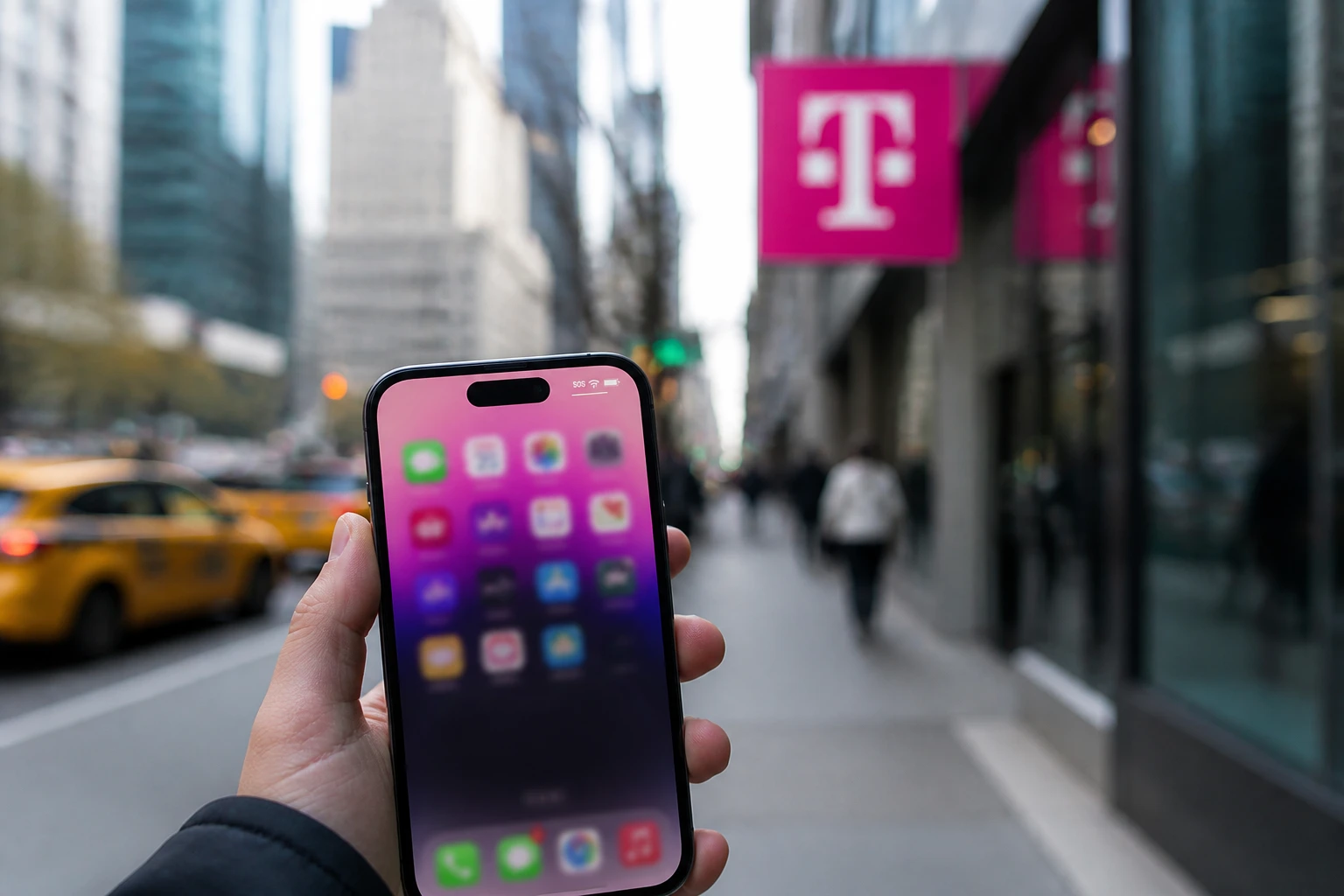
Why iPhones Flip to Emergency-Only Mode
The SOS label appears in an iPhone’s status bar when the device cannot register on its home network at all. It means zero connection to T-Mobile’s towers, not a software glitch or a single app misbehaving. Apple’s software still lets the phone dial 911 in that state, borrowing signal from any nearby carrier’s tower, a capability required industry-wide under the FCC’s 911 network reliability requirements.
That carrier-side SOS is a different system from stranded travelers reaching rescuers by satellite in Colorado’s backcountry, a separate Apple feature built for places with no cellular coverage at all, not a network failure like Monday’s.
Mint, Metro and Google Fi Share the Network
T-Mobile is not just a carrier that tens of millions of people pay directly; it is also the wholesale backbone for brands that look nothing like T-Mobile on the surface.
| Brand | Relationship to T-Mobile | July 27 Status |
|---|---|---|
| T-Mobile (postpaid and prepaid) | Flagship network | Nationwide SOS reports, restored by evening |
| Metro by T-Mobile | Wholly owned prepaid brand, same core network | Rode out the same disruption |
| Mint Mobile | T-Mobile-owned MVNO | Confirmed outage reports during the incident |
| Google Fi | Routes traffic over T-Mobile’s towers | Users reported service disruptions |
Metro by T-Mobile runs on the identical network T-Mobile itself uses. Mint Mobile, the budget carrier T-Mobile acquired outright, logged outage reports of its own during the incident. Google Fi, which sends a share of its traffic over the same towers, also saw disruptions. None of those three brands had a separate problem Monday. They inherited T-Mobile’s.
T-Mobile Won’t Name a Cause Yet
Asked directly what broke, T-Mobile has not said.
Our teams are actively working the reports of technical challenges impacting some customers. Any service impacts are in the process of being resolved and are our highest priority. We know how critical it is to stay connected, and every available resource is focused on resolving this as quickly as possible.
A T-Mobile spokesperson gave that statement to 9to5Mac at 4:15 p.m. PT Monday, more than three hours into the outage, without identifying a cause.
PhoneArena reported separately that T-Mobile pointed to a third-party transport vendor as the likely trigger for outages concentrated in the Washington DC, Virginia and Maryland region. T-Mobile has not confirmed that account publicly, leaving a gap between what one outlet reported and what the company said on the record.
What We Know:
- The outage began around 1 p.m. PT Monday and spread within the hour to major metro areas coast to coast.
- iPhones showed the SOS icon, meaning no normal network registration, though 911 calls still routed through other towers.
- T-Mobile called the fix a top priority in an on-record statement at 4:15 p.m. PT.
- Service was fully restored by Monday evening, and T-Mobile apologized to customers.
What’s Unconfirmed:
- The precise root cause; T-Mobile’s public statement did not name one.
- Whether the third-party transport vendor account is complete or accurate.
- The total number of affected lines once Mint Mobile, Metro and Google Fi customers are added to T-Mobile’s own count.
Whatever the trigger, Monday’s failure was not T-Mobile’s first this decade, and its previous breakdowns came with steep price tags attached.
Two Earlier Outages Cost $37 Million in Fines
The Federal Communications Commission, the US telecom regulator, has fined T-Mobile twice since 2014 for network failures that blocked 911 calls.
| Year | Fine | What Happened |
|---|---|---|
| 2014 | $17.5 million | Two nationwide outages in one day, tied to a failed leased fiber transport link, affecting nearly all 50 million customers for about three hours combined |
| 2020 | $19.5 million | A 12-hour, 13-minute 911 outage on June 15 that failed more than 23,000 emergency calls |
The FCC’s settlement over T-Mobile’s 2020 911 outage followed a breakdown that also stripped location data from thousands of additional 911 calls. Regulators concluded T-Mobile had skipped network reliability practices that could have kept the failure from spreading nationwide.
The 2014 case traced to a single leased fiber transport link failing at one location, a flaw a $17.5 million penalty over the 2014 outage later said better safeguards would have prevented. If PhoneArena’s vendor account of Monday’s outage holds up, it would echo that 2014 root cause closely: a breakdown in outside transport infrastructure rather than T-Mobile’s own hardware.
A Bigger Network Means a Bigger Blast Radius
T-Mobile’s subscriber base has grown substantially since its last FCC settlement, having absorbed Sprint’s customers and continued adding MVNO partners in the years since. Every brand it takes on rides the same infrastructure that went dark Monday.
Newer FCC rules, in effect since April 15, 2025, require voice providers to notify 911 call centers within 30 minutes of discovering a potential 911-impacting outage, with fuller formal reports filed in the days that follow. Monday’s outage looked different from 2014 and 2020 in one respect: SOS routing kept emergency calls working even as ordinary service failed. Whether the incident meets the threshold for that stricter reporting regime is unclear.
That distinction offered little comfort to customers who spent Monday afternoon unable to reach anyone who wasn’t dialing 911. For a growing list of brands with T-Mobile’s name nowhere on the bill, the afternoon was a reminder that one company’s bad hour is now everyone’s bad hour.
Frequently Asked Questions
Is the T-Mobile outage over now?
Yes. T-Mobile told Digital Trends that service was fully restored nationwide by Monday evening, several hours after the SOS reports began around 1 p.m. PT, and the carrier apologized for the disruption.
Did the outage affect Android phones too, or just iPhones?
The failure was on T-Mobile’s network, not inside iPhone software, so Android phones running on T-Mobile lost service too. Android displays a lack of signal differently than Apple’s SOS label, which is part of why coverage of Monday’s outage centered on iPhones.
How can you check if T-Mobile is down in your area?
Downdetector aggregates live, crowd-sourced outage reports by carrier and region and updates continuously, which is usually faster than waiting on hold with customer service during a widespread failure like Monday’s.
What should you do if your iPhone shows SOS?
Switch on Wi-Fi calling if a network is available, since it routes calls and texts around a cellular failure entirely. SOS mode itself still lets you dial 911 by borrowing whichever carrier’s signal is reachable nearby, even with no T-Mobile connection.
Did this outage cause 911 call failures like T-Mobile’s past incidents?
No reports surfaced of failed 911 calls this time. That contrasts with the 2020 outage, when the FCC found more than 23,000 emergency calls failed outright, because SOS mode is built specifically to keep emergency routing alive even when regular service drops.


MapLight Stock Plunges After Schizophrenia Trial Splits on Dosage

Starship Survives Its Splashdown, Clearing SpaceX’s Path to a Historic Catch

Red Cross Declares Second-Ever Blood Crisis as Donors Age Out

FDA Advisers Back Six Peptides but Gray Market Endures

Sandisk and ASML Shares Sink as China Ships Chip Tools

Maple Leaf Bacon Recall Exposes a Border Checkpoint Pattern

Mamdani’s 30% Grocery Discount Plan Alarms NYC’s Bodega Owners

Levothyroxine Recall Leaves Millions to Catch the Risk Themselves

Cyclospora Fears Push Americans Toward the Processed Foods RFK Jr. Opposes

Ford’s Custom Garage Push Bets Big on Owning the Aftermarket

Pokémon GO Developer Niantic Rebrands as Scopely Explore

Persona 4 Revival Hands All Anime Cutscenes to Studio MAPPA

Jaylen Brown Traded to 76ers for Paul George and Four Draft Picks

Doom Studio id Software Cuts Half Its Staff in Xbox Layoffs

Nintendo Switch Online Adds Four Classics and One Japan-Only Title

Jordan Henderson Hospitalized After Wrist Injury at the Azteca

Mexico’s World Cup Run Ends at Azteca as England Hold On 3-2

Meta’s Muse Image Lets Anyone Use Your Instagram Photos in AI

Louis Vuitton Beats Molly Tea in China, Triggers Cultural Backlash

Pink Bearista Cup Returns July 13 as Starbucks Pink Vibes Drops
-

 TECHNOLOGY3 years ago
How to Adjust a Bulova Watch Band – An Easy Guide
-

 News3 years ago
Fred Pentland: Athletic Bilbao’s English mentor who changed the essence of Spanish football
-

 FINANCE3 years ago
Tax Planning for Every Season: Guide to Maximizing Your Tax Benefits
-

 Education3 years ago
African Ministers New Education Plan
-

 BUSINESS3 years ago
What is Entrepreneurial Operating System? A Comprehensive Guide to EOS
-

 Education3 years ago
Innovate Your Learning Journey with Technology and Enhance Education
-

 News3 years ago
Russians formally out of World Athletics Championships
-

 BUSINESS3 years ago
Top 9 Most Expensive American Cities to Rent an Apartment