
BUSINESS
Activists Press Devon Energy to Sell After Permian Buy
Toms Capital and Kimmeridge want Devon Energy sold after a $2.6 billion Permian lease buy and only $88 million of asset sales.

Toms Capital Investment Management sent Devon Energy a letter on September 23 asking the shale producer to explore a sale. The New York firm is among the top five holders in the company that closed an all-stock merger with Coterra Energy on May 7.
The letter lands after Devon spent $2.6 billion on new Permian leases in May and recorded $88 million of asset sales in the first half. Kimmeridge Energy Management, a longtime energy activist, said the same day that Devon should replace directors or sell itself.
Toms Capital Puts a Sale on the Table
People familiar with the campaign said in June that Benjamin Pass, co-founder and chief investment officer of Toms, had already been meeting Devon managers and sounding out other oil firms as possible bidders. The September 23 letter takes that private pressure public.
Toms argues the post-merger map is too complex, spanning the Delaware Basin in the Permian plus the Marcellus, Eagle Ford, and Powder River. In its telling, that mix costs the stock at least one valuation multiple versus peers, and it puts Devon around 4.5 times 2027 estimated earnings before interest, taxes, depreciation, and amortization. A buyer of the whole company, the fund says, could then sell what it does not want, moving the risk of those sales off current holders.
Devon’s investor site listed no statement on the letter through September 24, when the shares closed at $48.90, up $0.86. The 52-week range on that tape ran from $31.47 to $52.71. Toms, founded in 2018 by Pass and Noam Gottesman, managed about $3.8 billion as of its September Voya filing and prefers to work out of the spotlight until it does not.
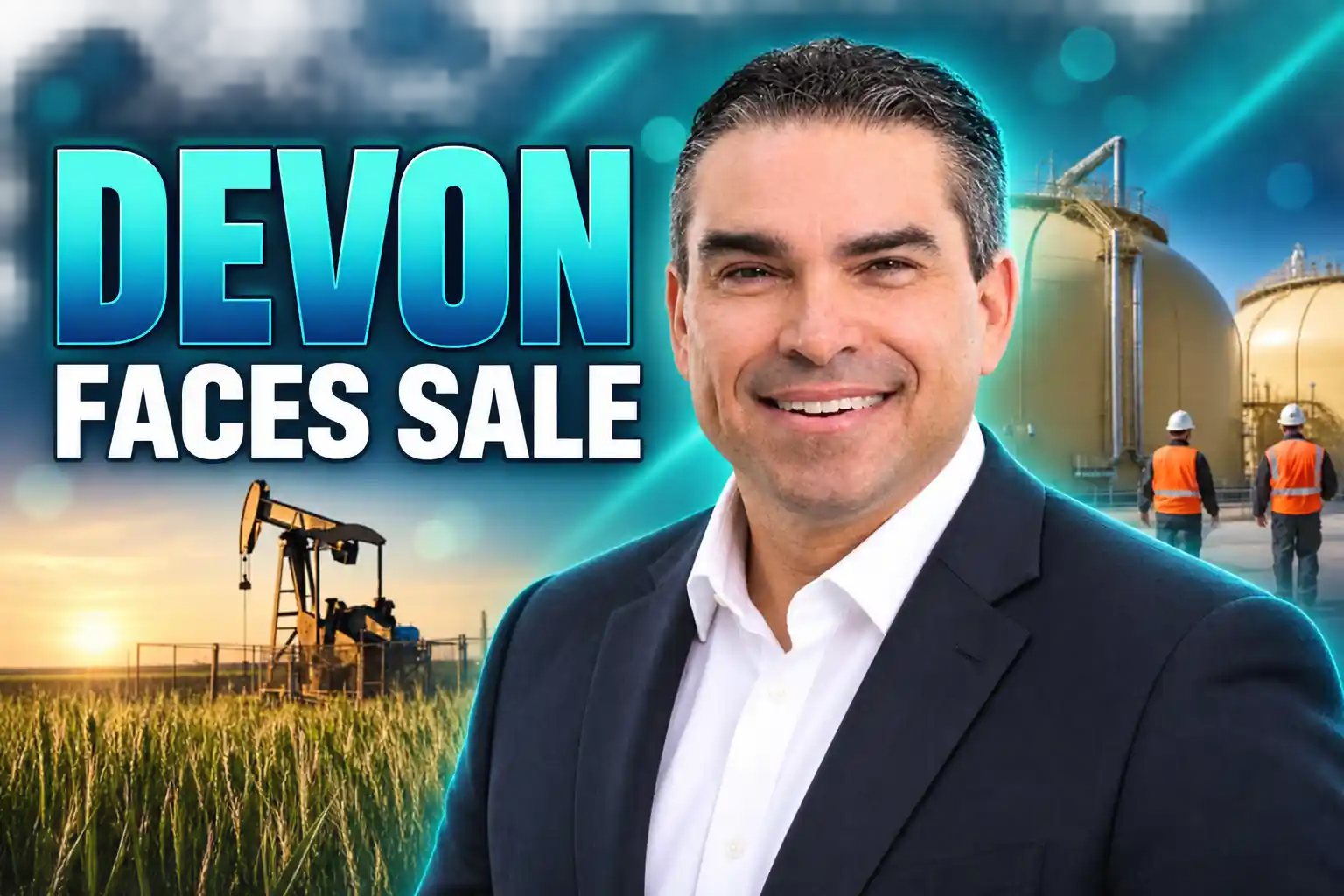
Thirteen Days After Closing, Devon Spent $2.6 Billion
The February 1 merger agreement, unanimously approved by both boards, closed on May 7 as an all-stock deal at 0.70 of a Devon share per Coterra share. Devon issued about 532 million shares. Using the May 6 close, the 10-Q puts that paper at about $24.8 billion. The combination had been described around the announcement as a $58 billion company, a different figure from the equity issued at close.
On May 20, 13 days later, Devon bought 16,300 net undeveloped acres in Lea and Eddy Counties, New Mexico, at a Bureau of Land Management sale for about $2.6 billion, or about $161,500 per net acre. The company said the block adds about 400 net locations, or about $6.5 million per location, with an 87.5% net revenue interest on untouched rock, and that it paid cash while keeping the new new $8.0 billion share repurchase program.
You’re damn right we spent $2.6 billion. We would do it again if it came up tomorrow. It’s not going to come up tomorrow.
Clay Gaspar, President and CEO, J.P. Morgan Energy conference, June 23, 2026
Gaspar told that New York audience the two bid teams could not share strategy before close, then had 13 days to align a new board on a multi-billion-dollar target. He called the sale A-plus and “ill-timed from an idealistic standpoint.” May 20, he said, happened on May 20.
The same week the merger closed, the board replaced a $5.0 billion buyback with the $8.0 billion plan, which runs to June 30, 2029. Devon raised the quarterly dividend to $0.32. In a June investor deck Gaspar wrote that within weeks of closing the company increased our dividend 33%. Second-quarter buybacks under the new plan were about 4.4 million shares for about $202 million, or $45.48 a share. Dividends paid in the quarter were $366 million.
Outside the Permian, 45% of Output Remains
The 10-Q for the quarter ended June 30 still lists five core areas: Permian, Rockies, Eagle Ford, Anadarko, and Marcellus. Combined production was 1,359 MBoe/d, including 503 MBbls/d of oil. Coterra’s legacy assets supplied about 488 MBoe/d in that stub period. Guidance for the third quarter, the first full quarter of the combined company, is about 1,660 to 1,690 MBoe/d.
Q2 2026 PRODUCTION BY BASIN
| Basin | Output (MBoe/d) | Share |
|---|---|---|
| Permian | 748 | 55% |
| Rockies | 192 | 15% |
| Marcellus | 210 | 15% |
| Anadarko | 128 | 9% |
| Eagle Ford | 77 | 6% |
| Other | 4 | 0% |
| Total | 1,359 | 100% |
The Permian is the core Gaspar keeps pointing at. It is also only 55% of the second-quarter barrel. The other 611 MBoe/d, about 45%, is what Toms and Kimmeridge keep describing as the discount. Operating cash flow in the quarter was $3.7 billion. Earnings attributable to Devon were $1.9 billion, or $2.03 a share. The company exited with $4.0 billion of liquidity, including $1.0 billion of cash, after assuming about $3.5 billion of Coterra debt and retiring $500 million of debt in the quarter.
On June 9 Devon guided 2026 capital to about $4.9 billion, with more than 60% aimed at the Permian, and said it still plans to return up to 70% of free cash flow. Gaspar had 31 rigs and 10 frac crews running when he sat down at J.P. Morgan, 47 days after close and 94 days after signing. Integration, he said, was moving with haste. Asset sales were not.
Kimmeridge Now Wants a Sale or a New Board
Kimmeridge got there first. On April 28, before the deal closed, the firm told Devon’s incoming board to sell non-core assets, reset pay, and spell out capital rules, warning of a “conglomerate discount.” Mark Viviano, a Kimmeridge managing partner, wrote that scale by itself does not create value. LSEG data then put the stake at about 1.4%. Kimmeridge voted against all of Devon’s directors and the pay plan at the annual meeting.
On July 9 the same firm said the divestment work was too slow. On September 23 it went further. In a statement it said Devon was moving too slowly after taking Coterra and should look to replace board members or sell itself. That is a different ask from the April letter, which wanted a tighter Permian company, not a full exit.
WHERE THE TWO SIDES DISAGREE
- Gaspar: The review will be measured in months, not years, and the $2.6 billion Delaware lease was the right call on virgin rock in the company’s backyard.
- Kimmeridge: The pace of sales is too slow, confidence in the board is eroding, and directors should be replaced or the company sold.
- Toms: Sell the whole company so a strategic buyer, not current holders, carries the job of breaking the map apart.
Gabriele Sorbara, an analyst at Siebert Williams Shank, said after the August results that activist pressure was unlikely to ease until the review produced real sales, and that non-core exploration and production assets could be worth about $25 billion. That tag is his, not a company figure, and it is several times the $8.0 billion buyback.
How Pass Pressed Voya Before Devon
Pass runs a repeatable sequence. Take a stake around a deal or a discount, talk privately, then send a letter that puts a sale on the list. At Voya Financial he did it in public. Toms holds about a 4.5% economic interest there. On June 1 Pass and principal Akash Bagaria told Voya’s board to open a formal review of all strategic alternatives, including a sale, and to engage every interested party.
TOMS CAPITAL’S OTHER 2026 CAMPAIGNS
- Voya Financial: About 4.5% economic interest, a June 1 board letter, then August proxy materials for a no-confidence vote after private talks failed.
- McCormick & Co: A sizable stake built after McCormick agreed to buy Unilever’s food business, a combination pitched as a $65 billion sauces-and-spice group, with Toms’ specific ask still undisclosed.
- Kenvue: An earlier push for a combination; Kimberly-Clark later bought the Band-Aid and Tylenol maker for nearly $48.7 billion.
The Devon letter fits that pattern, with one difference. Gaspar had already promised a full-map review and a fall update. Toms did not have to invent the process. It only had to argue that the process was too slow, and that a sale would finish it.
An $8 Billion Bid Already Came In
The pieces have had at least one serious look. In late May, people familiar with the matter said money manager Stone Ridge Asset Management had offered about $8 billion for Devon’s Marcellus position. That basin printed 210 MBoe/d in the second quarter, 15% of the company, all of it from Coterra’s side of the merger. First-half sale proceeds across the whole firm were $88 million, so that offer, if it was live, did not close by June 30.
On a May call Gaspar said every asset in the combined book “has to compete for its capital and earn its seat at the table.” The August earnings call was blunter on timing. He said the review was well under way, with one test of capital efficiency, the scale and durability of free cash flow, and strategic fit, and that he expected the work “to be measured in months, not years,” with an update this fall.
What has not shown up is a signed package. Talk on X on September 24 put BP in an Eagle Ford data room and hung a several-billion-dollar tag on that 77 MBoe/d slice. That remains unverified. The 10-Q does show that Devon and BPX Energy split their Eagle Ford Blackhawk partnership on April 1, 2025, so any later bid would be coming from a company that already knows the rock. Until a filing or a press release lands, it is talk.
Gaspar’s Fall Update Has a New Audience
August 17, Devon took a final investment decision on the Solitude Pipeline System, a WhiteWater-led joint venture for two 48-inch gas lines from the Permian toward Katy, Texas, sized at about 2.25 Bcf per day in the second half of 2029. That is a long-dated bet on keeping, and moving, Delaware gas. It is not a sale.
HOW THE SALE PRESSURE BUILT
- April 28, 2026: Kimmeridge tells Devon’s incoming board to sell non-core assets and avoid a conglomerate discount.
- May 7, 2026: The Coterra merger closes. Devon authorizes the $8.0 billion buyback and lifts the dividend to $0.32.
- May 20, 2026: Devon spends about $2.6 billion at the BLM sale in New Mexico.
- Late May 2026: People familiar with the matter describe an about $8 billion Stone Ridge offer for the Marcellus.
- June 9, 2026: Devon says a strategic and financial review is under way and that the map should concentrate on the Permian.
- June 17, 2026: People familiar with the matter say Toms is a top-five holder and is open to a full company sale.
- June 23, 2026: Gaspar defends the lease buy at J.P. Morgan and says the two firms were not sitting on their hands.
- July 9, 2026: Kimmeridge says asset sales are too slow.
- August 4, 2026: Second-quarter results show $88 million of first-half sale proceeds and a fall update on the review.
- September 23, 2026: Toms sends the sale letter. Kimmeridge says replace the board or sell the company.
On July 22 Devon had 1.1 billion shares outstanding. First-half buybacks across the old and new programs totaled about 6.3 million shares for $271 million, including $69 million in the first quarter under the retired $5.0 billion plan. Synergies are still pegged at $1.0 billion of annual pre-tax savings by the end of 2027, with about $600 million of that expected in 2027. Headquarters is now Three Memorial City Plaza in Houston.
Gaspar told investors he wanted the review done in months. The months are up, the $2.6 billion of new leases are on the books, and $88 million is what has come off. The September 23 letter makes that gap the argument. Shares closed at $48.90 on September 24. The company’s newsroom still lists the August 17 Solitude decision as its latest release.
Disclaimer: This article is news reporting and analysis of an activist campaign and related company filings, and it is for information only. It is not investment advice, a recommendation to buy or sell Devon Energy, Coterra legacy assets, or any other security, and it is not a solicitation to take part in any proxy or sale process. Readers should consult a licensed financial adviser or securities attorney before acting on any stake, vote, or bid discussed here. Figures, stakes, and statuses come from the cited company filings, official releases, and dated public statements and can change with later 8-Ks, 10-Qs, or activist notices.

The Salary Cap Fight That Can Freeze Baseball’s TV Payday

The 2027 Mercedes GLE and GLS Keep Alabama Busy

Margaret Hamilton Dies at 90 With a Harder Fight Unfinished

Unity Parks Its Engine Inside Google’s Prompt Games

The Hidden Vendor Cut in 403(b) vs 401(k) Plans

Microsoft 365 Auth Fault Took Down Exchange and Teams

IFA 2026’s Weird Gadgets Are Building a Sensor Home

Xbox Caps Game Pass Cloud Gaming at 15 Hours

Squishy Dumpling Toys Recalled After Hiding Illegal Water Beads

Tesla Puts Its Wheel-Free Cybercab on Austin Streets
-
 NEWS1 month ago
Microsoft 365 Auth Fault Took Down Exchange and Teams
-
 GAMING1 month ago
Xbox Caps Game Pass Cloud Gaming at 15 Hours
-
 NEWS1 month ago
IFA 2026’s Weird Gadgets Are Building a Sensor Home
-
 NEWS1 month ago
OpenAI Unveils GPT-6 Astra With a Critical Cyber Label
-
 AUTO1 month ago
Tesla Puts Its Wheel-Free Cybercab on Austin Streets
-
 NEWS1 month ago
OpenClaw 2.0 Ships a Team Workplace With Host-Trust Defaults
-

 NEWS1 month ago
Sony and Warner Sue Anthropic Over Torrented Song Lyrics
-
 LIFESTYLE1 month ago
Squishy Dumpling Toys Recalled After Hiding Illegal Water Beads