
FINANCE
US Sanctions Nobitex, Iran’s Largest Crypto Exchange
The US Treasury sanctioned Nobitex and three Iranian crypto exchanges on June 2, naming four executives and squeezing Iran’s stablecoin lifeline to the rial.

The US Treasury sanctioned Nobitex, Iran’s largest cryptocurrency exchange, on June 2, 2026, blacklisting three smaller Iranian platforms and four company executives in the same sweep. The Office of Foreign Assets Control (OFAC, the Treasury arm that enforces US sanctions) said the exchange moved more than half of all Iranian digital-asset inflows last year and routed payments to the Islamic Revolutionary Guard Corps (IRGC, Iran’s elite military and intelligence force).
Adding names to a blocklist is routine work for OFAC. What makes this one worth reading is the picture underneath it: years of American pressure have driven Iran’s money off conventional banking rails and onto crypto, and Washington is now chasing it onto the blockchain, exchange by exchange and wallet by wallet.
What OFAC Blocked and Who Treasury Named
OFAC named four exchanges, and the volumes show why Nobitex sat at the top of the list. The platform handled over 50% of all Iranian crypto inflows in 2025, dwarfing its rivals. Wallex took in 12% of national inflows and Bitpin another 10%. Ramzinex, a Tehran-based exchange founded in 2018, has cleared over $2.45 billion in lifetime transactions.
| Exchange | Share of 2025 Iranian crypto inflows | Treasury’s stated concern |
|---|---|---|
| Nobitex | Over 50% | IRGC payments, ransomware wallets, Central Bank stablecoin transfers |
| Wallex | 12% | Numerous IRGC-linked transactions |
| Bitpin | 10% | Millions in transfers, some IRGC-linked |
| Ramzinex | Over $2.45B since 2018 | Tehran-based, used for sanctions evasion |
Four people went onto the Specially Designated Nationals (SDN) list, the roster of blocked persons that OFAC keeps current through its published record of recent sanctions actions. Amir Hossein Rad, Nobitex’s chairman, co-founder and former chief executive, was named, along with Seyed Ali Khoee, the current CEO. Two co-founders, Seyed Mohammad Ali Aghamir Mohammad Ali and Seyed Mohammad Aghamir Mohammad Ali, belong to the Kharrazi family, which Treasury places inside Supreme Leader Ayatollah Ali Khamenei’s inner circle.
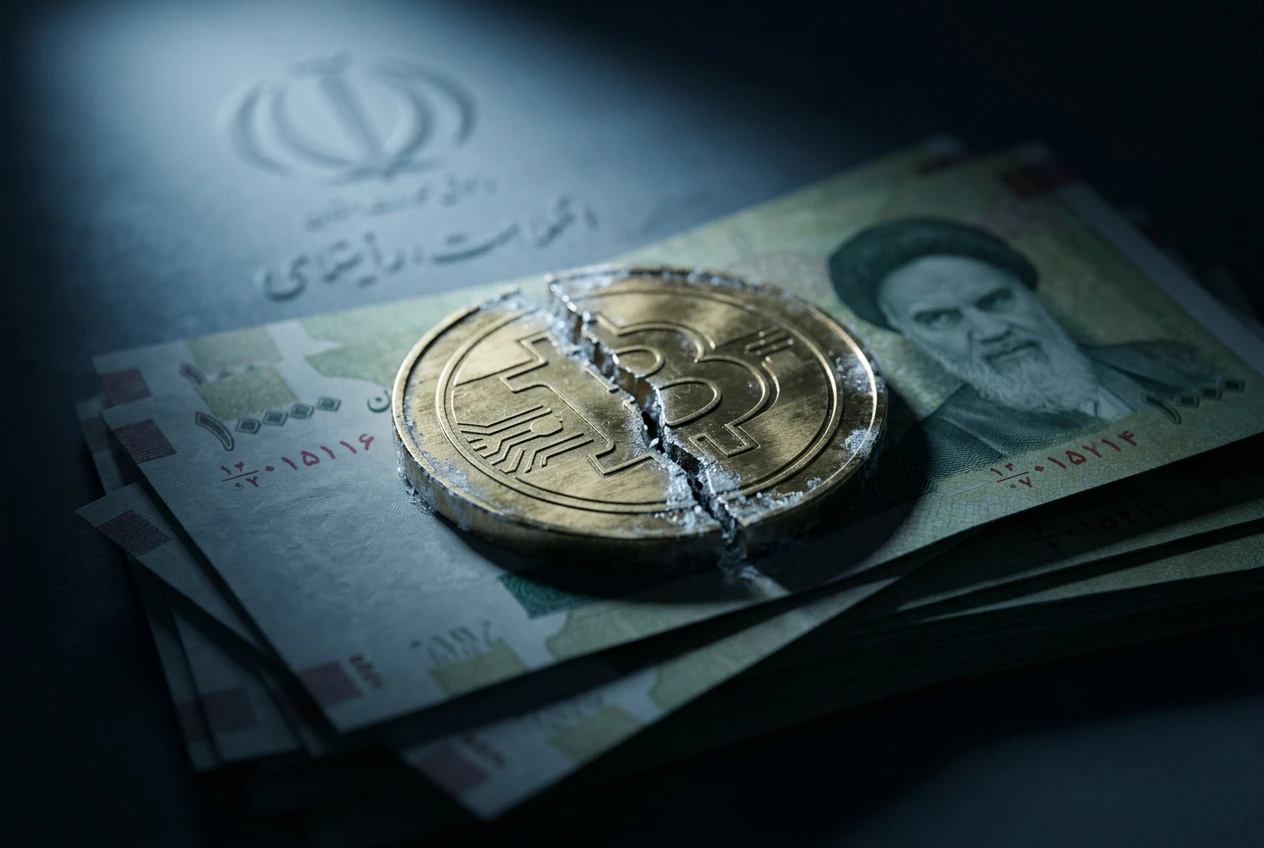
How Maximum Pressure Pushed Iran Onto Crypto Rails
Cut a country out of the dollar banking system for long enough and its money finds another door. For Iran, that door has increasingly been crypto. The country’s digital-asset sector took in roughly $7.78 billion in 2025, and addresses linked to the IRGC accounted for more than half of all value received in the final quarter of the year, according to blockchain analytics cited by Treasury.
The campaign driving that shift has a name. Treasury calls it Economic Fury, the enforcement arm of the maximum-pressure strategy set out in the President’s National Security Presidential Memorandum 2 (NSPM-2). The stated goal is to starve the regime of revenue and block any route to a nuclear weapon. The smaller exchanges were hit under Executive Order (E.O.) 13902, which targets anyone working in Iran’s financial sector, while Nobitex drew the heavier counterterrorism sanctions authority under E.O. 13224 for what Treasury called material support to the IRGC.
While Iran’s economy is in free fall, the regime has chosen to co-opt digital asset technologies for its own corrupt agenda, including evading sanctions and transferring wealth out of the country.
That was Scott Bessent, the Treasury Secretary, in the department’s statement. His framing casts exchanges like Nobitex as core financial infrastructure for the regime, which is why the designation reaches the company’s founders and not just its accounts.
Stablecoins Became the Rial’s Quiet Lifeline
The most consequential piece of this case has little to do with bitcoin. It runs through dollar-pegged stablecoins, chiefly Tether’s USDT (a token designed to hold a steady $1 value). Treasury says Nobitex helped the Central Bank of Iran, an entity OFAC tracks under its long-running Iran sanctions program, tap hundreds of millions of dollars in stablecoins to prop up the collapsing rial, handing the regime a synthetic dollar supply no Western bank would ever provide.
That dependency is also the weak point. In April 2026, Tether froze $344.2 million in USDT held across two wallets tied to the Central Bank of Iran, after US agencies flagged links to the IRGC and Hizballah. Because Tether can blacklist any address at the smart-contract level, a single issuer froze a slice of the regime’s reserves with no court order.
- $344.2 million in USDT frozen in April 2026 across two Central Bank of Iran wallets.
- Nearly $500 million in regime-linked crypto frozen overall under the Economic Fury campaign.
- Hundreds of millions in stablecoins that Treasury says Nobitex routed for the Central Bank to defend the rial.
For a central bank already locked out of the dollar system, there is no easy workaround. The same rails that let Iran reach digital dollars also let one company switch them off.
A Pro-Israel Hack Cracked Nobitex Open Last Summer
Nobitex was exposed long before OFAC named it. On June 18, 2025, during the Israel-Iran conflict, a pro-Israel hacker group called Gonjeshke Darande, or Predatory Sparrow, breached the exchange and drained more than $90 million in crypto. The attackers did not cash out. They sent the funds to unspendable vanity addresses, several carrying a profane variation of a phrase aimed at IRGC terrorists, and burned the money to make a political point.
A day earlier, the same group had hit Bank Sepah, a state-owned Iranian bank. After the Nobitex breach, the hackers published the exchange’s source code, exposing its internal wallet structure to anyone tracking Iranian money on the blockchain.
Treasury later credited Rad with helping the exchange reconstitute its operations after the breach, the same rebuild that kept the regime’s crypto channel running. That detail sits at the center of the counterterrorism charge against him.
Where the Sanctions Bite Hardest
A domestic Iranian exchange holds little US property to freeze, so the SDN listing on its own changes little inside Iran. The leverage sits one layer out, at the chokepoints every Iranian platform has to touch to reach the wider crypto market.
- Secondary sanctions: foreign banks and exchanges that process transactions for the designated platforms risk being cut off from the US financial system.
- Centralized stablecoin issuers can freeze flagged wallets on their own, as Tether did, without waiting on a regulator.
- OFAC’s 50% rule blocks any company owned half or more by the designated persons, pulling affiliated entities into the net.
- Blockchain analytics let investigators trace and tag wallets long after a transaction settles, raising the odds that funds touching these exchanges get frozen downstream.
Treasury paired the designations with an offer from the State Department’s Rewards for Justice program: up to $15 million for information that disrupts the financial machinery of the IRGC and its branches. People who report sanctions violations to the Treasury network’s whistleblower incentive program may also qualify for awards when their tips lead to penalties above $1 million.
The map of how Iran moves money is far clearer than it was a year ago. The families of the 1997 Jerusalem bombing, who hold US court judgments against Iran worth $552.3 million in compensatory and $1.86 billion in punitive damages, have already moved to claim part of the seized crypto.
Disclaimer: This article is for informational purposes only and is not legal, financial, or compliance advice. Transacting with sanctioned entities can carry serious civil and criminal penalties; anyone with exposure to Iranian digital-asset platforms should consult a qualified sanctions or legal professional. Figures are accurate as of publication.






Iowa Farmer Built Resilience for 16 Years Then Tariffs Hit Hard

HHS Adds FDA Tech and Drugs Deputies to Lock In AI and Review Power

Nvidia Earnings Carry a Built-In Sell-the-News Trap

HP Licenses Huawei Wi-Fi Patents Despite the Entity List

Poland Named in $131B F-15 Deal Echoes Apache Path

Sewer Scavengers Near Penn Station Repeat a Decades-Old NYC Pattern

Second Muni Fatigue Crash Exposes Surface Line Gaps

Chick-fil-A Chicken and Waffles Closes Its 80-Year Loop

Musk Data Centers Leave a Mississippi Family’s Historic Land Empty

OpenAI Data Center Chief Exits as Stargate Strategy Shifts

Double Fine Cuts 23 Jobs Weeks After Xbox Independence

Day-One Big Walk Lifts PS Plus August Beyond Recycled AAA

Curtis Mead’s Red Sox Debut Ends With Fractured Wrist

John Hight Exits Wizards After Digital Reckoning Hits

Moesch and Dressel Rewrite Night One at 2026 U.S. Nationals

Red Sox Squander Hot Streak Chance in 4-3 Loss to Athletics

Boutte’s Quiet Camp Takeover Forces Patriots Receiver Choices

Take-Two CEO Pushes Netflix Subs for GTA 6 Extended Look

Halo Campaign Evolved Skulls Meet Death Barriers That Kill the Hunt

Wildlands Free Update Hands Players the Tools They Already Invented
-

 TECHNOLOGY3 years ago
How to Adjust a Bulova Watch Band – An Easy Guide
-

 News3 years ago
Fred Pentland: Athletic Bilbao’s English mentor who changed the essence of Spanish football
-

 FINANCE3 years ago
Tax Planning for Every Season: Guide to Maximizing Your Tax Benefits
-

 Education3 years ago
African Ministers New Education Plan
-

 BUSINESS3 years ago
What is Entrepreneurial Operating System? A Comprehensive Guide to EOS
-

 Education3 years ago
Innovate Your Learning Journey with Technology and Enhance Education
-

 News3 years ago
Russians formally out of World Athletics Championships
-

 BUSINESS3 years ago
Top 9 Most Expensive American Cities to Rent an Apartment