
Science
Vera C. Rubin Observatory Launches Decade-Long Survey of Night Sky
The Vera C. Rubin Observatory has begun its 10-year Legacy Survey of Space and Time, scanning the southern sky with the world’s largest digital camera.

In late June 2026, the Vera C. Rubin Observatory officially began its decade-long Legacy Survey of Space and Time from a Chilean mountaintop. Run jointly by NSF NOIRLab and the Department of Energy’s SLAC National Accelerator Laboratory, the survey will photograph the same wide swatches of the southern sky every few nights for ten straight years. The instrument behind it is the world’s largest digital camera: a 3,200-megapixel sensor array built at SLAC in California.
This is a US-funded project described by the National Science Foundation as a campaign to create the most comprehensive, cinematic record of the universe in history. By the end of the run, partners say the archive will reach roughly 500 petabytes of images and data products, the deepest time-lapse the field has ever attempted. Every night the camera’s alert pipeline streams roughly 7 million notifications of change in the sky to any astronomer anywhere with a browser.
A 20-Year Bet Begins Filming
The build run for the project stretched from a 2001 proposal to a construction start on August 1, 2014. Two decades of fundraising, mirror work, and software development passed before the first photons reached the detector in April 2025 and the first public images followed in June of the same year, with shots of the Trifid and Lagoon nebulae and a wide-field view of the Virgo Cluster. At the end of June 2026, the team declared full survey operations underway in the observatory’s launch announcement, and the LSST Camera moved from commissioning to science. Brian Stone, performing the duties of the NSF director, opened with the line: “Today, we begin filming the greatest cosmic movie ever made.”
Operationally, the observatory is a joint venture. NSF NOIRLab and the SLAC National Accelerator Laboratory run it together, France’s CNRS/IN2P3 contributes key hardware through construction and operations funding, and the project’s outlay has been tallied at around $800 million. Bob Blum, director of the Rubin Observatory at NSF NOIRLab, put a longer shadow on the day’s meaning: “It is amazing and humbling to be here at this time and place as we start the Legacy Survey of Space and Time, after more than two decades of incredible work by our dedicated team.”
How the Camera Pulls Off a 40-Second Sky
The LSST Camera is roughly the size of a small car and weighs about 3,000 kilograms. Its sensor packs in 3,200 megapixels, roughly the same pixel count as 260 modern cell phone sensors combined. Those pixels need to be kept extremely cold, about negative 100 degrees Celsius, or defective bright pixels start to dominate the image. The camera was built at SLAC in California over years of testing; it shipped to Chile in May 2024 and was installed on the telescope in March 2025, as detailed in the LSST camera’s hardware spec.
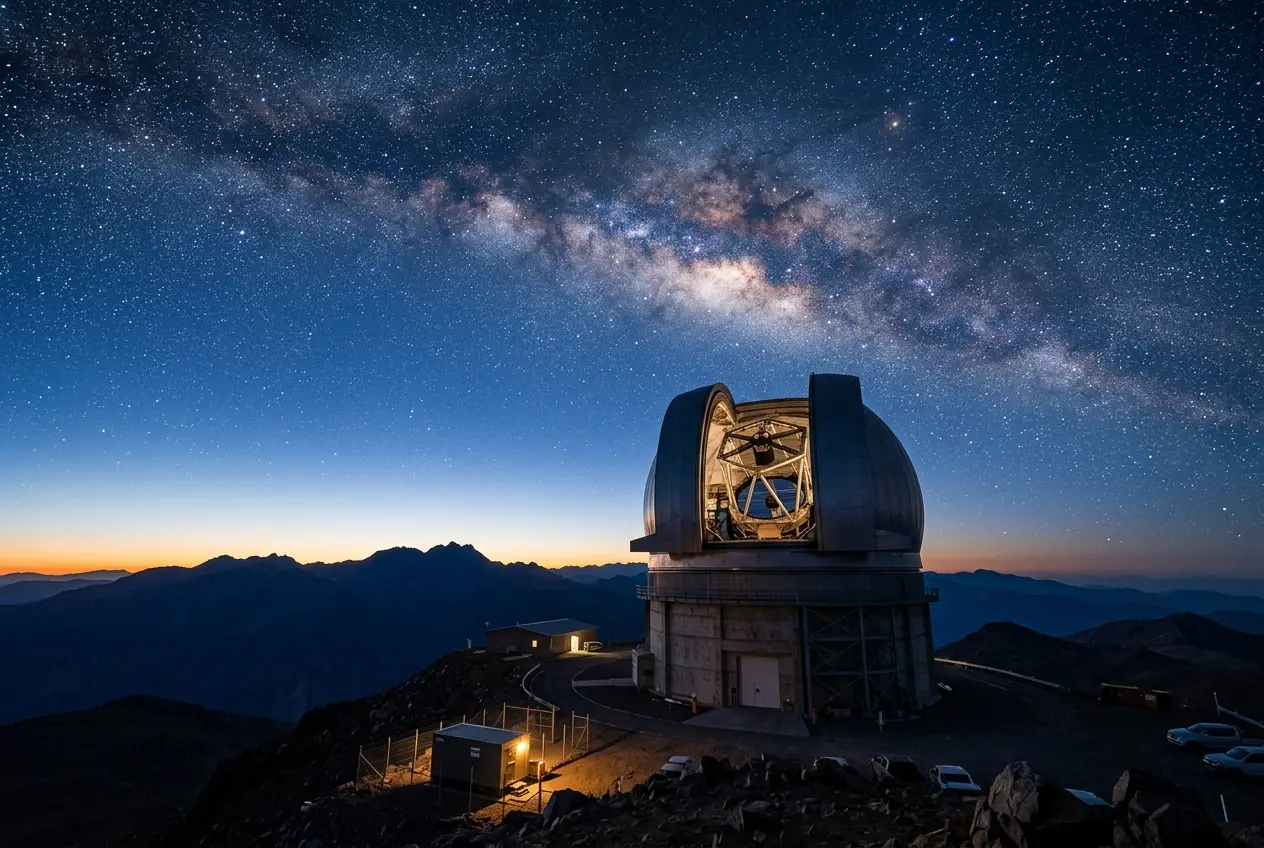
The hardware has to keep up with a punishing schedule. The 8.4-meter Simonyi Survey Telescope, with a unique three-mirror optical design, gives the camera a 3.5-degree-wide field of view. Inside that frame the instrument snaps an image every 40 seconds, then swings to a new patch of sky. Six color filters ride on a carousel inside the camera so the auto-changer can swap them in less than two minutes between frames. A full night logs about a thousand exposures, and the imaging system keeps running on its own schedule.
The headline figures on the camera, in plain:
- Sensor array: 3,200 megapixels total
- Operating temperature: about negative 100 degrees Celsius to suppress noise
- Filters: six color bands on a swappable carousel, each about 75 cm across
- Filter swap time: under two minutes between exposures
- Mass: roughly 3,000 kilograms, twice the weight of a small car
- Image cadence: a new, detailed frame about every 40 seconds
Six Weeks of Optimization, 11,000 Asteroids
In the run-up to full operations, the observatory spent about six weeks on what the team calls early optimization surveys, where the camera practiced on the southern sky while the team tuned image quality and cadence. The practice paid off faster than anyone had a right to expect. Across that single month and a half, Rubin discovered over 11,000 never-before-seen asteroids, the project said, including 33 near-Earth objects and 380 trans-Neptunian objects, plus one unusually large, fast-spinning main-belt asteroid now designated 2025 MN45.
The asteroid deluge was the headline, not the only line item. The same early runs logged pulsating stars, supernova candidates, transient objects, and a wide sample of distant galaxies that will feed the survey’s map of the universe’s structure. Rubin, the project said, is “the most powerful solar system discovery machine ever built.”
The cadence is what makes the difference. Rubin will return to each point in the southern sky about 800 times over ten years, log every supernova in its footprints, stack faint objects into view, and stitch the same field across years into a stop-motion film of cosmic change. Some signals, like slowly pulsing stars or the drift of asteroids in the outer belt, only emerge across years of repeated observation. Targets that move or change are routed to alert brokers the same night, before the next observation cycle starts. The whole survey works because every patch of sky is photographed on the same cadence, with the same filters, for the full decade. That consistency is what turns the data into a single time-lapse dataset rather than ten years of loosely connected observations.
The early haul, side by side:
- Over 11,000 never-before-seen asteroids logged in six weeks
- 33 near-Earth objects among them
- 380 trans-Neptunian objects spotted from the same early data
Open Data as the New Public Telescope
Roughly 10 terabytes of data per night streams off the summit, and as many as 7 million alerts per night flag changes in the sky to brokers around the world. None of that data sits behind a paywall waiting for an institution’s time allocation. Every alert broker is an open pipeline, and any astronomer, professional or amateur, with a working internet connection can sign up.
Millions of alerts in just the last couple of months show that Rubin is up and running as a discovery machine. Now we’re putting it all together.
Phil Marshall, deputy director of Rubin Operations for SLAC, said it the day the survey began. Željko Ivezić, head of LSST and a University of Washington professor of astronomy, said the project cleared image quality, effective survey speed, system uptime and reliability, and calibration accuracy through the optimization phase. The University of Washington team, which built the alert pipeline under Eric Bellm, had already used public alerts to follow up hundreds of transient events, according to the launch readiness review.
This is what makes the start a structural change in how surveys are run. Sky-survey astronomy used to mean a small group of institutions with privileged access to a few big telescopes; Rubin turns that into a feed anyone with a browser can read.
The Astronomer Behind the Name
The observatory’s namesake was an American astronomer whose mid-career decision to map how fast stars move inside galaxies rewrote what counts as ordinary matter. With her colleague Kent Ford, Vera Rubin measured rotation curves across more than sixty spiral galaxies and found the same flat rotation curve: stars at the outer edges of those galaxies were moving just as fast as stars closer to the center, even though the visible mass was not nearly enough to hold them in orbit.
The implied missing mass was not small. As the observatory’s own biographical page frames the result, dark matter now accounts for more than 80% of all the matter in the universe, while the ordinary matter that makes up stars, planets, and people is less than 20%. Rubin’s work is what turned dark matter from a footnote in cosmology into a subfield of astrophysics. The observatory was originally proposed as the Dark Matter Telescope, and US Congress renamed the project in her honor in December 2019.
What the Decade’s Petabytes Will Buy
The decadal run is built around four scientific goals the LSST project calls its pillars, and each one explains why the survey had to be a decade rather than three or five years long. Supernovae can show up in a single frame. The way a galaxy’s halo of dark matter bends the light of something farther behind it emerges only after thousands of frames are stacked. The discovery of faint asteroids in the outer solar system depends on limiting the time between revisits. And the Milky Way’s structure only resolves itself after the survey stitches years of overlapping data into one image.
The four pillars of the survey:
- Probing dark energy and dark matter.
- Taking a deep inventory of the solar system.
- Exploring the transient optical sky, from stellar flares to compact-object mergers.
- Mapping the Milky Way in higher resolution than any prior survey has managed.
Each pillar depends on the same dataset the alert brokers and the data releases are already streaming to the public. The cadence will continue to be tuned as the survey accumulates its first year of data. By the time the run ends, the project’s own pages put the final imaging archive at about 30 petabytes of data, with the LSST about page sizing the full set of images and data products at roughly 500 petabytes.
Ivezic closed the official start by listing the readiness bar his team had cleared, naming image quality, effective survey speed, system uptime and reliability, and calibration accuracy as the four gates the survey had to pass before operations could begin. Those four gates now sit on the project’s checklist for how the first year of survey data will be measured, alongside any new calibration questions that surface once full operations are in steady state.






Iowa Farmer Built Resilience for 16 Years Then Tariffs Hit Hard

HHS Adds FDA Tech and Drugs Deputies to Lock In AI and Review Power

Nvidia Earnings Carry a Built-In Sell-the-News Trap

HP Licenses Huawei Wi-Fi Patents Despite the Entity List

Poland Named in $131B F-15 Deal Echoes Apache Path

Sewer Scavengers Near Penn Station Repeat a Decades-Old NYC Pattern

Second Muni Fatigue Crash Exposes Surface Line Gaps

Chick-fil-A Chicken and Waffles Closes Its 80-Year Loop

Musk Data Centers Leave a Mississippi Family’s Historic Land Empty

OpenAI Data Center Chief Exits as Stargate Strategy Shifts

Double Fine Cuts 23 Jobs Weeks After Xbox Independence

Day-One Big Walk Lifts PS Plus August Beyond Recycled AAA

Curtis Mead’s Red Sox Debut Ends With Fractured Wrist

John Hight Exits Wizards After Digital Reckoning Hits

Red Sox Squander Hot Streak Chance in 4-3 Loss to Athletics

Moesch and Dressel Rewrite Night One at 2026 U.S. Nationals

Boutte’s Quiet Camp Takeover Forces Patriots Receiver Choices

Take-Two CEO Pushes Netflix Subs for GTA 6 Extended Look

Halo Campaign Evolved Skulls Meet Death Barriers That Kill the Hunt

Wildlands Free Update Hands Players the Tools They Already Invented
-

 TECHNOLOGY3 years ago
How to Adjust a Bulova Watch Band – An Easy Guide
-

 News3 years ago
Fred Pentland: Athletic Bilbao’s English mentor who changed the essence of Spanish football
-

 FINANCE3 years ago
Tax Planning for Every Season: Guide to Maximizing Your Tax Benefits
-

 Education3 years ago
African Ministers New Education Plan
-

 BUSINESS3 years ago
What is Entrepreneurial Operating System? A Comprehensive Guide to EOS
-

 Education3 years ago
Innovate Your Learning Journey with Technology and Enhance Education
-

 News3 years ago
Russians formally out of World Athletics Championships
-

 BUSINESS3 years ago
Top 9 Most Expensive American Cities to Rent an Apartment