
News
Indiana General Assembly Passes Bill Requiring Political Affiliation for School Board Elections

In a significant shift for Indiana’s school boards, the state legislature has passed a bill that will require candidates in school board elections to declare their political affiliations. The move is set to make school board elections more partisan, a change that has raised eyebrows across the state.
A Step Towards Partisanship
On Thursday, the Indiana General Assembly passed Senate Enrolled Act 287, a bill that mandates school board candidates to identify with a political party or register as independents. Currently, school board races in Indiana are one of the few nonpartisan elections, allowing candidates to run without any political party backing.
Senator Gary Byrne, the author of the bill, believes that knowing a candidate’s political affiliation is important for voters. “Knowing which political party a candidate identifies with will help Hoosiers know what kind of principles that person would apply to their position on the school board,” he explained.
Byrne argued that school boards are already influenced by political ideology, and this bill would merely formalize the reality that political views play a role in education policy decisions. “School boards are already partisan, and it’s more vital than ever that we recognize that,” he added.
A Shift in Indiana’s School System
The passing of Senate Enrolled Act 287 signals a shift in the way Indiana approaches school governance. Supporters argue that identifying candidates by party will lead to more transparency and clearer expectations for voters. However, critics warn that making school boards partisan could further politicize education and lead to greater division in what many consider a nonpartisan domain.
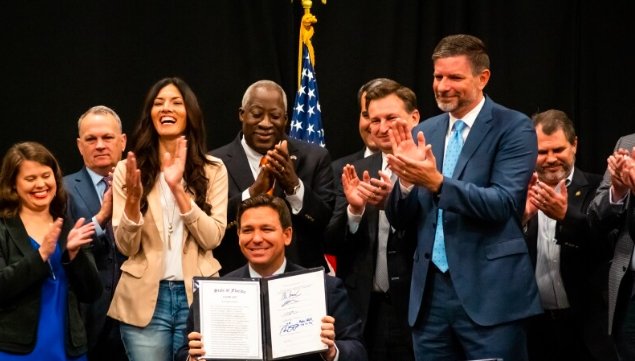
While the bill passed in the legislature, its fate now rests with Governor Mike Braun, who has the option to sign it into law. If signed, the law will go into effect on July 1, 2025, officially changing the landscape of school board elections in the state.
Reactions from Local Officials
The bill has sparked a range of reactions from local education leaders and politicians. Some argue that partisan politics have no place in local education, where decisions are often made based on the needs of students rather than party lines. Others contend that the increasing polarization in education policy makes political identification a necessity for voters who want to understand where candidates stand on key issues.
“Education should be about the needs of children, not about political ideologies,” said one local education advocate. “This bill might just turn our schools into another political battleground.”
The Road Ahead
As the bill heads to Governor Braun’s desk, the debate over partisan school board elections is far from over. Indiana residents, educators, and political leaders will continue to discuss the potential impact of this legislation as it moves closer to becoming law.
For now, all eyes will be on the Governor, whose decision will shape the future of school board elections in Indiana.











Spotify Running Mode hits Android and revives its old tempo experiment

Galaxy Tab S12 Ultra Renders Keep the Notch Fans Hate

Novato Spinning Round House Sells With Six Neighbors for $3.3 Million

Crop Tour Finds Indiana and Nebraska Corn Yields Lagging 2025

Best Buy 60th sale brings Android deals back to its roots

American Airlines reverses seatback screen bet years too late

Iran Hormuz Strikes Force Gulf Oil Onto Costlier Paths

Plague Tale Prequel Day One Joins Game Pass Wave 2 as Witcher Exits

NBA 2K27 opens The City to everyone and rewrites career eras

iOS 26.6.1 Patches 29 Flaws as AI Forces Faster Apple Updates

Double Fine Cuts 23 Jobs Weeks After Xbox Independence

John Hight Exits Wizards After Digital Reckoning Hits

Day-One Big Walk Lifts PS Plus August Beyond Recycled AAA

Curtis Mead’s Red Sox Debut Ends With Fractured Wrist

Moesch and Dressel Rewrite Night One at 2026 U.S. Nationals

Red Sox Squander Hot Streak Chance in 4-3 Loss to Athletics

Boutte’s Quiet Camp Takeover Forces Patriots Receiver Choices

Take-Two CEO Pushes Netflix Subs for GTA 6 Extended Look

Halo Campaign Evolved Skulls Meet Death Barriers That Kill the Hunt

Wildlands Free Update Hands Players the Tools They Already Invented
-

 TECHNOLOGY3 years ago
How to Adjust a Bulova Watch Band – An Easy Guide
-

 News3 years ago
Fred Pentland: Athletic Bilbao’s English mentor who changed the essence of Spanish football
-

 FINANCE3 years ago
Tax Planning for Every Season: Guide to Maximizing Your Tax Benefits
-

 Education3 years ago
African Ministers New Education Plan
-

 BUSINESS3 years ago
What is Entrepreneurial Operating System? A Comprehensive Guide to EOS
-

 Education3 years ago
Innovate Your Learning Journey with Technology and Enhance Education
-

 BUSINESS3 years ago
Top 9 Most Expensive American Cities to Rent an Apartment
-

 News3 years ago
Russians formally out of World Athletics Championships