
News
Earliest Flickering Quasar Found 850 Million Years After the Big Bang
An MIT team caught the earliest flickering quasar 850 million years after the Big Bang. Its flat disk deepens the puzzle of supermassive black hole growth.

An MIT-led team has caught the earliest known flickering quasar, a beacon called J0439+1634 whose light left the universe when it was just 850 million years old. The team detected the ancient object’s variable glow in archival infrared data and traced its flicker back to the cosmic dawn. It’s the first flicker seen from that era.
‘Although there have been a lot of quasars found in the cosmic dawn, this is the first time we actually see one flickering,’ said Gene Leung, a postdoc in MIT’s Kavli Institute for Astrophysics and Space Research. The quasar, formally J043947.08+163415.7, sits at a redshift of 6.51 and is gravitationally lensed by a foreground galaxy, a setup NASA’s Hubble catalog page for the quasar shows in three split images. Tracking the variation of its light across infrared and optical bands revealed that the accretion disk around the central black hole is thin, flat, ordered, a structure associated with nearby, mature black holes that have had billions of years to settle. Leung, Anna-Christina Eilers, an assistant professor of physics at MIT, and their co-authors at MIT and partner institutions reported the result in Nature Astronomy on June 8.
How a 14-Year Infrared Survey Caught the Flicker
Light from the early universe doesn’t arrive intact. The expansion of space stretches its wavelength toward the red end of the spectrum, a process called redshift, and it stretches the timing of any variation the same way. A flicker that takes a few weeks in the rest frame of the quasar can appear, from Earth, to span months or more.
To catch a flicker from cosmic dawn, the team needed to monitor the same patch of sky at infrared wavelengths, and to keep watching for years. They found it in archival data from NASA’s Near-Earth Object Wide-field Infrared Survey Explorer, a space telescope that scanned the entire sky in infrared from 2010 to 2024, a 14-year record of repeated coverage, as the NASA mission page for NEOWISE notes. Former MIT postdoc Kishalay De, now a faculty member at Columbia University, had launched a project to reprocess the mission’s archival light curves. On top of the team’s earlier systematic search for variability in all known high-redshift quasars, the work re-extracted a clean infrared time series for J0439+1634. The faint signal of its flicker came through clearly once the data were reanalyzed.
The team’s analysis put a number on the variability: about 20% in brightness, a swing of roughly 2 trillion Suns up and down, with no fixed period, the full write-up of the first flickering cosmic dawn quasar reports. ‘We saw the quasar flickering randomly over the 14-year period, much like a candle’s flame flickers without a fixed pattern,’ Leung said. The flicker is more than 10 standard deviations above the median flux in the WISE W1 infrared band, a degree of confidence the team reads as decisive. The pattern is the same kind astronomers have used for decades to probe nearby quasars, just stretched out by the redshift of cosmic time.
A Flat Disk in a Wild Era
Quasars at the cosmic dawn are spotted as pinpricks of light, bright enough to register across 13 billion years but otherwise featureless. Astronomers have cataloged more than 200 supermassive black holes in the universe’s first billion years by their quasar glow alone.
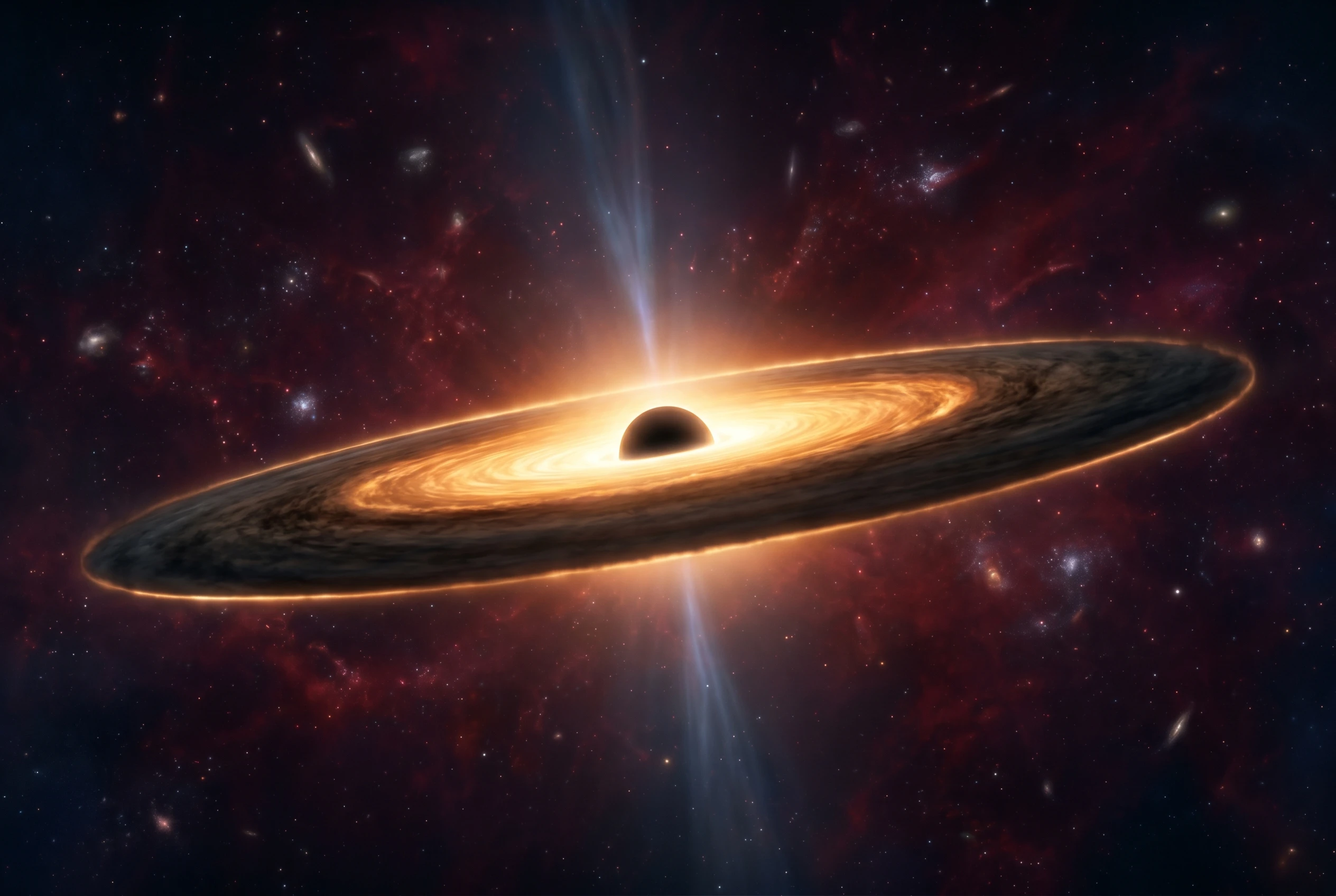
‘People have known that quasars in the nearby universe can flicker,’ Leung said. ‘The flickering comes from fluctuations in the way the gas is being fed into the black hole, and how a quasar flickers tells us something about the structure of a black hole’s accretion disk, and the kind of bites that the black hole is eating.’ To turn that statement into a measurement, the team tracked the quasar’s flux at multiple infrared and optical wavelengths at once. Each wavelength band traces a different temperature: hotter material closer to the event horizon, cooler material farther out in the disk. The disk’s shape is encoded in the colors of its flicker.
The team’s analysis of J0439+1634 returned a specific result for the variable spectrum, the difference between the brightest and faintest fluxes at each wavelength. The slope of that variable spectrum fits a standard geometrically thin, optically thick accretion disk, with a measured slope of -1.58 ± 0.25 close to the theoretical -4/3 prediction, the Nature Astronomy paper on J0439+1634 reports. A ‘slim’ disk, the puffed-up shape expected when matter is pouring in at extreme rates, would yield a flat spectrum that the data do not match.
The variability isn’t a fluke: the paper rules out a microlensing flare, the kind of brief brightening a foreground star would cause by bending the quasar’s light, on the basis of its long duration. The brightening seen in the WISE data spans about 1,830 days in the observed frame, longer than any plausible microlensing event at this redshift. The team attributes the variability to light-crossing timescale processes at the inner edge of the disk, the same basic mechanism that drives flickering in nearby active galactic nuclei. The signature may look distant in time and space, but the physics reads as familiar.
This provides direct evidence that the same feeding processes and structures observed in the nearby universe were already in place at very early times, despite very different cosmic environments, which had never been seen before.
Anna-Christina Eilers, assistant professor of physics at MIT.
Sizing the Beast at 12 Trillion Suns
The quasar is a heavyweight. It carries a black hole of (6.3 ± 0.2) × 10⁸ solar masses, more than 600 million times the mass of the Sun, at a redshift of 6.51. Its integrated brightness reaches the equivalent of 12 trillion Suns, with a variability amplitude of about 20%, a swing of roughly 2 trillion Suns up and down. The system is also feeding close to its physical limit, with an Eddington ratio of (60 ± 10)%, well above the average rate seen in local active galactic nuclei. The full light-travel time from quasar to telescope stretches more than 13 billion years.
For comparison, Sagittarius A*, the supermassive black hole at the heart of the Milky Way, weighs in at around 4 million solar masses. J0439+1634 hosts one of the heaviest black holes ever weighed so far back in cosmic time, and it was already that heavy when the universe was only about 10 percent of its present age. The mismatch is one of the longest-standing puzzles in cosmology, the question of how supermassive black holes of this size get built in so little cosmic time.
| Property | J0439+1634 | Sagittarius A* |
|---|---|---|
| Black hole mass | (6.3 ± 0.2) × 10⁸ M☉ | ~4 million M☉ |
| Accretion disk | Thin, flat, ordered | Not in an active quasar phase |
Why a Calm Disk Deepens the Cosmic Dawn Puzzle
The flat disk is the new evidence. Physicists have long assumed that a flat, well-ordered accretion disk reflects a black hole that is calm and stable, one that has had time to settle. A young supermassive black hole in the early universe should be feeding more chaotically, with a puffy, turbulent disk that has not yet organized itself. The paper also reports a high Eddington ratio of (60 ± 10)%, even though the disk itself is geometrically thin. The disk’s high feeding rate and its calm, ordered shape are a combination theorists had not expected at cosmic dawn.
Eilers reads the calm disk as a clue that the messy growth phase happens earlier than cosmic dawn, before the first quasars light up the sky. The wild adolescence of these black holes, the theorists’ expected chaotic phase, may sit in an era not yet seen by any telescope. That pushes the timeline for primordial or heavy-seed black hole growth back into the universe’s first few hundred million years, an era where direct observations are still scarce.
The work also offers a new way to measure the mass of the oldest quasars. By tracking the variable spectrum over time, the team effectively timed the light’s path across the disk and used the lag between the W1 and W2 infrared bands to size the accretion structure. The same approach, applied to other high-redshift quasars, can put independent constraints on the size of the original ‘seeds’ that had to exist to grow a billion-solar-mass black hole in the first billion years, a question that has been the central open problem in early-universe black hole research for two decades. Webb’s direct mass measurement of a cosmic dawn black hole, which weighed a black hole of 50 million solar masses at 700 million years after the Big Bang, applies the same dynamical approach to a different object in the same era.
Researchers have already cataloged more than 200 supermassive black holes in the universe’s first billion years, all spotted by their quasar glow. Catching their flickers is the next step.
I think what this suggests is that all the messy, very rapid growth phases that we expect all black holes to go through at some point happen very, very early on, before we see them as these very bright luminous quasars. That’s the picture that’s emerging.
Anna-Christina Eilers, MIT.
The Tools Coming Online
One flicker is the proof of concept. The team now plans to extend the technique to other high-redshift quasars, and to look for fainter flickers in data that the same NEOWISE archive has only begun to be searched. The next generation of observatories is also coming online, with sharper instruments and longer time baselines.
First to arrive is the NSF-DOE Vera C. Rubin Observatory in Chile, which released its first images in June 2025. Its wide field of view and rapid cadence are designed for exactly the kind of time-domain survey that the J0439+1634 study exploited in archival form. Coming next is NASA’s Nancy Grace Roman Space Telescope, scheduled to launch no later than May 2027, with a wide-field infrared imager capable of monitoring thousands of high-redshift quasars in a single field. Between them, Rubin and Roman turn the search for early-universe quasar flickers from a hunt through archival data into a regular observing program.
The team also plans to peer even further back in cosmic time, looking for the wilder, more chaotic disks that should sit just behind the calm one they have now mapped. A JWST follow-up program, combined with the next NEOWISE-style all-sky infrared survey, could close the gap between 850 million years after the Big Bang and the moment the first quasars ignited. Both the calm-disk case and the wilder-disk case will be in reach within the next few years.
- Vera C. Rubin Observatory in Chile, first images released June 2025
- Nancy Grace Roman Space Telescope, scheduled to launch no later than May 2027
- James Webb Space Telescope, already operating; the Nature paper includes new NIRSpec data on J0439+1634 from 2023
Frequently Asked Questions
What is J0439+1634?
J0439+1634 is the catalog name for the earliest known flickering quasar, a beacon of light from when the universe was 850 million years old. The central black hole weighs more than 600 million Suns, and the system is gravitationally lensed, magnified about 51 times by a foreground galaxy.
How far back in time does the quasar’s light come from?
The light from J0439+1634 has traveled more than 13 billion years to reach Earth, and it was emitted when the universe was just 850 million years old, during the cosmic dawn. The cosmic dawn is the era of first star and black hole formation, when the universe was around 10 percent of its present age.
What is a flickering quasar and why is this one special?
Quasars flicker when the flow of gas into the central black hole varies over time. The way a quasar flickers, including its timing, its amplitude, and its color, tells astronomers about the structure of its accretion disk. J0439+1634 is the first known cosmic-dawn quasar for which a flicker has been measured, giving a direct look at the disk around an early-universe supermassive black hole.
Why does a flat accretion disk matter for early-universe physics?
A flat, well-ordered disk is normally associated with a black hole that has had time to settle. The discovery of such a disk around a black hole that was already 600 million Suns when the universe was just 850 million years old means the messy growth phase must have happened even earlier, in an era that has not yet been observed. The flat disk also opens a new way to measure the mass of the oldest quasars.
What will the Vera C. Rubin Observatory and the Roman Space Telescope add?
The Vera C. Rubin Observatory in Chile, which released its first images in June 2025, has a wide field of view and a fast survey cadence. The Nancy Grace Roman Space Telescope, scheduled to launch no later than May 2027, has a wide-field infrared imager. Together, they turn the search for cosmic-dawn quasar flickers from a hunt through archival data into a regular observing program, with thousands of high-redshift quasars monitored at once.





Stripe Bid Shows PayPal Moat Cracked After Years of Slide

FDA Class I Tag Hits Finished Egg Recall Weeks Later

Berkshire’s Alphabet Surge Marks Abel’s Cash Deployment Shift

Aston Martin Bets 150 Valen V12s Will Print the Cash

Walmart Took Most of the Recalled Lettuce Behind Cyclospora Wave

Silver Lake Workday Talks Signal Private Floor for Software

Zuckerberg’s AI Letter Joins a Wave of Tech Manifestos

Pixel 11 Takes Battery Edge as Galaxy S26 Keeps the Power Lead

Trump Economy Faces Reckoning as Sentiment and Sales Slide

Apple’s 15% External Cut Still Faces Its Own Zero Admission

ZA/UM Lays Off 32 Staff as Zero Parades Wins Reviews, Not Players

EA’s New In-Game Ad Platform Skips the Games That Need It Most

Mortgage Rates Climb to 6.55%, the Highest Level in Nearly a Year

Colby Covington Stuns Tsarukyan as Askren Retires in Tears at RAF 11

Spain’s Diaspora-Rooted Squad Wins Over New York Ahead of the Final

NHL’s Monday Matinee Push Puts Capitals Fans on the Clock

DeChambeau’s Two-Shot Penalty Rewrites the Open’s Weekend Draw

Guardians Rout Twins With Seven Homers, Leave Joe Ryan One Shy of Record

England Beats France 6-4 to Claim World Cup Bronze Medal

Rainout Gives Red Sox Two Shots at a Franchise-Record Win Streak
-

 TECHNOLOGY3 years ago
How to Adjust a Bulova Watch Band – An Easy Guide
-

 News3 years ago
Fred Pentland: Athletic Bilbao’s English mentor who changed the essence of Spanish football
-

 FINANCE3 years ago
Tax Planning for Every Season: Guide to Maximizing Your Tax Benefits
-

 Education3 years ago
African Ministers New Education Plan
-

 BUSINESS3 years ago
What is Entrepreneurial Operating System? A Comprehensive Guide to EOS
-

 Education3 years ago
Innovate Your Learning Journey with Technology and Enhance Education
-

 News3 years ago
Russians formally out of World Athletics Championships
-

 BUSINESS3 years ago
Top 9 Most Expensive American Cities to Rent an Apartment