
News
Two Teams Build the First Working Thorium-229 Nuclear Clocks
Two teams have built the first working thorium-229 nuclear clocks, framing them as tools to test whether the universe’s constants are truly constant.

Two independent research teams have built the first working thorium-229 nuclear clocks, posting preprints to arXiv earlier this month. The devices come from Beichen Huang and colleagues at Tsinghua University in Beijing and from Luca Toscani De Col and colleagues at the Vienna Center for Quantum Science and Technology in Austria, and both lock a continuous-wave laser at 148 nanometers onto an energy jump inside the thorium nucleus. The two preprints describe the clocks as possibly surpassing even the best atomic clocks available today in precision, as detailed in a phys.org write-up of the thorium-229 nuclear clock preprints.
The result is more than a new entry in the timekeeping record book. Both teams frame the work as a sensor for physics that today’s best optical clocks cannot easily reach, from ultralight dark matter searches to direct tests of whether the constants governing the forces of nature are truly constant.
From Atomic Electrons to a Single Nucleus
Atomic clocks already anchor the most precise measurements in physics. They count time by registering the frequencies emitted as electrons jump between energy levels in an atom, and they are so predictable that frequency has become the most accurately measured quantity humans can produce. The oscillation defines the SI second.
A nuclear clock swaps the reference. Instead of an electron transition, the timekeeping signal sits inside the atomic nucleus, where protons and neutrons jump between their own energy levels. The nucleus is far more isolated from the environment than the electron cloud that surrounds it, so it is less vulnerable to stray electric and magnetic fields. In principle, that isolation yields a more stable reference, and a more rugged clock.
The thorium-229 nucleus, in particular, has been discussed as a candidate for decades, as recounted in a JILA review of the thorium-229 nuclear clock. Its low-lying isomeric state sits at an energy that is unusually low for a nuclear transition, and unusually accessible for laser light. The decades-long hunt for a working device has narrowed in on a single wavelength, around 148 nanometers in the vacuum ultraviolet.
Why Thorium-229 Is the One
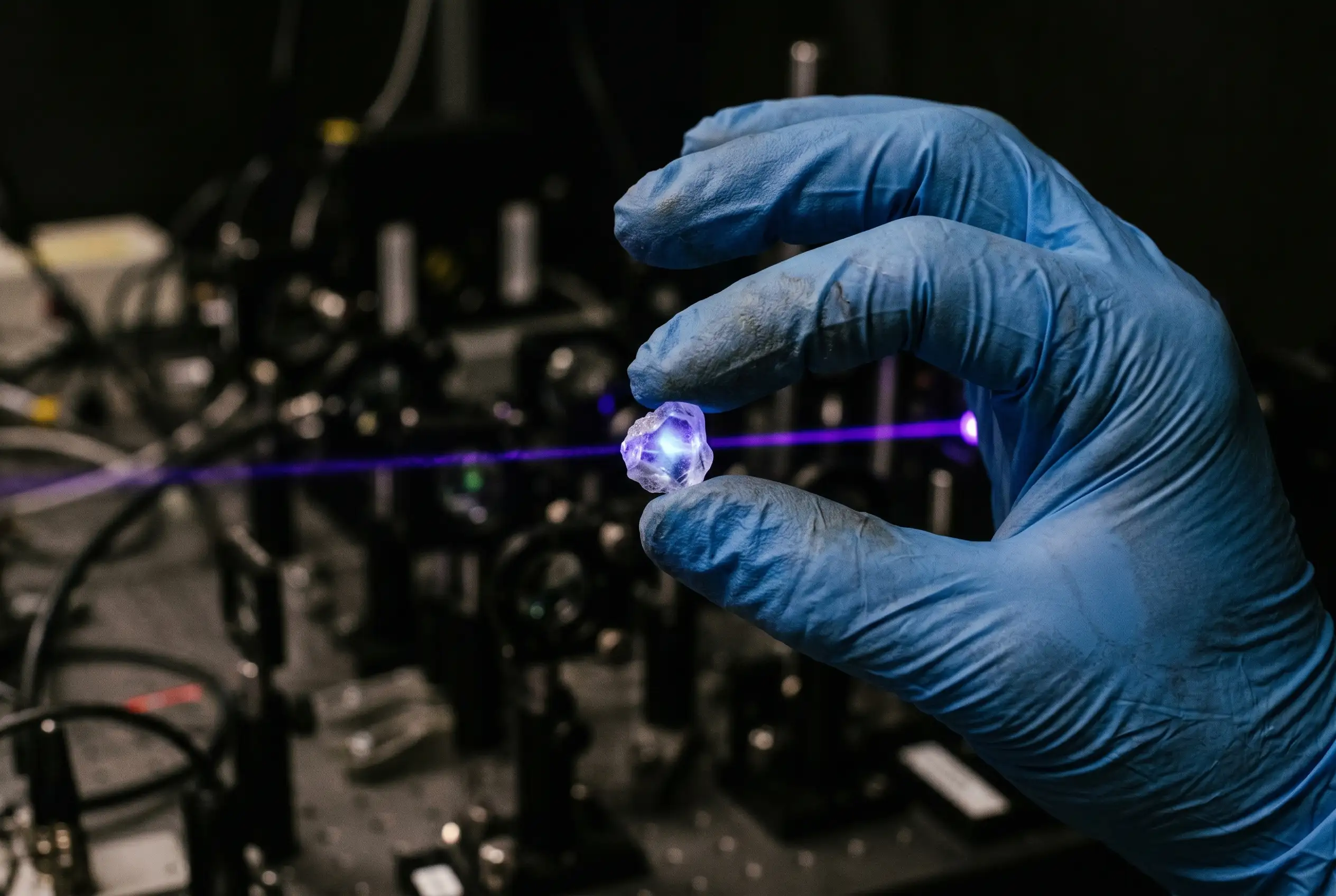
Of all the nuclei in the periodic table, only one is suitable for this purpose: thorium-229. The energy jump available inside its nucleus happens to be the right size to be triggered and measured using laser light, a property that no other known nucleus shares. That coincidence is what makes a thorium clock even conceivable. It is also what made the device so hard to build, because the required laser light sits in a region of the spectrum that is technically demanding to generate and to control, an issue examined in a Photonics.com feature on UV laser combs for high-frequency light.
The light required sits in the vacuum ultraviolet, at around 148 nanometers. The region is technically demanding to generate and to control, which is why no one has built a thorium-229 clock until now. Both teams closed that gap in June 2026, using different lasers and different crystal concentrations.
Two Teams, Two Validations
Huang and Toscani De Col’s teams each embedded thorium-229 nuclei in crystals of calcium fluoride and probed them with a continuous-wave laser operating at around 148 nanometers. The two setups diverged in the details. The Chinese team used a more powerful laser, 10 microwatts of vacuum-ultraviolet light generated by four-wave mixing in cadmium vapor. The European team worked with a crystal containing a higher concentration of thorium nuclei, held at room temperature, and compared the laser’s subharmonic against a ytterbium-ion single-ion clock as a reference.
Each team validated its clock differently. The Chinese team showed that the device could stabilize the frequency of its vacuum-ultraviolet laser, locking it to the nuclear transition, as described in the Chinese paper on a thorium-229 nuclear clock. The European team put the clock to work on a physics problem rather than a metrology one, in a paper on a thorium-229 optical nuclear clock that searches for ultralight dark matter signatures.
Reading the two preprints side by side, the choices each team made show up clearly. The Beijing group treated the device as a tool for stabilizing a laser. The Vienna group treated it as a search instrument. The two demonstrations are framed as complements rather than competitors. They landed on arXiv within days of each other in early June 2026, a milestone also covered in a Global Times report on the thorium-229 nuclear clock breakthrough.
| Team | Lead author & institution | Laser & crystal setup | Validation focus | Reported performance |
|---|---|---|---|---|
| Huang et al. | Beichen Huang, Tsinghua University, China | 10 µW continuous-wave VUV laser from four-wave mixing in cadmium vapor, locked to a home-grown 229Th:CaF2 crystal | Laser stabilization to the nuclear transition | Fractional frequency instability of 2×10-12/√(τ/s); two distinct crystals agree at the 10-13 level |
| Toscani De Col et al. | Luca Toscani De Col, Vienna Center for Quantum Science and Technology, Austria | Continuous-wave 148 nm laser on a millimeter-sized 229Th:CaF2 crystal at room temperature, subharmonic compared against a Yb+ single-ion clock | Search for ultralight dark matter signatures in the thorium transition | Fractional frequency instability of 3×10-12 × √(τ/s), approaching 10-15 instabilities over one day of continuous operation |
The Search Beyond Better Timekeeping
Toscani De Col’s team put the device to work on a problem that no atomic clock has settled: the hunt for ultralight dark matter. Such particles, if they exist, would make up much of the universe’s missing mass, and they would register as tiny, periodic shifts in the energy of the thorium transition. The Vienna group searched for those shifts on time scales from 20 seconds to one day. The technique borrows directly from the clock: any oscillation in the transition energy would show up as a drift in the laser’s lock, a method described in the Vienna group’s arXiv preprint on a thorium-229 optical nuclear clock with feedback.
The search turned up no signal. The result itself is a constraint: the sensitivity achieved matched or exceeded the best existing atomic clocks for dark matter coupling to photons, and went beyond previous measurements for the coupling to the strong force and to quarks.
Luca Toscani De Col and his Vienna colleagues are explicit about what changes once a nuclear clock is online. The team writes that the constraints on dark matter “compete with the best atomic clocks concerning dark matter coupling to photons and go beyond previous measurements regarding coupling to the strong force and quarks.” A null result at this sensitivity narrows where ultralight dark matter could be hiding. It also pushes the search past where any previous nuclear-style measurement has gone.
The teams describe the path forward in similar terms. Both teams are hopeful that compact nuclear clocks could eventually find their way into navigation systems, gravitational sensing, and tests of fundamental physics that are beyond the reach of today’s instruments, and the phys.org write-up of the preprints highlights the same three applications as a long-term goal.
- navigation systems
- gravitational sensing
- tests of fundamental physics that are beyond the reach of today’s instruments
Testing Whether the Constants Are Constant
The deeper promise of a thorium clock, beyond precision timekeeping, is a window onto the fundamental constants themselves. The energy of the thorium-229 transition is unusually sensitive to the fine-structure constant, the number that sets the strength of the electromagnetic interaction. A separate analysis of the thorium-229 fine-structure sensitivity, published in Nature, puts the enhancement factor K at roughly 5900, about three orders of magnitude larger than the highest sensitivity in current optical atomic clocks. That gap is the practical reason a thorium clock could turn into a dark matter detector rather than a slightly better stopwatch. The same sensitivity also opens the door to a more uncomfortable question: are the constants truly constant, or do they drift across the universe and over time?
In the two new arXiv preprints, the teams describe the same shift in framing. The Chinese team’s closing paragraph treats the result as the start of a new kind of measurement, not a faster stopwatch. The European paper frames the dark matter search the same way: a new instrument, not a better clock.
By making a laser-addressed atomic nucleus an operational clock reference, this work extends quantum metrology from electronic to nuclear transitions, and opens a new platform for compact clocks, solid-state nuclear quantum sensors and precision tests of fundamental physics.
That sentence is from lead author Beichen Huang and his Tsinghua University colleagues, in the team’s arXiv preprint on the nuclear clock. The same paper also notes that the nuclear transition is weakly temperature-sensitive, a hint that the clock can be made more rugged than an atomic reference, a property further explored in a MDPI Photonics study on solid-state thorium-229 nuclear clock physics.
What’s Still in the Way
Both results are preprints, and the journals have not yet weighed in. The fractional frequency instability reported so far is still well above the 10-19 frontier that optical atomic clocks have already crossed. The European team projects approaching 10-15 instabilities over a full day of continuous operation, a step in the right direction but a real gap, as benchmarked against the long-running effort catalogued on the Leibrandt Group’s thorium nuclear clock research page.
The hardware required sits in a handful of laboratories, not on a chip. A stable vacuum-ultraviolet laser and a clean thorium-doped crystal are both still specialist instruments, and the Chinese team’s home-grown 229Th:CaF2 crystal is itself a piece of one-off engineering, with progress on such crystals reported in a Menlo Systems note on advancing solid-state thorium-229 nuclear clocks. The two groups have not yet published a direct clock-versus-clock comparison. Both teams are hopeful that compact nuclear clocks could eventually find their way into navigation systems, gravitational sensing, and tests of fundamental physics, and for now the devices tick in two labs, on two crystals, in two cities, and the open question is what they will let physicists rule out next.
Frequently Asked Questions
What is a nuclear clock?
A nuclear clock keeps time by counting oscillations of a laser that is locked to an energy transition inside the nucleus of an atom, rather than to an electron transition as in an atomic clock. The two new devices use the thorium-229 nucleus, the only known nucleus whose isomeric energy sits in a band that ordinary laser light can reach.
How is a nuclear clock different from an atomic clock?
An atomic clock references a transition of electrons in the atomic shell. A nuclear clock references a transition of protons and neutrons inside the nucleus. The nucleus is more isolated from external electric and magnetic fields, which is why physicists expect a nuclear reference to be more stable and more rugged against environmental disturbance.
Why thorium-229?
Thorium-229 has the only known nuclear isomeric state whose energy is low enough to be triggered and read out with laser light. That coincidence makes it the only candidate for a laser-addressed nuclear clock, and the long search for a working device has been a search for a stable laser at the right wavelength.
Is the new clock more accurate than the best atomic clocks today?
The two preprints report fractional frequency instabilities that, after a day of averaging, the European team projects at approaching 10-15 and the Chinese team characterizes at the 10-13 reproducibility level between two crystals. The two figures measure different things, and both teams describe the work as a first step rather than a finished replacement for the best existing optical atomic clocks.
When could nuclear clocks leave the lab?
Both teams frame the next steps as refinement and miniaturization of the vacuum-ultraviolet laser and the thorium-doped crystal. The write-up of the preprints notes that compact nuclear clocks could eventually feed into navigation systems, gravitational sensing, and tests of fundamental physics, but no commercial or field-ready device has been announced.


Two Teams Build the First Working Thorium-229 Nuclear Clocks

Earliest Flickering Quasar Found 850 Million Years After the Big Bang

Birmingham Physicists Build a 24,000-Atom Mini-Universe to Test Time

Humans Have a Counterclockwise Walking Bias, and It Spans Cultures

Venus Flytrap Snap Solved: Cell Walls Soften, Not Water, Study Finds

The Former SpaceX Welder Whose $10,000 Stock Grant Became $1,046,175

Siri AI Compatible Devices: The Full List and the 12GB Catch

GameStop Pro Points End in 2026, But the $25 Fee Stays

Pokemon Go Player Scans Now Power Military Drone Navigation Tech

New Warhammer 40,000 Event Companions Lock In One Force Disposition

Subnautica 2 Studio Apologises, Holds Line on No-Kill Combat

Brent at $111 Hides the Hormuz Damage Hitting Fed and Asia

Shai Gilgeous-Alexander Wins Second Straight MVP With 83 of 100 First-Place Votes

Mitchell Matches Kobe in Game 7 Rout, Cavaliers Reach East Finals

Xperia 1 VIII Holds Price, Xiaomi 17 Max Loads Up: Week 20 Phone News

Colt Emerson Debuts, Mariners Get Swept by Padres in Vedder Cup

Samsung Strike Looms May 21 as Union Eyes SK Hynix Bonus Formula

Rousey Finishes Carano in 17 Seconds and Hands Netflix Its MMA Opening

Jaylen Brown Calls Stephen A. Smith the Face of Clickbait Media

LIRR Strike Hits Third Day as 250,000 Commuters Face a Tougher Manhattan Run
-

 TECHNOLOGY3 years ago
How to Adjust a Bulova Watch Band – An Easy Guide
-

 News3 years ago
Fred Pentland: Athletic Bilbao’s English mentor who changed the essence of Spanish football
-

 FINANCE3 years ago
Tax Planning for Every Season: Guide to Maximizing Your Tax Benefits
-

 Education3 years ago
African Ministers New Education Plan
-

 BUSINESS3 years ago
What is Entrepreneurial Operating System? A Comprehensive Guide to EOS
-

 Education3 years ago
Innovate Your Learning Journey with Technology and Enhance Education
-

 News3 years ago
Russians formally out of World Athletics Championships
-

 BUSINESS3 years ago
Top 9 Most Expensive American Cities to Rent an Apartment