
News
Google Taps Paris Hilton to Pitch Android’s AI App-Building Bet
Google has named Paris Hilton Android’s first Icon in Residence, a role anchored by a pink Gemini Canvas app she built in three prompts with no code.

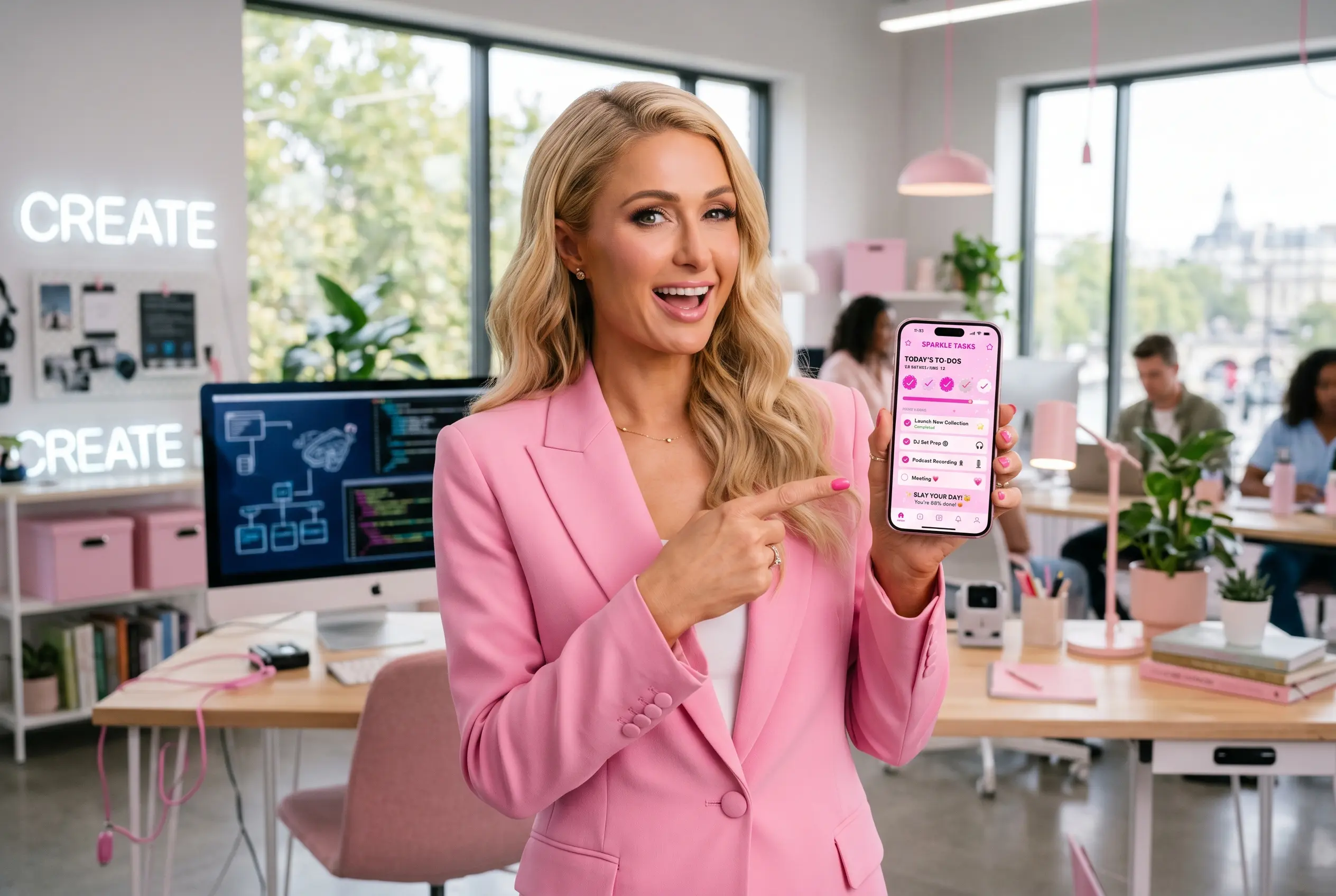
Google has named Paris Hilton Android’s first Icon in Residence, a new role that puts the celebrity at the center of a pitch for Android’s AI app-building tools. The first product of the partnership is Iconic Ideas, a productivity app Hilton says she built in Gemini Canvas after three prompts, with no code. The launch pairs Iconic Ideas with four Android AI tools already on the platform, framing the deal as Android’s pitch to non-developers.
Hilton calls herself an ‘undercover nerd’ in her own Paris Hilton’s first-person account of the partnership on Google’s Keyword blog, the search giant’s official publication, framing the launch as a shift in who gets to build software.
What Hilton Actually Built
The first proof point of the partnership is Iconic Ideas, a productivity app Hilton described in her blog post as ‘a tool inspired by the way my mind works.’ The app is themed pink and sparkly, complete with a gamification layer Google calls ‘sparkle points,’ earned for crossing items off the to-do list. Hilton has spoken publicly about having ADHD and frames the app as a way to capture the ideas that come faster than her old systems could handle.
The build itself took three prompts in Gemini Canvas. ‘I didn’t have to write code,’ Hilton wrote. ‘I described a vision, and Gemini bridged the gap between the idea in my head and an app I could actually use.’ Google set up a custom ‘Sliv Lab’ at its campus for the experimentation, and Hilton’s account frames the experience as a shift in who gets to build software.
The sparkle-points detail is a small but telling choice. The Iconic Ideas landing page describes the app as a way to ‘organize your ideas, inspo, and tasks’ while gamifying completion. It’s a consumer-product sensibility, with reward, color, and identity, layered onto a productivity category long dominated by plain-text tools.
Hilton’s framing of her own productivity problem is a deliberate choice for the partnership, because Iconic Ideas has to look like a tool anyone could want, not a vanity project. The app is positioned as the first deliverable of the Icon in Residence role, with the landing page inviting visitors to use it as-is or build something new from their imagination. Hilton wrote on The Keyword that she ‘expected to learn about new tools’ and instead realized the partnership had ‘completely changed how I think about who gets to build.’ The framing lands on Google’s broader Android pitch, which is that the next wave of Android apps can come from anyone with an idea, not just professional developers.
The Tools Behind the Pink
The Iconic Ideas landing page showcases four Android AI tools alongside the app, and the choice of tools signals what Google actually wants the partnership to demonstrate. The four are presented as a single creative stack, with Hilton as the on-screen user. The pairing matters because the Android pitch now treats ‘anyone with an idea’ as the target user, an open-door message for a category that has historically required developers.
| Tool | What it does |
|---|---|
| Gemini Canvas | Turns text prompts into working apps, games, and websites without writing code |
| Circle to Search | Searches anything on-screen with a circle gesture, used to identify objects and translate text |
| Nano Banana | Creates studio-quality image designs, part of Gemini’s creative tools |
| Gemini Omni | Generates video from text prompts and image inputs, the multimodal generation arm of Gemini |
Vibe coding is the technical frame for what Hilton did, the practice of describing a vision in natural language and letting the model build the app. The full definition of vibe coding at Google Cloud lays out the history and the technical approach. Google’s broader Android story has been moving in this direction for months, with the new tools already shipping in market. Hilton’s role is to put a recognizable face on a category that has mostly been developer-facing. The pitch is that vibe-coded consumer apps are an Android specialty, with Hilton’s Iconic Ideas as the public proof.
Why Google Picked Hilton
Hilton has been an Android user for years, and the partnership extends an existing relationship with Motorola around the Razr brand. Coverage of the announcement by 9to5Google, an Android-focused publication, noted that the new collaboration goes beyond Motorola’s pink Razr, which was aimed at a fashionable audience. Google’s pitch is the broader Android platform and its AI tools, with Hilton’s existing Android loyalty a deliberate part of the framing.
The Razr tie-in is still visible. The android.com/paris landing page ends with a ‘Buy now’ button for the Motorola razr fold, a phone 9to5Google says it has already reviewed. Hilton is positioned as an existing Android customer who already uses a foldable as her daily device. This is an angle Apple’s celebrity partnerships rarely lean into.
Motorola and Hilton’s Razr partnership dates back to the limited-edition razr+ Paris Hilton Edition, a phone marketed to fashion-conscious buyers. The new Google partnership adds a software and AI layer on top of that existing phone endorsement, an unusual layering for a celebrity deal. Hilton is no longer just a phone spokesperson. She is now the public face of a developer-tools pitch, a category shift that is small in brand terms and large in software terms. Google’s pitch is to convert her existing celebrity recognition into a tool for positioning Android as the consumer AI app platform.
An Innovation Challenge, With Teen Builders
The partnership includes a parallel program Google is treating as a substantive second pillar. Hilton hosted an Android Innovation Challenge at Google HQ, inviting young women from the YMCA and Altadena Girls to use Canvas, Circle to Search, and Nano Banana to build apps in a single afternoon. The challenge is a separate workstream from the Iconic Ideas demo, and Google is leaning on it for proof that the tools work for first-time builders.
- A social networking app that prioritizes user well-being
- An app for trying out different hairstyles virtually
- The challenge winner, an app that helps girls walk home safely from school, share their location with their parents, and report hazards along the route
The three apps came from a single afternoon, per Hilton’s account, and the safe-walk-home app is the most concrete output. The other two are softer fits, more aligned with social and lifestyle categories than with public safety. Google is not positioning Hilton’s ADHD-themed productivity app as the only proof point, and the teen-built apps do parallel work, framing Canvas as a tool for first-time builders and a category for non-developers.
The Tone-Deaf Read
The pink-and-sparkly framing of the partnership drew immediate skepticism from at least one major outlet. CNET, in commentary on Google’s broader 2026 Android Show where Hilton had an earlier appearance, called the rollout tone-deaf for everyday Android users. The critique targets a wider set of Google demos, including Hilton’s luxury-Genesis movie-theater cameo, Gemini booking floor-seat concert tickets, and agentic tools recommending a $65,000 Volvo to pick up a 65-inch TV. Iconic Ideas is not the primary target of the critique, but the Hilton-fronted announcement lands inside the same window, and the framing is a load-bearing part of the launch.
Google’s new features are talking squarely at the 1% who find Paris Hilton’s depressingly cringe-worthy sparkly car request a relatable life choice rather than what it is: a complete misunderstanding of how real people live their lives.
The disconnect is real. Iconic Ideas is a productivity app, not a Ferrari configurator, and the safe-walk-home app built by the teen challenge is closer to a public-safety product than to a luxury good. The objection is about the messenger and the aesthetic, not the underlying tool. The launch is built on the assumption that the audience will separate the messenger from the underlying tool.
Two Open Questions
The Hilton-fronted launch lands inside a bigger set of Google Android pitches that have drawn the ‘1% pitch‘ label, and Iconic Ideas is positioned as the rebuttal: a working productivity app, built by a recognizable user in minutes. Hilton’s own closing line for the moment, written in her Google blog post, is that the partnership made her realize ‘the distance between imagination and execution had become dramatically smaller.’ Hilton closed her Google post with ‘Now that’s hot.’ The framing has to hold, because the launch is a public test of whether celebrity-fronted consumer AI app-building can anchor an Android category claim.
Two open questions follow the launch. The first is whether Hilton reads as the right messenger for a mass-market Android audience, and the CNET 2026 Android Show commentary is the most direct challenge. The second is whether the teen-built apps from the Innovation Challenge, including the safe-walk-home app, can stand on their own as proof points for everyday users, with Google’s plain claim that anyone with an Android phone and an idea can ship a working app, with no engineering background.
Frequently Asked Questions
Who is Android’s first Icon in Residence?
Paris Hilton. Google announced the role this week, with Hilton as the inaugural holder. The role is built around showcasing Android’s AI app-building tools to mainstream users, with Hilton as the public face of that pitch.
What is Iconic Ideas?
Iconic Ideas is a productivity app Hilton built in Gemini Canvas, the Google tool for turning text prompts into working apps, games, and websites. Hilton’s blog post on The Keyword frames the app as ‘inspired by the way my mind works,’ and Google has themed it pink and sparkly, with a ‘sparkle points’ reward layer for crossing items off the to-do list.
How can I try Iconic Ideas?
The Iconic Ideas app is open to anyone with a Google account at the dedicated partnership landing page, and Hilton has invited users to share their own Canvas builds using the hashtag #IconicAndroid.
What other apps were built in the partnership?
The Android Innovation Challenge at Google HQ produced three apps in a single afternoon, built by young women from the YMCA and Altadena Girls using Canvas, Circle to Search, and Nano Banana. They included a well-being-focused social network, a virtual hairstyle try-on, and a safe-walk-home app for girls that lets them share their location and report hazards, which Hilton named as the challenge winner.






Judge Strips Google’s Last App Store Friction After Epic Demo

Fold 8 Success Makes Its Dusty Hinge Costlier Than Ever

Silver Lake Workday Talks Test PE Appetite for AI-Hit Software

Wholesale Prices Flat but Wage Lag Keeps Households Squeezed

Teen E-Motos Draw Hells Angels Label and Risk Legal Ebike Gains

Apple’s Siri Pay-Per-Use Plan Rewrites News Licensing Rules

Cramer Calls Cisco Plunge a Buy as AI Orders Surge

Play Points Platinum Quietly Cuts Pixel 11 Prices Again

Quincy Gas Station Sold the $1.04 Billion Powerball Ticket

Microsoft Scraps Failed Copilot Features in Forced App Merge

ZA/UM Lays Off 32 Staff as Zero Parades Wins Reviews, Not Players

EA’s New In-Game Ad Platform Skips the Games That Need It Most

Mortgage Rates Climb to 6.55%, the Highest Level in Nearly a Year

Colby Covington Stuns Tsarukyan as Askren Retires in Tears at RAF 11

Netflix Heads Into Earnings With Its 2022 Playbook Already Spent

Spain’s Diaspora-Rooted Squad Wins Over New York Ahead of the Final

NHL’s Monday Matinee Push Puts Capitals Fans on the Clock

DeChambeau’s Two-Shot Penalty Rewrites the Open’s Weekend Draw

Guardians Rout Twins With Seven Homers, Leave Joe Ryan One Shy of Record

England Beats France 6-4 to Claim World Cup Bronze Medal
-

 TECHNOLOGY3 years ago
How to Adjust a Bulova Watch Band – An Easy Guide
-

 News3 years ago
Fred Pentland: Athletic Bilbao’s English mentor who changed the essence of Spanish football
-

 FINANCE3 years ago
Tax Planning for Every Season: Guide to Maximizing Your Tax Benefits
-

 Education3 years ago
African Ministers New Education Plan
-

 BUSINESS3 years ago
What is Entrepreneurial Operating System? A Comprehensive Guide to EOS
-

 Education3 years ago
Innovate Your Learning Journey with Technology and Enhance Education
-

 News3 years ago
Russians formally out of World Athletics Championships
-

 BUSINESS3 years ago
Top 9 Most Expensive American Cities to Rent an Apartment