
FINANCE
Fed Holds Rates as Dot Plot Flags Possible 2026 Hike; Kospi Crosses 9,000
The Fed held rates at 3.5%-3.75% Wednesday as its dot plot flagged a possible 2026 rate hike, sending the S&P 500 down 1.21%. Kospi closed above 9,000 for the first time.

The Federal Reserve held its benchmark rate steady at a range of 3.5% to 3.75% on Wednesday, June 17, 2026, but a more hawkish dot plot under new Chair Kevin Warsh pushed the S&P 500 down 1.21% and pushed the two-year Treasury yield to a high of 4.22%. Markets now price a possible Fed rate hike in 2026, with futures implying a 77% chance of a move by December, up from 24% a month earlier. In Asia on Thursday, the Kospi closed above 9,000 for the first time and the Nikkei 225 crossed 71,000, yet underneath the chip-fueled rally, forced liquidations among Korean retail accounts holding single-stock leveraged ETFs hit a record 1.1986 trillion won.
The Fed’s Hawkish Dot Plot, Decoded
The Federal Open Market Committee left the federal funds target range unchanged at 3.50% to 3.75%, where it has stood since December 2025, in a unanimous 12-0 vote, the full June 17 rate decision with the updated dot plot shows. Markets had priced a hold at roughly 97%, so the action itself was not the news.
The real shift was in the projections. The median 2026 federal funds rate rose to 3.8%, up from 3.4% in March. That moved the median from a level that implied a rate cut to one above the current range midpoint of about 3.625%, a hawkish flip. Of the 18 officials who submitted projections for 2026, 9 placed their dot above the current midpoint, 8 at the midpoint, and 1 below. The full range ran from 3.4% to 4.4%, with a central tendency of 3.6% to 4.1%, a split that explains why the published median moved up even though the decision itself was unanimous. The longer-run median held at 3.1%.
The projections also reveal where the committee’s worry sits. Seventeen of the 18 participants judged the risks to their inflation forecast to be tilted to the upside, with 1 seeing balanced risks and none seeing downside risk. Warsh himself did not submit a rate projection in this round, an absence noted in the Summary of Economic Projections, which reflects 18 participants. The June statement also dropped earlier language about possible additional adjustments and removed what markets had read as an easing bias.
| Period | March 2026 SEP | June 2026 SEP |
|---|---|---|
| End of 2026 | 3.4% | 3.8% |
| End of 2027 | 3.1% | 3.6% |
| End of 2028 | 3.1% | 3.4% |
| Longer run | 3.1% | 3.1% |
Warsh’s First Day and the 1994 Comparison
Wednesday was the first meeting chaired by Kevin Warsh, who was sworn in as Fed Chair on May 22, 2026, and the Committee handed him a unanimous 12-0 decision, a marked change from the 8-4 split at the April meeting under the prior chair. Stocks fell across the board after the release. The Dow, which had hit a new all-time intraday high earlier in the session, ultimately declined 507.12 points, or 0.98%. The S&P 500 fell 1.21%, while the Nasdaq Composite lost 1.34%, the Fed’s pivot and the regional market reaction on June 17 recorded.
That selloff marked the worst performance for the S&P 500 on the first “Fed day” under a new chair since 1994, according to data from Bespoke Investment Group. Only three other new Fed leaders have been named in that span: Ben Bernanke, Jerome Powell, and Janet Yellen. The June statement was also noticeably shorter than those under former Chair Powell, and forward guidance was dropped entirely, a change visible in the published text and that the market treated as a hawkish signal in itself.
How Wall Street Read the New Path
Bond markets reacted faster than equities. The two-year Treasury yield, which tracks near-term rate expectations, jumped to a high of 4.22% on Wednesday. In the initial reaction, the 2-year rose about 11 basis points to around 4.15%, while the 10-year climbed about 4 basis points to around 4.47%, a flattening typical of markets pricing a higher near-term rate path.
Fed-funds futures moved to imply roughly a 77% probability of a rate hike by December 2026, up from about 24% a month earlier, according to market commentary cited by StockTitan. The June dots brought the Fed’s own median closer to that market view, the first time the two have converged on a hike-leaning path since the current tightening cycle began.
The first-month reaction also reset equities. The Dow and S&P 500 had set intraday records earlier in the session before the statement, before reversing. By Thursday’s pre-market, futures had stabilized: S&P 500 futures ticked up 0.83%, Nasdaq 100 futures climbed 1.32%, and Dow futures added 282 points.
The Fed held rates steady but spoiled the mood with a much more hawkish dot plot. Elevated inflation makes that understandable, but the committee is far from united, with only about half still penciling in rate hikes later this year.
Sonu Varghese, chief macro strategist at Carson Group, gave that assessment on Wednesday. David Zervos, chief market strategist at Jefferies, added on CNBC’s “Closing Bell: Overtime” that “the market doesn’t like regime change.” Both quotes appear in the Fed’s pivot and the regional market reaction on June 17.
Asia’s Chip Records Mask a Sharper Split
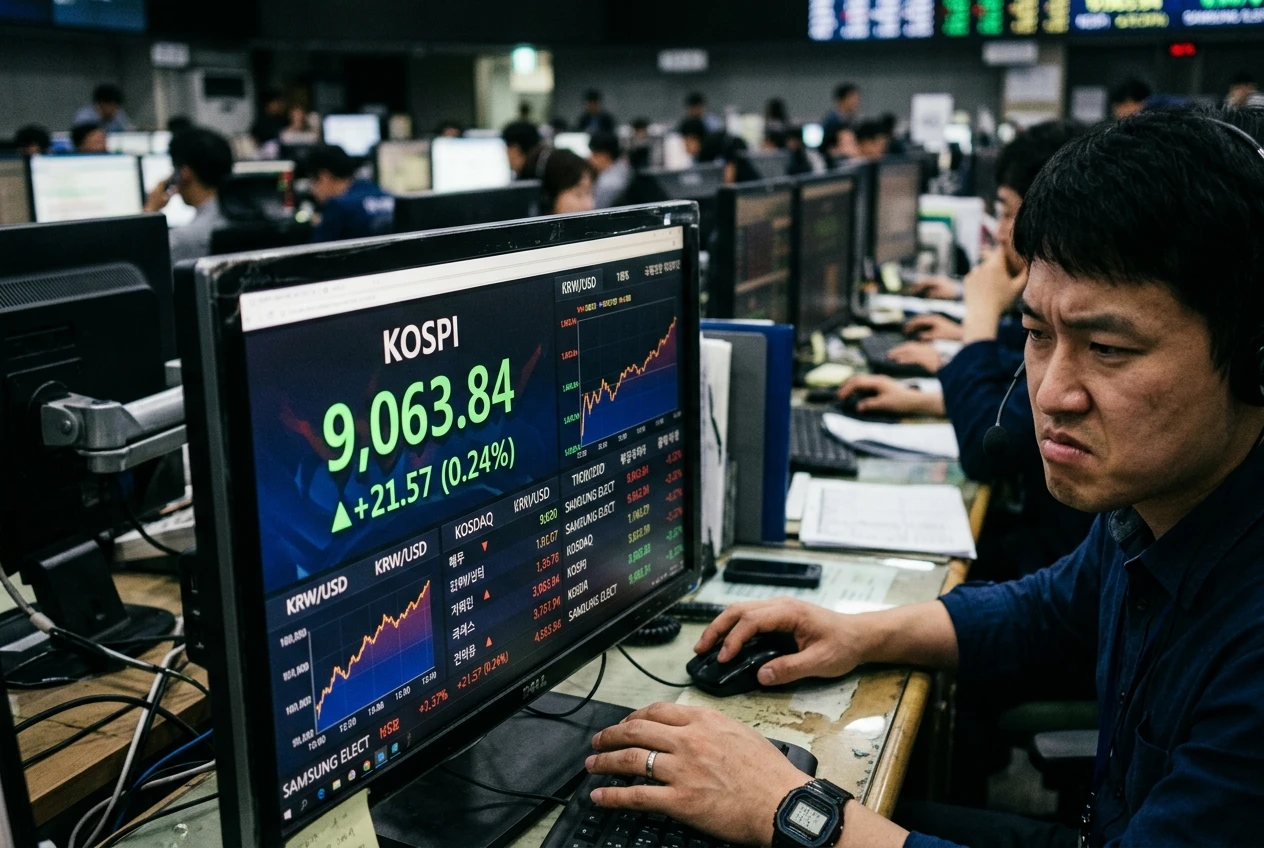
South Korea’s Kospi closed above 9,000 for the first time on Thursday at 9,063.84, up over 1%, with semiconductor heavyweights SK Hynix and Samsung Electronics doing most of the lifting. SK Hynix jumped 6.51% to a fresh record, and Samsung Electronics rose 4.62%. In Tokyo, the Nikkei 225 advanced 1.88% to 71,219.45, with an intraday record of 71,293.64, the first close above 71,000 in its history. The Topix, Japan’s broader index, rose 1.67% to 4,080.26. Of the Nikkei’s 225 constituents, 144 advanced and 75 declined.
The driver was the same in both markets: AI memory. SK Hynix announced Thursday that it has shipped samples of its 12-layer HBM4E memory chip to major customers. The next-generation product delivers data transfer speeds of up to 16 gigabits per second per pin and improves power efficiency by more than 20% from the previous generation, SK Hynix’s HBM4E sample announcement states. SK Hynix also achieved a 48GB capacity in the 12-layer stack and reduced heat resistance by 17% versus the prior HBM4 using its Advanced MR-MUF packaging process.
HBM4E is the successor to HBM4, which is set to be used in Nvidia’s Vera Rubin AI accelerator in the second half of this year, with the Vera Rubin Ultra, due next year, also expected to feature HBM4E. The sample shipments land as Nvidia ramps its next platform, a sequencing that explains why Korean memory stocks continue to outperform the rest of their market, as captured in Samsung’s earlier HBM4E sample shipping and the Kosdaq split.
Other Asia-Pacific markets closed mixed.
- Kospi: closed above 9,000 for the first time at 9,063.84
- Nikkei 225: +1.79% to above 71,000 for the first time
- Topix: +1.48%
- SK Hynix: +6.51% to a fresh record
- Samsung Electronics: +4.62%
- ASX 200: -0.29%
- Hang Seng: -0.76%
- CSI 300: flat
European markets opened Thursday in mixed territory. The pan-European Stoxx 600 was 0.1% lower shortly after 8:00 a.m. in London. The U.K.’s FTSE 100 was 0.65% lower, France’s CAC 40 was up 0.03%, Germany’s DAX rose 0.27%, and Italy’s FTSE MIB added 0.18%. The Bank of England’s Monetary Policy Committee is expected to leave its key rate unchanged at 3.75%, and the Swiss National Bank is also set to hold at 0%.
The Reckoning Underneath Korea’s 9,000
The Kospi hit its milestones at remarkable speed. It broke above 3,000 on June 20, 2025, passed 4,000 on Oct. 27, 2025, reached 5,000 on Jan. 22, 2026, and touched 6,000 on Feb. 25, 2026, according to Seoul stocks’ first close above the 9,000 milestone. It took less than a month for the index to top the latest round number, after breaking the 8,000-point mark on May 26, 2026, capping a record-breaking run of five straight sessions tied to a U.S.-Iran peace agreement and extended optimism for AI.
The rally is concentrated. Samsung Electronics has risen 188% since the start of the year, and SK Hynix vaulted over 287% during the past six months. The two chip giants now account for more than 50% of total KOSPI market capitalization, a level of concentration that one Wall Street asset management official quoted in Korean media compared to a “Samsung Electronics and SK Hynix Coalition Index” rather than the broad KOSPI.
That concentration has produced a sharp side effect. In 12 trading days from the May 27 listing of single-stock 2x leveraged and inverse ETFs tracking Samsung and SK Hynix, the market capitalization of those products more than doubled, from 4.5 trillion won to 9.6 trillion won, according to the Financial Supervisory Service. Retail investors accounted for 92.7% of the buying, a net 8.2 trillion won. As semiconductor names took a short-term breather, forced liquidations among retail accounts using credit trades and leveraged products exploded by 319.2% month-on-month to 1.1986 trillion won (about $799 million), the highest figure in South Korean stock market history.
| Product | Peak-to-trough drop | Underlying spot stock drop |
|---|---|---|
| Samsung Electronics 2x leveraged | -35.9% | -18.0% |
| SK Hynix 2x leveraged | -38.0% | -19.1% |
The Regulator’s First Leveraged-ETF Warning
The Financial Supervisory Service issued a Consumer Warning on the morning of June 18, in unusually forceful language for a Korean regulator. With the domestic market’s daily price limit set at plus or minus 30%, a single-stock 2x leveraged product is an instrument where a maximum loss of 60% can theoretically occur in just a single day, the FSS stated. The regulator stressed that these products carry no diversification effect, the structural advantage of broad ETFs, meaning a sudden unfavorable factor or earnings shock hitting a single enterprise can instantly reduce assets to near zero. It also flagged “volatility drag,” the compounding effect that erodes a leveraged product’s net asset value when the underlying stock moves sideways, even if the stock later returns to its starting price.
Beyond the volatility, the FSS investigation found a liquidity blind spot. Securities firms acting as liquidity providers are obligated to submit buy and sell quotes to balance ETF prices, but for the first 5 minutes after the 9:00 a.m. open and for the final 10 minutes from 3:20 p.m. until the close, that obligation is exempted. During those windows, retail market orders were being filled at prices detached from the product’s actual NAV. The initial disparity ratio between market price and net asset value averaged 1.0% to 3.5%, up to more than 3 times higher than the 0.8% to 1.2% range seen on existing index-type leveraged ETFs.
Five Task Forces, One Year-End Deadline
Warsh used his debut press conference to outline a broader review of how the Fed operates. He announced five task forces covering communications, balance-sheet management, data sources and methodology, productivity and jobs (including the reach of AI and other general-purpose technology), and the inflation framework itself, with a particular look at the ample-reserves regime. Warsh said the teams would be formed within the next two weeks and would release their findings by the end of the year. He also indicated he expects to propose changes, including to the Summary of Economic Projections itself.
His message on communications was sharper than his predecessors. “Financial markets perform best when they react to incoming data,” Warsh said, adding that “the financial markets are less efficient when they ask the question, ‘How will the Federal Reserve react to that incoming information?'” He also suggested he may not hold press conferences after every FOMC meeting, as has been customary in recent years, a procedural change that would mark a break with the post-2011 practice. Warsh reaffirmed 2% as the Fed’s longstanding inflation objective and said he saw no reason to revisit that goal until it has been delivered.
The near-term calendar now stacks with catalysts that the dot plot makes more consequential. With 17 of 18 officials seeing upside inflation risk, the next PCE, CPI, and employment prints become the swing factor for whether the penciled-in hike materializes. Thursday brings the BoE and SNB rate decisions, May’s leading indicators, the June Philadelphia Fed Index reading, and initial jobless claims for the week ended June 13. Accenture and Kroger report earnings before the opening bell. The Federal Reserve’s own SEP raised 2026 PCE inflation to 3.6% from 2.7%, and the May Consumer Price Index ran at 4.2% year-over-year, a gap that the next set of releases will test, as Asia chip stocks’ rebound and the AI IPO cash pull tracks in the regional read.
Frequently Asked Questions
What did the Fed decide on June 17, 2026?
The Federal Open Market Committee held the federal funds target range at 3.50% to 3.75% by a unanimous 12-0 vote, the Fed’s June 17, 2026 statement shows. The vote itself was the most unified since 2025, a contrast to the 8-4 split at the April meeting under the prior chair.
What is the dot plot telling markets?
The median 2026 federal funds rate projection rose to 3.8% from 3.4% in March. Of 18 officials who submitted projections for 2026, 9 see the rate higher by year-end and the full range runs from 3.4% to 4.4%. Fed-funds futures now imply roughly a 77% chance of a rate hike by December 2026, up from about 24% a month earlier.
Why is the Kospi hitting 9,000 while Korean retail investors are losing money?
Index gains are concentrated in Samsung Electronics, up 188% year to date, and SK Hynix, up more than 287% over the past six months, the two stocks together account for more than 50% of KOSPI market capitalization. As those names took a short-term breather, single-stock 2x leveraged ETFs tracking them dropped 35.9% and 38.0% peak to trough, and forced liquidations among retail accounts using credit and leveraged products hit 1.1986 trillion won (about $799 million), the highest in South Korean market history.
What are Kevin Warsh’s five task forces?
The five task forces cover communications, balance-sheet management, data sources and methodology, productivity and jobs (including AI’s reach), and the Fed’s inflation framework. Warsh said the teams would be formed within two weeks and would release their findings by the end of the year, and that he expects to propose changes including to the Summary of Economic Projections itself.






Spotify Running Mode hits Android and revives its old tempo experiment

Galaxy Tab S12 Ultra Renders Keep the Notch Fans Hate

Novato Spinning Round House Sells With Six Neighbors for $3.3 Million

Crop Tour Finds Indiana and Nebraska Corn Yields Lagging 2025

Best Buy 60th sale brings Android deals back to its roots

American Airlines reverses seatback screen bet years too late

Iran Hormuz Strikes Force Gulf Oil Onto Costlier Paths

Plague Tale Prequel Day One Joins Game Pass Wave 2 as Witcher Exits

NBA 2K27 opens The City to everyone and rewrites career eras

iOS 26.6.1 Patches 29 Flaws as AI Forces Faster Apple Updates

Caitlin Clark Skips the WNBA 3-Point Contest for a Third Straight Year

Rainout Gives Red Sox Two Shots at a Franchise-Record Win Streak

Double Fine Cuts 23 Jobs Weeks After Xbox Independence

Day-One Big Walk Lifts PS Plus August Beyond Recycled AAA

John Hight Exits Wizards After Digital Reckoning Hits

Curtis Mead’s Red Sox Debut Ends With Fractured Wrist

Moesch and Dressel Rewrite Night One at 2026 U.S. Nationals

Red Sox Squander Hot Streak Chance in 4-3 Loss to Athletics

Boutte’s Quiet Camp Takeover Forces Patriots Receiver Choices

Take-Two CEO Pushes Netflix Subs for GTA 6 Extended Look
-

 TECHNOLOGY3 years ago
How to Adjust a Bulova Watch Band – An Easy Guide
-

 News3 years ago
Fred Pentland: Athletic Bilbao’s English mentor who changed the essence of Spanish football
-

 FINANCE3 years ago
Tax Planning for Every Season: Guide to Maximizing Your Tax Benefits
-

 Education3 years ago
African Ministers New Education Plan
-

 BUSINESS3 years ago
What is Entrepreneurial Operating System? A Comprehensive Guide to EOS
-

 Education3 years ago
Innovate Your Learning Journey with Technology and Enhance Education
-

 News3 years ago
Russians formally out of World Athletics Championships
-

 BUSINESS3 years ago
Top 9 Most Expensive American Cities to Rent an Apartment