
News
Anduril Beats Boeing and Lockheed for CCA Drone Production Contract
Anduril and General Atomics won Air Force CCA contracts June 17, 2026, beating Boeing, Lockheed, and Northrop. Both must deliver 150+ drones by 2030.

Anduril and General Atomics have been selected to build the Air Force’s first Collaborative Combat Aircraft, the service announced Wednesday, beating Boeing, Lockheed Martin, and Northrop Grumman. Both companies now move into full-scale manufacturing under contracts awarded four months ahead of schedule. The two airframes, Anduril’s FQ-44 Fury and General Atomics’ FQ-42A, are slated to deliver more than 150 combat-capable aircraft by the end of the decade.
The Air Force is asking Congress for nearly $1 billion in fiscal 2027 to begin buying the drones, with a per-unit target of under $30 million, roughly one-third the cost of an F-35A. Mission autonomy software is being bought in a parallel competition that will pick a primary provider by summer 2027. Anduril, RTX Collins Aerospace, and Shield AI will spend the next year competing for that role.
The Production Contract Covers Three Lots
The contracts cover the first three production lots of unmanned aircraft for CCA Increment 1. The Air Force is buying an initial batch for continued testing, validation, and operational fielding, with follow-on lots spread across the next several years. Anduril’s deal structures additional purchases as separate lots, giving the service a clear path to scale up fighter capacity without renegotiating.
“Under the contract, Anduril will deliver an initial set of production FQ-44 semi-autonomous fighter aircraft to support continued testing, validation, and, ultimately, operational fielding,” the company said in its announcement. General Atomics president David Alexander called the win “an exciting day for our company and the nation,” adding that General Atomics has been “preparing for this order” and “manufacturing is already well underway.” The Air Force has not disclosed the value of either contract or how many aircraft each company will receive across the three lots, citing the figures as classified in its announcement of CCA Increment 1 production contracts. Col. Timothy Helfrich, the Air Force’s portfolio acquisition executive for fighters and advanced aircraft, told reporters the program is “meeting or exceeding” its cost target.
The Air Force picked both companies after a new source selection, not an extension of their 2024 prototyping contracts. The service re-solicited all five original bidders and decided on the basis of schedule, cost, and performance, Helfrich said on a call ahead of the announcement. “This is not just a continuation of the contracts we had with Anduril and General Atomics, this was a [completely] new source selection that was done,” he said. The five original bidders were Anduril, Boeing, General Atomics, Lockheed Martin, and Northrop Grumman. After Wednesday’s award, three of them are out of Increment 1 production for good.
The Air Force Decided Faster Than Planned
The contract award lands less than two years after the prototypes were first funded. Anduril’s Fury won a prototype award in April 2024, started ground testing in April 2025, and made its first flight on October 31, 2025, according to Anduril’s statement on the FQ-44 production contract. General Atomics’ YFQ-42A prototype first flew in August 2025. The Air Force’s June 17 production decision compresses that arc to just over 25 months from paper to production line. The Air Force originally planned to make a competitive production decision in fiscal year 2026 but had not committed to a specific month.
The Air Force’s announcement credits the early call to the maturity of both airframes after extensive flight testing. Anduril noted in its own statement that the decision marks “the first time a new company has won a fighter aircraft program since the 1970s,” the latest win for a company that took over the Army’s $22 billion IVAS headset program in 2025. “That timeline, prototype award in April 2024, start of ground test in April 2025, first flight in October 2025, and production contract in June 2026, represents the fastest path from prototype to production for a fighter aircraft in more than 50 years,” the company said. General Atomics experienced a setback in April 2026 when a YFQ-42A crashed during a test flight in California, triggering a roughly six-week pause in flight testing that Helfrich said played “no” role in the production decision.
Boeing, Lockheed, and Northrop Lost Out
Boeing, Lockheed Martin, and Northrop Grumman are now locked out of CCA Increment 1 production. The Air Force said it does not intend to reopen the first increment to the losing vendors, even though it allowed all five to compete for this round. The three had been told when they lost the 2024 prototype round that they could compete for production, but that door closed on Wednesday. Increment 2, in early development with nine vendors under contract, will be a separate competition open to the broader industry pool.
Helfrich said the Air Force wanted to keep continuous competition alive on the program, which is why it ran a fresh source selection rather than converting the prototype contracts. The decision criteria were the same trio the Air Force has used throughout CCA development: schedule, demanding cost, and the ability to deliver 150-plus aircraft by the end of the decade. Anduril and General Atomics cleared all three. “Both General Atomics and Anduril demonstrated that they had the ability to meet our schedule, meet our cost requirements, and meet the capabilities needed for a CCA,” Helfrich said, according to reporting on the source selection and software contract structure. Boeing’s MQ-28A Ghost Bat, Lockheed Martin’s unnamed design, and Northrop Grumman’s Model 437 were all unsuccessful at the production source selection, according to a Shephard Media program tracker. The Air Force has not published a public scorecard explaining why the three lost.
The April crash of General Atomics’ prototype did not move the dial. Helfrich said the autopilot miscalculation that brought the YFQ-42A down in California and led to the multi-week pause was remediated before the production decision and was not part of the evaluation. General Atomics has since resumed flight testing with a software fix. The takeaway from the Air Force: no role in the source selection.
The Cost Target Is One-Third of an F-35
The Air Force wants each CCA to cost under $30 million per tail, roughly one-third the price of an F-35A. The target has held since Frank Kendall, the former Secretary of the Air Force, first laid it out. A Lot 17 F-35A runs around $82.5 million, putting the CCA ceiling near the $27 million mark at the current F-35 rate. Helfrich told reporters the program is meeting or beating that goal, per Helfrich’s June 17 briefing on the CCA production decision. The Air Force declined to disclose the value of the contracts themselves, saying the figures are classified.
Congress will help shape the runway. The Air Force is asking for $996.5 million in its fiscal 2027 base budget to begin CCA Increment 1 procurement, plus roughly $1.4 billion for continued research and development. Travis Sharp, a senior fellow at the Center for Strategic and Budgetary Assessments, told DefenseScoop that if past cost estimates hold, the FY27 money would buy around 30 Increment 1 drones in the first production lot. He cautioned that early-production unit prices typically run higher than the long-run average.
Shephard Media estimates the entire Increment 1 procurement at around $4.5 billion for 100 to 150 aircraft, with the full development-plus-procurement outlay reaching $8.9 billion. The Air Force’s longer-range target is around 1,000 CCAs across multiple increments, with Increment 2 alone potentially adding another 2,350 aircraft. Increment 2 is being scoped separately, with nine vendors on early development contracts as of mid-2026. The Air Force has not yet committed to a specific Increment 1 lot split between Anduril and General Atomics, saying the determination will depend on which company can deliver “capability at speed and scale.”
- 150+ CCAs required by end of decade
- ~$30M per-unit cost target
- $996.5M FY27 procurement ask
- $1.4B FY27 R&D ask
- 9 Increment 2 vendors on early contracts
| Attribute | FQ-44 (Anduril) | FQ-42A (General Atomics) |
|---|---|---|
| Prototype designation | YFQ-44A | YFQ-42A |
| Internal name | Fury | Dark Merlin |
| First prototype flight | October 31, 2025 | August 2025 |
| Per-unit cost target | under $30 million | under $30 million |
| Combat radius target | at least 700 nautical miles | at least 700 nautical miles |
| Production site | Arsenal-1, Pickaway County, OH | undisclosed |
Software Is a Separate Competition
The brains behind the airframe are being bought on a parallel track. The Air Force picked Anduril, RTX subsidiary Collins Aerospace, and Shield AI to compete for the mission autonomy contract, beating General Atomics, Lockheed Martin, and Northrop Grumman on the software side. Each of the three winners received a six-month contract line item to advance their autonomy packages toward the Air Force’s initial operating capability criteria. At the end of that six months, the Air Force will down-select to one or two vendors for a second six-month option. A single primary mission autonomy provider for Increment 1 will be chosen by summer 2027.
The acquisition strategy, dubbed “software sold separately” by the Air Force, decouples the airframe from the autonomy stack. The service wants the ability to swap autonomy providers as technology evolves, without re-engineering the physical aircraft. A government-owned Autonomy Government Reference Architecture, or A-GRA, acts as the connective tissue, ensuring any vendor’s software can be ported across the airframes in the pool. The Air Force retains a backup pool of six vendors across the six-year contract window, including Lockheed Martin and Northrop Grumman, and can pull software licenses from any of them if the lead vendor falters.
Arsenal-1 Is Already Building
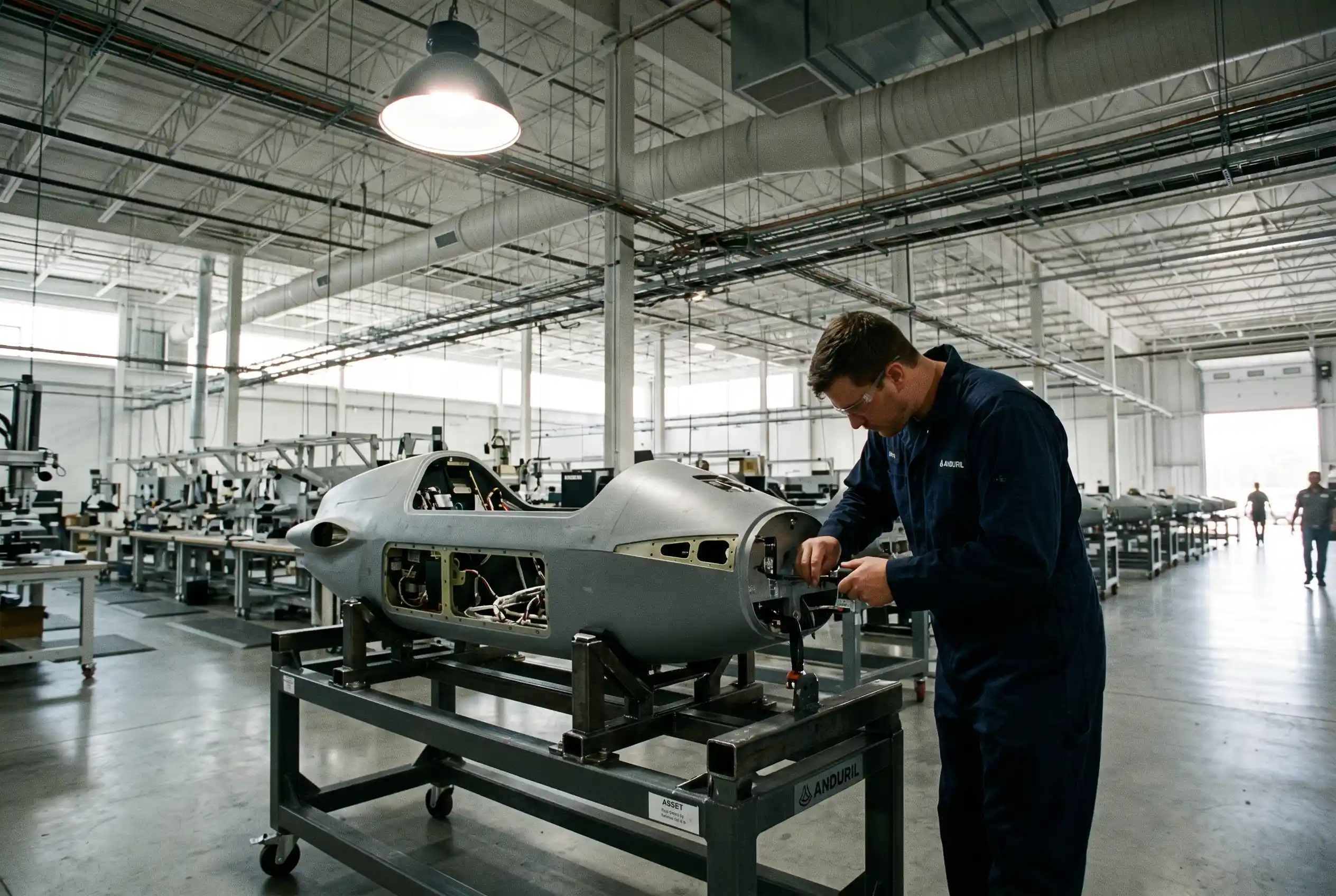
Anduril’s CCA production line is already running at Arsenal-1, the company’s hyperscale factory in Pickaway County, Ohio. Workers began assembling YFQ-44A airframes at the facility in late March, before the production contract was awarded, per an inside look at Arsenal-1 and the CCA production timeline. The plant sits near Rickenbacker International Airport, about 20 miles south of Columbus, and runs on a deliberately low-fi model: 22 workstations, no robotics, and utilities hung from overhead rails so every station can be moved. Anduril says 94 percent of the YFQ-44A’s components are commercially available, including a Williams FJ44-4M turbofan engine shared with business jets.
The line is sized for speed. Anduril says Arsenal-1 can deliver up to 150 aircraft per year in its current configuration, with every station on wheels to allow rapid reconfiguration. The company expects to employ 250 people at the site by the end of 2026 and 4,000 over the next decade. The first aircraft off the Ohio line are scheduled for this summer.
The build is closer to a kit than a monument. John Malone, Anduril’s head of production for autonomous airpower, told Air & Space Forces Magazine that the line is “automation-free to start” by design, so changes to the aircraft can be folded into production without rebuilding tooling. The first four stations build structure, subsequent stations install hydraulics, fuel lines, and avionics, later stations mate the landing gear, wings, and engine. Final stations run tests with the aircraft supported by its own gear. About 30 workers, trained at Anduril’s California facilities, are on the first production batches.
We have been refining, testing, and iterating on our production system, in parallel with aircraft development, for the past two years. We have already implemented our full rate production processes and tooling on prototype aircraft, identifying and addressing issues during prototyping to streamline the transition into production.
Mark Shushnar, Anduril’s vice president for autonomous airpower, said in the company’s announcement on Wednesday.
The FY27 Money and a 1,000-Drone Goal
The Air Force plans to award the first CCA production lot as soon as Congress passes the fiscal 2027 budget. The $996.5 million procurement request sits inside the Trump administration’s $1.5 trillion defense topline for FY27, which includes $1.15 trillion in discretionary funding. The Air Force’s FY27 aircraft procurement budget totals $30.6 billion, with the CCA line item appearing for the first time. The service says it will give Anduril and General Atomics “equal opportunity” to receive orders in the first lot.
The longer-arc plan reaches well past Increment 1. The Air Force is targeting a fleet of around 1,000 CCAs in total, of varying types and complexity, to fly alongside the F-22 Raptor, the F-35A, and the in-development sixth-generation F-47. Increment 1 will field air superiority drones, while later increments are expected to add strike, reconnaissance, and electronic warfare variants at lower cost. The Air Force also said Wednesday it would open Increment 2 to a broader vendor pool, with the nine companies holding early development contracts eligible to compete. Anduril’s next round of CCA milestones, including a primary mission autonomy decision in summer 2027, will run on the same clock as the FY27 production buy.
Frequently Asked Questions
What is the Air Force’s CCA program?
The Collaborative Combat Aircraft (CCA) program is the Air Force’s effort to field large numbers of semi-autonomous unmanned fighters that fly alongside crewed jets. Increment 1, the focus of the June 17 contract awards, targets air superiority drones with a combat radius of at least 700 nautical miles. Later increments are expected to add strike, reconnaissance, and electronic warfare variants at lower unit cost.
How is Anduril’s FQ-44 different from a traditional fighter?
The FQ-44 Fury has no onboard crew. It is designed to fly semi-autonomously under mission autonomy software, operating with crewed fighters through manned-unmanned teaming. Anduril says the aircraft has a ferry range that lets it deploy anywhere in the world, can take off and land from a short field, and has a combat radius that exceeds current crewed fighters. The Air Force wants a unit cost under $30 million, compared with around $82.5 million for a Lot 17 F-35A.
Why did Boeing, Lockheed, and Northrop lose out?
The Air Force re-solicited all five original CCA bidders in 2026 and selected Anduril and General Atomics on schedule, demanding cost, and performance, the same criteria used throughout the program. Col. Timothy Helfrich said the Air Force is not reopening Increment 1 to the three losing vendors. The door to Increment 2 remains open, with nine companies already on early development contracts.
When will the first CCA drones reach the Air Force?
Anduril says the first FQ-44s off the Ohio production line will roll out this summer, before the end of FY27. The Air Force’s June 17 contracts cover the first three production lots and require 150 or more combat-capable aircraft by the end of the decade. The service plans to award the first lot as soon as the FY27 budget is approved.
What is the software competition doing separately?
Mission autonomy, the brains that let the drones fly themselves, is being bought on a parallel track from a pool of six vendors. The Air Force selected Anduril, RTX Collins Aerospace, and Shield AI to compete in a six-month performance phase. After a second six-month option, a single primary mission autonomy provider for Increment 1 will be chosen by summer 2027. The Air Force can pull licenses from any of the six pool members if the lead vendor falters.





Iowa Farmer Built Resilience for 16 Years Then Tariffs Hit Hard

HHS Adds FDA Tech and Drugs Deputies to Lock In AI and Review Power

Nvidia Earnings Carry a Built-In Sell-the-News Trap

HP Licenses Huawei Wi-Fi Patents Despite the Entity List

Poland Named in $131B F-15 Deal Echoes Apache Path

Sewer Scavengers Near Penn Station Repeat a Decades-Old NYC Pattern

Second Muni Fatigue Crash Exposes Surface Line Gaps

Chick-fil-A Chicken and Waffles Closes Its 80-Year Loop

Musk Data Centers Leave a Mississippi Family’s Historic Land Empty

OpenAI Data Center Chief Exits as Stargate Strategy Shifts

Double Fine Cuts 23 Jobs Weeks After Xbox Independence

Day-One Big Walk Lifts PS Plus August Beyond Recycled AAA

Curtis Mead’s Red Sox Debut Ends With Fractured Wrist

John Hight Exits Wizards After Digital Reckoning Hits

Red Sox Squander Hot Streak Chance in 4-3 Loss to Athletics

Moesch and Dressel Rewrite Night One at 2026 U.S. Nationals

Boutte’s Quiet Camp Takeover Forces Patriots Receiver Choices

Take-Two CEO Pushes Netflix Subs for GTA 6 Extended Look

Halo Campaign Evolved Skulls Meet Death Barriers That Kill the Hunt

Wildlands Free Update Hands Players the Tools They Already Invented
-

 TECHNOLOGY3 years ago
How to Adjust a Bulova Watch Band – An Easy Guide
-

 News3 years ago
Fred Pentland: Athletic Bilbao’s English mentor who changed the essence of Spanish football
-

 FINANCE3 years ago
Tax Planning for Every Season: Guide to Maximizing Your Tax Benefits
-

 Education3 years ago
African Ministers New Education Plan
-

 BUSINESS3 years ago
What is Entrepreneurial Operating System? A Comprehensive Guide to EOS
-

 Education3 years ago
Innovate Your Learning Journey with Technology and Enhance Education
-

 News3 years ago
Russians formally out of World Athletics Championships
-

 BUSINESS3 years ago
Top 9 Most Expensive American Cities to Rent an Apartment