
News
5 Desk Gadgets Under $200, Ranked by How Often They Get Used
TechCrunch’s July 2026 roundup of five desk gadgets under $200 splits into cheap, everyday picks and pricier mood-setters. The cheap ones touch more hours.

TechCrunch’s consumer news reporter Aisha Malik published a roundup of five desk gadgets under $200 on July 5, 2026, and the picks split into two distinct groups. The Odistar Desktop Vacuum Cleaner at $13, Speks fidget magnets at $35, and the Amazon Echo Dot at $50 cover the cheap side of the list. The Ember Mug 2 at $150 and the Govee Glide Hexa Light Panels at $189.99 take the rest of the budget. The cheap ones touch more hours of the workday than the bright lights and the smart mug, even though Malik does not rank the picks in that order.
Malik’s framing is the standard work-from-home pitch: “the right desk gadgets can help you reduce clutter, stay focused, and add a little extra convenience to your day,” and the five picks all live up to that framing on paper. The vacuum cleans as you eat lunch at your desk, while Speks keep hands off pen caps during a call. For calendar checks and reminders, the Echo is the answer. The Ember keeps coffee at one temperature for up to 80 minutes. Behind the monitor, the Govee lights the wall.
Aisha Malik’s July 5, 2026 desk-gadgets roundup lays out all five.
A Round-Up With a Cheap-Stuff Bias
The reading order that makes the roundup sing is by price, low to high. Three groups make up the list: two picks under $50 at the cheap end, the Echo Dot in the middle, and the two premium picks taking the rest of the budget. Malik does not say the cheap ones matter most, but the hours they touch are the ones the bright lights and the smart mug never reach.
5 desk gadgets, by price:
- Odistar Desktop Vacuum Cleaner ($13)
- Speks fidget magnets ($35)
- Amazon Echo Dot ($50)
- Ember Mug 2 ($150)
- Govee Glide Hexa Light Panels ($189.99)
The framing of the roundup is a typical work-from-home pitch: workers “spend dozens of hours at our desks each week (if not more),” Malik writes in the opening, and a workspace that is “productive and enjoyable” gets built with “ambient lighting to smart mugs” and the small conveniences that add up. The five picks all live up to that pitch on paper. The interesting question is which ones change the texture of a workday versus which ones decorate it. The vacuum cleans as you eat lunch at your desk, the Speks keep hands off pen caps during a call, and the smart mug, voice assistant, and light panels each matter in narrower windows: a coffee break, a calendar check, a long focus session.
A $13 Vacuum for the Lunch-at-Your-Desk Crowd
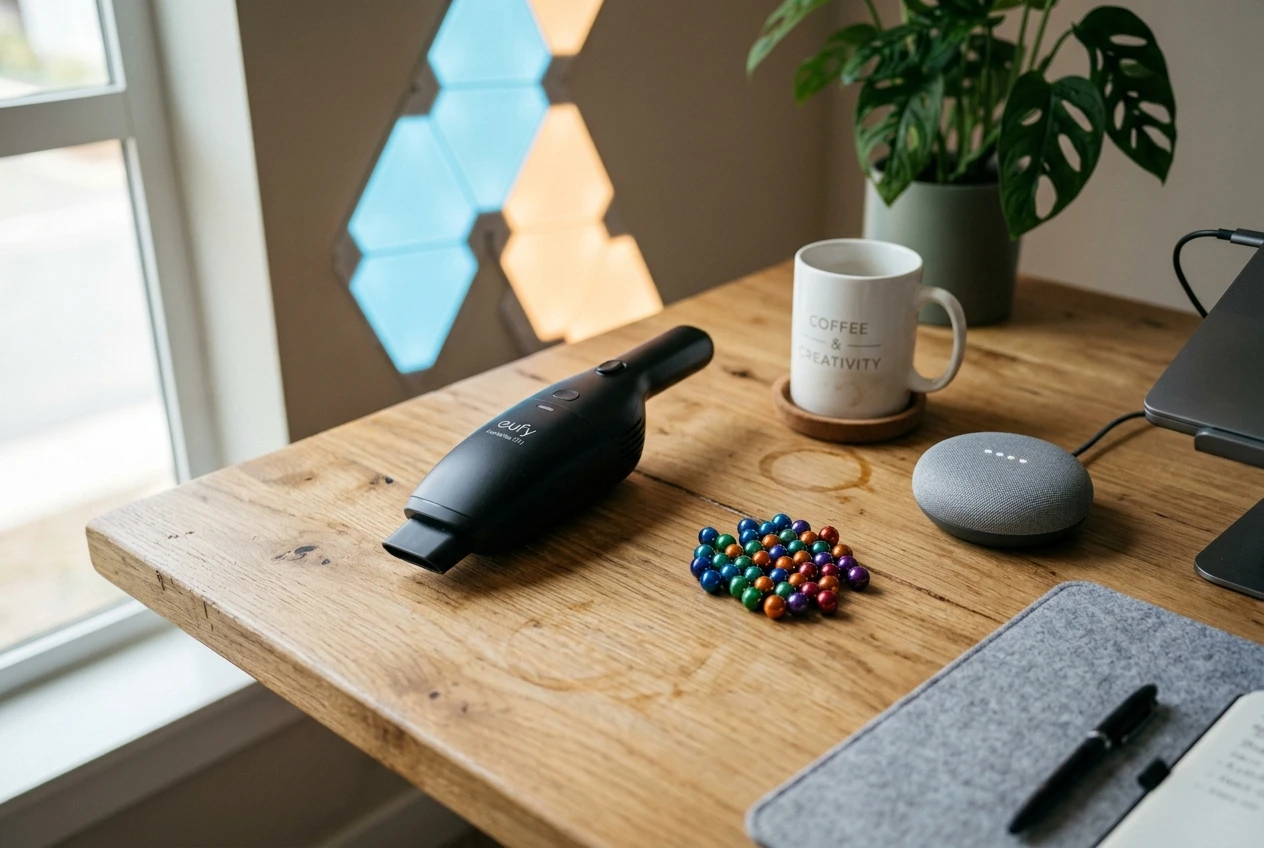
The Odistar Desktop Vacuum Cleaner sits at the bottom of Malik’s list at $13, and the use case is direct. “The Odistar desktop vacuum is an affordable option for keeping your desk clean and crumb-free, especially if you often eat lunch or snack at your desk,” Malik writes, and the same machine works between keyboard keys for dust and debris. The gadget is quiet and simple to use, and the compact body fits on a desk or in a drawer.
The price is low enough that the roundup’s “productive and enjoyable” framing reads almost like a small-office supply. Malik’s closing line captures the pitch in a sentence: “At just $13, the desktop vacuum is a great way to keep your desk clean as you work.” The Odistar desktop vacuum product page confirms the design runs on two AA batteries, the same configuration Malik notes, with a 90-minute runtime for the standard white and orange versions. The 90-minute figure is the runtime the company prints on the standard white and orange models, and the same cordless design shows up across the line.
That runtime is enough to cover a work week of daily crumb cleanup on a single set of cells. The vacuum also rotates 360 degrees and weighs little enough to keep on a desk without crowding the workspace. The setup cost is two batteries and a $13 line item, and the use case covers a problem most workers do not think about until lunch leaves a mark on the keyboard. For a worker who eats at the desk, the vacuum pays for itself the first time a snack meets a key cap. The compact design also means the same tool covers both the desk surface and the spaces between keyboard keys, per Malik’s framing.
Speks, $35 of Magnets Made for Meetings
Speks are the second-cheapest pick on the list at $35, and the use case is the only one in the roundup that addresses the fidget habit with a tool built for it. The pitch lands on the universal habit of picking up whatever happens to be within reach during a call, the pen cap, the corner of a notebook, the wrapper from lunch. The standard Speks set costs $35, and the small magnets are designed to give hands something to do during a call.
They’re tiny magnets that you can fidget or build with to keep your brain focused and your hands busy.
Aisha Malik, a consumer news reporter at TechCrunch, wrote the line in her July 5, 2026 roundup of five desk gadgets under $200. The appeal is the swap. Pen caps, paper clips, and wrappers all lose their role as fidget stand-ins once a set of small, satisfying magnets is on the desk. The Speks magnetic desk and fidget toy line includes the magnetic balls, the Geode set, and the Fleks flexible silicone version, each built around the same core pitch: giving hands something to do during a call. Malik frames the magnets as a focus tool, and the Speks product page describes the same tool as stress relief.
One note worth flagging: the Speks magnets are small and powerful, and the same strength that makes them satisfying to fidget with is also the reason a Consumer Reports investigation flagged high-strength desk-magnet toys as an injury risk around kids. Speks co-founder Craig Zucker told Consumer Reports that the company’s magnets meet the strength standards set by the original CPSC settlement on the category. The roundup’s adult-focused framing keeps the magnets out of reach of children.
For an adult who takes calls at a desk all day, the math is simple. The fidget habit was already costing minutes of attention, and the magnets convert those minutes into a tactile activity that does not break the flow of the meeting. The Geode set on Amazon lists for under $30, the magnetic balls in the standard Speks set run $35, and the Fleks silicone version sits in the same range. The cheaper entry is the one Malik’s price line points to, and the snap-and-stack loop the magnets create is the one that survives a long call. The magnets are also quiet, which is the actual reason they beat a mechanical fidget spinner at a desk.
The Ember Mug 2 Keeps Coffee at One Temperature for 80 Minutes
The Ember Mug 2 sits at the second-highest price in the roundup, $150, and the value is a single, narrow use case. The mug keeps coffee at a user-set temperature through a phone app, and the time it holds that temperature depends on the size. “The smart mug maintains it for up to one and a half hours with the 10-ounce version and up to 80 minutes with the 12-ounce version,” Malik writes. The Ember Mug 2 product page confirms the 80-minute figure is for the 12-ounce model and notes the battery life shown is at 135°F and “may vary by environment, lid use, and starting temperature.”
The pitch is a fix for one specific failure mode: a coffee that goes cold mid-task. “If you’re someone who enjoys hot coffee but often finds yourself drinking it cold after getting sidetracked while working, the Ember Mug 2 can help keep your drinks at the perfect temperature,” Malik writes, and the framing is the most situational of the five picks. The mug only matters when there is a drink in it, the drink matters when there is a break in the day, and the break matters when the work has ground to a halt. For a worker whose day runs as a string of uninterrupted focus blocks, the Ember gets touched twice. For a worker who nurses a coffee through a long meeting, the Ember gets touched every few minutes.
The product page notes that the precision sensors maintain a “uniform temperature throughout,” so the same 135°F is the temperature the drink starts and ends at. The price is the cost of replacing a kitchen mug plus a coaster, and the 10-ounce version’s 1.5-hour battery life is enough for a long meeting or a long focus block. The Ember sits at the high end of the roundup for a reason, and the value is a narrow one that depends on how much of the workday happens to include a hot drink.
An Echo Dot for the Voice-First Workspace
The Amazon Echo Dot is the middle pick on the list at $50, and the use case is the broadest of the five. “The Amazon Echo Dot can be a great addition to your work desk as you can use voice commands to set reminders, create to-do lists, check your calendar, play music, adjust smart lights, or get quick answers to questions without having to reach for your phone,” Malik writes. The Dot is small enough to keep on a corner of the desk, and the range of voice commands is the same one Echo users get anywhere in the home. The pitch is hands-free, and the device is the same device a lot of workers already have in their kitchen or living room.
The Echo Dot also sits inside a fuller 2026 Echo lineup that includes the Echo Dot Max and the Echo Studio as the newer options, both of which are positioned as upgrades over the standard Dot. The Dot still has the same core use case: voice commands for the small daily tasks that would otherwise pull a hand off the keyboard. The $50 price is the cheapest of the Echo family, and the desk placement is the use case Malik’s roundup targets.
Govee’s Hexagon Panels Light the Wall, Not the Desk
The Govee Glide Hexa Light Panels are the priciest item on the list at $189.99, and the use case is the most decorative. “The hexagon-shaped panels mount on the wall behind your monitor and can display different colors and customizable lighting effects through the Govee app,” Malik writes. The Govee Glide Hexa product page lists the panels as RGBIC, with each edge a different color, and control via app, control box, or voice, and the panels run on 24 volts. The wall placement is what makes the panels a desk gadget at all: they take up zero desk space.
The use case splits between work hours and downtime. “They can be used to create a focused atmosphere during work hours and can be switched to more dynamic effects when gaming or taking a break,” Malik writes, and the two-mode pitch is the most situational of the five. The panels are arranged in patterns and run effects through the Govee Home App, with the same effects working whether the desk is in focus mode or end-of-day mode. The price is the roundup’s ceiling, and the wall-mount, app-controlled design is the most involved of the five setups.
The hexagons are also the one pick that requires installation. The panels mount on the wall behind a monitor, the cables route to a control box, and the Govee Home App does the rest. The system takes longer to set up than the other four picks, and the wall space is a commitment that the desk-only picks avoid. The appeal is the visual lift: the same wall that was bare now does double duty as ambient light and a backdrop. For a worker who uses the desk for video calls, the visual backdrop is also the backdrop the camera sees.
How the Five Picks Stack Up
Read in price order, the roundup’s structure is the story. The cheap half of the list covers the most repetitive desk problems, the pricey half covers the situational ones, and the Echo Dot sits at the seam. The spread of use cases is the spread a typical workday actually delivers, and the table below lays the picks out side by side.
Five of the cheapest and most common desk-gadget categories get one product each, with the cheapest three covering the most hours. The two picks above $100, the Ember Mug 2 and the Govee panels, sit in narrower windows of the day. The spread of use cases is the spread a typical workday actually delivers. Reading the table top to bottom is the same as reading the workday outside-in: the cheap, daily items first, the situational ones last.
| Product | Price | Source-quoted key detail |
|---|---|---|
| Odistar Desktop Vacuum Cleaner | $13 | Cordless, two AA batteries, 90-minute runtime |
| Speks | $35 | Tiny magnets to fidget or build with |
| Amazon Echo Dot | $50 | Voice commands for reminders, calendar, music |
| Ember Mug 2 | $150 | Keeps drinks at a set temperature for up to 80 minutes |
| Govee Glide Hexa Light Panels | $189.99 | Hexagon panels on the wall, RGBIC colors |
What a Gadget Round-Up Leaves Out
The roundup is honest about being a gadget roundup, and the five picks all work. The workdays the gadgets do not touch are the ones tied to the body, not the desk surface, and the roundup’s “productive and enjoyable” pitch leans on the desk surface for both. A worker who logs long hours at the same desk will feel the chair, the monitor height, and the screen glare before the crumb buster or the smart mug.
Malik’s framing is the right one for a consumer desk-gadget story: a workspace that is “productive and enjoyable” built with the small conveniences that add up. The five picks all earn that framing in their own way. The next tier of choices is the body, the part of the desk setup a gadget roundup cannot decorate.
- Chair that supports eight hours
- Monitor at eye level
- Standing-desk converter for posture variety
- Keyboard tray that does not bend the wrists
The body covers the items a worker feels before the desk surface, and the long hours of sitting make the chair the item that costs the most to get wrong. The body items also tend to cost more than $200 and ship in a single box, which is why they sit outside a consumer desk-gadget roundup.
For a reader who wants the full list, the roundup is the start, not the end. The five picks cover the surface, the wall, the mug, the magnet, and the speaker. The next set of choices covers the body: a chair that supports eight hours, a monitor that sits at eye level, a keyboard that does not bend the wrists. Malik’s July 5, 2026 roundup lands on the cheap side of the desk-gadget budget, and the back half of that list of choices is the one that decides whether the workday ends tired or ends well.
Frequently Asked Questions
What is the cheapest desk gadget in the roundup?
The Odistar Desktop Vacuum Cleaner comes in at $13, the lowest price on a list that runs from $13 to $189.99. The vacuum is one of three picks on the list priced under $50, alongside the $35 Speks and the Echo Dot, which together cover the cheapest third of the roundup’s budget.
How long does the Ember Mug 2 keep drinks hot?
The Ember Mug 2 holds coffee at a user-set temperature for up to one and a half hours on the 10-ounce version and up to 80 minutes on the 12-ounce version. Ember’s product page lists the same numbers and notes the runtime is shown at 135°F, with battery life varying by environment, lid use, and starting temperature.
Do Speks magnets pose a safety risk?
Speks are small, high-strength magnets that the company says meet the original CPSC strength standards for the category. A Consumer Reports investigation flagged high-strength desk-magnet toys as an injury risk around children, so the magnets should be kept out of reach of kids, the same framing Malik’s roundup uses.
Which desk gadget needs the most setup?
The Govee Glide Hexa Light Panels require wall mounting, cable routing to a control box, and pairing with the Govee Home App before the first effect runs. The other four picks (the Odistar vacuum, Speks, Echo Dot, and Ember Mug 2) work as soon as they are unboxed or paired with a phone.






Spotify Running Mode hits Android and revives its old tempo experiment

Galaxy Tab S12 Ultra Renders Keep the Notch Fans Hate

Novato Spinning Round House Sells With Six Neighbors for $3.3 Million

Crop Tour Finds Indiana and Nebraska Corn Yields Lagging 2025

Best Buy 60th sale brings Android deals back to its roots

American Airlines reverses seatback screen bet years too late

Iran Hormuz Strikes Force Gulf Oil Onto Costlier Paths

Plague Tale Prequel Day One Joins Game Pass Wave 2 as Witcher Exits

NBA 2K27 opens The City to everyone and rewrites career eras

iOS 26.6.1 Patches 29 Flaws as AI Forces Faster Apple Updates

Double Fine Cuts 23 Jobs Weeks After Xbox Independence

Day-One Big Walk Lifts PS Plus August Beyond Recycled AAA

John Hight Exits Wizards After Digital Reckoning Hits

Curtis Mead’s Red Sox Debut Ends With Fractured Wrist

Red Sox Squander Hot Streak Chance in 4-3 Loss to Athletics

Moesch and Dressel Rewrite Night One at 2026 U.S. Nationals

Boutte’s Quiet Camp Takeover Forces Patriots Receiver Choices

Take-Two CEO Pushes Netflix Subs for GTA 6 Extended Look

Halo Campaign Evolved Skulls Meet Death Barriers That Kill the Hunt

Wildlands Free Update Hands Players the Tools They Already Invented
-

 TECHNOLOGY3 years ago
How to Adjust a Bulova Watch Band – An Easy Guide
-

 News3 years ago
Fred Pentland: Athletic Bilbao’s English mentor who changed the essence of Spanish football
-

 FINANCE3 years ago
Tax Planning for Every Season: Guide to Maximizing Your Tax Benefits
-

 Education3 years ago
African Ministers New Education Plan
-

 BUSINESS3 years ago
What is Entrepreneurial Operating System? A Comprehensive Guide to EOS
-

 Education3 years ago
Innovate Your Learning Journey with Technology and Enhance Education
-

 News3 years ago
Russians formally out of World Athletics Championships
-

 BUSINESS3 years ago
Top 9 Most Expensive American Cities to Rent an Apartment