
News
iRobot’s First Non-Robot Floor Cleaner Runs on Tap Water
iRobot launches the $399.99 Roomba Electro Plus, its first non-robotic floor cleaner, alongside five new Roomba robots priced from $599.99. Preorders open now.

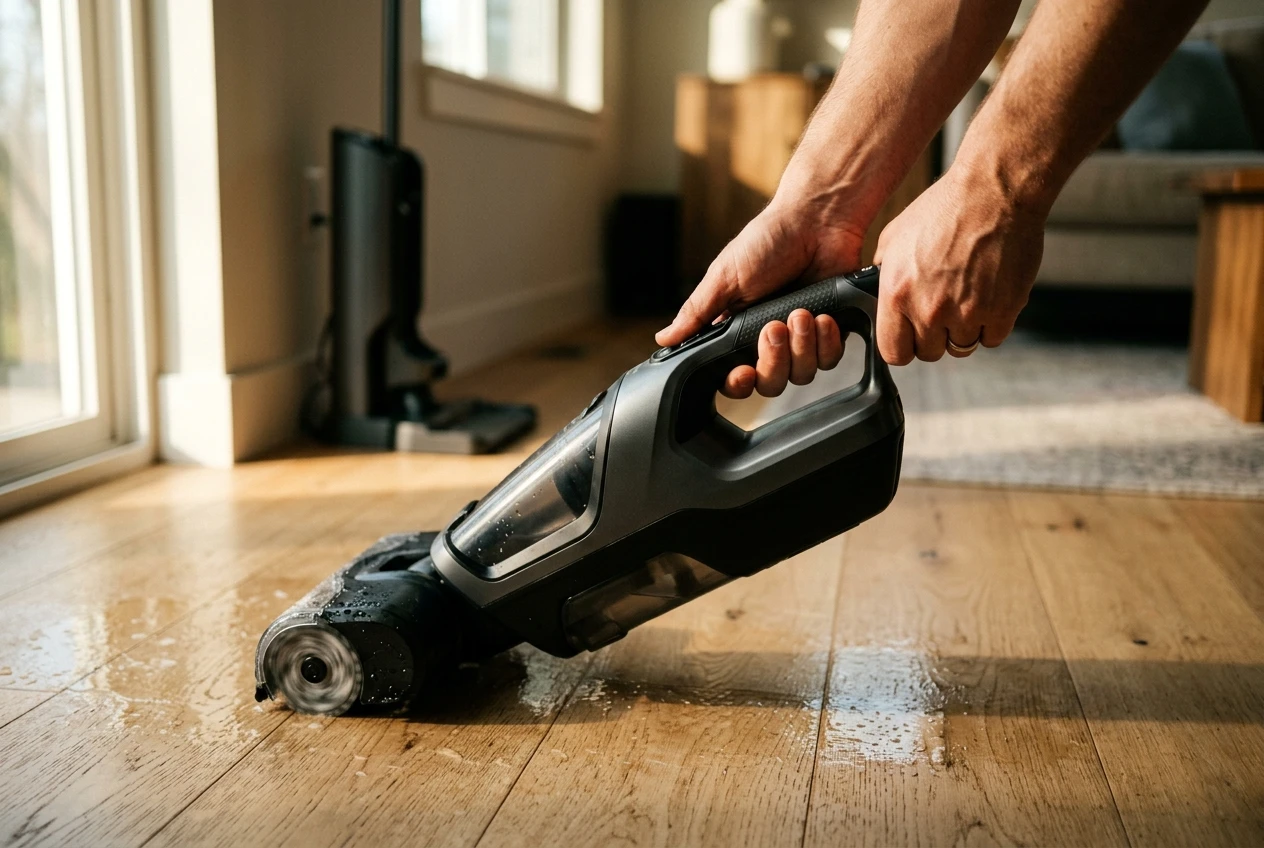
iRobot, the company that put a robotic vacuum in millions of homes starting in 2002, announced on July 7 its first non-robotic floor cleaner. The $399.99 device, called the Roomba Electro Plus, is a cordless stick that vacuums, mops, and turns ordinary tap water into a commercial-grade disinfectant. It is a deliberate departure for a brand built around autonomy.
Alongside the manual cleaner, iRobot introduced five new Roomba robot vacuums priced from $599.99 to $999.99, all but one of them lower than the model they replace. The full lineup, detailed in iRobot’s launch announcement, is available to preorder on irobot.com as of July 7, with select retailers to follow later this month. The launch is iRobot’s first major product release since emerging from Chapter 11 as a wholly owned subsidiary of Shenzhen Picea Robotics, its former contract manufacturer.
iRobot’s First Non-Robot Floor Cleaner Runs on Tap Water
The Roomba Electro Plus handles hard floors only, not carpet, and looks like a manual wet-dry cleaner you push yourself. iRobot chief engineer and vice president Adam Pope told The Verge the device was a frequent request from owners who wanted a faster, more targeted option for a single mess than waiting for a robot to finish a full run. The category did not exist in any meaningful way when iRobot’s first Roomba shipped in 2002.
Its distinguishing feature is the disinfecting step, which uses electrolyzing technology developed by iRobot’s parent company, Picea. According to iRobot’s announcement, the device turns tap water inside its own tank into a sanitizing solution that kills 99.99% of bacteria, viruses, fungi, and germs without added chemicals, toxins, or steam. Picea, the Shenzhen-based contract manufacturer that acquired iRobot this year, had already been making the lidar-based Roombas iRobot released in 2025. The Electro Plus is the first iRobot-branded product to lean directly on the parent’s research pipeline. Engadget puts the cordless runtime at up to 35 minutes and the coverage at 1,292 square feet per charge.
The cordless cleaner is self-propelled and runs a PowerSpin roller mop that washes itself continuously during use. After each job, the included ThermaClean dock washes, sanitizes, and dries the roller with hot water and hot air. iRobot notes users still need to drain, clean, and refill the water tank by hand.
- Disinfecting: electrolyzed tap water, 99.99% kill of bacteria, viruses, fungi, and germs, no added chemicals
- Mop system: PowerSpin roller with continuous self-cleaning and anti-hair wrap
- Smart features: Dirt Detect sensors, self-propelled drive, streak-free finish
- Dock: ThermaClean, hot-water wash and hot-air dry after each use
- Floor type: hard floors only
Five New Roombas, $300 Cheaper at the Top
Three months after a revenue warning, a Chapter 11 filing, and a sale to its Chinese manufacturer, iRobot refreshed the bulk of the lidar-based Roomba line it introduced in 2025. The five replacements span $599.99 to $999.99 and focus on more suction, smaller bodies, and lower prices than the models they replace. At the top sits the Roomba Max 775 Combo Robot + AutoWash Dock at $999.99, which replaces the $1,299.99 Roomba Max 705 Combo and adds 30,000Pa of suction. It also gains hot-water mop washing and a plastic cover that automatically extends over the roller mop when the bot crosses onto carpet, which iRobot calls an industry first.
The vacuum-only Roomba Max 715 Vacuum Robot + AutoEmpty Dock, at $699.99, replaces the $899.99 Roomba Max 705 and more than doubles suction, from 13,000Pa to 30,000Pa. Both Max models use ClearView Pro LiDAR mapping and PrecisionVision AI obstacle avoidance, and both promise up to three months of hands-free operation through self-emptying docks. The 775 adds 167°F heated mop water and a carbon-bag odor control system.
Below the Max tier, the midrange trio replaces the 2025 Roomba 505, 515, and 405 series with bodies that are 46% more compact than the 505. The $799.99 Roomba Plus 575 Combo Robot + AutoWash Dock leads the midrange with 3.5x more suction than the previous generation, 2x deeper scrubbing under what iRobot calls SmartScrub, and 9cm of clearance for sliding under furniture. The $699.99 Roomba Plus 515 Combo Robot + AutoWash Dock adds an onboard water tank and 295 minutes of battery life, enough to clean 2,000 square feet on a single charge. The $599.99 Roomba Plus 415 Combo Robot + AutoWash Dock rounds out the lineup, with extendable mop pads, no onboard water tank, and 113°F heated pad drying.
All five new Roombas were first announced in Europe in May and now reach the U.S. for the first time. The U.S. lineup is missing the Roomba Plus 615, the Roomba 675, and the entry-level Roomba 115 Combo that iRobot sells in other markets. Together, the five robots supersede the bulk of the lidar-based lineup iRobot introduced in 2025. The Verge notes the lineup is mostly incremental updates paired with significant price drops, and PCMag adds that the flagship Max 775 Combo undercuts the $1,099.99 Ecovacs Deebot X11, a comparable premium hybrid. The combination of higher suction, smaller bodies, and lower prices sets up iRobot’s first full catalog refresh under Picea’s ownership.
| Model | MSRP | Replaces | Key upgrade |
|---|---|---|---|
| Roomba Max 775 Combo | $999.99 | Roomba Max 705 Combo ($1,299.99) | 30,000Pa suction, roller-mop cover |
| Roomba Max 715 Vacuum | $699.99 | Roomba Max 705 ($899.99) | 30,000Pa from 13,000Pa |
| Roomba Plus 575 Combo | $799.99 | Roomba 505 Combo ($999.99) | 46% smaller, 9cm clearance |
| Roomba Plus 515 Combo | $699.99 | – | 46% smaller, 295-min battery |
| Roomba Plus 415 Combo | $599.99 | Roomba 405 ($799.99) | 46% smaller, extendable mop pads |
The Picea Tech Behind the Electro Plus
The disinfecting technology in the Electro Plus is the first piece of iRobot-branded hardware to draw directly on Picea’s research pipeline. Picea is a Shenzhen-based contract manufacturer that had been making iRobot’s lidar-based Roombas since 2025, including the dual-lidar sensor that lets the new midrange models fit into 9 cm of clearance. After iRobot filed for Chapter 11 in December 2025, Picea completed a court-supervised acquisition this year, taking 100% of iRobot’s equity in exchange for canceling the company’s outstanding debt, per the announcement of the bankruptcy completion.
Picea says it holds more than 1,300 intellectual property rights worldwide, has manufactured, sold, and serviced over 20 million robotic vacuums, and employs more than 7,000 people. The company has research, development, and manufacturing facilities in China and Vietnam, and provided liquidity and operational support during iRobot’s restructuring. To address U.S. data-privacy concerns raised when the Chinese acquisition cleared, iRobot set up a U.S. subsidiary called iRobot Safe Corp. to house American consumer data, with an independent U.S. citizen board and a U.S.-based data security officer. iRobot’s headquarters remain in Bedford, Massachusetts.
Innovation in floor care shouldn’t create more complexity for consumers.
Jennifer Lichtenheim, iRobot’s senior vice president and general manager for the Americas, made the case in the launch announcement. Pope, iRobot’s chief engineer, told The Verge that customers had been asking for a way to handle a quick mess without waiting for a robot to finish a full run. The framing positions the manual cleaner as a complement to the robot line, not a replacement for it.
Can a Newcomer Win the Manual Wet-Dry Category?
The Electro Plus enters a category that did not exist in any meaningful way when iRobot’s first Roomba shipped in 2002. Manual wet-dry floor cleaners from Dreame, Roborock, and other Chinese challengers have carved out a fast-growing niche for the kind of targeted, immediate clean a robot cannot deliver. iRobot enters that field as a late newcomer, leaning on its 50-million-home brand recognition and a piece of Picea’s intellectual property rather than years of manual-cleaner experience. The category positioning is direct competition with established manual-wet-dry players in a market segment iRobot has never addressed before.
PCMag’s hands-on coverage notes that the new flagship Max 775 Combo, at $999.99, undercuts the $1,099.99 Ecovacs Deebot X11, a recent favorite with similar specs. The pricing edge extends iRobot’s reputation for value into the premium robot tier even as the manual cleaner enters a tier where Ecovacs, Dreame, and Roborock all have established products. The competitive map is more crowded in the manual segment, where the brand advantage is less direct.
What iRobot is selling that the manual competitors are not is the chemical-free disinfection step. The electrolyzed tap water angle is unique to iRobot in this category and is the only piece of the Electro Plus story that does not already exist on a Dreame or Roborock shelf. The differentiation rests entirely on Picea’s electrolyzing technology, which iRobot did not develop itself. That makes the Electro Plus a test of how far a borrowed technical advantage can carry a brand new to the manual product category.
The new robots, by contrast, are iterations of a category iRobot invented more than two decades ago. Higher suction, smaller bodies, and lower prices are the levers iRobot is pulling to defend the robotic-vacuum business it has owned since 2002. The Electro Plus is the swing, and the new Roombas are the substance of the launch.
Pricing and Preorder Details
All six new products, the Electro Plus and the five new Roombas, are available to preorder on irobot.com as of July 7. Select retailers will carry the lineup later this month. The U.S. launch excludes the Roomba Plus 615, the Roomba 675, and the entry-level Roomba 115 Combo that iRobot sells abroad. iRobot’s preorder page for the launch lists the full lineup with feature breakdowns and links.
The product strategy is to cover both jobs from the same brand rather than cede the manual category entirely to Dreame, Roborock, and others. iRobot frames the manual cleaner and the robots as complementary: targeted cleanup in the kitchen or bathroom, full-home coverage everywhere else. The lineup is the first to land under Picea’s full ownership and the first to draw directly on the parent’s research and development.
Frequently Asked Questions
What is the Roomba Electro Plus?
The Roomba Electro Plus is iRobot’s first non-robotic floor cleaner, a $399.99 cordless stick for hard floors. It vacuums, mops with a self-cleaning PowerSpin roller, and uses electrolyzed tap water to kill 99.99% of bacteria, viruses, fungi, and germs without added cleaning solutions.
How does the Electro Plus disinfect without chemicals?
It uses electrolyzing technology developed by Picea, iRobot’s parent company. The device turns tap water inside its own tank into a sanitizing solution on demand. iRobot says the solution is safe for kids, pets, and finished hard floors, and leaves no chemical residue.
How much do the new Roombas cost?
The five new Roomba robot vacuums are priced from $599.99 to $999.99. The Roomba Max 775 Combo, at $999.99, replaces the $1,299.99 Roomba Max 705 Combo. The Roomba Max 715 Vacuum, at $699.99, replaces the $899.99 Roomba Max 705. The Roomba Plus 575, 515, and 415 combos list at $799.99, $699.99, and $599.99, respectively.
Who is Picea, and how did it come to own iRobot?
Picea is Shenzhen Picea Robotics, a Chinese contract manufacturer that had been making iRobot’s lidar-based Roombas since 2025. After iRobot filed for Chapter 11 in December 2025, Picea completed a court-supervised acquisition, taking 100% of iRobot’s equity in exchange for canceling the company’s outstanding debt. To address U.S. data concerns, iRobot set up iRobot Safe Corp., a U.S. subsidiary that houses American consumer data under an independent U.S. citizen board.
Why is iRobot making a non-robotic cleaner?
iRobot says customers asked for a way to clean up a quick mess without waiting for a robot to finish a run. The manual Electro Plus is meant to handle targeted cleanups in kitchens and bathrooms, while the new Roombas continue to cover the rest of the house. iRobot frames the two product lines as complementary, not competitive.


Samsung Sets Galaxy Unpacked for July 22 in London With a Wider Fold

Pink Bearista Cup Returns July 13 as Starbucks Pink Vibes Drops

Pixel 11 Leak Doubles Base Storage to 256GB, Lifts Entry to €999

iRobot’s First Non-Robot Floor Cleaner Runs on Tap Water

Nintendo Switch Online Adds Four Classics and One Japan-Only Title

Meta’s Muse Image Lets Anyone Use Your Instagram Photos in AI

US Trade Deficit Jumps to 14-Month High as AI Spending Lifts Imports

Samsung’s $1,230 Galaxy Unpacked Deal: How It Stacks Up

Doom Studio id Software Cuts Half Its Staff in Xbox Layoffs

The $14,985 Fiat Topolino Has Landed in America, Highway Free

Destiny 2’s Final Update Pulls Its Biggest Crowd in Two Years

Nintendo Confirms Zelda: Ocarina of Time Remake for Switch 2

Xenoblade Genesis Reveals Director, Composers, Character Designers

Parabilis Sets $670M Biotech IPO Record After Decade of Building

EU Probes $24B Gulf Backing for Paramount’s Warner Bros. Deal

Susman Godfrey Pays Associates $5,000 to $10,000 Above Milbank Scale

Parabilis Sets $670M Biotech IPO Record After Decade of Building

Salesforce Cuts Agentforce Staff a Week After Its $1.2B AI Revenue

Bungie Was ‘Below the Red Line’ Before Sony’s Buyout, Ex-CM Says

Black Ops 1 and 2 PS5 Ports: $40 Price Tag Has Fans Uneasy
-

 TECHNOLOGY3 years ago
How to Adjust a Bulova Watch Band – An Easy Guide
-

 News3 years ago
Fred Pentland: Athletic Bilbao’s English mentor who changed the essence of Spanish football
-

 FINANCE3 years ago
Tax Planning for Every Season: Guide to Maximizing Your Tax Benefits
-

 Education3 years ago
African Ministers New Education Plan
-

 BUSINESS3 years ago
What is Entrepreneurial Operating System? A Comprehensive Guide to EOS
-

 Education3 years ago
Innovate Your Learning Journey with Technology and Enhance Education
-

 News3 years ago
Russians formally out of World Athletics Championships
-

 BUSINESS3 years ago
Top 9 Most Expensive American Cities to Rent an Apartment