
News
AMD’s Ryzen 7 7700X3D Is Priced Too Close to Its Faster Sibling
AMD’s $329 Ryzen 7 7700X3D matches the pricier 7800X3D’s street price in some markets, and reviewers are split on whether that ruins the deal.

AMD’s Ryzen 7 7700X3D went on sale July 16 at $329, built around the same 96 megabytes of stacked cache that turned the Ryzen 7 7800X3D into one of the best-reviewed gaming chips of the last three years. Reviewers who spent the week benchmarking it agree it is fast, cool and remarkably efficient.
They also agree AMD priced it badly. In the United States, the faster 7800X3D currently sells for about $20 more. In the United Kingdom, AMD listed both chips at the identical £294.99. A chip built to be the budget entry point into 3D V-Cache gaming launched standing shoulder to shoulder with the chip it was supposed to undercut.
The Cache Trick Behind Every X3D Chip
Every AMD chip with an X3D suffix runs on the same basic idea. AMD stacks extra memory, called 3D V-Cache, directly on top of the processor die, giving the cores a much bigger pool of ultra-fast L3 cache to draw from before they have to reach out to system RAM.
The 7700X3D carries 104MB of total cache, including 96MB of L3, matching the 7800X3D exactly. It is an eight-core, sixteen-thread Zen 4 chip, AMD’s architecture that predates the newer Zen 5 line, built for Socket AM5, and its 120W TDP is identical to its pricier sibling too. It also carries the same RDNA 2 integrated graphics and full AVX-512 support found on other Ryzen 7000 chips, fine for desktop tasks but not meant for serious gaming, TechPowerUp noted in its review.
The only real difference between the 7700X3D and 7800X3D is clock speed. The 7700X3D runs a 4.0GHz base and 4.5GHz boost, while the 7800X3D runs 4.2GHz base and 5.0GHz boost, a gap TechPowerUp traced to firmware alone, since the two chips otherwise share the same eight-core die.
Guru3D’s review explains why AMD leaves that clock speed on the table. First-generation 3D V-Cache stacks an extra SRAM die directly above the compute chiplet, and that extra layer “acts as an insulating barrier, making heat transfer more difficult,” the site’s testing found. That thermal ceiling is why every first-generation X3D chip trades clock speed for cache.
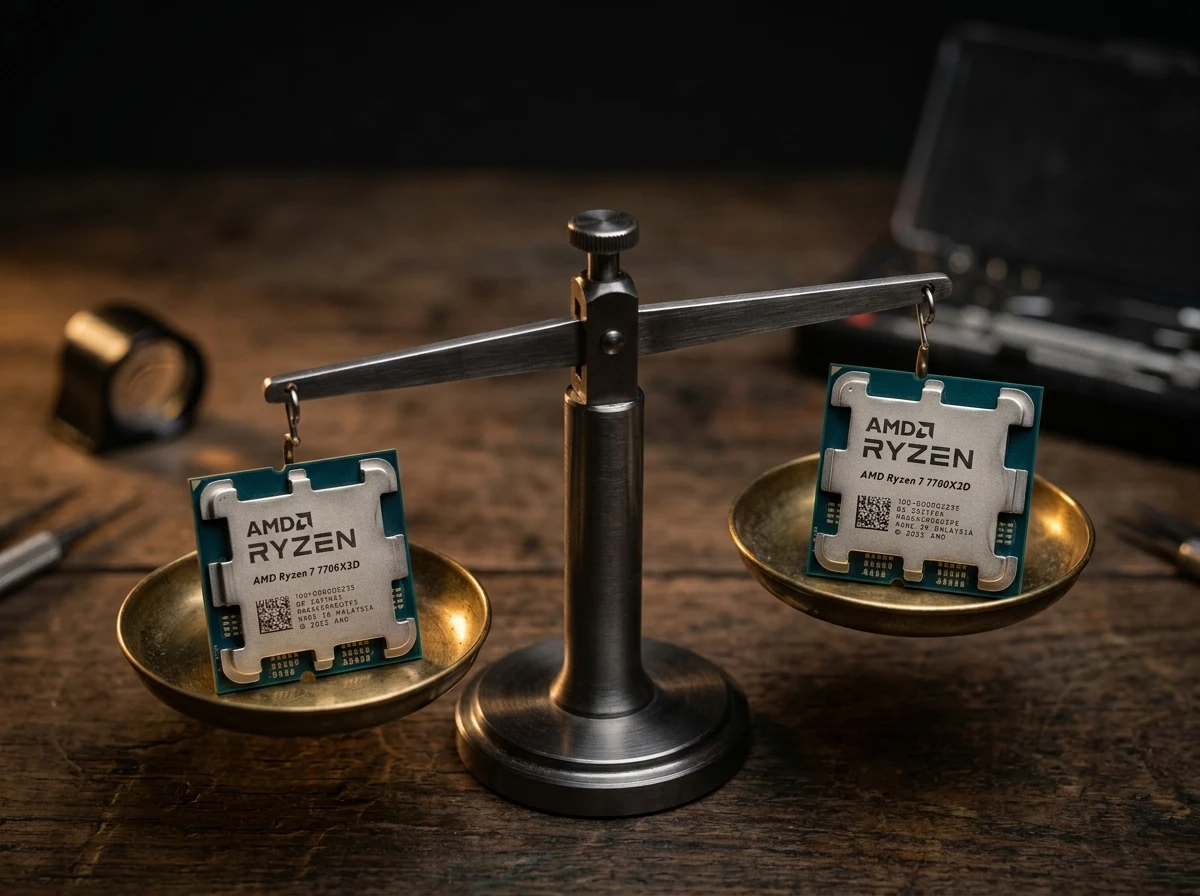
AMD Priced Its Budget Chip Like a Flagship
AMD’s own marketing frames the 7700X3D as the accessible way into X3D gaming, a $120 discount off the 7800X3D’s original $449 launch price from 2023. That framing held up for exactly as long as it took reviewers to check current shelf prices.
Tom’s Hardware found the 7800X3D selling for $349 at review time, just $20 above the newer chip. TechPowerUp saw the same $20 gap and reached the same conclusion in its own testing.
At $330, the $350 7800X3D is simply the smarter buy for a few dollars more.
TechPowerUp’s review wrote that verdict into its conclusion, and Tom’s Hardware’s Jake Roach, the outlet’s senior CPU analyst, landed in the same place, calling the 7700X3D “a day late and a buck short.”
The math got worse outside the United States. KitGuru’s Leo Waldock found AMD listing the 7700X3D at the exact same £294.99 as the 7800X3D in the United Kingdom, and gave the chip a 7.5 out of 10 rating anyway. OC3D’s review was blunter, admitting the launch had “left me a little baffled” once its reviewer checked prices at other retailers.
Four Chips, One Crowded Price Bracket
The pricing problem is not just about the 7800X3D. AMD’s Zen 4 X3D lineup now spans four chips within about $250 of each other, and the gaps between them are thin enough that a single retailer sale can flip the best buy overnight.
| Chip | Street Price (Mid-2026) | Cores / Threads | Boost Clock | Cache |
|---|---|---|---|---|
| Ryzen 5 7600X3D | About $230 | 6 / 12 | 4.7GHz | Smaller L3 pool, 2MB less L2 than the 7700X3D |
| Ryzen 7 7700X3D | $329 | 8 / 16 | 4.5GHz | 104MB total, 96MB L3 |
| Ryzen 7 7800X3D | About $349 | 8 / 16 | 5.0GHz | 104MB total, 96MB L3 |
| Ryzen 7 9800X3D (Zen 5) | $450 to $480 | 8 / 16 | Higher clocks, 2nd-gen V-Cache | 15% to 20% faster gaming than Zen 4 X3D chips |
Tom’s Hardware measured the 7700X3D as only 2% faster in average gaming performance than the cheaper 7600X3D, and about 5% slower than the 7800X3D above it. That places it in what the outlet called “hotly contested waters,” squeezed from both sides by its own siblings.
How Much Performance Does $20 Buy?
Not much, according to independent testing. Multiple reviewers clocked the gap between the 7700X3D and the pricier 7800X3D at roughly 5% to 9% in games, depending on the title and test suite, while application and rendering workloads showed a similar single-digit deficit tied directly to the lower boost clock.
Individual game results explain why gamers still like the chip despite that gap. XDA Developers recorded strong frame rates across multiple demanding titles during its test suite.
- Forza Horizon 6 (1440p, Extreme settings): 93 fps average, 83 fps 1% lows, per XDA Developers
- Counter-Strike 2 (1440p, low settings): 501 fps average, 235 fps 1% lows, per XDA Developers
- Watch Dogs: Legion (1080p, high settings): 188 fps, just behind the Ryzen 9950X3D, per CGMagazine
- Cyberpunk 2077 (1080p): 203 fps average, per KitGuru’s testing
TechPowerUp’s application benchmarks tell a rougher story. The 7700X3D trailed the 7800X3D by around 6% across its application suite and about 9% in single-threaded work, a direct reflection of the clock deficit, though it still ran roughly 19% faster than the older Ryzen 7 5800X3D in multi-threaded Cinebench.
The One Spec Where It Wins Outright
Every reviewer who plugged in a power meter came away impressed. The lower clocks that hold back the 7700X3D’s raw numbers also cap its power draw, by a wide margin.
- Under 60 watts of gaming power draw, according to TechPowerUp, less than half the Intel Core Ultra 7 270K Plus it competes against on price
- 66 watts in multi-threaded Cinebench, still the lowest of any chip TechPowerUp tested, the 7800X3D and 9800X3D included
- Best FPS-per-watt result Tom’s Hardware says it has recorded in its efficiency testing
- Zero thermal throttling across a full test suite, which XDA Developers called rare for any processor it reviews
That efficiency has a practical payoff. A cooler, lower-power chip needs less motherboard VRM headroom and a smaller cooler, which matters when nearly every other line item in a gaming PC build has gotten more expensive.
A Budget Chip Arrives Inside a Memory Shortage
The 7700X3D did not launch into a normal market. DDR5 memory prices have climbed nearly fivefold, according to TechPowerUp, as AI data center demand pulls capacity away from consumer memory production.
That shortage is the backdrop AMD built this chip for, a point earlier coverage of the looming RAM shortage flagged before the chip even launched. A cheaper CPU frees up part of a shrinking build budget for memory and storage that now cost far more than they did a year ago.
AMD is leaning on nostalgia to soften the same squeeze elsewhere in its lineup. The company revived the Ryzen 7 5800X3D as a 10th Anniversary Edition at $349, giving AM4 owners on older, cheaper DDR4 platforms a reason to stay put rather than fund an entire DDR5 upgrade. Both moves point the same direction: AMD reading a market where component prices, not CPU performance, decide what people can actually afford to build.
The chip’s retail footprint adds another wrinkle. Tom’s Hardware confirmed the 7700X3D is sold exclusively through Newegg in the United States and Canada through the end of the third quarter of 2026, so it will not appear on Amazon or at Micro Center in that window. Micro Center instead holds exclusivity on the Ryzen 5 7600X3D, 7500X3D and 5600X3D.
Who Should Actually Buy This Chip?
Reviewers split on the recommendation, but the split follows a clear line. Anyone shopping at full price, with a faster 7800X3D sitting just $20 away, is better off buying that chip instead. The 7700X3D earns its keep once a sale lands, or for a builder specifically chasing the lowest possible power draw.
The disagreement across outlets is real enough to lay out directly.
- Tom’s Hardware and TechPowerUp say skip it at list price. Both outlets independently concluded the 7800X3D is the smarter buy while the two chips sit $20 apart.
- CGMagazine and XDA Developers call it one of the best value upgrades on AM5 regardless, pointing to its efficiency and its ability to keep pace with pricier chips in CPU-bound games.
- KitGuru lands in between, scoring the chip 7.5 out of 10 while faulting AMD directly, writing that the company’s pricing strategy “has mucked things up entirely.”
Buyers doing anything besides gaming are left out of the argument entirely. TechPowerUp’s testing found the 7700X3D falling behind higher-core-count chips, AMD’s own and Intel’s, in rendering and compression work, and Tom’s Hardware pointed builders who split time between games and productivity toward the Ryzen 7 9700X or Intel’s Core Ultra 7 270K Plus instead.
Frequently Asked Questions
Is the Ryzen 7 7700X3D worth buying over the 7800X3D?
It depends entirely on the day’s prices. Tom’s Hardware noted that a $20 or $30 sale on either chip flips the recommendation completely, so buyers should compare live prices at checkout rather than trust either chip’s list price.
Does the Ryzen 7 7700X3D need a new motherboard or cooler?
It runs on any Socket AM5 motherboard, from budget B650 boards to flagship X870E boards, typically after a BIOS update. AMD does not include a stock cooler in the box, so buyers need to budget for one separately, and a DDR5-6000 memory kit is the sweet spot for the platform.
How much slower is the 7700X3D than the 7800X3D in games?
The gap narrows the higher the resolution goes. TechPowerUp found that at 1440p, and especially 4K, the bottleneck shifts from the CPU to the graphics card, shrinking the difference between the 7700X3D and pricier chips to almost nothing, since the GPU becomes the limiting factor at those settings.
Will the Ryzen 7 7700X3D price drop?
Reviewers expect it. TweakTown suggested the chip could fall under $300 around Thanksgiving and pre-Christmas sales, reaching as low as $269, and Tom’s Hardware reported AMD is already discussing a cheaper Ryzen 5 9600X3D for a future release.
Is the 7700X3D good for anything besides gaming?
Not really. CGMagazine’s synthetic testing put the chip’s Cinebench R23 multi-core score at 16,595, last place among the CPUs it tested and just behind the Ryzen 5 9600X, confirming the chip trades multi-threaded throughput for its gaming cache.
Where can I buy the Ryzen 7 7700X3D?
In the United States and Canada, Newegg holds exclusive retail rights through the end of the third quarter of 2026, so it will not appear on Amazon in that window. Micro Center instead holds exclusivity on AMD’s Ryzen 5 7600X3D, 7500X3D and 5600X3D chips in the same market.


Mortgage Rates Climb to 6.55%, the Highest Level in Nearly a Year

EU Orders Google to Open Gemini’s Android Access to ChatGPT, Claude

Caviar Bets $13,130 on a Galaxy Fold Samsung Hasn’t Confirmed

TSMC Pledges $100 Billion More for US Chips as Its Shares Slide

Google Vids Lets You Clone Your Face and Voice Into AI Videos

Netflix Stock Sinks Nearly 9% on a Revenue Miss and Weak Guidance

EA’s New In-Game Ad Platform Skips the Games That Need It Most

ClickLock Malware Kills Mac Apps Until Victims Type a Password

OpenAI’s $70 ChatGPT Basketball Distracts From a Bigger Hardware Bet

Starship Flight 13 Abort Drags SpaceX Stock Below Its IPO Price

Halo Studios Reverses PS Plus for Halo: Campaign Evolved on PS5

Black Ops 1 and 2 PS5 Ports: $40 Price Tag Has Fans Uneasy

Matt Brown Dismisses Rousey and Paul’s MVP MMA Ratings Win Over UFC

Star Wars: Galactic Racer Is a Roguelite Racer With a Podracing Skin

Julius Randle Traded to Nets as Wolves Reclaim Cap Space for Dosunmu

Sega’s $49.99 Sonic Classic and Modern Bundles Hit Switch in October

Colombia Edge DR Congo as Muñoz Books World Cup Knockout Place

Douze Dixièmes Closes Five Months After MIO: Memories in Orbit

Warriors Take Yaxel Lendeborg, the Oldest Pick in the 2026 NBA Draft

Warhammer Horus Heresy Super-Heavy Tanks Share a Plastic Chassis
-

 TECHNOLOGY3 years ago
How to Adjust a Bulova Watch Band – An Easy Guide
-

 News3 years ago
Fred Pentland: Athletic Bilbao’s English mentor who changed the essence of Spanish football
-

 FINANCE3 years ago
Tax Planning for Every Season: Guide to Maximizing Your Tax Benefits
-

 Education3 years ago
African Ministers New Education Plan
-

 BUSINESS3 years ago
What is Entrepreneurial Operating System? A Comprehensive Guide to EOS
-

 Education3 years ago
Innovate Your Learning Journey with Technology and Enhance Education
-

 News3 years ago
Russians formally out of World Athletics Championships
-

 BUSINESS3 years ago
Top 9 Most Expensive American Cities to Rent an Apartment