
News
OpenAI’s $70 ChatGPT Basketball Distracts From a Bigger Hardware Bet
OpenAI’s first hardware includes a $230 Codex Micro keyboard and a $70 ChatGPT basketball, launched days after Apple sued it over trade secrets.

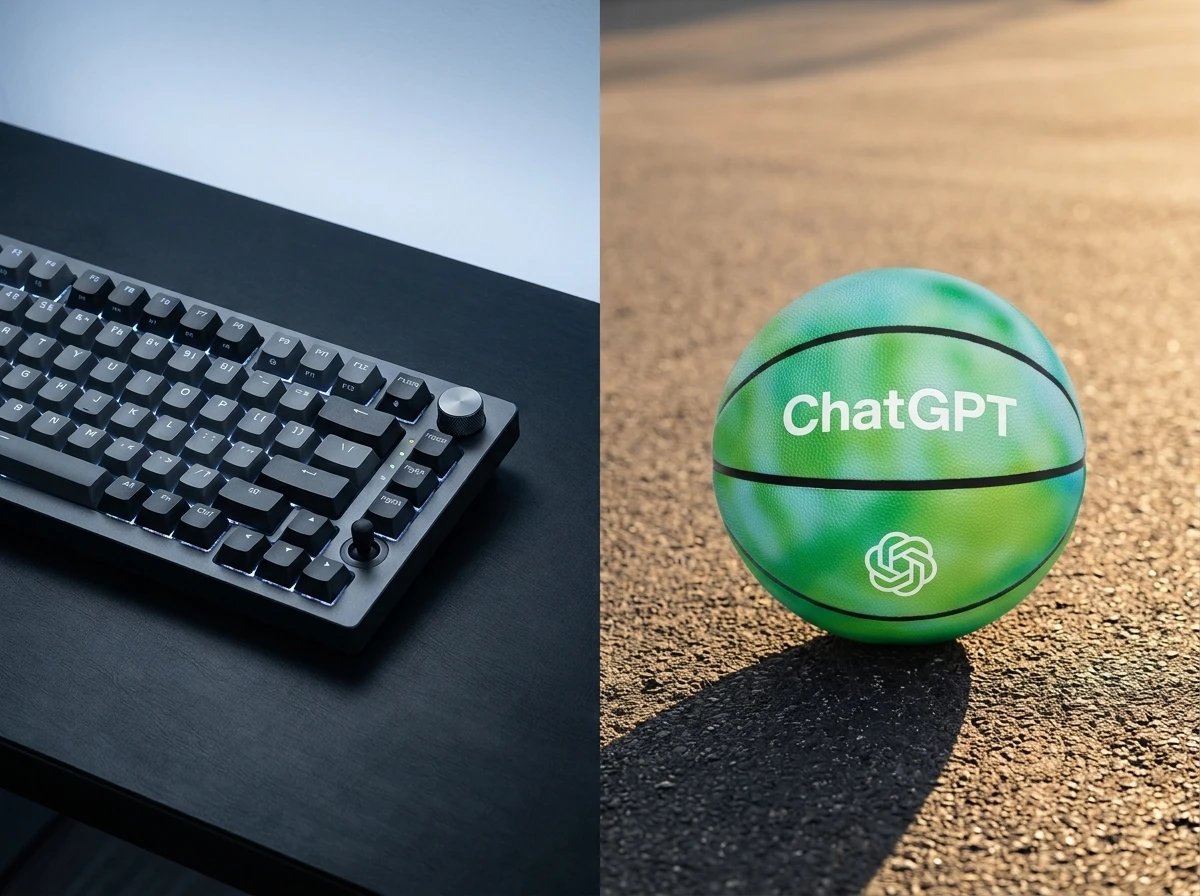
OpenAI sold two things this week: a $230 light-up keyboard for coding agents, and a $70 rubber basketball stamped with the ChatGPT logo. One is a serious pitch to developers. The other comes from a campaign called “Pause. Play. Prompt.,” pitched as a cure for screen time.
The bigger news broke two days earlier. Bloomberg reported that OpenAI’s actual first consumer device is a screenless speaker with a camera and moving parts, and days before that, Apple sued OpenAI, accusing its hardware team of stealing trade secrets to build it. Next to that fight, a rubber ball is the smallest part of the story.
OpenAI’s New Merch Math
OpenAI’s listing for the size 7 rubber ball prices it at $70 and calls it “a physical reminder that creativity doesn’t just live on our screens,” part of a campaign named “Pause. Play. Prompt.”
TechCrunch senior writer Amanda Silberling could not find that campaign mentioned anywhere else on OpenAI’s site. She figured it was the company’s roundabout way of telling Codex users to log off, and calculated that $70 buys about 56 million input tokens for GPT-5.
OpenAI is also selling a $175 quarter-zip with “research” stitched in cursive, plus shirts carrying slogans like “Good research takes time.” Here is how the new lineup breaks down against the device that actually matters to OpenAI’s future.
| Product | Price | What It Is |
|---|---|---|
| ChatGPT Basketball | $70 | Size 7, 100% rubber, tied to the Pause Play Prompt campaign |
| Research quarter-zip | $175 | Cotton-blend zip-up with cursive “research” branding |
| Codex Micro keyboard | $230 | Bluetooth or USB-C keyboard with agent status lights and a reasoning dial |
| Screenless smart speaker | Reported $200 to $300 | Camera-equipped, not yet released, tied up in litigation |
Only one row on that list is a design bet OpenAI is staking its future on. The other three are gift-shop items, and one of them is currently sitting in a federal courtroom.
A Coding Tool Beat OpenAI’s Real Device to Market
OpenAI calls the Codex Micro a “command center for agentic work.” The keyboard launched Wednesday, July 15, co-designed with specialty keyboard maker Work Louder, and connects over Bluetooth or USB-C to Mac and Windows machines. OpenAI told TechCrunch the Micro is a limited-run collaboration, more novelty than mass-market product.
It packs real functionality into a small footprint.
- Agent Keys – light up to show which coding agent is running and its current status.
- Command Keys – customizable shortcuts for frequent Codex actions.
- A joystick – launches saved workflows without opening a separate app.
- A reasoning dial – trades response speed for computing power on a given task.
The device sold out almost immediately, though OpenAI says more units are coming. Codex has become the company’s main growth bet: Codex and ChatGPT reached 8 million active users, according to Thibault Sottiaux, Codex’s engineering lead, and OpenAI folded Codex directly into the ChatGPT desktop app last week.
That push has a financial backdrop. OpenAI is not expected to turn a profit until 2029 and could lose roughly $44 billion before then, and its pending IPO filing has already set off a compute cash race with Anthropic. A keyboard that locks developers deeper into Codex is cheap marketing next to that math.
Who Buys a $70 Basketball?
Nobody at OpenAI has said. The obvious buyer is someone deep enough in AI culture to carry ChatGPT-branded gear in public without flinching, and even TechCrunch’s own coverage struggled to name that person beyond corporate gifting and internal swag closets.
You could not pay me $70 to walk onto a community court in Philadelphia with this ChatGPT basketball.
Amanda Silberling wrote that in the piece that first surfaced the ball. She later shared her take on the ball’s price tag on X, and the comparison to input tokens spread faster than the product itself.
There is a real difference between a company handing out a tote bag at a conference and charging retail for the same idea. A free item reads as a joke. A $70 line item reads as a product decision, and OpenAI has to own that one.
Humane’s Ai Pin Still Haunts Every AI Gadget
OpenAI is not the first AI company to learn this lesson at a much higher cost. Humane, founded in 2018 by two Apple veterans, launched its wearable Ai Pin in 2024 promising a smartphone alternative built around voice and a projector. Sam Altman was an early investor.
The device collapsed fast.
- $700 – the Ai Pin’s launch price in 2024, cut to $499 that October.
- 10,000 units – shipped by that August, far short of a 100,000-unit goal.
- February 2025 – Humane stopped selling the device and shut off its servers for good.
OpenAI’s answer to that history leans on money and design pedigree. It acquired Jony Ive’s hardware startup, io, for roughly $6.5 billion in May 2025, bringing in Ive’s LoveFrom studio and former Apple industrial design chief Evans Hankey to lead the new device’s look.
Altman has described the goal in almost spiritual terms. “You can then go for a vibe that is not like walking through Times Square,” he said in a video posted by Emerson Collective in November, describing instead the feeling of sitting in a cabin by a lake.
Apple Is Chasing the Same Living Room Gadget
Apple is not waiting to see how OpenAI’s device lands. The company is building its own AI home hub, code-named J490, with a 7-inch square display, video calling, facial recognition and the rebuilt Siri coming in iOS 27, plus a version mounted on a robotic arm that repositions itself as you talk.
Apple is also rumored to be adding cameras to a future AirPods Ultra, which would put it in direct competition with the sensing features OpenAI’s speaker is said to include. Already, about 10 million AI-equipped glasses ship every year, a figure Qualcomm’s CEO expects to climb toward 100 million within two years.
Supply-chain analysts at Futuresource Consulting say Foxconn has been picked to manufacture OpenAI’s device, with first-year shipment targets between 40 and 50 million units. That is a far cry from the 100 million units Altman reportedly told staff OpenAI wanted to ship faster than any company ever has, in a conversation that later leaked.
OpenAI’s Courtroom Fight Could Freeze Its Bigger Bet
Apple sued OpenAI on July 10, accusing its hardware leadership of a deliberate campaign to extract confidential Apple information and use it to build the new device. The complaint names Tang Tan, OpenAI’s chief hardware officer, a former Apple iPhone design chief and io co-founder, and counts more than 400 Apple employees who have since moved to OpenAI. Apple’s filing goes further, calling the allegations disclosed so far “the tip of the iceberg.”
OpenAI says the lawsuit lacks any merit, arguing its speaker differs enough from anything Apple currently sells that infringement is unlikely. Apple is seeking an injunction that could stop OpenAI from selling any hardware at all, and Apple has conceded that discovery will be needed to prove its claims.
The timeline keeps slipping. OpenAI once said the public could see its first gadget in the second half of 2026. Court filings now show it will not ship before February 2027, and the device has dropped the “io” name entirely after a trademark dispute with hearing-aid startup iYo.
What we know:
- Codex Micro shipped this week at $230 and sold out almost immediately.
- Apple sued OpenAI on July 10 over trade secrets tied to hardware hiring.
- Bloomberg reports OpenAI’s first consumer device is a screenless, camera-equipped speaker with moving parts.
What’s unconfirmed:
- Whether Apple wins an injunction that delays or blocks the device entirely.
- The device’s final name, retail price and exact 2027 ship date.
For now, the only OpenAI hardware anyone can actually buy is a keyboard for programmers and a rubber ball for whoever wants one. The device that might really matter is still waiting on a judge.
Frequently Asked Questions
Is OpenAI’s Codex Micro keyboard still available to buy?
OpenAI’s store listed the Codex Micro as out of stock within days of launch, though the company says more units are coming. The keyboard ships in “clicky” and “silent” mechanical switch options and pairs with Mac or Windows over Bluetooth or USB-C.
What is OpenAI’s Pause Play Prompt campaign?
It is the marketing name behind the ChatGPT basketball alone, and it does not appear elsewhere on OpenAI’s site according to TechCrunch’s review. OpenAI has run themed merch before, including research-branded caps and shirts, but this is the first drop built around a named campaign.
Why is Apple suing OpenAI over hardware?
Apple’s complaint accuses OpenAI’s chief hardware officer, a former Apple design chief, of leading a strategy to obtain confidential Apple information for OpenAI’s own device. Apple’s filing calls the disclosed allegations “the tip of the iceberg” and says more will surface during discovery.
When will OpenAI release its first real consumer device?
Court filings indicate the screenless speaker will not ship before February 2027, later than the second half of 2026 OpenAI originally floated. OpenAI’s own policy chief has drawn a distinction between unveiling the device this year and actually putting it on sale.


NFL Three-Strike Safety Fouls Now Pull Coaches and Clubs In

Browns Fans Tape Protest Signs to Jim Brown Statue Over Watson

Amazon Pixel 11 Deal Erases the $100 Hike for One More Day

Elden Ring on Switch 2 Turns Its Own Worst Label Into a Portable Win

Ternus Takes the Stage With Apple’s Foldable Debut

Ikea Xbox Yxstaby Turns Controller Thumbstick Into Home Furniture

Pokémon Center Turns Past Worlds Wins Into Bundles and a Pikachu Coin

NFL Scraps Pro Bowl Game to Restore Pure Player Honor

New Twitter.now Bets the Brand Musk Left Behind

Bella Mir’s Famous First Loss Meets the Accountant Who Won

Double Fine Cuts 23 Jobs Weeks After Xbox Independence

Day-One Big Walk Lifts PS Plus August Beyond Recycled AAA

Curtis Mead’s Red Sox Debut Ends With Fractured Wrist

John Hight Exits Wizards After Digital Reckoning Hits

Red Sox Squander Hot Streak Chance in 4-3 Loss to Athletics

Moesch and Dressel Rewrite Night One at 2026 U.S. Nationals

Boutte’s Quiet Camp Takeover Forces Patriots Receiver Choices

Take-Two CEO Pushes Netflix Subs for GTA 6 Extended Look

Halo Campaign Evolved Skulls Meet Death Barriers That Kill the Hunt

Wildlands Free Update Hands Players the Tools They Already Invented
-

 TECHNOLOGY3 years ago
How to Adjust a Bulova Watch Band – An Easy Guide
-

 News3 years ago
Fred Pentland: Athletic Bilbao’s English mentor who changed the essence of Spanish football
-

 FINANCE3 years ago
Tax Planning for Every Season: Guide to Maximizing Your Tax Benefits
-

 Education3 years ago
African Ministers New Education Plan
-

 BUSINESS3 years ago
What is Entrepreneurial Operating System? A Comprehensive Guide to EOS
-

 Education3 years ago
Innovate Your Learning Journey with Technology and Enhance Education
-

 News3 years ago
Russians formally out of World Athletics Championships
-

 BUSINESS3 years ago
Top 9 Most Expensive American Cities to Rent an Apartment