
News
Starship Flight 13 Abort Drags SpaceX Stock Below Its IPO Price
SpaceX aborted Starship Flight 13 when Raptor engines failed to ignite, deepening a stock slide that has erased 42% of its value since June’s IPO peak.

SpaceX aborted Thursday’s Starship launch at the last second when Raptor engines failed to ignite, and for the first time in the rocket’s history, a scrub moved a stock price in real time. The countdown reached zero at Starbase, Texas, at 6:45 p.m. Eastern before automated safety systems shut everything down.
It was an ordinary kind of failure for a rocket still in flight testing. What was new was the audience. Shares in the newly public company, already trading below their IPO price for the first time that same day, fell further within minutes of the abort before partially recovering.
Some of the Engines Didn’t Start
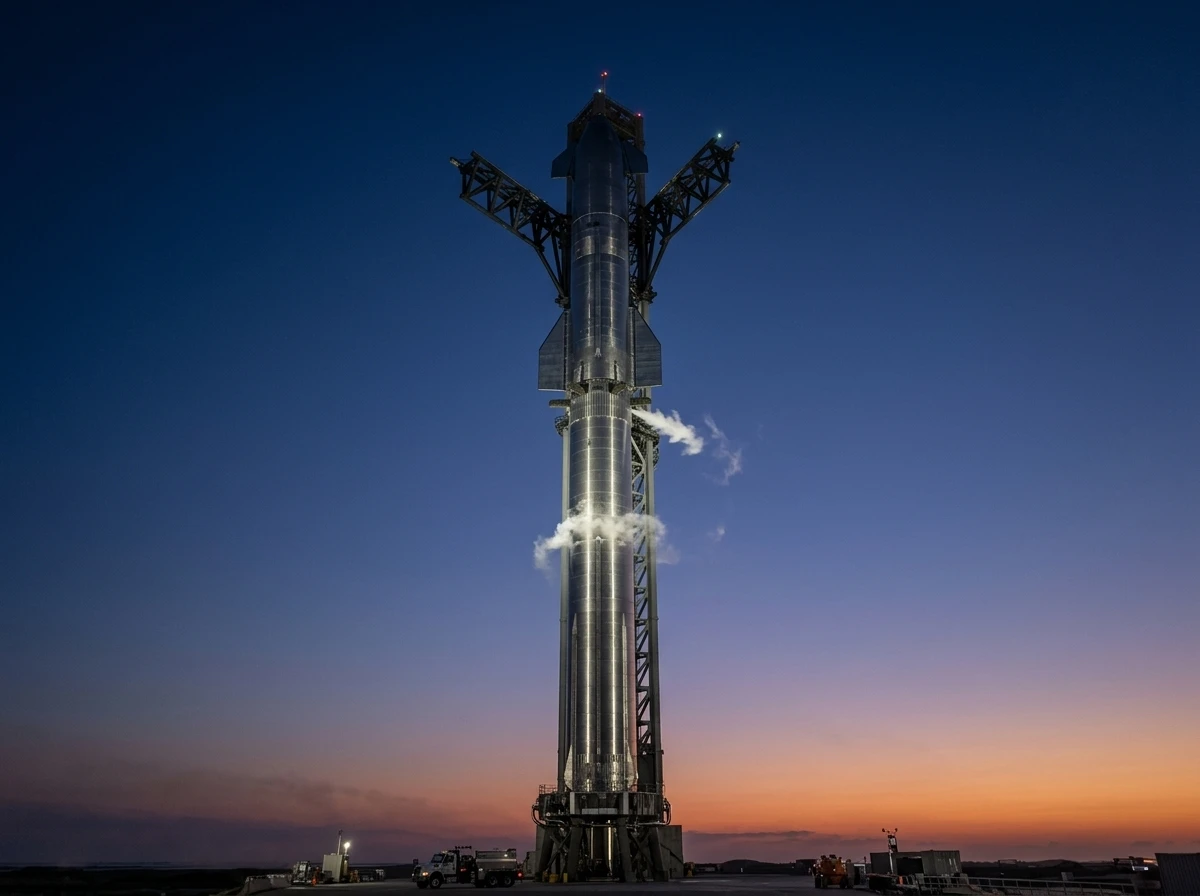
Starship was set to lift off from SpaceX’s Starbase site in South Texas at 6:45 p.m. Eastern, the opening of a 90-minute window, as SpaceNews first reported. Fueling and the countdown had gone smoothly. Then, just as Raptor engines in the Super Heavy booster began to ignite, the flight computer called a hold.
SpaceX confirmed within moments that it was standing down for the day.
Some of the engines didn’t start, triggering an automatic launch abort.
Elon Musk, SpaceX’s chief executive, wrote on X about 10 minutes after the abort, saying the team was offloading propellant to safe the vehicle and that another attempt was hopefully just days away.
Hours later he narrowed down the fix. Musk detailed plans to remove and replace two Raptor engines, writing that the team wanted to be confident of a good flight before trying again, with the most probable launch timing early the following week.
The mission will fly Booster 20 and Ship 40, both brand-new vehicles making their first flights. Neither stage will attempt recovery, according to Spaceflight Now, a reminder that Starship’s celebrated tower catch remains rare. SpaceX has caught a Super Heavy booster three times, but not since Flight 8 in March 2025, and has never caught Ship at all.
Wall Street Was Already Bracing for This
The scrub capped a rough week for the stock before the countdown even started. SpaceX shares slipped for a fifth straight session Thursday, closing at $131.11, the first time they had finished a trading day below the $135 initial public offering price set on June 11, the day before Nasdaq trading began.
That offering had been the largest in Wall Street history a month earlier, and its aftermath fed a fee bonanza for the banks that arranged it, even as the stock underwriting those fees kept sliding.
The table below traces the stock’s short, volatile life on the exchange.
| Date | Milestone | Share Price |
|---|---|---|
| June 12, 2026 | Nasdaq trading debut, a day after $135 IPO pricing | Opened at $150, rose as high as $193 |
| June 16, 2026 | Stock hits its all-time peak | Above $225 |
| July 15, 2026 | First intraday dip under the IPO price | Fell to $132.75, closed at $135.27 |
| July 16, 2026 | First close below the IPO price | Closed at $131.11, down about 3% |
| July 16, 2026 (after hours) | Starship Flight 13 aborted at T-0 | Fell to about $125 before recovering to $127 |
Two of those five milestones landed on the same day, the day the rocket never left the ground.
Its addition to the Nasdaq-100 the week before, made possible by a rule change that shortened the eligibility window to just 15 trading days for new listings, should have been a bullish catalyst. Shares kept falling anyway.
Why Does a Routine Scrub Move a Trillion-Dollar Stock?
Because SpaceX is no longer a private company insulated from daily trading, and its new shareholders are still learning to read ordinary rocket-testing setbacks. A scrub that once would have drawn a shrug from engineers now triggers selling, short bets and headline risk within minutes of an abort.
Shares fell from about $132 to nearly $125 within five minutes of Thursday’s abort before climbing back to around $127, SpaceNews reported. Other trackers put the after-hours low closer to $124.
The reaction fits a pattern that has played out since the company’s Nasdaq debut.
- 42% – the share of its value SpaceX has lost since shares hit an all-time peak above $225 in mid-June, per Yahoo Finance.
- More than $1.2 trillion – the amount SpaceX’s market value has shed from that peak, according to NBC News.
- Nearly $4 billion – the size of short-seller bets reportedly stacked against the stock.
- $290 – the mean Wall Street price target from Visible Alpha, a markets data provider, still well above where shares now trade.
Not every bank agrees on where the stock goes from here. Morgan Stanley’s $300 price target splits opinion among the six major underwriters who took SpaceX public, even as shares trade closer to $130 than to $300.
Retail investors who bought at the $150 debut price were already sitting on an 11%-plus paper loss before Thursday’s slide, NBC News calculated. A bigger test may be weeks away: SpaceX is expected to report its first earnings as a public company soon, an event that triggers the expiration of lockup agreements barring early shareholders from selling.
Who Actually Has Skin in This Flight
Thursday’s dip hit shareholders first. Other stakeholders have just as much riding on Starship’s performance.
Musk’s own fortune is now tied to the stock more than ever. His net worth surged from about $700 billion to as much as $1.32 trillion after the IPO, then contracted alongside the shares to roughly $850 billion, according to the Bloomberg Billionaires Index.
NASA has just as much at stake. The agency is counting on an orbital-capable Starship to land astronauts on the moon under the Artemis program, and a government watchdog report published in March found SpaceX wasn’t keeping to schedule. Starship still owes NASA a complex orbital refueling demonstration before Artemis 3 can fly, a lunar-orbit mission currently planned for 2027. Blue Origin is developing a competing lunar lander as a hedge in case Starship slips further.
SpaceX’s own satellite business is riding on this flight too. Flight 13 carries the first 20 functioning Starlink V3 satellites, a sharp upgrade over the version already blanketing low Earth orbit.
- 1 terabit per second of downlink capacity, 10 times existing Starlink satellites
- 160 gigabits per second of uplink capacity, 22 times better than today’s fleet
- Backhaul antennas spanning Ka-, E-, V- and W-bands, an eightfold jump in capacity
- Solar arrays generating twice the power of the current V2 satellites
SpaceX says the satellites will get roughly 20 minutes of in-space testing before reentry, including solar array and antenna deployment and laser links to the wider constellation, compared with roughly 10,839 satellites already active in orbit today.
Flight 12 Left a Punch List
Flight 13 exists because Flight 12 didn’t finish the job. When Starship V3 debuted on May 22, the upper stage reached its planned trajectory and splashed down in the Indian Ocean largely as intended. The Super Heavy booster did not.
After stage separation, several booster engines failed to relight cleanly during the boostback burn. The booster never built enough thrust to reverse course and hit the Gulf of Mexico at high speed instead of making its planned splashdown. One of the ship’s six engines, a vacuum-optimized Raptor, also shut down less than a minute after separation, cutting short a planned in-space relight test.
The FAA activated a debris response area over the Gulf and later declared the booster loss a mishap, grounding Starship pending an investigation. Regulators closed that investigation on July 13, approving SpaceX’s corrective actions and clearing the way for Thursday’s attempt, just three days before the abort.
SpaceX said it modified the Super Heavy’s re-light hardware and updated what the company called “engine alarms and aborts to match the conditions seen in the multi-engine flight environment.” Engineers also revised Ship’s startup sequence and kept iterating on the heat shield, adding load-sensing tiles to measure stress on the airframe.
Two Raptors Out, One Launch Window In
SpaceX’s fix looks mechanical rather than existential. Two Raptor engines will be pulled from Super Heavy and replaced, with early next week the likeliest window for another try. SpaceX gave no exact date, and the company’s own launch commentator said the unusual nature of Thursday’s hold made it hard to predict how quickly the vehicle could be recycled.
More than a satellite test rides on this flight. Gwynne Shotwell, SpaceX’s president and chief operating officer, told CNBC in June that an orbital Starship launch could come as soon as Flight 14, depending on how this mission goes, with a monthly launch cadence as the company’s eventual target.
SpaceX now has two Raptor engines to swap and a shareholder base with barely a month of history watching how it handles setbacks. Musk’s own timeline points to early next week for the next attempt.
Frequently Asked Questions
When Will SpaceX Attempt Starship Flight 13 Again?
Elon Musk said early next week is the most probable timing, after two Raptor engines are pulled from the Super Heavy booster and replaced. SpaceX has not set an exact date, and Booster 20 and Ship 40 are already stacked at the pad, so the turnaround does not require assembling new hardware.
How Much Do Starlink V3 Satellites Weigh?
Each Starlink V3 satellite weighs roughly 4,400 pounds, considerably heavier than earlier generations, according to mission details reported ahead of Flight 13. The added mass comes from larger phased-array antennas, more powerful solar arrays and hardware built specifically for deployment from Starship rather than Falcon 9.
Has a Starship Test Ever Moved SpaceX’s Stock Price Before?
No. Flight 12 launched in May, three weeks before SpaceX’s Nasdaq debut, so no public shareholders were watching it happen. Thursday’s abort was the first Starship test since the June 12 listing, and it landed on a day when broader markets were already tumbling amid a tech sell-off.
Why Does SpaceX Need Starship to Reach Orbit?
Starship is designed to carry more than 100 metric tons to orbit and stands roughly 124 meters tall fully stacked, making it the largest rocket ever built. NASA is counting on an orbital version for its Artemis III lunar mission, currently planned for 2027, while SpaceX needs the same vehicle to deploy a planned fleet of up to 100,000 Starlink V3 satellites.
Disclaimer: This article is for informational purposes only and does not constitute investment advice. Newly public, highly volatile stocks like SpaceX carry significant risk, and share prices referenced here are accurate as of publication on July 17, 2026. Consult a licensed financial advisor before making investment decisions.


Mortgage Rates Climb to 6.55%, the Highest Level in Nearly a Year

EU Orders Google to Open Gemini’s Android Access to ChatGPT, Claude

Caviar Bets $13,130 on a Galaxy Fold Samsung Hasn’t Confirmed

TSMC Pledges $100 Billion More for US Chips as Its Shares Slide

Google Vids Lets You Clone Your Face and Voice Into AI Videos

Netflix Stock Sinks Nearly 9% on a Revenue Miss and Weak Guidance

EA’s New In-Game Ad Platform Skips the Games That Need It Most

ClickLock Malware Kills Mac Apps Until Victims Type a Password

OpenAI’s $70 ChatGPT Basketball Distracts From a Bigger Hardware Bet

Starship Flight 13 Abort Drags SpaceX Stock Below Its IPO Price

Halo Studios Reverses PS Plus for Halo: Campaign Evolved on PS5

Black Ops 1 and 2 PS5 Ports: $40 Price Tag Has Fans Uneasy

Matt Brown Dismisses Rousey and Paul’s MVP MMA Ratings Win Over UFC

Star Wars: Galactic Racer Is a Roguelite Racer With a Podracing Skin

Julius Randle Traded to Nets as Wolves Reclaim Cap Space for Dosunmu

Sega’s $49.99 Sonic Classic and Modern Bundles Hit Switch in October

Colombia Edge DR Congo as Muñoz Books World Cup Knockout Place

Douze Dixièmes Closes Five Months After MIO: Memories in Orbit

Warriors Take Yaxel Lendeborg, the Oldest Pick in the 2026 NBA Draft

Warhammer Horus Heresy Super-Heavy Tanks Share a Plastic Chassis
-

 TECHNOLOGY3 years ago
How to Adjust a Bulova Watch Band – An Easy Guide
-

 News3 years ago
Fred Pentland: Athletic Bilbao’s English mentor who changed the essence of Spanish football
-

 FINANCE3 years ago
Tax Planning for Every Season: Guide to Maximizing Your Tax Benefits
-

 Education3 years ago
African Ministers New Education Plan
-

 BUSINESS3 years ago
What is Entrepreneurial Operating System? A Comprehensive Guide to EOS
-

 Education3 years ago
Innovate Your Learning Journey with Technology and Enhance Education
-

 News3 years ago
Russians formally out of World Athletics Championships
-

 BUSINESS3 years ago
Top 9 Most Expensive American Cities to Rent an Apartment