
Health
Cyclospora Fears Push Americans Toward the Processed Foods RFK Jr. Opposes
A record Cyclospora outbreak is driving two in five Americans away from fresh produce and toward the processed snacks Kennedy’s health agenda has targeted.

Forty percent of Americans say they are eating or buying less fresh produce because of a Cyclospora outbreak that has now infected more than six times as many people as at this point last year, according to a CBS News/YouGov poll conducted July 22 to 24. Health and Human Services Secretary Robert F. Kennedy Jr. says the outbreak is “under control.” Former federal food safety officials call the response something closer to a collapse.
The pullback lands squarely on the food group Kennedy has spent this year telling Americans to eat more of. His Make America Healthy Again, or MAHA, agenda has spent 2026 steering the country away from packaged snacks and toward produce and whole foods. Now shoppers scared off by lettuce are stocking up on the boxed and bagged foods his own department has vilified.
A Six-Fold Surge Traced to One Bag of Lettuce
The outbreak traces back to iceberg lettuce grown by Taylor Farms de Mexico, according to the Centers for Disease Control and Prevention (CDC), which has been tracking the spread through its ongoing cyclosporiasis outbreak investigation. What started as a cluster in a handful of Midwestern states had, by July 24, reached nine: Illinois, Indiana, Kansas, Kentucky, Michigan, Ohio, Oklahoma, Pennsylvania and West Virginia.
The agency’s own newsroom confirmed the geographic creep in a release announcing the outbreak’s expansion into four new states. Ninety-eight people have been hospitalized. No deaths have been reported.
| Metric | 2026 Figure | Context |
|---|---|---|
| Confirmed cases since May 1 | 1,645 | More than six times the 249 cases reported by the same point in 2025 |
| Suspected cases under review | 5,100+ | Still being verified by state health labs |
| States affected | 9 | Up from an initial cluster in the Midwest |
| Hospitalizations | 98 | No deaths reported as of July 24 |
Cyclospora cayetanensis is a microscopic parasite, not a bacterium or virus. It rides into the food supply on contaminated water or soil and survives ordinary rinsing far better than most foodborne pathogens, which is part of why this year’s numbers dwarf the usual seasonal bump.
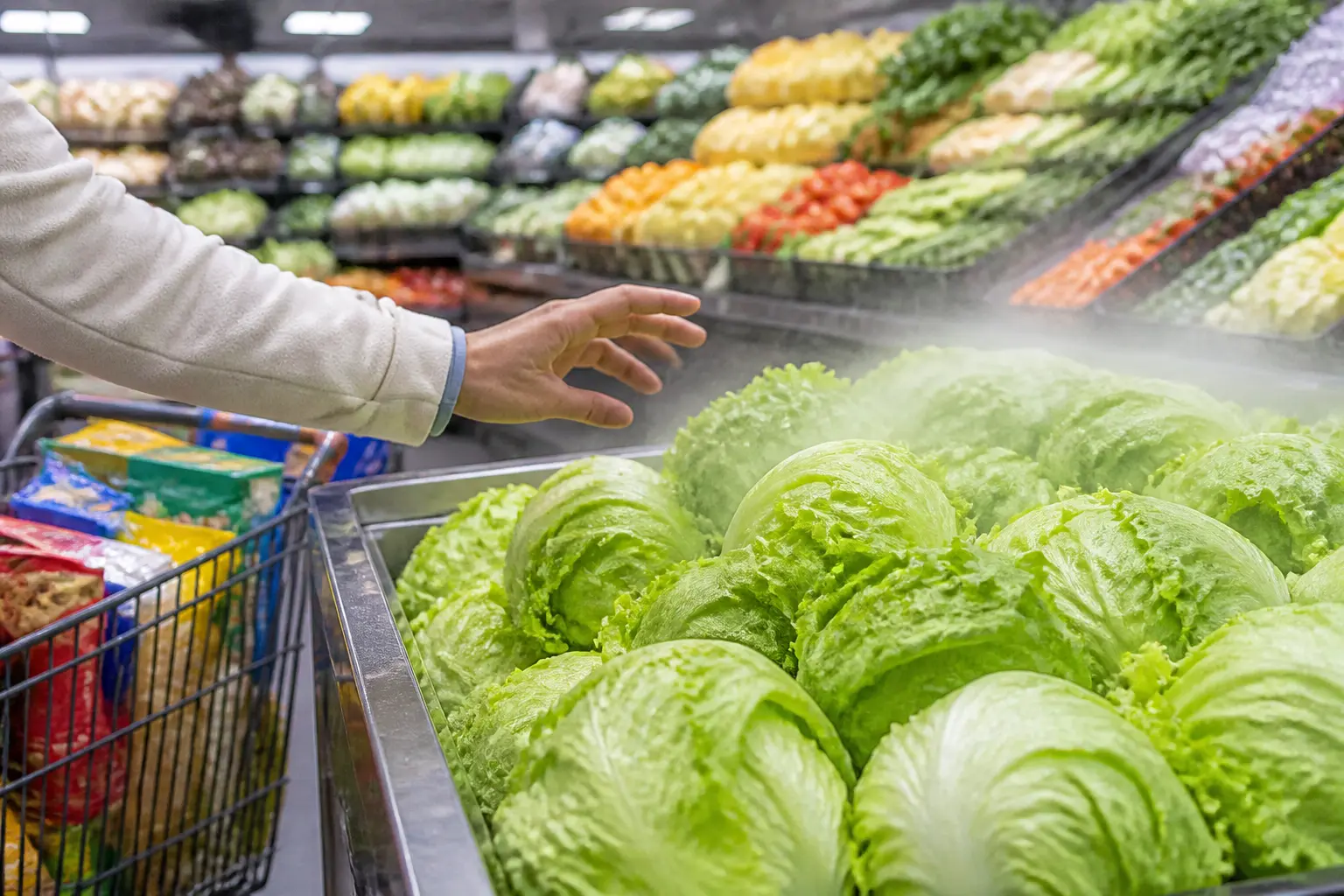
Two in Five Shoppers Change What’s in the Cart
The CBS News/YouGov survey questioned 2,193 U.S. adults and found 40 percent eating or buying less produce, 4 percent buying more, and 56 percent reporting no change at all. People who said they were following the outbreak closely were far more likely to be among the ones cutting back.
The same poll found confidence in the FDA’s handling of the crisis split sharply along political lines, a divide a companion survey examined in detail when confidence in the agency’s outbreak response broke along party lines. More respondents expressed at least some confidence in the FDA than none, but few expressed a lot.
Grocers have not reported the kind of empty produce shelves seen during past recalls. What has shifted is intent: shoppers are choosing bagged chips over bagged spinach, not because the chips are healthier, but because they feel safer right now.
The Diet Kennedy Built His Year Around
Kennedy has used nearly every month of 2026 to build a public case against processed food. The Department of Health and Human Services (HHS), which he leads, has pushed a string of actions aimed at shrinking the packaged-food aisle rather than the produce section.
- January: New MAHA dietary guidelines urged more protein and less packaged food, singling out white bread, chips and candy for cuts.
- February: Kennedy pressed ahead with a legal challenge to the industry practice that lets food companies certify their own additives as safe without third-party review.
- March: A MAHA rally keynote targeted synthetic food dyes, SNAP-eligible junk food purchases and ultra-processed foods (UPFs) by name.
- Ongoing: HHS, the Department of Agriculture and the FDA were directed to agree on a single federal definition of “ultra-processed food,” something that has never officially existed.
Kennedy told “60 Minutes” he intends to act on a broader ultra-processed food overhaul plan first sketched out by former FDA commissioner David Kessler. The pitch all year has been the same: whole foods are the safe choice, packaged foods are the problem.
When “Real Food” Becomes the Riskier Choice
That pitch is now colliding with a produce aisle that made thousands of people sick. Susan Mayne, who led the FDA’s Center for Food Safety and Applied Nutrition from 2015 to 2023, wrote in a Stat News op-ed that she has watched people online treat pizza, bagged chips and store-bought cookies as the safer bet over salad.
Oreos never gave me explosive diarrhea!
That was how one social media commenter put it, Mayne wrote, capturing a trade-off she says consumers should never have to make. “Consumers should not be faced with a trade-off between nutrition and food safety,” she wrote. “‘Real foods’ are vulnerable to real pathogens.”
Mayne called the outbreak a wake-up call on how tightly food safety and nutrition are wound together. Undermine trust in one, her argument goes, and you undermine the other, no matter how many guidelines tell people to eat their vegetables.
Officials Trade Blame Over a “Catastrophic” Response
Kennedy said last week that the Cyclospora surge was “under control.” Brad Woodhouse, president of the public health nonprofit Protect Our Care, was not buying it. “If history is any judge, when the Trump administration declares a crisis ‘under control,’ it’s time to brace for the worst yet to come,” he said in a statement.
Frank Yiannas, who served as the FDA’s deputy commissioner for food policy and response under both the first Trump administration and the Biden administration, has publicly called for an independent investigation into how the outbreak was handled. “This one deserves a lot of questions, and it is starting to approach a catastrophic level in terms of how mismanaged it’s been on multiple fronts,” Yiannas told Politico.
Yiannas pointed to the outbreak’s sheer size, mixed public messaging and what he called a lack of strong federal leadership. He did not point to a single failure. He described a pattern of them.
A Tracing Rule Pushed Back to 2028
One piece of that pattern predates the outbreak. In 2025, the FDA delayed the compliance deadline for its Food Traceability Rule, a regulation designed to let investigators trace contaminated food like Taylor Farms lettuce back to its source within hours instead of days. The agency’s own Food Traceability Rule overview confirms the deadline moved from January 2026 to July 20, 2028, and Congress’s 2026 appropriations package locked that later date in.
A coalition of food safety and consumer groups saw the risk coming. Before the delay was finalized, the Safe Food Coalition sent the FDA a letter warning the extension would leave investigators working with the same slow, paper-based tracing systems during exactly the kind of large outbreak now underway. The group’s letter opposing the compliance date extension argued the rule’s whole point was faster identification of exactly this kind of contamination.
The rule’s substance has not changed, only its timeline. That distinction offers little comfort to investigators chasing a lettuce supply chain with 2026 tools while operating under a 2028 deadline.
The Snack Aisle’s Unplanned Winner
The outbreak arrives less than a year after a separate recall pulled nearly 19 million eggs over a Salmonella scare, part of a run of food safety incidents that has left consumers jumpier about the basics of a grocery run. Packaged food makers are not the ones being blamed for either outbreak. They are simply the beneficiaries of the fear both left behind.
That is the trade nobody in the MAHA movement asked for. A year spent steering Americans toward whole foods and away from packaged ones has run straight into a produce-linked outbreak that is doing the opposite job for free. Mayne’s warning cuts through the noise on both sides of the political fight over food policy: real foods are vulnerable to real pathogens.
Frequently Asked Questions
What Food Is Linked to the 2026 Cyclospora Outbreak?
CDC traceback data point to iceberg lettuce grown by Taylor Farms de Mexico. Investigators identified the link through epidemiologic interviews and supply chain records tracing sick patients back to lettuce served at restaurants and sold in stores across the outbreak states.
Which States Have Reported Cyclospora Cases?
As of the CDC’s July 24 update, the outbreak spans nine states: Illinois, Indiana, Kansas, Kentucky, Michigan, Ohio, Oklahoma, Pennsylvania and West Virginia. The footprint has grown several times since the cluster was first identified in late spring.
When Does the FDA’s Food Traceability Rule Finally Take Effect?
The compliance date is now July 20, 2028, after the FDA extended it by 30 months in 2025 and Congress’s 2026 appropriations law directed the agency not to enforce it any earlier. The rule’s requirements themselves were not changed, only the timeline for enforcing them.
Is It Safe to Eat Lettuce and Other Produce Right Now?
The CDC has not issued a blanket warning against lettuce or produce generally. Its guidance centers on product tied to Taylor Farms de Mexico, alongside standard advice to wash fresh produce thoroughly and check current recall notices before eating bagged salad greens.
What Is Cyclospora and How Does It Spread?
Cyclospora cayetanensis is a one-celled parasite, not a bacterium or virus, that contaminates produce through tainted water or soil during growing or processing. It does not spread person to person, which is why investigators focus on tracing the contaminated crop rather than close contacts.
Disclaimer: This article is for general information only and is not medical advice; anyone experiencing persistent diarrhea, dehydration or fever should contact a healthcare provider, and food safety figures here reflect data available as of publication.


MapLight Stock Plunges After Schizophrenia Trial Splits on Dosage

Starship Survives Its Splashdown, Clearing SpaceX’s Path to a Historic Catch

Red Cross Declares Second-Ever Blood Crisis as Donors Age Out

FDA Advisers Back Six Peptides but Gray Market Endures

Sandisk and ASML Shares Sink as China Ships Chip Tools

Maple Leaf Bacon Recall Exposes a Border Checkpoint Pattern

Mamdani’s 30% Grocery Discount Plan Alarms NYC’s Bodega Owners

Levothyroxine Recall Leaves Millions to Catch the Risk Themselves

Cyclospora Fears Push Americans Toward the Processed Foods RFK Jr. Opposes

Ford’s Custom Garage Push Bets Big on Owning the Aftermarket

Pokémon GO Developer Niantic Rebrands as Scopely Explore

Persona 4 Revival Hands All Anime Cutscenes to Studio MAPPA

Jaylen Brown Traded to 76ers for Paul George and Four Draft Picks

Doom Studio id Software Cuts Half Its Staff in Xbox Layoffs

Nintendo Switch Online Adds Four Classics and One Japan-Only Title

Jordan Henderson Hospitalized After Wrist Injury at the Azteca

Mexico’s World Cup Run Ends at Azteca as England Hold On 3-2

Meta’s Muse Image Lets Anyone Use Your Instagram Photos in AI

Louis Vuitton Beats Molly Tea in China, Triggers Cultural Backlash

Pink Bearista Cup Returns July 13 as Starbucks Pink Vibes Drops
-

 TECHNOLOGY3 years ago
How to Adjust a Bulova Watch Band – An Easy Guide
-

 News3 years ago
Fred Pentland: Athletic Bilbao’s English mentor who changed the essence of Spanish football
-

 FINANCE3 years ago
Tax Planning for Every Season: Guide to Maximizing Your Tax Benefits
-

 Education3 years ago
African Ministers New Education Plan
-

 BUSINESS3 years ago
What is Entrepreneurial Operating System? A Comprehensive Guide to EOS
-

 Education3 years ago
Innovate Your Learning Journey with Technology and Enhance Education
-

 News3 years ago
Russians formally out of World Athletics Championships
-

 BUSINESS3 years ago
Top 9 Most Expensive American Cities to Rent an Apartment