
News
Apple Builds an iPhone Snatch Lock as Android’s Lead Hits 19 Months

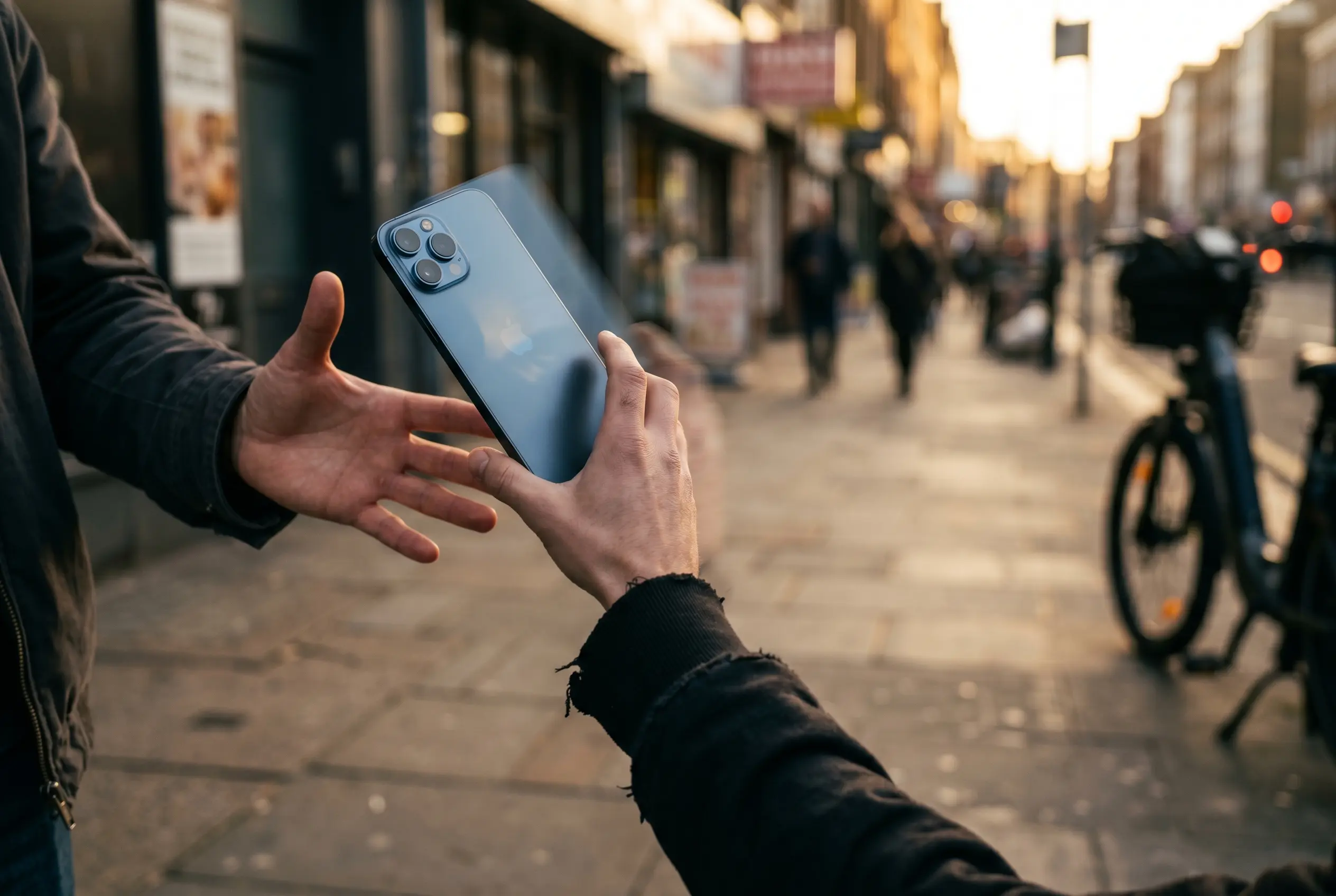
Apple is wiring an automatic lock into the iPhone that fires the moment the device is yanked out of a user’s hand, according to code 9to5Mac surfaced this week from an internal iOS build. The signals lining up to confirm a snatch include the iPhone’s own accelerometer (the motion sensor that already powers Crash Detection), the distance to a paired Apple Watch, and whether the phone is on a familiar WiFi network or at a familiar location such as home or work.
The trigger fixes a hole in Apple’s existing theft stack. Find My, Activation Lock, and Stolen Device Protection all assume the phone is locked when a thief takes it. Snatching grabs the device while the screen is live, the wallet is open, and the owner is two seconds from realising what happened.
The Signals Apple Is Stitching Together
The detection logic reads like a checklist a snatcher would struggle to defeat in real time. The code references list four inputs feeding the lock:
- The iPhone’s accelerometer, which already powers Crash Detection and Fall Detection on newer models, watching for the sharp jerk-and-run motion pattern.
- The Bluetooth and ultra-wideband distance to a paired Watch, which separates “the phone moved” from “the phone moved away from the owner.”
- Whether the iPhone is currently joined to a WiFi network the device has recognised before.
- Whether the iPhone’s location matches one the system has learned as familiar, such as home, an office, or a gym.
When several of those readings break in the wrong direction at once, the phone locks itself. The handoff matters: a normal screen lock keeps a thief out of the home screen, but Apple’s plan, per the code, is to also flip the device into the same restricted state the operating system already uses when a phone reads as stolen. That cuts off Apple Pay, saved Keychain passwords, and the controls a thief needs to change the Apple Account password and start wiping recovery options.
That sensor is doing real work here. Snatch grabs produce a recognisable motion signature: a fast lateral acceleration followed by a longer-duration push in a single direction as the thief runs, cycles, or rides off. Apple has been training the same chip on harder problems for years, including reading a car crash through impact pattern matching and a hard fall through tumble dynamics. Catching a hand grab is, in motion-signal terms, an easier task.
The Apple Watch as a Second Witness
The wrist signal is what distinguishes this from a generic motion trigger. Android’s equivalent feature reads accelerometer, WiFi, and Bluetooth on the phone alone. Apple has access to a second device most rival platforms cannot count on: a sensor strapped to the user’s wrist that knows, to the centimetre, how far the phone has just travelled.
A paired wearable sitting on the same wrist that just held the iPhone is the most reliable way to confirm the phone has actually left the owner’s body. If the wearable and the iPhone stay together, the system can wave off a motion blip as a stumble, a handoff to a partner, or a phone dropping into a bag. If the two devices separate at running speed while the WiFi network drops, the snatch case is strong.
That is also why the extra rules matter. A motion-only trigger would mis-fire on cyclists, runners, and anyone who hands their unlocked phone to a child. Cross-referencing motion data with paired-wearable distance, network identity, and learned location lets the system filter normal life out of the alert.
Android Shipped This in October 2024
Apple’s draft of the idea arrives 19 months after Google rolled out the same concept under the name Theft Detection Lock. Google’s feature went live globally in October 2024 through Google Play services, reaching every Android 10 and newer phone without requiring a system update.
The mechanics are close to identical. Theft Detection Lock uses on-device AI, the accelerometer, WiFi, and Bluetooth to detect a quick grab followed by movement away. If the model confirms a snatch, the phone screen locks. Google bundled it alongside Offline Device Lock (auto-lock when the phone is disconnected for too long) and Remote Lock, which can lock the device using only a verified phone number.
| Capability | Android Theft Detection Lock | Apple’s reported feature |
|---|---|---|
| Live since | October 2024 | In development, no public date |
| Paired-wearable signal | No | Yes (distance to paired Watch) |
| Familiar-location rule | No | Yes (reuses Apple’s existing list) |
| Minimum OS | Android 10, via Play services | iOS version not disclosed |
| Locks beyond the screen | No | Yes (restricts the protected actions list) |
The two differentiators Apple is building in cut both ways. They make false positives less likely, and they raise the bar for users who do not own a Watch or who have not let the iPhone learn their daily places.
Why Stolen Device Protection Was Never Enough
Apple shipped Stolen Device Protection in iOS 17.3 in January 2024, after reporting showed thieves were shoulder-surfing passcodes in bars, grabbing the phone, and using the passcode to reset the Apple Account password. The fix sat on top of the passcode: once enabled, any major change to the account or wallet would also demand Face ID or Touch ID, with a one-hour delay before the device would accept the new biometric.
Apple’s own support page sets the scope:
Stolen Device Protection adds a layer of security when your iPhone is away from familiar locations, such as home or work, and helps protect your accounts and personal information in case your iPhone is ever stolen.
That layer covers what a thief tries to do after the phone is in their pocket. It does not cover the seconds between the grab and the auto-lock timer firing. On a default iOS setup, that window can run to thirty seconds or longer. Within it, an unlocked iPhone exposes Apple Pay, banking apps that already trust the device, messages with two-factor codes, and the Settings app.
The new lock is the missing pre-event signal. It tries to slam the door before the thief is past the kerb, by ending the unlocked state the moment the motion and proximity signature reads as a grab. If it works as described, those same restricted-state rules kick in instantly, not after a delay long enough to lose a bank balance. Our earlier coverage of iPhone safety features in real-world incidents tracks the same pattern of Apple pushing detection earlier in the threat timeline.
London, 80 Percent, and the Snatch Economy
The pressure to build this has been visible on the street for two years. The Metropolitan Police’s freedom-of-information disclosure recorded 27,167 mobile phone thefts in London in the first three months of 2025, with iPhones the target of choice.
- 80 percent of phones stolen in London are iPhones, with the iPhone 15 Pro Max the single most-snatched model, according to the House of Commons Library briefing on mobile phone thefts.
- 42 percent of all UK phone thefts happen in the capital.
- 30 percent drop inside the Square Mile in early 2025 versus the same period a year earlier, after a new patrol operation launched in January.
- 27,167 thefts logged in Q1 2025 alone, per the Met’s own disclosure.
Anecdotal accounts out of the capital have been unusually consistent. Thieves on e-bikes target unlocked handsets because a locked iPhone is worth almost nothing once Activation Lock kicks in; an unlocked one can be drained through Apple Pay, used to authorise bank transfers, or stripped of two-factor codes before the owner can blacklist it. Reports have linked the wave to organised resale routes pushing stolen devices to markets where Activation Lock can be partially worked around.
Patrol operations attack the problem from the kerb. Apple’s draft lock attacks the same problem from the device side: if the screen is dark again two seconds after the grab, the resale economics of a snatched iPhone collapse back to the locked-phone price.
What Has Not Been Confirmed
9to5Mac’s report is built on code references inside an internal iOS build, not on a public Apple announcement. The publication did not name an iOS version, did not quote any timing language, and noted only that development is active. Apple’s standard pattern with features at this stage is to either ship them with the next major release in September or hold them for a mid-cycle point update.
Apple’s annual developer conference begins on June 8 at Apple Park, with the keynote at 10 a.m. Pacific, as we noted in our preview of the WWDC schedule and Siri overhaul timeline. If the snatch lock is far enough along to demo, that is the natural surface. If it is not, the next likely window is the iOS point release that typically follows the holiday quarter. Apple has been folding security-grade features into point updates more aggressively over the past two cycles.
Two open questions matter most. The first is whether the feature will require a Watch as a hard dependency or only use it when available; the bulk of iPhone owners do not wear one. The second is whether Apple will let users tune sensitivity, which is the trade-off Google has been adjusting since launch.
If Apple announces the lock at the June 8 keynote and ships it in the autumn, the unlocked-phone resale window closes for snatchers across two of the world’s largest iPhone markets before the next holiday shopping cycle. If the feature slips into a point release or arrives gated to Apple Watch owners only, the snatch economy keeps running on the assumption it has profited from for two years: that the screen will still be lit when the thief reaches the corner.


Applied Digital Breaks Ground on $3.6B Delta Forge 1 in Louisiana

Nasal Spray Reverses Brain Aging in Aged Mice, Texas A&M Study Finds

Nvidia Retires Its 20-Year Control Panel as 610.47 Driver Ships

PS Plus June 2026 Free Games Lean on Two Xbox-Born Co-Ops

Logitech’s Signature Comfort Plus Adds Cushioned Mice and Keyboard From $40

KeySmart SmartCard Pro Doubles Find Hub Wallet Tracker Battery Life

Apple Builds an iPhone Snatch Lock as Android’s Lead Hits 19 Months

Dodge Bets the Copperhead SRT Can Refill Its Halo White Space by 2030

Lilly Drops $3.83B on Vaccines Targeting Roots of Chronic Disease

GoPro Mission 1 Pro Review: A $699 Bet on 8K Video Quality

Mitchell Matches Kobe in Game 7 Rout, Cavaliers Reach East Finals

Shai Gilgeous-Alexander Wins Second Straight MVP With 83 of 100 First-Place Votes

Colt Emerson Debuts, Mariners Get Swept by Padres in Vedder Cup

Brent at $111 Hides the Hormuz Damage Hitting Fed and Asia

Samsung Strike Looms May 21 as Union Eyes SK Hynix Bonus Formula

Jaylen Brown Calls Stephen A. Smith the Face of Clickbait Media

Xperia 1 VIII Holds Price, Xiaomi 17 Max Loads Up: Week 20 Phone News

LIRR Strike Hits Third Day as 250,000 Commuters Face a Tougher Manhattan Run

Santa Marta’s Fossil Fuel Exit Plan Puts Scotland’s Drilling U-Turn on the Clock

Rousey Finishes Carano in 17 Seconds and Hands Netflix Its MMA Opening
-

 TECHNOLOGY3 years ago
How to Adjust a Bulova Watch Band – An Easy Guide
-

 FINANCE3 years ago
Tax Planning for Every Season: Guide to Maximizing Your Tax Benefits
-

 News3 years ago
Fred Pentland: Athletic Bilbao’s English mentor who changed the essence of Spanish football
-

 Education3 years ago
African Ministers New Education Plan
-

 BUSINESS3 years ago
What is Entrepreneurial Operating System? A Comprehensive Guide to EOS
-

 Education3 years ago
Innovate Your Learning Journey with Technology and Enhance Education
-

 News3 years ago
Russians formally out of World Athletics Championships
-

 BUSINESS3 years ago
Top 9 Most Expensive American Cities to Rent an Apartment