
News
Apple Watch Ultra 4 Redesign Hides a Bigger Supplier Bet

In September 2025, Apple’s hypertension notifications feature, cleared by the US Food and Drug Administration (FDA, the federal regulator that clears medical devices) on Apple Watch Series 9 and later, began passively scanning wearers’ optical heart-sensor data over rolling 30-day windows. Eight months later, on May 18, DigiTimes reported that a different blood pressure feature is now under FDA review for the Apple Watch Ultra 4. The two features sound near-identical because, technically, they overlap on the same sensor.
That overlap matters. The Ultra 4 upgrade reads less like a sensor breakthrough than a clinical refinement of hardware Apple already ships, paired with a body redesign rumored to carry eight sensors in a ring pattern and a supply contract pointing to Taiwan-Asia Semiconductor as the quieter winner from this launch cycle.
Parsing the Two Hypertension Features
The feature already on shelves arrived with watchOS 26 last September. Apple announced it alongside Apple Watch Series 11, ran the optical heart sensor in the background, and used the photoplethysmography signal to look for blood-vessel response patterns associated with chronic hypertension. The FDA cleared it in September 2025. It runs on Series 9 and later plus Apple Watch Ultra 2 and later. Apple estimated the rollout would flag more than a million people with undiagnosed hypertension in the first year, validated by a clinical study of over 2,000 participants and trained on data from over 100,000.
The Ultra 4 feature, as described by DigiTimes, applies the same underlying mechanic (optical sensor data scanned for vascular response anomalies) but according to the report it interprets individual heartbeats rather than a 30-day aggregate. That single change is the reason the feature needs fresh FDA review even though the broader hardware family already cleared the agency seven months ago.
Where the two features differ:
| Attribute | Hypertension Notifications (watchOS 26) | Ultra 4 Blood Pressure Feature |
|---|---|---|
| Analysis window | Rolling 30 days | Per-heartbeat |
| Regulatory status | FDA-cleared September 2025 | Under FDA review (DigiTimes) |
| Compatible devices | Series 9+, Ultra 2+ | Ultra 4 (initially) |
| Use case | Long-term chronic flag | Acute anomaly alert |
| Sensor | Existing optical heart sensor | Refined optical heart sensor |
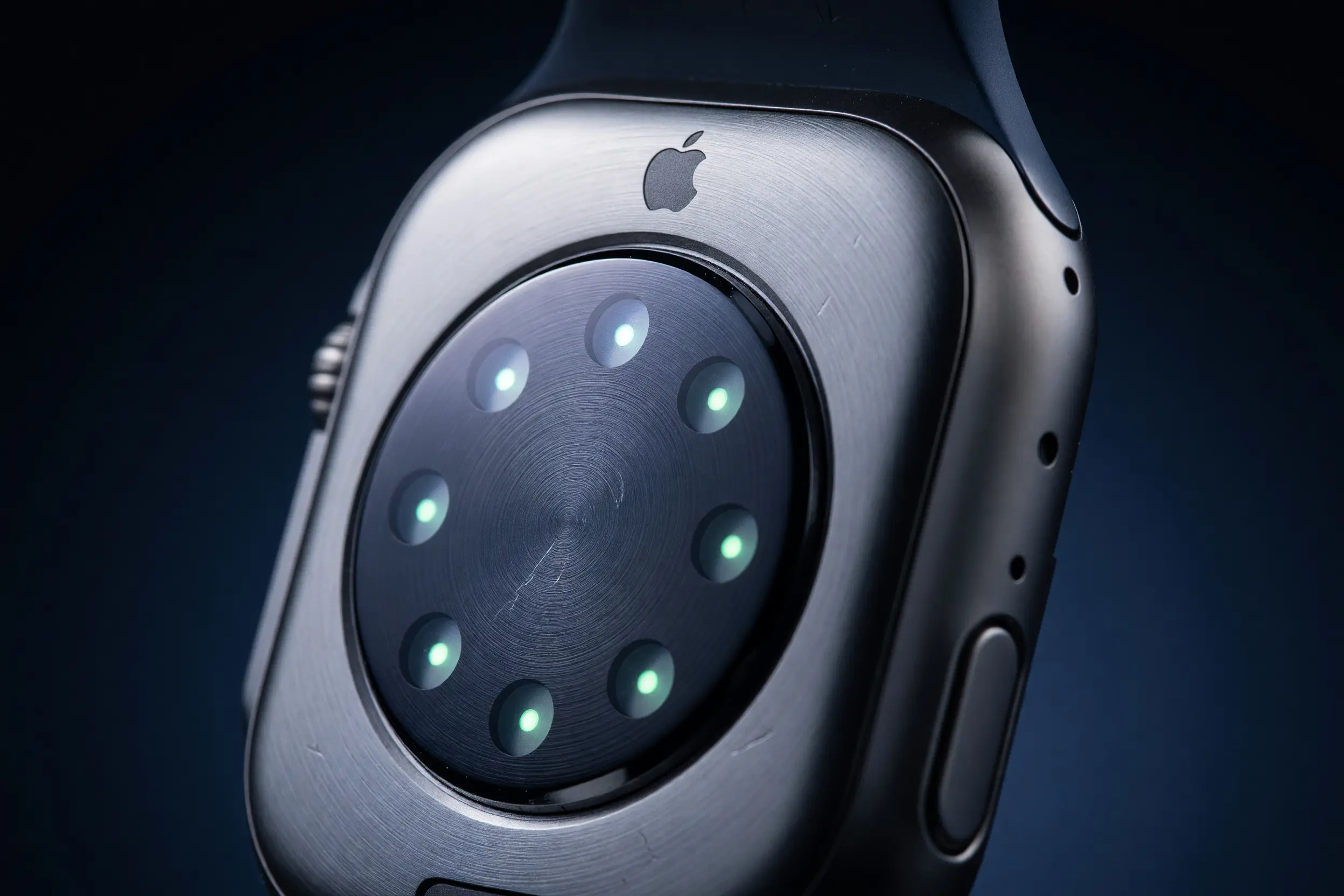
The Eight-Sensor Ring on the Back
DigiTimes describes the Ultra 4 as a “full redesign,” what would be the first since the original Apple Watch Ultra debuted in 2022. Supply-chain leaks pinned by the same report point to eight sensors arranged in a ring pattern on the back of the device. That layout would replace the current Ultra 3’s centered cluster of optical, electrocardiogram (ECG, the cardiac-rhythm readout introduced on Series 4), and temperature sensors with a circular distribution capturing data from more contact points across the wrist.
No photos or renderings have leaked. What the redesign involves on the front of the case (bezel, crown layout, button placement, display sizing) remains a blank. DigiTimes’ framing has escalated from last year’s “significant redesign” to this round’s “full redesign,” language that usually signals engineering samples circulating among suppliers rather than concept work on paper.
What the eight-sensor layout is likely to enable, per the reporting:
- More consistent blood-vessel coverage across wrist-position variance
- Per-heartbeat blood pressure inference, the feature under FDA review
- A wider hardware base for future health sensors not yet announced
- Higher contact-area redundancy when the watch is loose-fitted during sleep or exercise
Why Taiwan-Asia Semiconductor Wins Big in July
Apple’s exclusive sensor-component supplier for the Apple Watch is a Taiwanese fab that most consumers will never have heard of. Taiwan-Asia Semiconductor (TASC) has supplied short-wave infrared (IR) light-emitting diodes to the Apple Watch since at least Series 8, where they sit inside the body temperature sensor. The same firm also supplies photodiodes to AirPods Pro 3 for heart-rate sensing.
DigiTimes reports TASC is expected to begin large-volume order intake for the Ultra 4’s sensor ring as early as July. That is roughly two months ahead of a typical fall-launch ramp and suggests Apple wants the sensor module in tested production by August. The publication’s supply-chain coverage of the TASC ramp describes the orders as a meaningful step-up over the firm’s current Apple revenue base.
Some quick numbers:
- 8 sensors in the rumored ring pattern, up from the current Ultra cluster
- July flagged for the start of large-volume TASC order intake
- 20% to 30% projected uplift in Apple Watch shipments versus 2025
- 150+ countries where Apple’s existing hypertension feature is already live
TASC is a niche compound-semiconductor fab, and Apple’s order volumes can swing its quarter. In December 2025 the firm announced a deepening compound-semiconductor and smart-medical partnership with Itochu Taiwan, a move that fits the profile of a supplier preparing for a much larger Apple ramp.
The Glucose Question Sits One Sensor Closer
Apple’s longest-running unfinished health project is noninvasive blood glucose monitoring. The company has been pursuing optical absorption spectroscopy (shining light through the skin to infer glucose levels in interstitial fluid) for more than a decade, and Bloomberg’s Mark Gurman last year described the feature as many years away from debut despite over 15 years of internal work.
The Ultra 4 redesign does not ship glucose tracking. What it does, if the eight-sensor ring is real, is lay down the hardware framework: more optical sites, a refined LED-and-photodiode stack from TASC, and a body designed around the sensor cluster rather than the cluster crammed into an existing body. Apple’s pattern with new health features is to seed hardware first on Ultra and Series flagships, then enable the software two to three years later once regulators sign off. The ECG hardware shipped on Series 4 in 2018; the atrial fibrillation history feature followed in watchOS 9 in 2022; atrial fibrillation as an approved clinical-trial endpoint cleared in 2024. Hardware leads regulatory clearance by three or four years on every meaningful new Apple Watch sensor.
The Math Behind a 20% to 30% Shipment Lift
The 20% to 30% uplift figure DigiTimes carries is attributed to “market observers” rather than a named industry tracker. Two things make that range plausible.
First, Apple Watch unit shipments have been broadly flat or down since 2022, when the original Apple Watch Ultra and Series 8 lifted the category. A full-redesign year historically resets the upgrade curve, and the Ultra line carries the highest average selling price (ASP, the per-unit revenue Apple banks) in the Watch family. Second, the existing hypertension notifications feature is already pulling first-time wearers toward the platform; layering a refined, per-heartbeat version onto a fully redesigned Ultra strengthens the high-tier upgrade case among existing Series 9 and Ultra 2 owners.
Two things make the range fragile. Apple Watch ASPs have been rising, and the Ultra sits at $799 in the US. A volume uplift of that scale at that price point requires household budgets to absorb a premium-watch upgrade in a fall when the iPhone 18 Pro and the foldable “iPhone Ultra” are simultaneously launching. And the one health metric that would force a hardware refresh across a five-year-old Series base, noninvasive glucose, is still absent from the Ultra 4 spec sheet.
The shipment forecast is therefore a hardware-upgrade-cycle bet, not a software-feature bet. The math holds if Ultra 2 and Ultra 3 owners decide the eight-sensor ring and a clinically validated per-heartbeat alert are worth $799. It softens fast if they wait for the glucose feature that has been one year away for five years.
What the Fall Reveal Will Test
The Apple Watch Ultra 4 is currently scheduled for Apple’s September event alongside Series 12, the iPhone 18 Pro line, and the foldable “iPhone Ultra.” Whether the redesign carries enough sensor and software differentiation to support the shipment uplift attributed to DigiTimes’ market observers depends on signals Apple has not yet sent.
If the FDA clears the per-heartbeat blood pressure feature ahead of the September keynote, Apple can land the Ultra 4 as a category-defining clinical health upgrade and hold the price premium over Ultra 3. The watchOS 26 hypertension layer already shipped on Series 11; the Ultra 4 needs an upgrade that goes meaningfully beyond it to justify a redesign-year ASP bump. TASC’s July order ramp is the cleanest leading indicator; compound-semiconductor shipments at the scale Apple typically buys are not subtle to track inside a supplier’s quarter.
If clearance slips into 2027 and TASC’s order book stays at current run rates, the Ultra 4 ships on body and battery alone, and the 20% to 30% shipment lift gets repriced before Apple’s groundbreaking-health-insights framing from Series 11 gets a second outing. Watch the supplier quarter, not the keynote slide.


Canadiens Edge Sabres in OT Thriller, Hurricanes Await Thursday

Malika Andrews Lobs Brunch Line at Blake Griffin on NBA Today

Inside Ghost of Yotei Legends Raid: Sucker Punch’s Farewell Boss Fight

Wembanyama Drops 41 and 24 as Spurs Stun Thunder in Double OT

Subnautica 2 Bets the Studio on a Knife-Free Ocean

Nintendo’s Pictonico Lands May 28 With WarioWare DNA and No Gacha

Apple Watch Ultra 4 Redesign Hides a Bigger Supplier Bet

Sony Pulls PlayStation’s Single-Player Crown Jewels Off the PC Track

Microsoft Concedes Crash-Free Drivers Bled Windows 11 Batteries for Years

LEGO Batman: Legacy of the Dark Knight Release Times and Deluxe Access Confirmed

Mitchell Matches Kobe in Game 7 Rout, Cavaliers Reach East Finals

Brent at $111 Hides the Hormuz Damage Hitting Fed and Asia

Colt Emerson Debuts, Mariners Get Swept by Padres in Vedder Cup

Santa Marta’s Fossil Fuel Exit Plan Puts Scotland’s Drilling U-Turn on the Clock

Samsung Strike Looms May 21 as Union Eyes SK Hynix Bonus Formula

Xperia 1 VIII Holds Price, Xiaomi 17 Max Loads Up: Week 20 Phone News

Shai Gilgeous-Alexander Wins Second Straight MVP With 83 of 100 First-Place Votes

LIRR Strike Hits Third Day as 250,000 Commuters Face a Tougher Manhattan Run

Aaron Rai’s Stubborn Bet on Iron Covers Pays Off at the PGA

Googlebook Repeats Google’s Decade-Long Laptop Pattern
-

 TECHNOLOGY3 years ago
How to Adjust a Bulova Watch Band – An Easy Guide
-

 FINANCE3 years ago
Tax Planning for Every Season: Guide to Maximizing Your Tax Benefits
-

 Education3 years ago
African Ministers New Education Plan
-

 BUSINESS3 years ago
What is Entrepreneurial Operating System? A Comprehensive Guide to EOS
-

 News3 years ago
Fred Pentland: Athletic Bilbao’s English mentor who changed the essence of Spanish football
-

 Education3 years ago
Innovate Your Learning Journey with Technology and Enhance Education
-

 News3 years ago
Russians formally out of World Athletics Championships
-

 BUSINESS3 years ago
Top 9 Most Expensive American Cities to Rent an Apartment