
FINANCE
BART Rescue Tax Books November Ballot After Signature Surge

Connect Bay Area submitted 305,895 signatures to county elections offices on Tuesday, blowing past the 186,000 required by June 3 to qualify a BART rescue measure for the November ballot. The five-county sales tax now heads to a regional vote that polled at 56 percent support last October.
Signatures were the easy lift. What voters decide in November is whether to close BART’s $376 million fiscal-year-2027 deficit before a January 2027 service-cut trigger, with a contingency plan already approved by the BART board sitting on the table behind them.
The Signature Surplus and What It Bought
Connect Bay Area, the coalition formed to carry the regional measure, had eyed June 3 as the hard deadline for its 186,000-signature minimum. The campaign cleared that bar by roughly 64 percent. Final certification by the five county elections departments takes a few weeks. Barring duplicates or invalid filings beyond the cushion, the measure lands on the November 4 ballot.
Five counties carry it: San Francisco, Alameda, Contra Costa, San Mateo and Santa Clara. The measure does not require approval inside each. A simple majority across the combined regional electorate carries it across the line.
Fundraising so far runs north of $5.5 million, much of it from regional employers and labor groups. No significant opposition campaign has organized yet.
Sacramento’s role came first. State Senator Scott Wiener and Senator Jesse Arreguín introduced SB 63, the Connect Bay Area Act, in early 2025; the Legislature passed it in September; Governor Gavin Newsom signed it on October 13, 2025, per the Metropolitan Transportation Commission’s record of the bill signing. The statute took effect January 1, 2026, opening the signature window. Connect Bay Area began collecting names later that same month.
The $376 Million Cliff Behind the Win
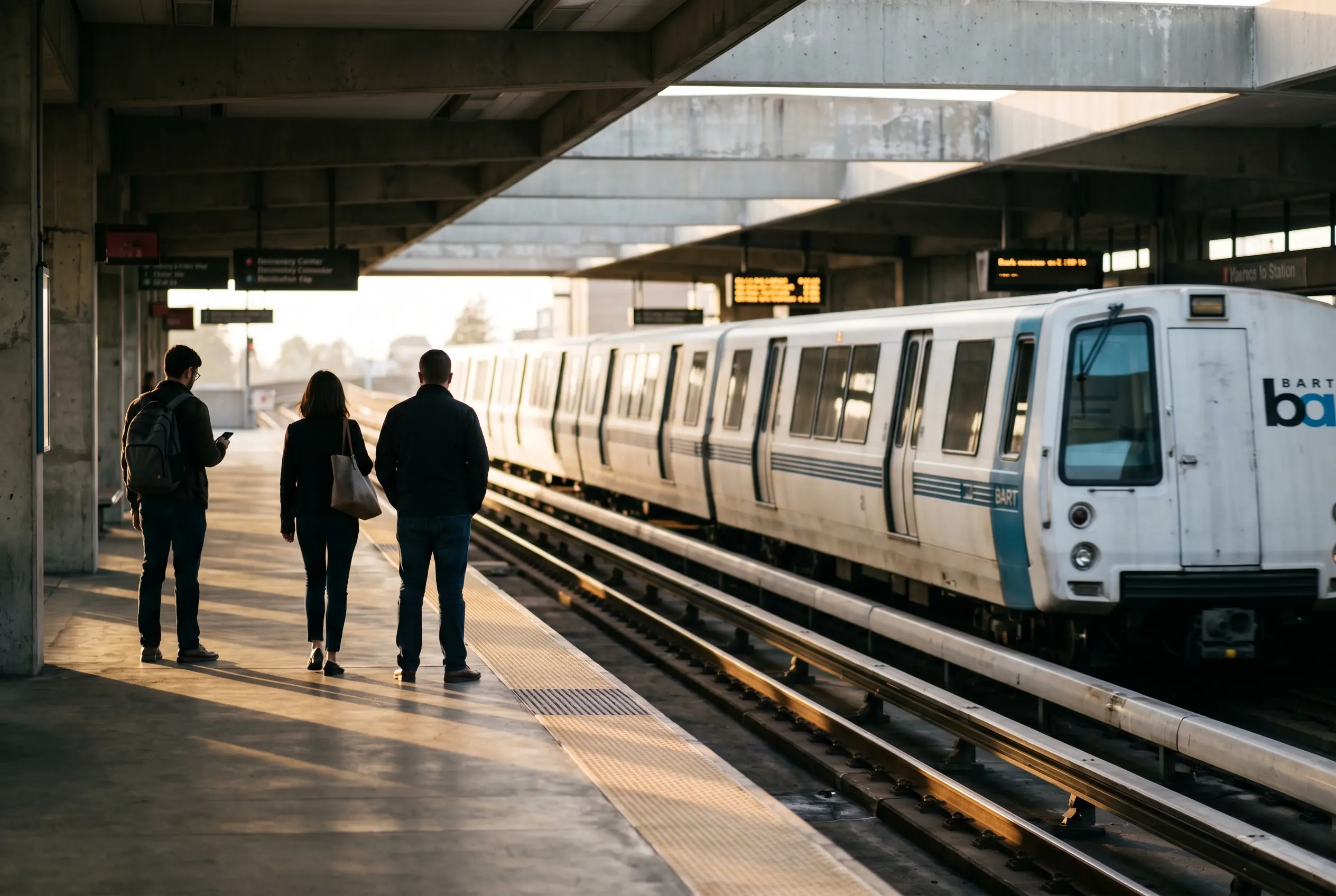
BART’s structural deficit has not gone away through ridership growth alone. March 2026 was the system’s best post-pandemic month, with 5.4 million station exits and weekday averages back above 200,000 for the first time since 2020. That figure still sits at around half the pre-pandemic norm of roughly 410,000 weekday riders. With operating costs largely fixed and federal pandemic aid spent, fare revenue alone does not close the gap, and remote work has not reversed.
On February 26, the BART board approved an Alternative Service Plan to cover the fiscal-year-2027 budget hole. The official deficit is $376 million, as confirmed on BART’s published fiscal crisis page. The plan is the agency’s legally adopted Plan B, ready to execute if no new revenue lands by mid-fiscal year. The cuts itemized in that plan:
- Three-line service only (Yellow, Blue and Orange routes), with limited peak-direction service on Red and Green
- Systemwide closures at 9 p.m. seven days a week
- A 30 percent hike in fares and parking fees, lifting the average fare from $4.98 to $6.38
- Layoffs of approximately 1,200 employees
- A 40 percent reduction in system support services
If the November sales tax measure fails, the first phase of the Alternative Service Plan begins in January 2027. If the measure passes, BART expects roughly $74 million in transit operating revenue in the fourth quarter of FY27 (April through June 2027) and an estimated $310 million annually starting in fiscal year 2028. The distance between those two scenarios is what every BART rider, AC Transit passenger and Muni commuter is voting on.
What the Half-Cent (and Full-Cent) Tax Buys
SB 63 set the default rate at one-half cent and granted San Francisco an option to go to one full cent, given the city’s heavier dependence on the San Francisco Municipal Transportation Agency (SFMTA, the operator of Muni). All five counties opted in by the July 31, 2025 negotiation deadline detailed in Senator Wiener’s announcement of the Connect Bay Area Act. The result is a single regional measure carrying a variable rate by county.
| County | Sales Tax Increase | Primary Transit Beneficiary |
|---|---|---|
| San Francisco | 1.0% | Muni (SFMTA), BART |
| Alameda | 0.5% | BART, AC Transit |
| Contra Costa | 0.5% | BART, county transit authority, AC Transit |
| San Mateo | 0.5% | Caltrain, SamTrans, BART (SFO line) |
| Santa Clara | 0.5% | VTA, Caltrain |
HdL Companies, the firm contracted by MTC for the fiscal-year-2031 sales tax projection, estimated the combined measure would generate about $1 billion annually. BART’s slice is roughly $310 million per year once collections fully ramp. The remainder flows to Muni, AC Transit, Caltrain and the county transit authorities.
That funding split is built into the statute. The measure dedicates dollars to specific operators and obligates them to participate in MTC’s Regional Network Management framework. If an operator fails to comply with the new accountability requirements, MTC can withhold its share.
Each county had a July 31, 2025 deadline to opt in. All five did, though the negotiation involved months of back-and-forth between Wiener’s office, county supervisors, and MTC. The split rate kept the measure on the path to a single November ballot question.
Volunteer Nerds Outran the Paid Gatherers
Campaign forecasts credited paid signature-gatherers with most of the haul. Volunteers were supposed to bring in roughly 28,000 names. They brought in 77,000.
Math matters here because California’s signature campaigns this spring chased the same paid talent pool. Connect Bay Area was in market against a half-dozen statewide initiatives. Without the volunteer overage, the cushion above the 186,000 floor would have been thinner. With it, qualification was never close.
Volunteers worked locations where transit riders, oddly, were not. Farmers markets, the No Kings rallies that spread across the region this spring, San Francisco Giants home games, and the Hunky Jesus contest in Dolores Park on Easter Sunday delivered more names per shift than the BART platforms themselves. Riders aboard the trains gave the clipboard the cold shoulder.
A few months ago, we were all a little bit nervous. The paid signature-gatherers were so overstretched because of all the stuff happening at the state level. The volunteer transit nerds saved the day.
That was Wiener, the measure’s lead author, speaking on Tuesday after the count was confirmed. In recent weeks Wiener has said he “wakes up every morning worrying about service cuts” and described the measure as “truly existential” for BART and the agencies dependent on the bill.
Sal Cruz, president of AFSCME Local 3993, the union that represents BART’s supervisory and professional employees, called Tuesday’s count a “major milestone” and credited “supporters of public transit from across the Bay Area” for the volunteer turnout.
Five Counties, One Vote, Different Math
Polling has been steady. EMC Research, the Oakland firm commissioned by MTC, found 56 percent voter support in October 2025, up from 54 percent in January 2025, per the October 2025 MTC poll of 2,800 Bay Area voters. Eighty-four percent told the pollster public transit is important to the region; 58 percent called it very important, up from 47 percent in 2023.
Underneath the aggregate runs a county-by-county gradient. Support tracks rail access. San Francisco and Alameda poll well above the regional average, where Muni and direct BART exposure define daily life. Contra Costa, San Mateo and Santa Clara sit lower, where ridership density is thinner and the half-cent sales tax meets less voter familiarity with the agencies that benefit. Connect Bay Area does not need to win every county. A simple majority of the combined five-county vote carries the measure.
Organized opposition is thin so far. The coalition has raised roughly $5.5 million as of this spring, much of it from regional businesses and labor groups, and no significant No-side committee has registered. November is a long way off.
The Strings Attached to the Billion-Dollar Pot
SB 63 did not write a check; it wrote conditions. The bill subjects BART, Muni, AC Transit and Caltrain to MTC’s Regional Network Management policies and requires the regional planning body to commission an independent, third-party financial efficiency review of each operator. Each agency must then file an implementation plan showing what cost-cutting measures it intends to adopt. Non-compliance can trigger funds being withheld.
The accountability layer was the political price of passage. Legislators outside Wiener’s San Francisco district insisted on visible reform language; the operators agreed because the alternative was an unfunded fiscal cliff. BART had already eliminated its FY26 deficit through internal cuts and one-time resources, but the FY27 number could not be closed without new revenue.
BART’s own published guidance is unusually direct on the stakes. The agency frames the gap as $350 million to $400 million annually, notes that ridership alone cannot close it, and points to the November measure as the only path it sees to stabilizing the operating budget through the back half of this decade. The agency formalized that posture in BART’s official statement after Newsom signed SB 63.
If voters say yes in November, BART receives an estimated $74 million in Q4 FY27 funding and starts FY28 with roughly $310 million in new annual revenue, putting the Alternative Service Plan back on the shelf. If they say no, the contingency plan begins phasing in by January 2027, with 9 p.m. closures, three-line service, and 1,200 fewer employees. Either branch arrives in early 2027. The vote that decides between them now has its ballot line, and the campaign that put it there has five months to convert 56 percent polling support into a majority that turns out.







NFL Three-Strike Safety Fouls Now Pull Coaches and Clubs In

Browns Fans Tape Protest Signs to Jim Brown Statue Over Watson

Amazon Pixel 11 Deal Erases the $100 Hike for One More Day

Elden Ring on Switch 2 Turns Its Own Worst Label Into a Portable Win

Ternus Takes the Stage With Apple’s Foldable Debut

Ikea Xbox Yxstaby Turns Controller Thumbstick Into Home Furniture

Pokémon Center Turns Past Worlds Wins Into Bundles and a Pikachu Coin

NFL Scraps Pro Bowl Game to Restore Pure Player Honor

New Twitter.now Bets the Brand Musk Left Behind

Bella Mir’s Famous First Loss Meets the Accountant Who Won

Double Fine Cuts 23 Jobs Weeks After Xbox Independence

Day-One Big Walk Lifts PS Plus August Beyond Recycled AAA

John Hight Exits Wizards After Digital Reckoning Hits

Curtis Mead’s Red Sox Debut Ends With Fractured Wrist

Moesch and Dressel Rewrite Night One at 2026 U.S. Nationals

Red Sox Squander Hot Streak Chance in 4-3 Loss to Athletics

Boutte’s Quiet Camp Takeover Forces Patriots Receiver Choices

Take-Two CEO Pushes Netflix Subs for GTA 6 Extended Look

Halo Campaign Evolved Skulls Meet Death Barriers That Kill the Hunt

Wildlands Free Update Hands Players the Tools They Already Invented
-

 TECHNOLOGY3 years ago
How to Adjust a Bulova Watch Band – An Easy Guide
-

 News3 years ago
Fred Pentland: Athletic Bilbao’s English mentor who changed the essence of Spanish football
-

 FINANCE3 years ago
Tax Planning for Every Season: Guide to Maximizing Your Tax Benefits
-

 Education3 years ago
African Ministers New Education Plan
-

 BUSINESS3 years ago
What is Entrepreneurial Operating System? A Comprehensive Guide to EOS
-

 Education3 years ago
Innovate Your Learning Journey with Technology and Enhance Education
-

 News3 years ago
Russians formally out of World Athletics Championships
-

 BUSINESS3 years ago
Top 9 Most Expensive American Cities to Rent an Apartment