
AUTOMOBILE
Ferrari’s €550,000 Electric Luce Backfires as Salvini and Maranello Loyalists Revolt

Ferrari priced its first all-electric car at €550,000 and unveiled it in Rome on Monday. By Tuesday morning, the country’s transport minister was on X telling his 1.5 million followers the prancing horse should be removed from the bodywork. Milan-listed shares closed down 8.4%, wiping roughly €4 billion off the company’s market value in a single session.
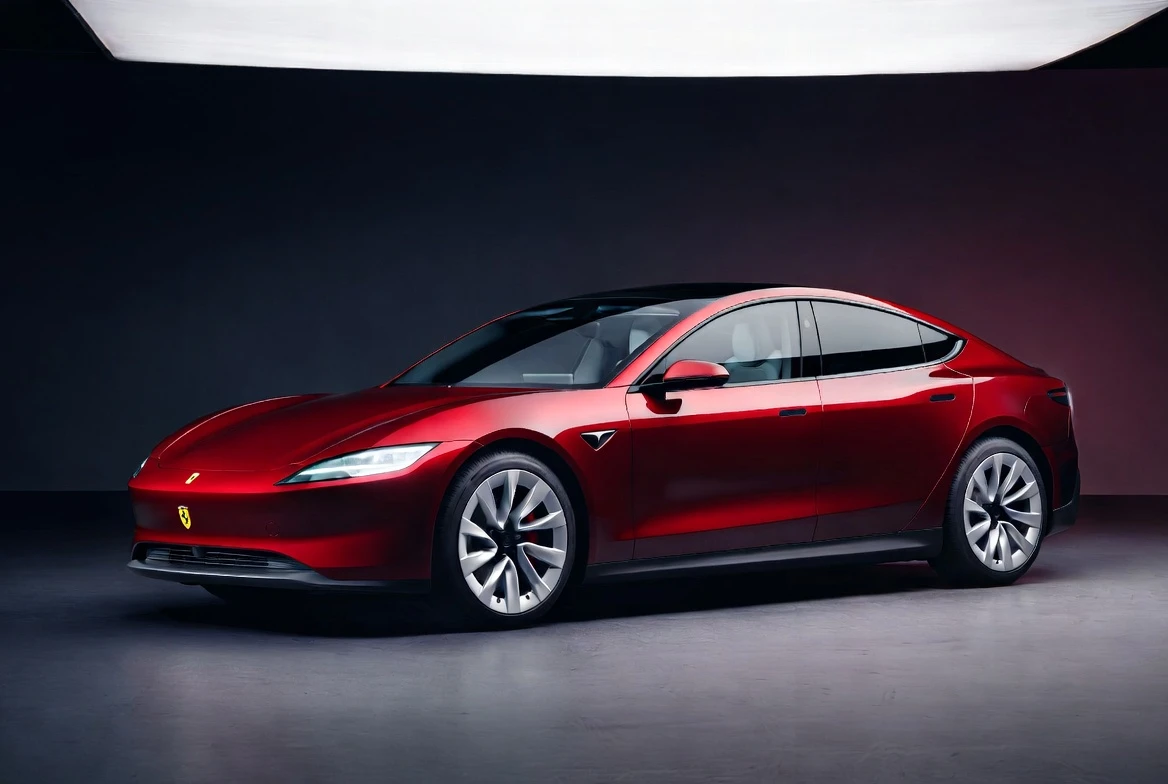
The Luce is the most technically ambitious vehicle Maranello has ever shipped: 1,036 horsepower, an 800-volt architecture, a 122-kilowatt-hour battery, more than 60 new patents, and a design signed by former Apple chief designer Jony Ive’s studio LoveFrom. It is also a four-door, five-seat liftback, and that single sentence is why a sitting Italian deputy prime minister felt confident weighing in on the styling of a private company’s product launch.
The Luce by the Numbers
The car Ferrari unveiled is a clean break from Maranello’s V8 and V12 lineage on every measurable axis. Four permanent-magnet motors, one at each wheel, produce 1,036 horsepower and push the 5-door sedan from 0 to 100 km/h in 2.5 seconds. Top speed lands at 310 km/h. The 122 kWh battery pack, built on an 800-volt architecture, delivers a WLTP range of 530 km and accepts up to 350 kW DC fast charging.
The interior is where the LoveFrom partnership shows most clearly. Where Tesla, Mercedes-Benz EQS, and Lucid have leaned hard into giant central touchscreens, the Luce keeps machined metal knobs, physical toggles, and tactile fan controls. It carries five seats, a first for the brand, and a 597-litre trunk, also a first.
| Spec | Ferrari Luce | Ferrari Purosangue (V12 SUV) |
|---|---|---|
| Powertrain | 4 electric motors, 122 kWh battery | 6.5L naturally aspirated V12 |
| Output | 1,036 hp | 715 hp |
| 0 to 100 km/h | 2.5 seconds | 3.3 seconds |
| Top speed | 310 km/h | 310 km/h |
| Seats | 5 | 4 |
| Starting price (Italy) | €550,000 | ~€390,000 |
| First deliveries | Q4 2026 (Europe) | 2023 |
At the listed Italian price, the Luce is the most expensive series-production car Ferrari has ever offered, sitting roughly €160,000 above the Purosangue. The first deliveries are scheduled for the fourth quarter of this year in Europe, with US customer cars following in 2027. Orders are already open.
Salvini’s Prancing Horse Line
The minister did not wait for the reviews to land. Matteo Salvini, leader of the Lega party and deputy prime minister with the transport portfolio, posted on X within hours of the reveal. His message ridiculed the silhouette and questioned whether Enzo Ferrari would have signed off on it. A few hours later, at a business event in Rome, he sharpened the line.
I hope that they take off the prancing horse from that car.
The speaker was Salvini, talking to reporters on the sidelines of an industry conference in Rome on Tuesday. Coming from a national transport minister about an Italian export icon’s flagship product on its launch day, the comment is closer to a political statement than a styling critique. Lega has spent the last three years building a constituency hostile to the European Union’s 2035 combustion-engine ban, and a government minister attacking Ferrari’s first electric car fits the playbook cleanly.
Carlo Calenda, founder of the Azione opposition party and a former industry minister who briefly worked at Ferrari in the early 2000s, joined from the other flank of Italian politics. He called the Luce “an aesthetic and technological insult” to anyone who loves the brand and questioned chairman John Elkann’s stewardship of the Agnelli family’s industrial portfolio. When a Salvini attack and a Calenda attack arrive on the same product within 24 hours, it is no longer a partisan moment. It is a consensus.
An 8.4% Day in Milan
Markets followed the rhetoric. The stock opened lower in Milan and closed at €284.05, an 8.4% drop on the day. New York-listed RACE shares closed down 5.3%. The single session erased roughly €4 billion in market capitalisation.
- -8.4%: Milan close on May 26, the worst single-day move for Ferrari stock since 2020
- -32%: rolling 12-month decline in the Milan listing heading into the reveal
- €4 billion: approximate market-cap erased in the post-launch session
- ~€640,000: starting price in US dollars at the prevailing FX rate
Several sell-side desks split the move into two components. One was a textbook “travel and arrive” reaction. Ferrari stock had run up into the reveal, and the unveiling itself removed the catalyst. The other was design hate, in the words of one analyst note circulating in London on Tuesday. The Luce’s profile sits closer to a Porsche Taycan or a long-wheelbase Tesla Model S than to anything that has carried a Ferrari badge before, and a meaningful slice of the existing shareholder base is also part of the existing customer base. Both groups looked at the same Rome photographs and reached the same conclusion at the same time.
Montezemolo, Calenda, and the Founders’ Loyalty Test
Luca Cordero di Montezemolo, who ran Ferrari as chairman from 1991 to 2014 and oversaw both the Schumacher dynasty and the company’s IPO preparation, gave the most quoted line of the day. He said publicly that if he stated what he truly thought, he would damage Ferrari, then added that the brand risks “the destruction of a myth.” His suggestion that the prancing horse be removed from the Luce predates Salvini’s by hours.
The institutional resistance is layered, and each layer matters to a different part of the buyer pool:
- The political layer. Salvini’s Lega and Calenda’s Azione almost never agree on anything. Their alignment here signals that the Luce sits on the wrong side of an Italian cultural fault line, not just a partisan one.
- The dynastic layer. Montezemolo is the most credible living link to the Enzo-era Ferrari mythology. His public coolness gives every skeptical collector permission to say the same thing at dinner parties in Modena and Milan.
- The dealer layer. Ferrari’s allocation system rewards loyal collectors who buy across the range. If the Luce is treated as the embarrassing cousin nobody asks for, the brand’s allocation leverage on the next limited-edition V12 falls with it.
Chief executive Benedetto Vigna, who took the job in 2021 and has spent four years steering the company toward this launch, offered the most disciplined reply available. He told Italian outlets that when a company develops a new technology it needs to remember a word called “respect.” The line lands, but it concedes that the audience he was speaking to was not buying.
Why Porsche and Lamborghini Are Watching
The Luce arrives into the worst luxury electric market in a decade. Porsche, the closest direct comparable, has been cutting back on electrification commitments since the second half of 2025. Deliveries fell 15% to 60,991 vehicles in the first three months of this year, profit collapsed 98% in 2025, and the Taycan has effectively disappeared from China, with fewer than 50 units registered there in January and February combined. Lamborghini quietly pushed back its first fully electric model, the Lanzador, and is now widely expected to keep it as a 2029-model-year product at the earliest.
The Demand Side
Buyers at the top of the market have not stopped spending. They have stopped spending on plug-in versions of the cars they used to buy on combustion. Bentley delayed its first EV. Aston Martin pushed its electric programme to 2027. Even Rolls-Royce’s Spectre, the cleanest execution in the category, sells in low four-figure annual volumes. The category that the Luce is meant to define does not yet exist in the form Maranello is betting on.
The Supply Side
Ferrari’s industrial answer is to make almost everything in house. Battery cells come from external suppliers, but the pack assembly, the motors, the inverters, and the software stack are all built at Maranello. The 60-plus patents Ferrari filed during development are spread across the e-axle, the side-slip control system rebuilt for instant torque, and the Vehicle Control Unit. The bet is that vertical integration will let Ferrari preserve gross margins when the rest of the luxury EV segment cannot.
The execution risk is that vertically integrated programmes are the most expensive to abandon if the demand never shows up. Porsche is finding that out one quarter at a time.
The October Calendar
European deliveries begin in the fourth quarter, with the first cars expected at dealers in October. That window is the next data point. Allocation lists for the Luce have been compiled for two years; Ferrari has not disclosed how many of those allocations have been converted to firm orders since the Rome reveal, and how many existing collectors have asked to swap their slot for a future combustion model.
Vigna’s revenue target for 2030 still leans on the Luce delivering meaningful volume, on the upcoming second EV programme being further along by the time it lands, and on the brand’s combustion lineup continuing to generate the gross margin that funds both. If the October cars start arriving into a market where Salvini’s line is still circulating and Montezemolo’s still gets a sympathetic nod at the Maranello factory gates, the equity story changes. If the cars deliver on time, the early reviews land cleanly, and the first owners post pictures that look more like Ferraris than the renders did, the May share-price move will read as noise.
The horse is still on the car. Whether it stays there depends on what happens between now and the first delivery.






Spotify Running Mode hits Android and revives its old tempo experiment

Galaxy Tab S12 Ultra Renders Keep the Notch Fans Hate

Novato Spinning Round House Sells With Six Neighbors for $3.3 Million

Crop Tour Finds Indiana and Nebraska Corn Yields Lagging 2025

Best Buy 60th sale brings Android deals back to its roots

American Airlines reverses seatback screen bet years too late

Iran Hormuz Strikes Force Gulf Oil Onto Costlier Paths

Plague Tale Prequel Day One Joins Game Pass Wave 2 as Witcher Exits

NBA 2K27 opens The City to everyone and rewrites career eras

iOS 26.6.1 Patches 29 Flaws as AI Forces Faster Apple Updates

Double Fine Cuts 23 Jobs Weeks After Xbox Independence

Day-One Big Walk Lifts PS Plus August Beyond Recycled AAA

John Hight Exits Wizards After Digital Reckoning Hits

Curtis Mead’s Red Sox Debut Ends With Fractured Wrist

Red Sox Squander Hot Streak Chance in 4-3 Loss to Athletics

Moesch and Dressel Rewrite Night One at 2026 U.S. Nationals

Boutte’s Quiet Camp Takeover Forces Patriots Receiver Choices

Take-Two CEO Pushes Netflix Subs for GTA 6 Extended Look

Halo Campaign Evolved Skulls Meet Death Barriers That Kill the Hunt

Wildlands Free Update Hands Players the Tools They Already Invented
-

 TECHNOLOGY3 years ago
How to Adjust a Bulova Watch Band – An Easy Guide
-

 News3 years ago
Fred Pentland: Athletic Bilbao’s English mentor who changed the essence of Spanish football
-

 FINANCE3 years ago
Tax Planning for Every Season: Guide to Maximizing Your Tax Benefits
-

 Education3 years ago
African Ministers New Education Plan
-

 BUSINESS3 years ago
What is Entrepreneurial Operating System? A Comprehensive Guide to EOS
-

 Education3 years ago
Innovate Your Learning Journey with Technology and Enhance Education
-

 News3 years ago
Russians formally out of World Athletics Championships
-

 BUSINESS3 years ago
Top 9 Most Expensive American Cities to Rent an Apartment