
LIFESTYLE
Costco Grapevine Recall Tests California’s 25-Year Pest Defense Line

The numbers from a single nursery in Fresno County now drive a six-county pest emergency. Costco received 854 staked grapevines from Burchell Nursery, Inc. between April 21 and May 21, and inspectors have so far destroyed 304 of them. The other 550 sit in residential yards, patios and back gardens across Napa, Sonoma, Marin, Solano, Yolo and Yuba counties, each potentially carrying eggs, nymphs or adults of the glassy-winged sharpshooter (GWSS, an invasive leafhopper that vectors the bacterium behind Pierce’s disease).
California has spent roughly 25 years and about $45 million a year keeping this exact insect out of the northern wine valleys. A pallet of staked grapevines just exposed how thin that perimeter can get.
Inside the Costco Shipment from Burchell
The trace begins in Fresno County on April 21. Burchell Nursery, a long-established wholesale producer of fruit, nut and vine stock based in the San Joaquin Valley, shipped 854 grapevines (Costco SKU #197266, sold as Staked Grape Vine) on a single truck route serving six Costco warehouses across Northern California.
Inspectors at the Santa Rosa store identified pest activity first. On May 19 the warehouse flagged the shipment to the Sonoma County Agricultural Commissioner. County offices in Napa, Marin, Solano and Yolo opened parallel intercepts within 48 hours. By midweek, investigators had recovered 304 plants of the original 854, with 63 destroyed at the Napa warehouse alone after one GWSS egg mass was confirmed on a vine still in the store.
The remainder is the operational problem. Costco is contacting individual members through purchase records tied to the SKU, but more than 550 grapevines have already left the warehouse with customers.
| Costco location | Plants received | Destroyed | Unaccounted |
|---|---|---|---|
| Santa Rosa and Rohnert Park (combined) | 634 | 241 | 393 |
| Napa | 220 | 63 | 157 |
| Combined total | 854 | 304 | 550 |
“Vigilance and prompt reporting are essential,” said Tracy Cleveland, Napa County Agricultural Commissioner, in a statement urging buyers to call the county before touching the plant. The Marysville warehouse in Yuba County extended the consumer alert to citrus stock as well, after the same supplier corridor reached the Sacramento Valley.
What Residents Should Do This Week
The instructions are deliberately specific. The wrong move spreads the pest faster than no move at all, because eggs hidden on the underside of a leaf travel with the plant.
If you bought a grapevine from any of the named Costco stores between April 21 and May 21, the protocol from the county commissioner offices is:
- Do not return the plant to the store and do not transport it elsewhere. Moving the vine moves the pest, including egg masses you cannot see.
- For grapevines, place two large garbage bags over the plant and secure them tightly at the base. Leave the plant where it stands until inspectors arrive.
- For citrus purchased from the Marysville Costco beginning May 21, do not bag the plant. Schedule an in-place inspection through the county agriculture office.
- Do not place the vine in the trash, green-waste container or backyard compost. All three vectors push the insect into neighbouring properties.
- Call the county where you live. Yuba County runs the consumer line at 530-749-5400 or yubaag@yuba.gov; Sutter at 530-822-7500; Colusa at 530-458-0580; Nevada at 530-470-2690. Bay-area counties are taking calls through their respective commissioner offices.
The grapes a Costco shopper buys in the produce aisle are not part of this alert. The plants in question were nursery vines sold for backyard planting and landscaping, not table grapes intended for consumption.
Why the North Has Stayed Sharpshooter Free Since the 1990s
The Temecula Outbreak That Set the Rules
In August 1999, more than 300 acres of grapevines in the Temecula Valley were destroyed in the first major Pierce’s disease outbreak tied to GWSS, establishing the insect as a vineyard killer rather than a backyard nuisance. The pest, native to the southeastern United States and northern Mexico, had been quietly establishing in Orange and Ventura counties since 1989, almost certainly arriving on infested ornamental nursery stock from the Gulf states. By the time growers connected the dots, southern California already had a permanent infestation.
The Nursery Stock Approved Treatment Protocol
California’s institutional response was the Nursery Stock Approved Treatment Protocol, signed between CDFA and shipping nurseries operating in infested counties. Outbound shipments to GWSS-free counties must be foliar-treated under county supervision with carbaryl or fenpropathrin, inspected for all life stages, and certified clean by the origin county commissioner before loading. The treatment manual is the spine of the program every wholesale nursery moving plants north of Kern County is supposed to follow.
A Containment Line With a 36-County Footprint
In the program’s 2024 review filed to the state legislature, water-sensitive papers placed in shipments by CDFA staff caught 16 retreatment-trigger events out of 307 inspections. Thirty-six counties received treated shipments that year. None contained viable insects. That clean record is what the Burchell trace just interrupted, and why six county offices are working the recovery in parallel rather than handing it to one lead agency.
The $110 Million Bill Behind the Alert
The economics explain why an 854-plant trace mobilises six county departments inside 72 hours.
A 2025 study from UC Davis’s Robert Mondavi Institute Center for Wine Economics, led by economist Julian Alston, put the current annual cost of Pierce’s disease in California at $110 million, with the containment program already running.
- $45 million spent annually on control, prevention and research, jointly funded by USDA APHIS (Animal and Plant Health Inspection Service), a winegrape grower assessment, and the State General Fund on occasion.
- $48 million in lost winegrape production and vineyard replanting tied to the disease in a normal year.
- $17 million in lost table and raisin grape revenue, plus the vine replacement that follows.
- $56 million in additional losses the program prevents every year by keeping GWSS out of the major wine regions, per the UC Davis estimate.
The wider exposure is bigger. California’s grape and wine industry generates $73 billion in state economic activity and $170.5 billion nationally, according to the same dataset the CDFA Pierce’s Disease Control Program cites for its grower-led advisory board. The containment perimeter is what stops that exposure from doubling.
How a Single Egg Mass Becomes a Vineyard Problem
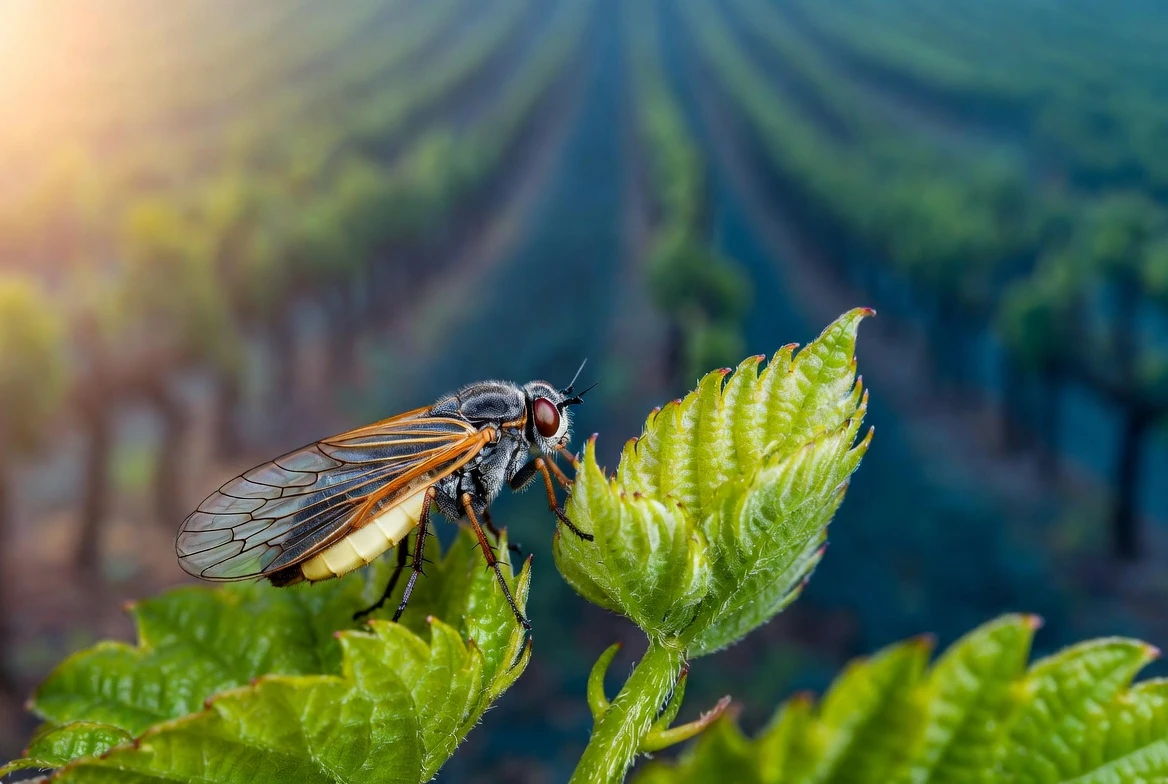
The insect itself looks unremarkable. About half an inch long, dark brown, translucent wings, the kind of bug a homeowner brushes off a tomato plant without a second look.
The biology is the problem. UC Riverside’s Center for Invasive Species Research notes that GWSS feeds by inserting straw-like mouthparts into the xylem (the water-conducting tissue) of host plants. Because xylem sap is dilute, the insect must consume large volumes, and it picks up Xylella fastidiosa bacteria from infected plants and delivers them into the next host with every feeding. Its host range covers roughly 250 plant species, including almond, citrus, oleander, alfalfa and stone fruit. A single insect in a residential yard can hop between an apricot tree, a citrus hedge and a neighbour’s grapevine within days.
There’s still a chance to claw those vines back and make sure there won’t be a spread.
That window, described by Chris D’Alo, a viticulturist at Nord Vineyard Services, is what the next two weeks will test. If most of the 550 unaccounted vines are recovered intact and bagged in place, the Napa-Sonoma containment line holds and the cost stays at inspection and disposal. If one vine harbours an egg mass that hatches in a residential yard next to a commercial vineyard, the same program that has been saving growers $56 million a year starts spending that figure backward.
Frequently Asked Questions
Which Costco stores sold the affected grapevines?
Plants from the Burchell shipment reached Costco warehouses in Santa Rosa, Rohnert Park, Napa and Novato, with related grape and citrus stock also flagged at the Marysville store in Yuba County. The affected SKU was Item #197266, sold as Staked Grape Vine, between April 21 and May 21.
Can I still eat grapes I bought from Costco?
Yes. The alert covers nursery grapevines sold for backyard planting, not table grapes sold in the produce aisle. Grapes intended for eating are not part of this recall and are unaffected.
What if I already planted the grapevine in my yard?
Do not dig it up or move it. Call your county agriculture department and request an in-place inspection. Disturbing a planted vine can dislodge eggs or adult insects and spread them across the property before officials arrive.
Will Costco issue a refund?
Costco is contacting affected members directly through purchase records tied to the grapevine SKU and is coordinating with county agriculture offices on the recovery. The retailer has signalled it will work with members on the purchase, but residents should not return the plant to the store under any circumstance.
Why is the glassy-winged sharpshooter worse than native sharpshooters?
Native blue-green sharpshooters carry the same bacterium, but they prefer riparian vegetation away from vineyards and rarely move into commercial blocks. GWSS flies farther, feeds on roughly 250 plant species, tolerates the dry interior climate, and lays eggs on a wide range of ornamental hosts. That combination is what produced the 1999 Temecula outbreak and what California has worked to keep north of the Tehachapis ever since.


Applied Digital Breaks Ground on $3.6B Delta Forge 1 in Louisiana

Nasal Spray Reverses Brain Aging in Aged Mice, Texas A&M Study Finds

Nvidia Retires Its 20-Year Control Panel as 610.47 Driver Ships

PS Plus June 2026 Free Games Lean on Two Xbox-Born Co-Ops

Logitech’s Signature Comfort Plus Adds Cushioned Mice and Keyboard From $40

KeySmart SmartCard Pro Doubles Find Hub Wallet Tracker Battery Life

Apple Builds an iPhone Snatch Lock as Android’s Lead Hits 19 Months

Dodge Bets the Copperhead SRT Can Refill Its Halo White Space by 2030

Lilly Drops $3.83B on Vaccines Targeting Roots of Chronic Disease

GoPro Mission 1 Pro Review: A $699 Bet on 8K Video Quality

Mitchell Matches Kobe in Game 7 Rout, Cavaliers Reach East Finals

Shai Gilgeous-Alexander Wins Second Straight MVP With 83 of 100 First-Place Votes

Colt Emerson Debuts, Mariners Get Swept by Padres in Vedder Cup

Brent at $111 Hides the Hormuz Damage Hitting Fed and Asia

Jaylen Brown Calls Stephen A. Smith the Face of Clickbait Media

Samsung Strike Looms May 21 as Union Eyes SK Hynix Bonus Formula

Xperia 1 VIII Holds Price, Xiaomi 17 Max Loads Up: Week 20 Phone News

Rousey Finishes Carano in 17 Seconds and Hands Netflix Its MMA Opening

LIRR Strike Hits Third Day as 250,000 Commuters Face a Tougher Manhattan Run

Santa Marta’s Fossil Fuel Exit Plan Puts Scotland’s Drilling U-Turn on the Clock
-

 TECHNOLOGY3 years ago
How to Adjust a Bulova Watch Band – An Easy Guide
-

 FINANCE3 years ago
Tax Planning for Every Season: Guide to Maximizing Your Tax Benefits
-

 News3 years ago
Fred Pentland: Athletic Bilbao’s English mentor who changed the essence of Spanish football
-

 Education3 years ago
African Ministers New Education Plan
-

 BUSINESS3 years ago
What is Entrepreneurial Operating System? A Comprehensive Guide to EOS
-

 Education3 years ago
Innovate Your Learning Journey with Technology and Enhance Education
-

 News3 years ago
Russians formally out of World Athletics Championships
-

 BUSINESS3 years ago
Top 9 Most Expensive American Cities to Rent an Apartment