
BUSINESS
ExxonMobil Shareholders Vote 71% to Move Legal Home to Texas

ExxonMobil shareholders on Wednesday voted 71.3% in favor of moving the oil major’s legal home from New Jersey to Texas, ending a corporate domicile that has held since the company filed as Standard Oil of New Jersey in 1882. The proposal cleared with about 88.1% of outstanding shares represented at the virtual annual meeting in Spring, Texas, according to ExxonMobil’s preliminary proxy voting summary.
The vote landed on the same day legal academics published a one-year retrospective on Texas Senate Bill 21, the law that built out a specialized business court and rewrote enough of the Texas Business Organizations Code to start pulling Fortune 500 charters out of Delaware. Wednesday’s result hands that court its biggest customer to date.
The Vote and the Reasoning Behind the Board’s Push
ExxonMobil’s board recommended the move unanimously in March, framing the change as a paperwork update rather than a governance shift. The company’s operational headquarters has been in Texas since 1989, when it left Manhattan for Irving, then later consolidated in a campus north of Houston. About 75% of its U.S. workforce sits in the state.
Darren Woods, the company’s chief executive, argued in the proxy that the redomicile aligns the legal entity with the operating reality. Texas, he wrote, offers “lawmakers, judges and juries” with better familiarity with the oil and gas industry. The board did not promise a tax saving or a financial bump; the case rested on judicial familiarity and what the company called regulatory alignment.
Wednesday’s tally is preliminary. Final certified results will arrive in an 8-K filing within four business days. The board has indicated the redomicile will proceed by statutory merger into a Texas successor corporation, the same mechanism Tesla and Coinbase used.
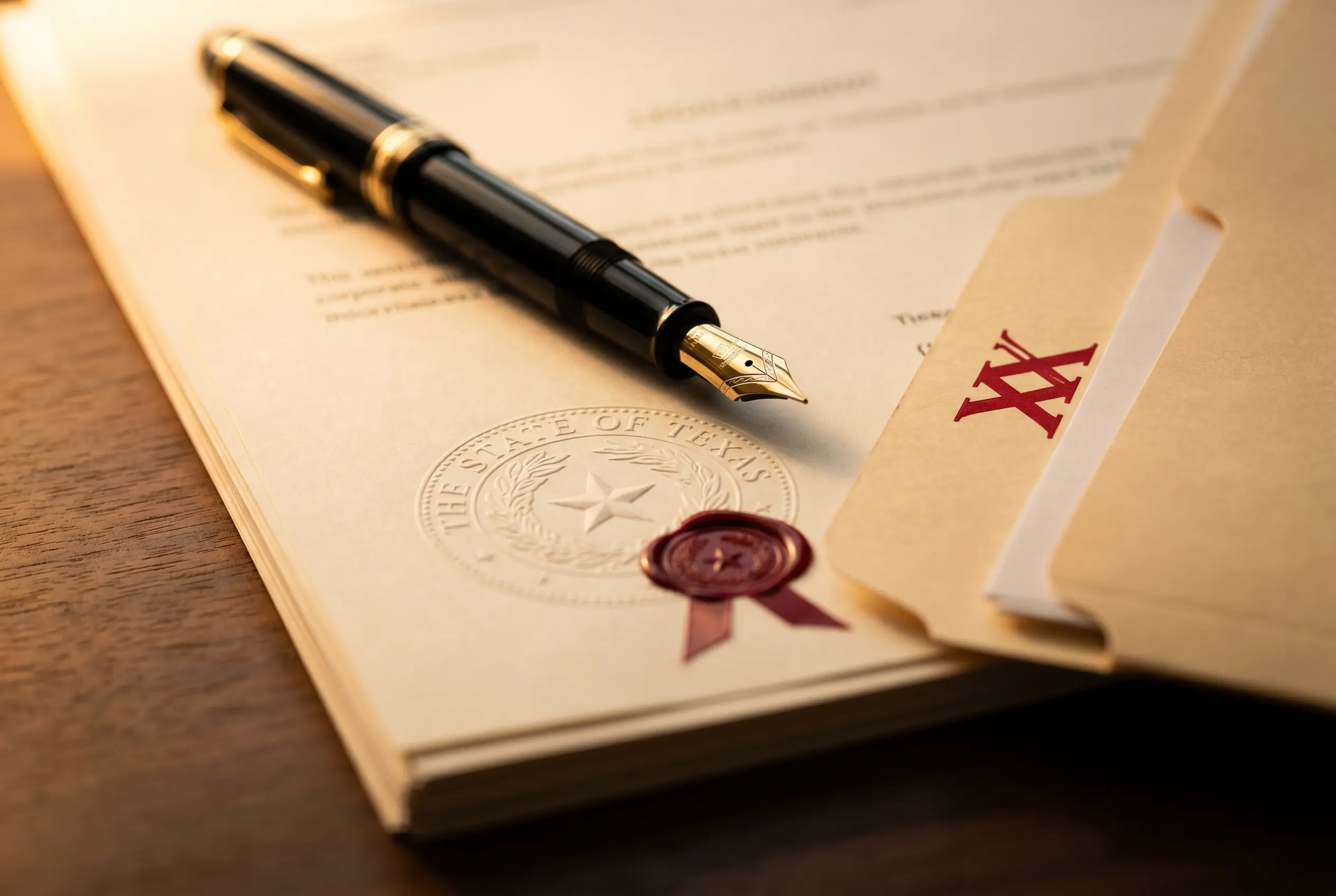
Texas Spent Two Years Building a Court for This Moment
The Texas Business Court opened for filings on September 1, 2024, after the state legislature created it in 2023. It is modeled, openly, on Delaware’s Court of Chancery: a single bench of judges handling complex commercial disputes, written opinions, no juries on most internal-affairs questions.
The Bench and the Backlog
The court is divided into eleven divisions covering Texas’s major metropolitan corridors. Sitting judges include Bill Whitehill in the First Division, Jerry Bullard in the Eighth, and a roster covering the Eleventh that has already published opinions on trade-secret misappropriation and fiduciary duty in Unimacts Global v. Ayr Energy this month. Decisions have been arriving in volume since March.
The Legislative Floor Underneath It
Two laws make the court attractive to issuers used to Delaware practice:
- Senate Bill 21 (2023), which created the business court itself and adopted a version of the business-judgment rule that mirrors Delaware case law for officer and director liability.
- Senate Bill 29 (2025), which lets Texas-chartered public companies adopt a bylaw or charter provision requiring shareholders to hold at least 3% of outstanding shares before bringing a derivative lawsuit, and to clear a $1 million test before submitting a shareholder proposal.
- A 2025 amendment to the Texas Business Organizations Code that allows Texas entities to write a Texas Business Court forum-selection clause into their governing documents.
SB 29’s threshold survived its first court challenge on March 17, when a federal judge dismissed a derivative action against Southwest Airlines in Gusinsky v. Southwest Airlines Co. The court enforced a 3% bylaw against a plaintiff who held a fraction of a percent. That ruling, more than the marketing from Austin, is what changed how plaintiffs’ firms look at the trade.
The Shareholder Rights Trade-Off ExxonMobil Did Not Pre-Commit On
Both Institutional Shareholder Services (ISS, the larger of the two proxy advisors that publish recommendations to institutional investors) and Glass Lewis recommended a vote against the redomicile. Their objection was not that Texas is unfamiliar law. It was that Texas law gives boards optional tools that materially raise the cost of suing them.
ExxonMobil’s proxy statement said the company would not, at the moment of the redomicile, adopt either the 3% derivative threshold or the $1 million proposal floor. It stopped short of binding itself against future adoption.
Aligning our legal home with our operating home, in a state that understands our business and has a stake in the company’s success, is important.
That sentence, from Woods’s March statement, is the spine of the company’s pitch. What it does not address is whether the Texas-friendly toolkit gets used later, after the redomicile is irreversible. A federal court has now confirmed those tools are enforceable. Adopting them takes a board vote, not a shareholder vote.
What ISS Actually Flagged
The ISS recommendation, summarized in coverage by law-firm guidance on the ExxonMobil reincorporation, ran the math from the other direction: even with no immediate change to bylaws, the option value of SB 29 sits with the board after the move, and shareholders lose the bargaining chip of having to consent to a future amendment that would import the same provisions into a Delaware-chartered entity.
The AG’s Response
Texas Attorney General Ken Paxton sued ISS in September 2025 for what his office called misleading institutional investors, citing the firm’s recommendation against the ExxonMobil move as one example. Paxton also filed under the Texas Deceptive Trade Practices Act seeking civil penalties of up to $10,000 per violation. ISS and Glass Lewis countersued, challenging a separate Texas law (SB 2337) that requires proxy advisors to flag when recommendations rest on non-financial factors. A federal judge has blocked enforcement against both firms while the case is heard.
Tesla Started the Pattern, Dell Is the Next Test
ExxonMobil is the largest company by market capitalization to put a redomicile to a shareholder vote, but it is not breaking new ground. Tesla and SpaceX moved their charters to Texas in 2024 after a Delaware Chancery judge voided Elon Musk’s $56 billion pay package. Coinbase filed to leave Delaware in late 2025, citing what it described as Delaware’s litigious legal climate. Dell Technologies has its own shareholder vote on a Texas move scheduled for Dell’s June 2026 annual meeting filing.
| Company | Prior domicile | Vote / filing | Stated reason |
|---|---|---|---|
| Tesla | Delaware | 2024 shareholder vote | Chancery ruling on CEO pay |
| SpaceX | Delaware | 2024 conversion | Litigation climate |
| Coinbase | Delaware | Filed Nov 2025 | Litigation climate |
| Dell Technologies | Delaware | Vote June 25, 2026 | Founder roots in Austin |
| ExxonMobil | New Jersey | Approved May 27, 2026 | Operations alignment |
The pace is picking up. Through the first five months of this year, nine Texas reincorporation announcements have been made by publicly traded issuers, against seven for Nevada. Texas’s count has already exceeded its full-year 2025 total of eight.
Delaware’s Slow Bleed Is Real but Narrower than Houston Says
James Lee, chief executive of the Dallas-based Texas Stock Exchange, said in a Wednesday statement that Wednesday’s vote signaled that “hundreds of companies representing trillions of dollars in market capitalization are poised to make similar moves.” The franchise-tax data tells a quieter story.
- $2.2 billion: Delaware’s annual franchise-tax stream, roughly one-third of the state budget.
- Under $10 million: The estimated annual franchise-tax loss from every high-profile DExit combined, less than 0.5% of the stream.
- 100,000: Net new Delaware-formed entities between 2024 and 2025, bringing the registered base to 2.2 million.
- Flat: Corporate franchise-tax receipts in Delaware between December 2025 and March 2026, with the state’s Revenue Estimating Council projecting no growth in fiscal years 2027 or 2028.
The mismatch is the structure of the Delaware advantage. Big public-company redomiciles get the headlines, but the franchise tax is a per-entity charge that scales mostly on share count and assumed par value. Losing a dozen large filers does not dent a base of 2.2 million entities, most of them LLCs and holding vehicles. Where Delaware will feel real pain is if the formation rate slows, not when the marquee names leave.
The other Delaware export at risk is the case law itself. Court of Chancery opinions are the reference text that corporate lawyers across the country draft against. If Texas builds enough volume in its business court to start producing its own reference set, the network effect that has held Delaware in place for a century starts to leak.
The Politics Sitting Behind the Filing
Wednesday’s vote did not happen in a neutral environment. Paxton’s investigation of ISS and Glass Lewis, the SB 2337 disclosure law, and a string of executive actions targeting environmental, social and governance frameworks form the policy backdrop. Conservative shareholders, including activist firms aligned with the state’s political leadership, voted enthusiastically for the move.
The activist groups that historically push climate-disclosure resolutions at ExxonMobil’s annual meeting voted against the redomicile. Climate-focused investors warned that a Texas charter, combined with the option to invoke SB 29’s thresholds, would make future Rule 14a-8 shareholder proposals on emissions and reserves harder to file and easier to exclude.
The deeper context is that ExxonMobil’s legal home has been more symbolic than functional since the early 1990s. The company already pays New Jersey nothing meaningful in tax under that incorporation; its disputes have been litigated across federal courts and in Houston and Dallas for decades. What the New Jersey charter did give was a default to Delaware-derived corporate law principles that have set the boundaries of shareholder activism since the 1980s.
Wednesday traded that default for a Texas one. The Texas one is friendlier to boards. It is also younger, with fewer reported decisions and less predictability when an edge case lands.
What Happens After ExxonMobil Files in Austin
The next concrete step is administrative. ExxonMobil will file a certificate of conversion with the Texas Secretary of State and a corresponding filing with New Jersey to dissolve the existing charter. The board will adopt restated bylaws under Texas law. Those bylaws are where the SB 29 questions get answered for real. If ExxonMobil holds to its proxy commitment and leaves the derivative threshold and the proposal floor out, the Glass Lewis and ISS objections collapse into a difference about future option value. If the bylaws import either provision, the trade-off the advisors warned about becomes the trade-off the company made.
Dell’s June 25 vote will arrive before the ExxonMobil filing fully closes. If Dell passes by a similar margin and follows the same no-immediate-adoption posture, the template for the next wave is set. If a board moves more aggressively, the early adopters of SB 29’s full toolkit will define what a Texas charter actually means in practice, and whether shareholders’ optimistic read of Wednesday’s vote needs revisiting.






NFL Three-Strike Safety Fouls Now Pull Coaches and Clubs In

Browns Fans Tape Protest Signs to Jim Brown Statue Over Watson

Amazon Pixel 11 Deal Erases the $100 Hike for One More Day

Elden Ring on Switch 2 Turns Its Own Worst Label Into a Portable Win

Ternus Takes the Stage With Apple’s Foldable Debut

Ikea Xbox Yxstaby Turns Controller Thumbstick Into Home Furniture

Pokémon Center Turns Past Worlds Wins Into Bundles and a Pikachu Coin

NFL Scraps Pro Bowl Game to Restore Pure Player Honor

New Twitter.now Bets the Brand Musk Left Behind

Bella Mir’s Famous First Loss Meets the Accountant Who Won

Take-Two CEO Pushes Netflix Subs for GTA 6 Extended Look

Halo Campaign Evolved Skulls Meet Death Barriers That Kill the Hunt

Wildlands Free Update Hands Players the Tools They Already Invented

Quake Gets 19 Free Maps From MachineGames Quake Club

Destiny 2 Fans Unlock Vaulted Maps After Live Service Ends

Stripe Bid Shows PayPal Moat Cracked After Years of Slide

Quordle Monday Delivers Gavel Crush Speed Ethos Cleanly

Tyson’s Five-Year Utah Plant Falls to Cattle Shortage Reckoning

Silver Lake Workday Talks Signal Private Floor for Software

Kennedy Lewis Takes Majority Control of The Greenbrier in $500M Deal
-

 TECHNOLOGY3 years ago
How to Adjust a Bulova Watch Band – An Easy Guide
-

 News3 years ago
Fred Pentland: Athletic Bilbao’s English mentor who changed the essence of Spanish football
-

 FINANCE3 years ago
Tax Planning for Every Season: Guide to Maximizing Your Tax Benefits
-

 Education3 years ago
African Ministers New Education Plan
-

 BUSINESS3 years ago
What is Entrepreneurial Operating System? A Comprehensive Guide to EOS
-

 Education3 years ago
Innovate Your Learning Journey with Technology and Enhance Education
-

 News3 years ago
Russians formally out of World Athletics Championships
-

 BUSINESS3 years ago
Top 9 Most Expensive American Cities to Rent an Apartment