
News
July 4th Storms and Heat Leave 600,000 Without Power on US 250th
Severe storms and a record heat wave disrupted July 4th, 2026 celebrations across the US, leaving over 600,000 without power and killing three children on a Wisconsin lake.

A punishing heat wave and a fast-moving line of severe storms converged on the country’s 250th Independence Day on July 4, 2026, leaving more than 600,000 utility customers without power across four states by Sunday morning, emptying the National Mall twice, canceling or reshaping holiday celebrations from Hartford to Harrisburg, and killing three children on a Wisconsin lake. The reckoning came in two acts: a heat dome that set temperature records from New York to the nation’s capital, and a thunderstorm complex that used the heat’s fuel to rip through the Northeast and Midwest at peak holiday hours.
The cascade unfolded as millions of Americans tried to mark the semiquincentennial outdoors. PowerOutage.us reported that more than 600,000 utility customers remained powerless in Michigan, New Jersey, New York and Pennsylvania on Sunday morning. The figure had peaked at about 750,000 customers across those states plus Wisconsin, Illinois and Ohio at noon on Saturday, with nearly 1 million customers affected at the system’s worst points. Hundreds of restoration crew members from 12 states and Canada were dispatched to Michigan on Saturday afternoon to help speed recovery, according to CBS Detroit.
The Heat Dome That Set the Stage
The atmosphere over the Eastern United States had been baking for days before the fireworks. The National Weather Service’s Weather Prediction Center said on the night of July 4 that the ongoing heat wave had tied or broken numerous temperature records across the Eastern U.S. over the prior week. Central Park in New York hit a sweltering 98 degrees on Friday, CBS New York reported, and the city spent the holiday weekend under a heat alert. Atlantic City, New Jersey, recorded 105 degrees on Saturday, its highest July temperature on record, the Weather Prediction Center said.
Washington, D.C. entered the holiday under its own record. The National Weather Service said the capital set an all-time warmest low temperature at 84 degrees, a mark that did not break by the time the sun rose. By noon on July Fourth, temperatures across the Northeast were already climbing back toward triple digits, and the Great American State Fair on the National Mall temporarily closed the previous day after D.C. Fire and EMS logged 45 patient contacts and 16 patient transports, though it was unclear how many of those calls were heat-related. A 79-year-old woman later experienced a heat-related emergency at the Salute to America 250 Celebration and Fireworks and was transported to a local hospital, the National Special Security Event Joint Information Center said.
Storms Tear Through the Northeast
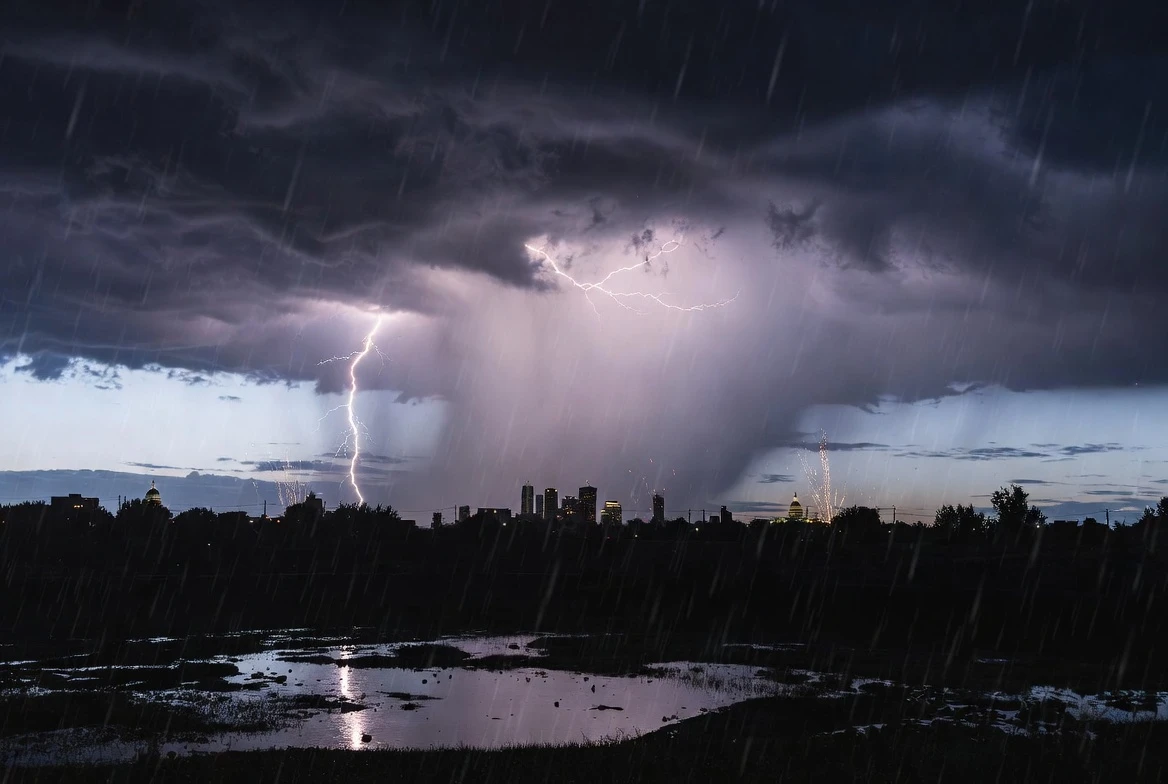
The heat dome did more than wilt crowds. It fed the thunderstorm complex that swept from the Midwest into the Northeast on Friday night and Saturday. The storm that struck the New York area late Friday left hundreds of thousands of utility customers in the dark in the middle of the heat wave, and wind gusts reached 70 mph in places like Perth Amboy, New Jersey. Trains into New Jersey were canceled or delayed, and hundreds of trees were damaged or uprooted across the region.
By Sunday morning, the bulk of the outages had settled into four states. PowerOutage.us tallied the remaining damage: Michigan, Pennsylvania, New Jersey and New York. Cities moved through the storm with widely different results. Boston cleared its fireworks and concert event after a brief shelter-in-place. Philadelphia ordered an evacuation, as did Washington. New York and Pittsburgh ran their fireworks shows but shifted the start times to clear the weather. Belleville, New Jersey Mayor Frank Velez took a harder line, telling residents his town would reschedule its fireworks for next year: “While we’re disappointed we couldn’t celebrate together tonight, your safety will always come first.”
Holiday Schedules Shattered Across the Region
From Connecticut to Maryland, the calendar gave way to the radar. Annapolis, home of the U.S. Naval Academy, canceled its Independence Day Parade and the Naval Academy Electric Brigade concert the morning of July Fourth, citing “a forecast of severe weather, as well as wind and extreme heat,” according to the city’s Office of Emergency Management. Philadelphia’s Salute to Independence Parade was canceled Friday due to the heat, and the city later said its One Philly Unity Concert was “stopped until further notice due to impending severe storms.”
The patchwork of cancellations and adjustments played out across the holiday’s biggest venues:
- Hartford, Connecticut: July Fourth celebrations canceled over the weather.
- Harrisburg and Wilkes-Barre, Pennsylvania: Holiday events canceled.
- Boston: Fireworks and concert event paused, then resumed after the storm passed.
- Philadelphia and Washington, D.C.: Evacuations ordered; fireworks shows in D.C. rescheduled hours later.
- New York and Pittsburgh: Fireworks moved forward with delayed start times.
On the National Mall, the Freedom 250 celebration briefly emptied twice. Signs at the Great American State Fair posted an alert shortly after 7 p.m. ET on Saturday encouraging participants to leave and prompting crowds to gather in museums, subway stations and federal buildings near the Mall. Some waited in chairs and sat on the floor of the Ronald Reagan Building and International Trade Center to cool off in the air conditioning. “A severe thunderstorm is occurring near the National Mall,” D.C. Homeland Security and Emergency Management said in its evacuation notice. “Seek shelter immediately. Do not wait. Follow instructions from event staff and public safety officials on site.”
A President’s Speech Delayed, Then Delivered
President Donald Trump had been scheduled to deliver remarks at 9:45 p.m. Eastern Time, according to Freedom 250 organizers. After the evacuation, organizers announced on social media that the gates would reopen at 9:45 p.m. and that the president would deliver remarks at 11:00 p.m. “Rain or shine, the American people deserve a celebration worthy of our nation’s historic 250th birthday,” the Freedom 250 account posted. The speech was ultimately delayed by about two hours.
Earlier in the day, Trump had posted on his own social media account that “despite the heat, which isn’t as bad as predicted, the crowds in D.C. are INCREDIBLE!” As the storm closed in, he struck a different tone:
Storms bring luck to whatever the occasion. They also make events a little bit more exciting! We will wait it out, I don’t care if it’s 2:00 O’Clock in the morning, or in one hour from now. Looks like it is going to pass, they always do.
He added: “I will be there no matter what, but the ‘what’ usually turns out to be a good thing.” The president delivered his remarks at the rescheduled time, with the fireworks following into the early hours of July 5.
A Lake Becomes a Crime Scene in Wisconsin
Farther west, the same storm system turned a holiday weekend outing on Geneva Lake in Wisconsin into a triple-fatality scene. A privately owned recreational motorboat carrying 10 occupants, including four children, tried to race to safety before being overwhelmed by severe wind and waves, the city’s police department said. The boat took on water, capsized and sank. Six adults and a child were rescued from the water, but three children recovered from the lake after an intensive search were unresponsive to lifesaving measures, police said. A source who spoke to CBS News Chicago said the three victims were believed to all be under the age of 13. Officials confirmed all four children on board were wearing life jackets.
Lake Geneva Mayor Todd Krause declared an emergency after the storm. One person suffered minor injuries from a falling tree, and downed power lines and trees blocked some streets. The Wisconsin Department of Natural Resources and the Geneva Lake Law Enforcement Agency were investigating. The city’s police department blamed the capsizing on a “sudden and severe storm” that “rapidly produced hazards for boats” on the lake.
What the Morning After Left Behind
By Sunday morning, the storm had moved on but the heat had not. Restoration crews from 12 states and Canada were working through Michigan, where the bulk of the remaining outages sat, and utilities in New Jersey, New York and Pennsylvania were racing to reconnect customers before the next round of daytime highs. The NWS Prediction Center said the heat wave had been setting records for a full week, and forecasters warned the Eastern U.S. was not done baking. For a country trying to celebrate its 250th birthday outside, the weather had offered a different kind of anniversary: a reminder of how thin the margin is between a holiday gathering and a mass-casualty event when a heat dome and a storm cell arrive on the same calendar date.




Spotify Running Mode hits Android and revives its old tempo experiment

Galaxy Tab S12 Ultra Renders Keep the Notch Fans Hate

Novato Spinning Round House Sells With Six Neighbors for $3.3 Million

Crop Tour Finds Indiana and Nebraska Corn Yields Lagging 2025

Best Buy 60th sale brings Android deals back to its roots

American Airlines reverses seatback screen bet years too late

Iran Hormuz Strikes Force Gulf Oil Onto Costlier Paths

Plague Tale Prequel Day One Joins Game Pass Wave 2 as Witcher Exits

NBA 2K27 opens The City to everyone and rewrites career eras

iOS 26.6.1 Patches 29 Flaws as AI Forces Faster Apple Updates

Caitlin Clark Skips the WNBA 3-Point Contest for a Third Straight Year

Rainout Gives Red Sox Two Shots at a Franchise-Record Win Streak

Double Fine Cuts 23 Jobs Weeks After Xbox Independence

Day-One Big Walk Lifts PS Plus August Beyond Recycled AAA

John Hight Exits Wizards After Digital Reckoning Hits

Curtis Mead’s Red Sox Debut Ends With Fractured Wrist

Moesch and Dressel Rewrite Night One at 2026 U.S. Nationals

Red Sox Squander Hot Streak Chance in 4-3 Loss to Athletics

Boutte’s Quiet Camp Takeover Forces Patriots Receiver Choices

Take-Two CEO Pushes Netflix Subs for GTA 6 Extended Look
-

 TECHNOLOGY3 years ago
How to Adjust a Bulova Watch Band – An Easy Guide
-

 News3 years ago
Fred Pentland: Athletic Bilbao’s English mentor who changed the essence of Spanish football
-

 FINANCE3 years ago
Tax Planning for Every Season: Guide to Maximizing Your Tax Benefits
-

 Education3 years ago
African Ministers New Education Plan
-

 BUSINESS3 years ago
What is Entrepreneurial Operating System? A Comprehensive Guide to EOS
-

 Education3 years ago
Innovate Your Learning Journey with Technology and Enhance Education
-

 News3 years ago
Russians formally out of World Athletics Championships
-

 BUSINESS3 years ago
Top 9 Most Expensive American Cities to Rent an Apartment