
LIFESTYLE
KFC’s 1991 Name Change Reason Still Splits the Fact-Checkers
Kentucky really did trademark its own name in 1990, and fact-checkers still disagree whether that, not the word fried, forced KFC’s 1991 rebrand.

Kentucky Fried Chicken shortened its name to KFC in 1991, and thirty-five years later the professional myth-busters still cannot agree on why. The company blamed the word “fried.” A rival explanation, rooted in an actual 1990 trademark grab by the state of Kentucky, has been called both a debunked myth and the real cause by outlets that all claim to be settling the same question.
One version of the story, a rumor about mutant chickens, was fake enough that a Chinese court fined three companies for spreading it. And the whole branding calculation is playing out again this year: KFC is mid-rollout on a global rebrand built on the same logic that shrank its name the first time around.
KFC’s Official Story for Dropping ‘Fried’
By 1991, Kentucky Fried Chicken was struggling with declining earnings and higher prices, and the company had settled on the word “fried” as the problem. Around the same time, it rolled out a skinless product first branded “Lite’n Crispy” and later renamed “Skinfree Crispy,” a direct answer to customers who thought fried chicken meant unhealthy chicken.
Kyle T. Craig, president of Kentucky Fried Chicken USA at the time, explained the thinking to United Press International that year.
We want to position KFC to a more contemporary image. Fried is not a contemporary image.
Craig had also noted that fried chicken on the bone was not growing as fast as the rest of the poultry category, a plain sales problem dressed up as a branding one. That is the version KFC’s own corporate history still tells today.
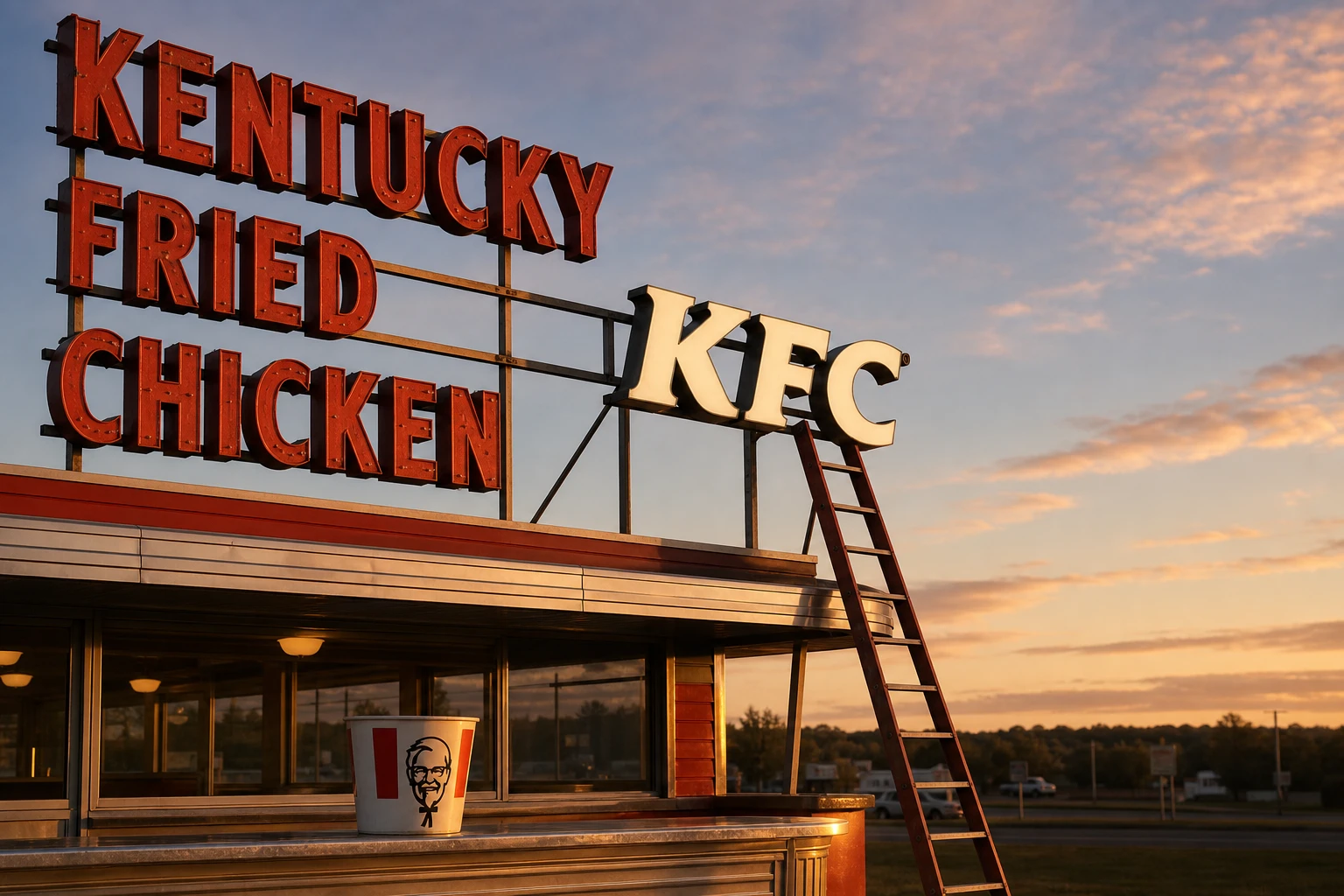
Was the Real Reason a Trademark Fight With Kentucky?
Not entirely. In 1990, the debt-strapped Commonwealth of Kentucky trademarked its own name, meaning any business using the word “Kentucky” commercially would owe the state licensing fees. That part is factually real. Whether it actually forced KFC’s rebrand a year later is where fact-checkers themselves now split.
Snopes’ original write-up on the episode, dated to the year 2000, traces the 1991 rename to that 1990 trademark fight, describing a year of failed negotiations before the chain gave up and rebranded. Later outlets citing that same Snopes entry have landed in opposite places.
- Reader’s Digest confirms the 1990 trademark was real but concluded there is no evidence it actually drove the name change.
- Yahoo, citing Harvard Business Review, states flatly that the rename “stemmed from trademark issues and licensing fees with the state of Kentucky.”
- KFC’s own account, echoed by Fox News, calls the entire trademark story a myth and points only to the word “fried.”
Three outlets, one shared source, three different verdicts on a decision made in 1991. That is not a resolved rumor. It is a live disagreement still running through 2025 and 2026 coverage of the same 35-year-old press release.
How a Mutant Chicken Rumor Ended Up in a Shanghai Courtroom
The other legend was never close to ambiguous. A chain email and later viral photos claimed KFC bred featherless, beakless birds with six or eight legs, supposedly why regulators forced the company to drop “chicken” from its name. Snopes rated it, in its own words, “complete hokum.”
The joke stopped being just a joke in China. Doctored photos of deformed birds went viral there in 2013, and KFC’s parent company sued in 2015 over false posts spread across ten WeChat accounts. A Shanghai court ruled in the company’s favor in February 2016.
| Company Named in the Lawsuit | Platform Used | Court’s Ruling |
|---|---|---|
| Yingchenanzhi Success and Culture Communication | WeChat (Tencent) | Ordered to apologize and pay share of penalty |
| Taiyuan Zero Point Technology | WeChat (Tencent) | Ordered to apologize and pay share of penalty |
| Shanxi Weilukuang Technology | WeChat (Tencent) | Ordered to apologize and pay share of penalty |
The Xuhui District People’s Court ordered a combined 600,000 yuan fine, worth about $91,191 at the time, well short of the 1.5 million yuan per company that Yum Brands had sought in damages. A hoax University of New Hampshire study cited in the original posts was later disowned by the university itself. The rumor still would not stay buried. KFC’s spokesman was forced to deny it publicly again in 2014, two years before that ruling even landed.
The Branding Logic Behind Losing Three Words
Ken Albala, a history professor at the University of the Pacific, told Fox News Digital that KFC’s 1991 move fit a broader corporate pattern. Coca-Cola was leaning harder into “Coke” around the same era, part of a wave of companies rethinking logos and names to travel faster across languages and cultures.
“Kentucky Fried Chicken” takes up real space on a sign, an ad and, eventually, a phone screen. Albala argued that trimming a name to four letters was less about hiding a word and more about winning a split-second of attention on a crowded highway or a cluttered app.
That framing does not erase the trademark question so much as sit beside it. A company can genuinely want a leaner logo and also be facing a state government asking for licensing checks. Both pressures landed in the same year.
From a Corbin Gas Station to a Global Bucket
Harland Sanders’ company history begins earlier and messier than either rumor suggests. KFC’s own site dates his first roadside service station to 1930, where he began serving his Southern-style chicken to travelers. The Sanders Cafe and Museum in Corbin, Kentucky, which occupies his original site, dates the same building’s start as a gas station along U.S. Route 25 to 1937, a small but real gap between the corporate telling and the museum’s own record.
The name itself reportedly did not even originate with Sanders. That trail, along with dozens of other roadside chains, runs through how America’s biggest food franchises actually began, most of them from a single location before growing into national names.
Whatever the exact founding year, the trajectory since is not in dispute. KFC now describes itself as having the widest global footprint of any quick-service brand, a claim that has only grown truer as the chain expanded past the 30,000-restaurant mark it cited a few years ago toward the more than 34,000 locations tied to its newest rebrand.
KFC Reruns the Same Playbook in 2026
KFC just did, on a much bigger stage, roughly what it did in 1991. In June, the chain and design agency JKR unveiled a full global identity overhaul, rolling out first in the United Kingdom and Ireland before reaching Australia and the United States later this year.
The bucket itself was redrawn as a “storytelling vehicle,” a concept JKR has branded the redrawn bucket it now calls the Bucketverse. Colonel Sanders got a subtler update too: a thicker outline, an added collar, and a warmer expression, while staying recognizable enough that KFC’s own spokesperson would not detail exactly what changed.
The rest of the overhaul reads like a menu of new bets rather than a single tweak:
- Dipped and Dunked, two new menu categories built around boneless tenders and more than 20 sauces.
- KWENCH, a beverage platform adding Boba Refreshers and Krunch Shakes, expanding into Australia and Canada this year.
- Open House, a next-generation restaurant prototype being tested near Yum Brands’ Plano, Texas headquarters.
- Two custom typefaces, Kentucky Fried Serif and Kentucky Fried Sans, built with StudioDRAMA for a brand that has not needed new lettering in decades.
KFC Global CEO Scott Mezvinsky framed its next chapter global rebrand announcement around setting the standard for modern chicken in an increasingly crowded quick-service category. The pressure is real: rival McDonald’s is running its own chicken and AI drive-thru push at the same time, while other chains lean the opposite direction into fast food’s nostalgic nineties menu revival this summer. KFC is betting on the newer, sleeker version of itself instead, the same wager it placed on four letters back in 1991. New physical locations in McKinney, Texas, and an immersive two-story venue in Dubai are both slated to open later this year.
Frequently Asked Questions
Where did the name ‘Kentucky Fried Chicken’ actually come from?
According to Mashed’s account of the chain’s early history, the name was not Sanders’ own idea. A sign painter named Don Anderson coined it for the window of Pete Harman’s Salt Lake City cafe in 1952, after Sanders supplied the fried chicken recipe that Harman put on his menu.
Has the mutant chicken rumor resurfaced since the 2016 court ruling?
It never fully went away. KFC’s spokesman, Rick Maynard, had to publicly shoot down the claim again in 2014, telling Business Insider there was “absolutely no truth to this ridiculous urban legend, which has been debunked many times.”
Did Kentucky’s trademark push end with KFC?
No. The University of Kentucky later fought a separate trademark battle over the word “Kentucky” against a distillery called Kentucky Mist Moonshine, and a judge ultimately sided with the university over the small craft producer.
How big is KFC compared to other restaurant chains today?
KFC ranked as the world’s fifth-largest restaurant chain as of 2025, according to design trade coverage of its 2026 rebrand, operating more than 34,000 locations across over 150 countries.
Have other major brands faced backlash for shortening or changing their names?
Yes. Mars renamed its UK Marathon bar to Snickers for global consistency, and Kellogg’s briefly renamed Coco Pops to Choco Krispies in the late 1990s before reverting within months after nearly a million people voted against the switch.


Walmart’s $50 Million Opioid Settlement Closes Case Without Admission

California Sues Over $120 Million Morro Bay Wind Lease Buyout

Gilead Bixlenvo FDA Nod Opens Single Pill Path for Complex HIV Cases

Meta’s $18B Kids Deal Forever Shields Data Used to Spot Under-13s

Lettuce Outbreak Drove Record Cyclospora Spike Across 20 States

Amazon Shaves $20 Off M6 Mac Mini Before It Even Ships

SpaceX Louisiana Port Tests Debt Markets on Orbital AI Scale

Microsoft High Lifts Indexes as Small Caps Crack Support

Apple Replays 2015 Saturday Midnight Preorder for iPhone 18 Pro

Updated COVID Shots Clear FDA but Access Friction Hits High-Risk Groups

Take-Two CEO Pushes Netflix Subs for GTA 6 Extended Look

Wildlands Free Update Hands Players the Tools They Already Invented

Destiny 2 Fans Unlock Vaulted Maps After Live Service Ends

Quake Gets 19 Free Maps From MachineGames Quake Club

Quordle Monday Delivers Gavel Crush Speed Ethos Cleanly

Stripe Bid Shows PayPal Moat Cracked After Years of Slide

Tyson’s Five-Year Utah Plant Falls to Cattle Shortage Reckoning

Silver Lake Workday Talks Signal Private Floor for Software

Kennedy Lewis Takes Majority Control of The Greenbrier in $500M Deal

Best Buy Marks 60 Years With Sale That Echoes Its Audio Shop Roots
-

 TECHNOLOGY3 years ago
How to Adjust a Bulova Watch Band – An Easy Guide
-

 News3 years ago
Fred Pentland: Athletic Bilbao’s English mentor who changed the essence of Spanish football
-

 FINANCE3 years ago
Tax Planning for Every Season: Guide to Maximizing Your Tax Benefits
-

 Education3 years ago
African Ministers New Education Plan
-

 BUSINESS3 years ago
What is Entrepreneurial Operating System? A Comprehensive Guide to EOS
-

 Education3 years ago
Innovate Your Learning Journey with Technology and Enhance Education
-

 News3 years ago
Russians formally out of World Athletics Championships
-

 BUSINESS3 years ago
Top 9 Most Expensive American Cities to Rent an Apartment