
News
Earth’s Last Plant May Survive 1.87 Billion Years, Model Finds
A new 3D climate model from Blue Marble Space puts Earth’s last plant at 1.87 billion years from now. Evolution and engineering could push that further.

The last plant on Earth will likely die in about 1.87 billion years, according to a new 3D climate model from the nonprofit research group Blue Marble Space. The study, published in the Journal of Geophysical Research: Atmospheres, was built by astrobiologist Jacob Haqq-Misra and planetary climate scientist Eric Wolf, both based at the Seattle institute. It tested how Earth’s weather responds to two slow-moving pressures over the next 2 billion years: an aging, brightening Sun and the natural carbonate-silicate cycle that pulls CO2 from the atmosphere. The full study sits on the paper’s official publication page.
Both pressures work in the same direction. At the moment the last plant dies, the Sun will shine about 20 percent brighter than today, hot enough either to bake the surface or to strip the atmosphere of the CO2 plants need. The researchers are explicit that the headline figure is a soft limit, one that evolution, geoengineering, and orbital engineering could all push further out.
The 1.87-Billion-Year Headline
The paper’s central finding is a date. 1.87 billion years from now is when every land plant on Earth will likely be gone, assuming no intervention from humans or any future intelligent civilization. The result comes from a three-dimensional climate model that tested how Earth’s weather responds to two slow-moving pressures: an aging, slowly brightening Sun and the natural carbonate-silicate cycle that pulls CO2 out of the atmosphere over millions of years. Haqq-Misra and Wolf framed their answer not as a single number but as two trajectories, each pushing the green planet toward extinction through a different mechanism.
The longer of the two trajectories, weak weathering, puts the upper thermal limit at about 65 degrees Celsius (150 degrees Fahrenheit), the mean surface temperature at which no land plant can survive. Under strong weathering, by contrast, the limit arrives through carbon starvation rather than heat, with CO2 falling so low that conventional photosynthesis stops working.
Plants are not a small slice of the planet’s biology. They make up about 80 percent of all biomass on Earth, a figure that puts the timeline’s stakes in plain terms: when the last plant dies, most of Earth’s living mass disappears with it. The model assumes no major evolution of plant biology and no technological intervention, two caveats the researchers themselves flag.
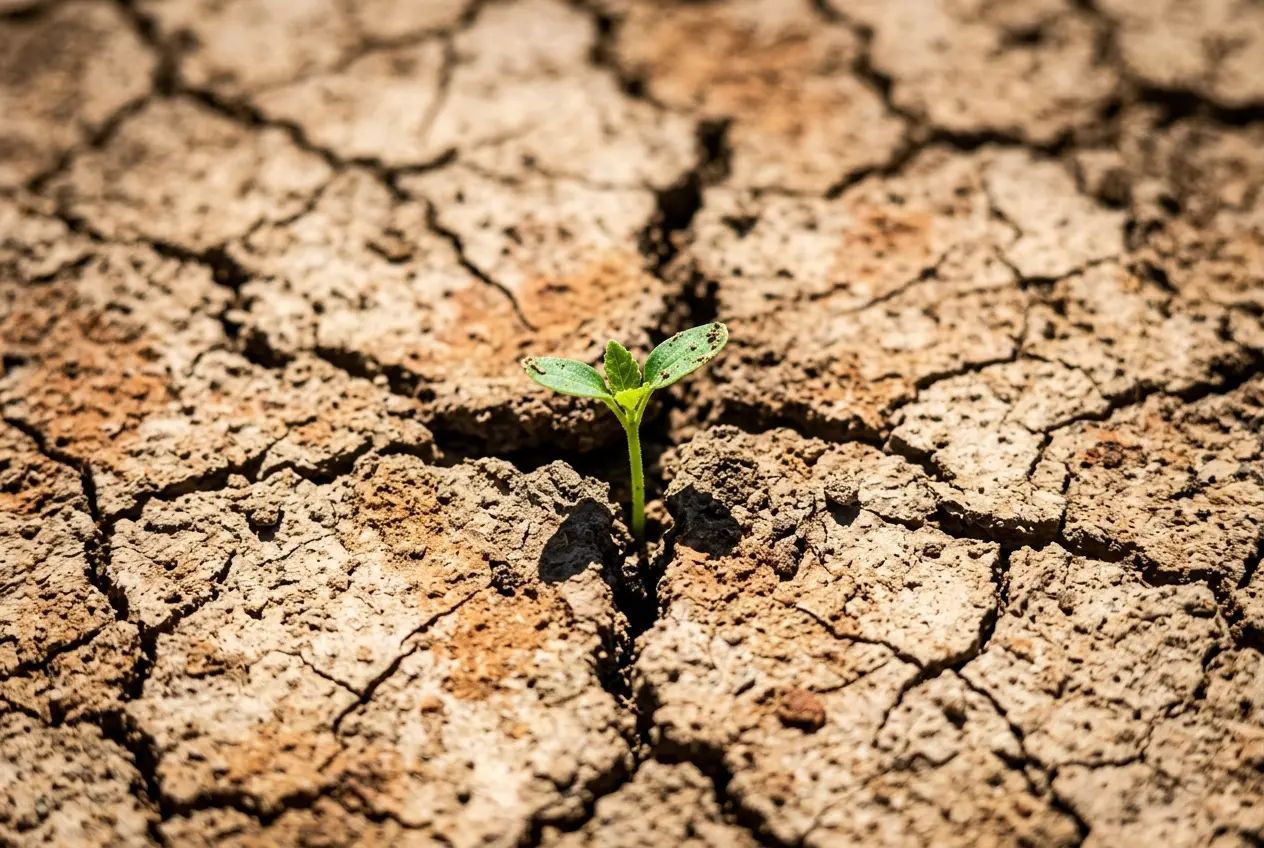
Two Ways the Green Ends
The headline number splits into two scenarios, and the gap between them is a measure of how little is known about deep-time geochemistry. In the strong weathering scenario, the carbonate-silicate cycle scrubs CO2 from the atmosphere efficiently, surface temperature stays close to today’s, and plants lose not to heat but to hunger. In the weak weathering scenario, CO2 holds steady while the brightening Sun drives temperatures upward, and plants lose to heat before they ever run out of carbon.
The strong weathering scenario runs through carbon starvation in two stages. The conventional 10 parts-per-million CO2 limit, the floor for C4 photosynthesis, is hit at 1.35 billion years from now. If CAM photosynthesis and aquatic macrophytes that use dissolved bicarbonate can stretch the limit down to 1 part per million, the vegetative biosphere continues to 1.84 billion years.
The weak weathering scenario runs through temperature instead. At 1.68 billion years from now, surface temperatures above 323 Kelvin (about 50 degrees Celsius) cross the threshold where most land plants can no longer survive. The hotter ceiling, above 338 Kelvin (about 65 degrees Celsius), arrives at 1.87 billion years, the point at which every land plant fails. Both thermal thresholds sit close to the moist and runaway greenhouse limits for Earth, the points at which water vapor starts to escape the atmosphere and the oceans evaporate.
| Scenario | What fails first | Plants last until |
|---|---|---|
| Strong weathering (CO2 drawn down, surface temperature stable) | Carbon starvation | ~1.84 billion years at a 1 ppm CO2 limit; 1.35 billion years at the conventional 10 ppm C4 limit |
| Weak weathering (CO2 steady, surface temperature rises) | Surface heat | 1.87 billion years (all land plants above 338 K); 1.68 billion years for most (above 323 K) |
The new paper’s headline figure, 1.87 billion years, is the weak weathering case with full thermal failure. The strong weathering case is shorter if CAM photosynthesis is ignored, longer if it is credited. The plants die before the 2 billion year mark, with the model assuming pockets of water remain after the oceans vaporize in about 1.5 billion years.
Why the Estimate Climbed Past a Billion Years
Earlier estimates of how long plants could survive on Earth came in much shorter. Some early guesses, the new paper notes, placed the date as soon as 100 million years from now. Others, including a model by Caldeira and Kasting built around C4 photosynthesis, put the range at 0.9 to 1.5 billion years, considerably shorter than Haqq-Misra and Wolf’s 1.87-billion-year ceiling. The new estimate stretches the upper end by including photosynthetic strategies that earlier models excluded, especially CAM photosynthesis and aquatic macrophytes that can use dissolved bicarbonate. Each new metabolic pathway or environmental niche tested in the model adds hundreds of millions of years to the timeline.
The other upgrade is computational. Earlier biosphere-end studies leaned on one-dimensional climate models, which the new paper argues overestimate warming when solar constant is raised and CO2 is held fixed. The three-dimensional model used here, available in the Maximum Lifetime of the Vegetative Biosphere preprint, captures how heat redistributes through the atmosphere in ways the older approach could not. The model deliberately sets aside the human-driven CO2 spike, treating present-day biology as a baseline rather than a forecast.
The 3D model also lets the researchers add nuance to the Sun’s slow brightening, which the paper shows has very different effects depending on which CO2 scenario is run. Earth warms by just over 20 degrees Celsius during the next 1.5 billion years under the weak weathering scenario, then accelerates through the next half-billion years, when another 40 degrees Celsius of warming piles on. That curve is what kills plants, not any single threshold but the cumulative heating across deep time.
The Asterisks the Researchers Themselves Flag
The model does not pretend to be the last word on plant survival. The simulations explicitly leave out two things that could change the timeline by billions of years: plant evolution and technological intervention. The paper’s authors are blunt about the consequence.
Life on Earth is resilient, and limits posed by thermal stress or CO2 starvation may only reflect our observations of the biosphere today rather than hard limits on how the biosphere may evolve.
The line came from Haqq-Misra and Wolf, the astrobiologist and planetary climate scientist behind the model. The paper appeared in the Journal of Geophysical Research: Atmospheres in 2026.
On the biological side, the paper sketches a future in which plants migrate up, not out. As the Sun brightens, the researchers write, plants could favor an aerial environment, spreading to high-altitude terrain and then to the stratosphere and beyond, where the temperature and pressure regimes differ sharply from the surface. From Earth’s upper atmosphere, life could continue to disperse to low-gravity objects like comets and the Moon, as well as into free-floating space. The model also considers whether CAM photosynthesis and aquatic macrophytes that draw on dissolved bicarbonate could keep plant life going below the 10 parts-per-million atmospheric CO2 threshold where conventional C3 and C4 pathways give up.
On the engineering side, the options are speculative but named. Reflective aerosols in the upper atmosphere and orbital sunshades could in principle cool the planet back down. Pushing Earth into a wider orbit, or trimming the Sun’s mass to keep its brightness steady, are options the paper mentions and immediately flags as risky and poorly understood.
- CAM photosynthesis persisting below the 10 ppm CO2 limit that starves conventional C3 and C4 plants.
- Aquatic macrophytes that draw on dissolved bicarbonate once atmospheric CO2 falls.
- Plant evolution toward high altitudes, the stratosphere, and low-gravity objects beyond Earth.
- Reflective aerosols in the upper atmosphere to bounce sunlight back into space.
- Orbital sunshades, a wider Earth orbit, or a lighter Sun to hold brightness steady.
From a 1982 Estimate to a 3D Model in 2026
In 1982, James Lovelock and Michael Whitfield published a Nature paper arguing that life’s future on Earth could not be assumed to mirror its past, an early challenge to the idea that the biosphere would simply persist as long as the planet did. The Caldeira and Kasting C4 model that followed explored the relationship between silicate weathering and atmospheric CO2, and found that a C4-plant-based biosphere could survive another 0.9 to 1.5 billion years. The Haqq-Misra and Wolf paper is the latest in that pattern, and its central revision is not the 1.87-billion-year headline figure but the methods behind it. Those methods include a three-dimensional climate model, two explicit weathering scenarios, and direct treatment of CAM photosynthesis and bicarbonate-using aquatic plants. Each subsequent study has tended to add biological pathways or geological mechanisms that earlier models ignored, and each has nudged the number further out.
The trajectory of the field is toward longer estimates, not shorter. Haqq-Misra and Wolf work at Blue Marble Space’s research staff page, a nonprofit research institute based in Seattle. The paper, published in the Journal of Geophysical Research: Atmospheres, is the most recent study in that line.
What “As Long as Earth Lasts” Means in Practice
Even with the 1.87-billion-year headline, plant death on Earth comes well before the planet itself is uninhabitable. The Sun is expected to enter its red giant phase in about 5 billion years, by which point it will likely consume Mercury and Venus, with Earth extremely likely to be consumed as well. Microbial life could persist deep underground after the last land plant dies, the paper notes, pushing the dying gasps of Earth’s biosphere forward by another billion years or more.
The paper’s closing line is the most striking part.
We suggest that the default story for our planet’s future is that life will survive at least as long as Earth.
Haqq-Misra and Wolf wrote in the paper’s conclusion. Their study, published in the Journal of Geophysical Research: Atmospheres, frames the 1.87-billion-year figure as a soft deadline for plant life. Read this way, the headline is less a death sentence for plantkind than a baseline for what current biology can deliver. Microbes already survive in environments no plant can tolerate, and any civilization still around in a billion years would have options the present model does not consider. The paper’s question is not whether Earth’s biosphere will end, but how long the parts of that biosphere we are used to will last, and how much further the next billion years of biology, geology, and engineering could push that date out.
Frequently Asked Questions
How long will plants survive on Earth?
According to a new 3D climate model from Haqq-Misra and Wolf at Blue Marble Space, plants could last roughly 1.87 billion years under the longer of two scenarios tested, with the shorter scenario ending closer to 1.35 billion years if the conventional carbon dioxide starvation limit is used. Both figures assume no major plant evolution and no technological intervention.
What is the carbonate-silicate cycle?
It is the slow geological process that removes carbon dioxide from the atmosphere. Rainwater dissolves CO2, weathers silicate rocks, carries the carbon to the ocean as bicarbonate, and locks it into seafloor carbonates, before volcanoes and tectonic activity return it to the air over millions of years. The Haqq-Misra and Wolf paper tests both strong and weak versions of this cycle.
Could plants evolve to survive longer than 1.87 billion years?
The paper explicitly considers this. It points to crassulacean acid metabolism (CAM) photosynthesis, which the authors suggest could persist below the conventional 10 ppm CO2 limit, and to aquatic macrophytes that use dissolved bicarbonate. If those strategies work, the vegetative biosphere could push past 1.84 billion years even under strong weathering, and the paper acknowledges that its thresholds may describe today’s biology, not its upper limit.
What is CAM photosynthesis?
Crassulacean acid metabolism (CAM) is a photosynthetic pathway used by plants such as cacti and succulents that opens its stomata at night to take in CO2 and store it as an acid, reducing water loss in dry conditions. The Haqq-Misra and Wolf paper argues CAM plants could keep photosynthesizing below the 10 ppm CO2 threshold that would starve conventional C3 and C4 plants, and could spread to higher altitudes as the surface heats up.
Could humans or technology keep plants alive on Earth?
The paper discusses several speculative interventions, including reflective aerosols in the upper atmosphere, orbital sunshades, moving Earth into a wider orbit, and reducing the Sun’s mass to hold its brightness steady. None has been tested at the scale required, and the authors flag the consequences of these strategies as not fully understood. If a civilization were able to deploy them, the paper’s own framework implies the 1.87-billion-year headline could be pushed back considerably.





Spotify Running Mode hits Android and revives its old tempo experiment

Galaxy Tab S12 Ultra Renders Keep the Notch Fans Hate

Novato Spinning Round House Sells With Six Neighbors for $3.3 Million

Crop Tour Finds Indiana and Nebraska Corn Yields Lagging 2025

Best Buy 60th sale brings Android deals back to its roots

American Airlines reverses seatback screen bet years too late

Iran Hormuz Strikes Force Gulf Oil Onto Costlier Paths

Plague Tale Prequel Day One Joins Game Pass Wave 2 as Witcher Exits

NBA 2K27 opens The City to everyone and rewrites career eras

iOS 26.6.1 Patches 29 Flaws as AI Forces Faster Apple Updates

Caitlin Clark Skips the WNBA 3-Point Contest for a Third Straight Year

Rainout Gives Red Sox Two Shots at a Franchise-Record Win Streak

Double Fine Cuts 23 Jobs Weeks After Xbox Independence

Day-One Big Walk Lifts PS Plus August Beyond Recycled AAA

John Hight Exits Wizards After Digital Reckoning Hits

Curtis Mead’s Red Sox Debut Ends With Fractured Wrist

Moesch and Dressel Rewrite Night One at 2026 U.S. Nationals

Red Sox Squander Hot Streak Chance in 4-3 Loss to Athletics

Boutte’s Quiet Camp Takeover Forces Patriots Receiver Choices

Take-Two CEO Pushes Netflix Subs for GTA 6 Extended Look
-

 TECHNOLOGY3 years ago
How to Adjust a Bulova Watch Band – An Easy Guide
-

 News3 years ago
Fred Pentland: Athletic Bilbao’s English mentor who changed the essence of Spanish football
-

 FINANCE3 years ago
Tax Planning for Every Season: Guide to Maximizing Your Tax Benefits
-

 Education3 years ago
African Ministers New Education Plan
-

 BUSINESS3 years ago
What is Entrepreneurial Operating System? A Comprehensive Guide to EOS
-

 Education3 years ago
Innovate Your Learning Journey with Technology and Enhance Education
-

 BUSINESS3 years ago
Top 9 Most Expensive American Cities to Rent an Apartment
-

 News3 years ago
Russians formally out of World Athletics Championships