
News
Nvidia’s $500B Backstop Builds a Market for Aging GPUs
Nvidia’s residual support with six Wall Street firms aims to keep used AI chips liquid, locking in the stack while carrying wrong-way risk if demand softens.

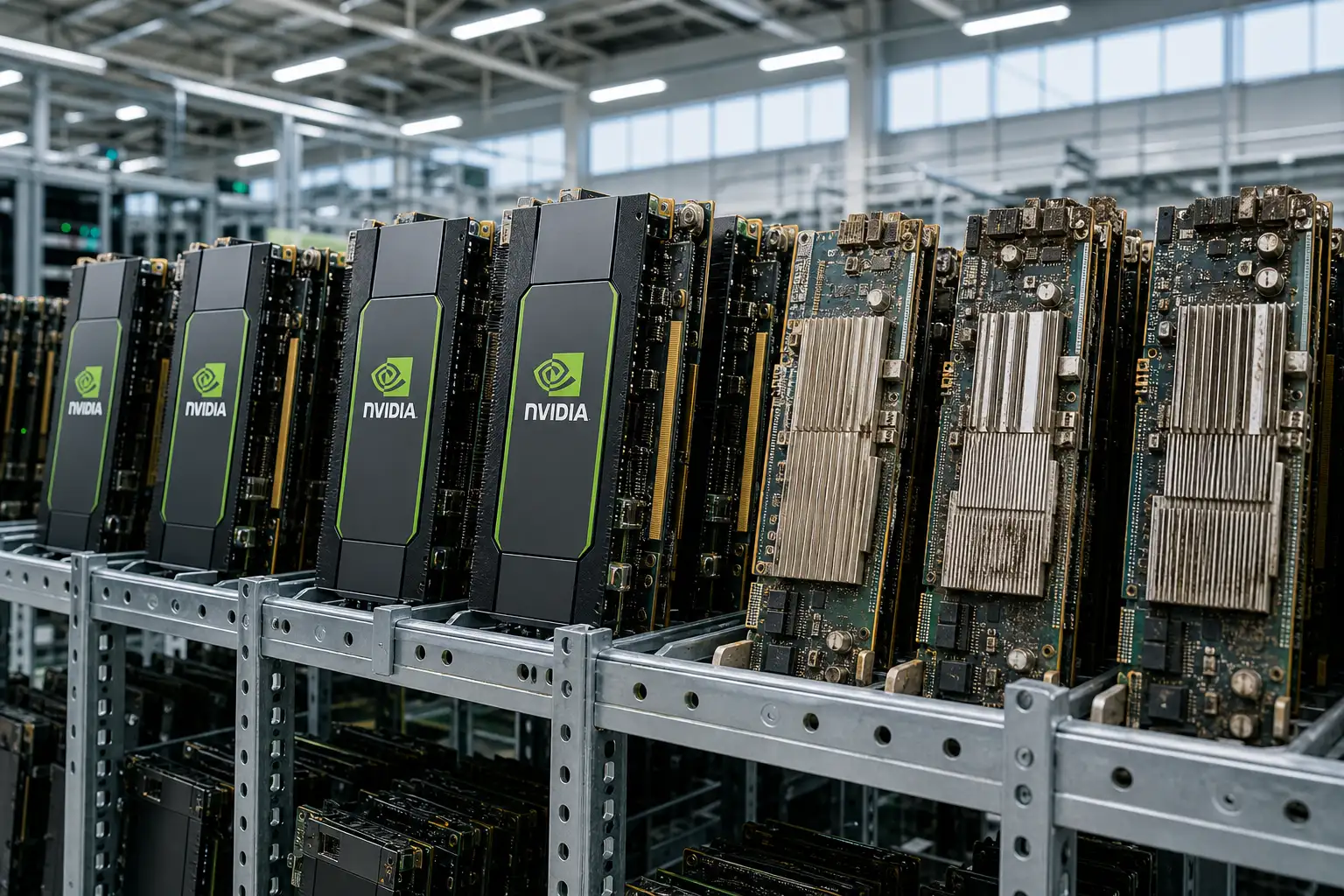
Nvidia will cover up to 25% of any residual-value shortfall on its GPUs used as collateral inside new financing platforms meant to mobilize over $500 billion of third-party capital. The six partners are Apollo, BlackRock, Blackstone, Brookfield, Goldman Sachs and KKR. The number that drew headlines is the capital pool. The lasting change sits in the residual backstop itself.
That limited guarantee is how Nvidia turns aging accelerators into bankable collateral and, in the process, tries to create a deep secondary market for used AI hardware. Startups, enterprises and researchers stand to gain cheaper older silicon. Nvidia keeps CUDA demand alive years after the initial sale. The same structure also creates wrong-way risk if utilization or resale prices fall.
Six Firms and a New Financing Platform
On August 10, 2026, Nvidia announced memorandums of understanding with the six institutions to build independent compute financing platforms. The capital is third-party money aimed at hyperscalers, frontier labs, enterprises and AI clouds. It is not Nvidia revenue, not one fund, and not a commitment to any single customer. Final agreements are still pending.
Jensen Huang, Nvidia founder and CEO, framed the shift on X and in interviews: the company has moved from selling chips project by project to helping finance “AI factories” as productive infrastructure. Partners echoed the infrastructure language. Larry Fink of BlackRock spoke of connecting long-term capital to essential capacity. Jon Gray of Blackstone pointed to surging AI usage inside the firm’s portfolio companies. David Solomon of Goldman Sachs called it a moment in a historic investment cycle.
| Partner | Public emphasis | Role in framing |
|---|---|---|
| Apollo | Flexible long-term capital | Credit and industrial renaissance angle |
| BlackRock | Long-term capital to infrastructure | Jobs and growth narrative |
| Blackstone | Confidence in Nvidia platform | Existing ecosystem investor |
| Brookfield | Scale AI factories globally | Real-asset operator view |
| Goldman Sachs | Credit market for Nvidia compute | Distribution and markets |
| KKR | Long-duration capital and delivery | Infrastructure execution |
The platforms are meant to supply dedicated capital pools at attractive rates so customers can acquire Nvidia full-stack infrastructure without shouldering every dollar of up-front cost on their own balance sheets.
The 25 Percent Residual Floor
Huang stated the support terms directly. In some cases Nvidia may provide a residual-value support mechanism for up to 25% of an opportunity, assessed project by project. The support is residual-value based. It is designed to complement independent underwriting by the capital providers, not replace it. Huang called the share “substantially lower” than other compute-financing arrangements.
If a borrower defaults and the lender liquidates the chips below the book residual, Nvidia covers part of the gap up to that 25% slice. Some reporting has translated the ceiling into a potential $125 billion exposure if the full $500 billion were drawn and fully supported; the company has not framed a hard total liability that way. Credit decisions on customer quality, utilization, cash flow and residual curves stay with the financial institutions.
- H100 rental evidence: one-year pricing rose from about $1.70 per GPU-hour in October 2025 to about $2.35 in March 2026.
- On-demand median: roughly $2.00 to $2.70 per GPU-hour from October 2025 to June 2026.
- Blackwell premium: reported B200 cloud rates about $5.30 to $7.05 per GPU-hour.
- A100 longevity: introduced 2020, still in active commercial use six years later, with multi-year commitments extending economic life toward a decade.
Those figures are Huang’s market proof that Nvidia compute behaves more like durable infrastructure than consumer electronics.
Who Gets Access to Older Silicon
The second-order effect is a thicker market for used and redeployed GPUs. Once residuals have a partial floor and capital providers treat the hardware as fungible, the same boards can move from training clusters to inference, batch jobs, enterprise fine-tuning or smaller operators. That is the piece TechCrunch and others flagged as especially consequential for parties outside the largest hyperscalers.
Potential beneficiaries form a clear list:
- AI-native startups that need capacity but lack investment-grade balance sheets
- Enterprises building internal AI services without hyperscaler-scale capital budgets
- Researchers and academic groups that can run productive work on prior-generation hardware
- Neoclouds and specialist operators that already pioneered chip-collateral lending
- Secondary buyers and lessors who gain clearer pricing signals and exit liquidity
Nvidia’s pitch is that CUDA software keeps improving installed hardware over its life, so an older factory still produces more intelligence at lower cost. When a customer’s needs change, the same standard architecture can be handed to another cloud or operator. That redeployment story is what is supposed to protect residual value and keep demand for the installed base alive.
Wrong-Way Risk and the Lucent Shadow
Financiers call the exposure “wrong-way” risk. Nvidia’s obligations rise precisely when demand weakens and chip values fall. In that scenario its own product revenues would also face pressure. Bond markets reacted quickly enough that Huang went on X and business television to stress that the support is limited, residual-based and secondary to independent underwriting.
Comparisons to Lucent Technologies in the late-1990s telecom boom are already circulating. Lucent lent customers money to buy its gear and suffered when the bubble burst. Nvidia’s version differs in structure: most of the capital and credit risk sit with the six institutions. Nvidia supplies a partial residual floor rather than the bulk of the debt. Still, the company has already extended large support to buyers including OpenAI, Anthropic, CoreWeave, Nebius, Firmus and Lambda, and Bloomberg has tallied hundreds of billions more in circular-style arrangements this summer. The new platforms are presented as the answer to circular-financing critiques by bringing in independent long-term capital.
What we know
- MOUs with six named firms targeting aggregate third-party capital over $500 billion over time
- Residual support capped at up to 25% of an opportunity, project-by-project
- Capital providers retain underwriting of customer, demand, utilization, cash flow and residual
What remains unconfirmed
- Individual firm commitments, rates, draw schedules and final legal terms
- Exact residual curves and stress assumptions used by the platforms
- How the structure interacts with sovereign or non-U.S. financing vehicles
CoreWeave originated much of the modern GPU-as-collateral playbook. The new platforms industrialize that model at far larger scale. Crowd discussion on X has compared the residual piece to auto-loan securitisation without a deep, liquid used-car market: the 25% floor moves risk onto Nvidia’s balance sheet rather than eliminating it. Others note that the house still sets the durability assumptions that justify the floor.
CUDA, Fungibility and the Infrastructure Claim
Huang’s long X thread is the primary source for the durability thesis. He wrote that NVIDIA compute is a full AI factory platform, not just a chip: accelerated computing, networking, systems software, frameworks and a global developer ecosystem. It runs a broad range of models and modalities. It is used across major clouds and systems makers. Software upgrades improve performance and total cost of ownership of already-installed gear.
When needs change, the factory can be used by another customer, another cloud or another operator. This broad ecosystem gives NVIDIA compute a deep market of potential users and offtakers, helping protect residual value.
Huang said that in the same post that answered the circular-financing question and laid out the 25% support language. The company also has earlier OpenAI-linked data center guarantee talks that sit in the same family of vendor-supported financing, though on a different project scale and structure.
Whether GPUs truly behave like railroads or airlines rather than PCs is the open empirical question. Rising rental rates in a scarcity market support Huang’s side for now. A multi-year stretch of oversupply, slower enterprise adoption or a shift to alternative architectures would test the residual curves that lenders will price.
What a Working Secondary Market Must Deliver
For the platforms to function, used Nvidia hardware needs reliable buyers, transparent pricing and redeployment paths that match the residual assumptions. Specialist providers already offer specialist residual value insurance for GPU fleets outside this deal; Nvidia’s backstop would sit alongside or above private insurance in many structures.
Prior milestones show how fast the collateral model matured: CoreWeave’s multi-billion chip-backed facilities, Lambda’s GPU ABS experiments, Anthropic-linked SPVs with Apollo and Blackstone, and a growing private-credit appetite for AI infrastructure. The August platforms attempt to turn those one-offs into standing capital rails. Morgan Stanley and other houses have published multi-trillion estimates for hyperscaler and related spending through the late 2020s; $500 billion is large but still a fraction of those totals.
Success looks like older generations finding steady work in inference and mid-tier training while new silicon captures frontier workloads. Failure looks like a glut of under-utilized boards whose liquidation prices force Nvidia to write residual checks at the same moment product demand softens. That is the second-order bet the residual floor is making. Huang is selling AI factories as investable infrastructure. The secondary market for aging GPUs is the mechanism that has to make the residual math true.
The MOUs are only the start. Final terms, first draws and the first real secondary trades will show whether the backstop creates the liquid used-chip ecosystem Nvidia needs or simply concentrates more cycle risk on the company that already dominates the primary market.


Sony and Warner Sue Anthropic Over Torrented Song Lyrics

Microsoft 365 Auth Fault Took Down Exchange and Teams

OpenClaw 2.0 Ships a Team Workplace With Host-Trust Defaults

Honor’s Robot Phone Works, Then Prices Itself Out

Florida Cities Top Retirement Rankings the Scores Cannot Explain

Walmart’s $50 Million Opioid Settlement Closes Case Without Admission

California Sues Over $120 Million Morro Bay Wind Lease Buyout

Gilead Bixlenvo FDA Nod Opens Single Pill Path for Complex HIV Cases

Meta’s $18B Kids Deal Forever Shields Data Used to Spot Under-13s

Lettuce Outbreak Drove Record Cyclospora Spike Across 20 States

Take-Two CEO Pushes Netflix Subs for GTA 6 Extended Look

Quake Gets 19 Free Maps From MachineGames Quake Club

Destiny 2 Fans Unlock Vaulted Maps After Live Service Ends

Wildlands Free Update Hands Players the Tools They Already Invented

Quordle Monday Delivers Gavel Crush Speed Ethos Cleanly

Stripe Bid Shows PayPal Moat Cracked After Years of Slide

Tyson’s Five-Year Utah Plant Falls to Cattle Shortage Reckoning

Silver Lake Workday Talks Signal Private Floor for Software

Kennedy Lewis Takes Majority Control of The Greenbrier in $500M Deal

Best Buy Marks 60 Years With Sale That Echoes Its Audio Shop Roots
-

 TECHNOLOGY3 years ago
How to Adjust a Bulova Watch Band – An Easy Guide
-

 News3 years ago
Fred Pentland: Athletic Bilbao’s English mentor who changed the essence of Spanish football
-

 FINANCE3 years ago
Tax Planning for Every Season: Guide to Maximizing Your Tax Benefits
-

 Education3 years ago
African Ministers New Education Plan
-

 BUSINESS3 years ago
What is Entrepreneurial Operating System? A Comprehensive Guide to EOS
-

 Education3 years ago
Innovate Your Learning Journey with Technology and Enhance Education
-

 News3 years ago
Russians formally out of World Athletics Championships
-

 BUSINESS3 years ago
Top 9 Most Expensive American Cities to Rent an Apartment