
News
Sewer Scavengers Near Penn Station Repeat a Decades-Old NYC Pattern
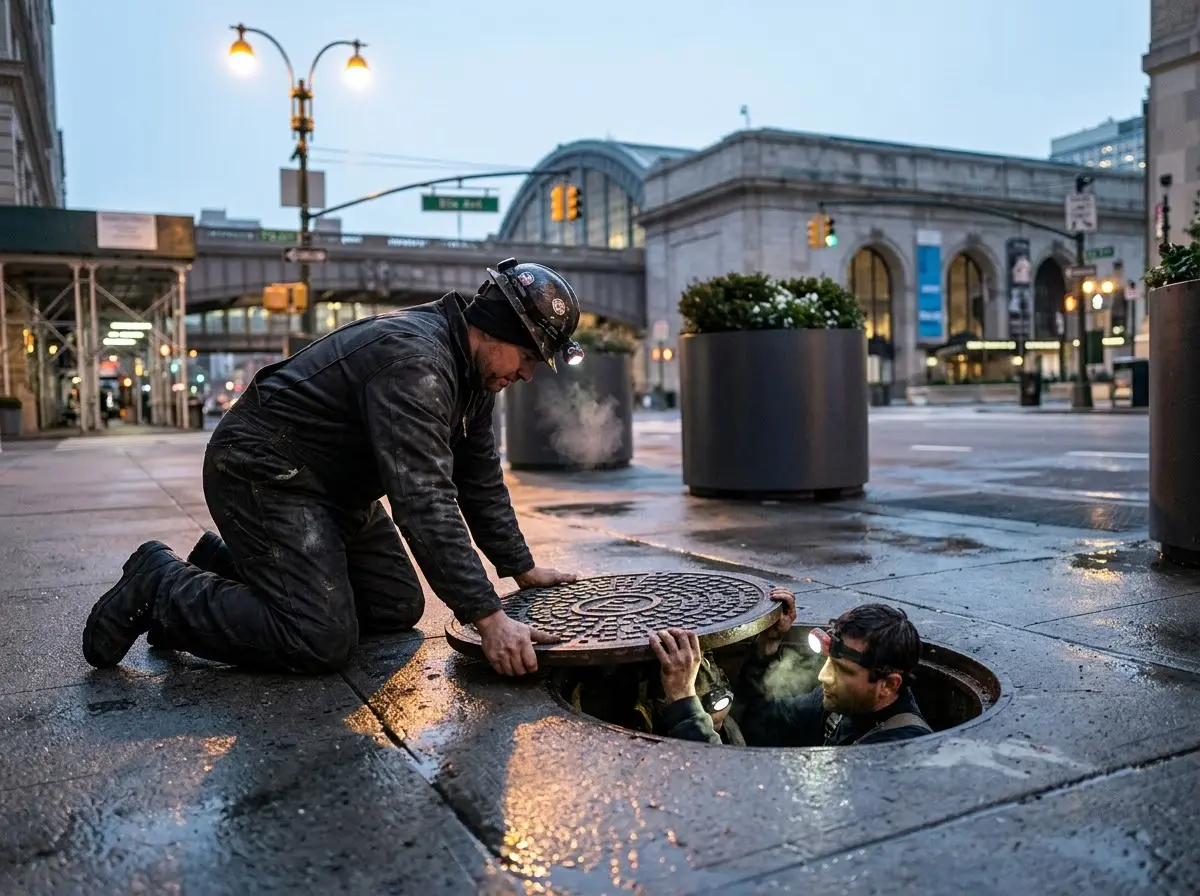
Three men in headlamps exited a manhole near Penn Station on Aug. 18 as NYPD links scavengers to migrant groups and a long history of sewer treasure hunts that.

Three people in overalls and headlamps climbed out of a manhole on Seventh Avenue near 32nd Street at about 4 a.m. on August 18, steps from Penn Station. NYPD detectives say many such underground scavengers are migrants hunting anything of value in the sewers, and the department is still looking for the trio with no arrests yet in this case.
The scene fits a pattern that stretches back years and even decades in New York City, one that soft outcomes on low-level charges and familiar scavenging habits from abroad have done little to break.
Each new exit adds little novelty on its own. What changes is the setting, the timing, and how close the work comes to places the city treats as critical. The August 18 video put that mix on a busy corner before dawn.
The Latest Exit Near the Station
A passerby waiting near Madison Square Garden filmed the group emerging, replacing the cover and walking off. Police later confirmed the time as 4:19 a.m. at the southeast corner of West 31st Street and Seventh Avenue and said they are reviewing surveillance video.
Construction worker Matt McCann, who works in the area, told reporters he has seen similar trespassers before.
“I don’t know what the hell they’re doing down there because they get the waders on. You know, they got their coal miners caps going on,” McCann said.
- August 18, 2026: Three people exit manhole near Penn Station; no arrests yet.
- May 2026: Groups of seven and eight exit manholes in Gravesend and Williamsburg; four arrests followed.
- Earlier 2026: At least one Queens incident ended in arrest with charges not pursued.
- System size: 7,400 miles of wastewater and stormwater pipes dating to the 1800s.
DEP inspections after the recent exits found no damage or threat to the infrastructure.
The film itself is brief. The cover goes back into place. The three walk off in kit that matches earlier sightings in other boroughs. Police have the clock time and the corner. They do not yet have names tied to this exit.
McCann’s description lines up with what cameras caught in Brooklyn in the spring: waders, lamps, the look of a job rather than a one-off stunt. That continuity is part of why detectives treat the Penn Station clip as another point on a known line, not a break from it.
A Line of Treasure Hunts Under the Streets
Sewer scavenging is not new to New York. Nineteenth-century newspaper accounts already described jewels pulled from the depths. In 2015 a part-time DEP worker named Marquis Evans led two friends into a Brooklyn manhole hunting gold, jewelry and guns. They spent four hours below before arrests on criminal trespassing charges. Then-Police Commissioner Bill Bratton said he would never crawl through the sewers himself.
In April 2025 another trio was arrested after a similar descent. One of the men, Willer Green, told police, “The reason we went down there is that people lose their gold down there. We got to sell it to make money.”
- 1800s: New York Times-era reports of jewels recovered from sewers and drains.
- 2015: Marquis Evans and two companions arrested after Brooklyn sewer “scavenger hunt” for gold, jewelry and guns.
- April 2025: Three men arrested; Willer Green cites lost gold sold for cash.
- May 2026: Simultaneous groups exit Williamsburg and Gravesend manholes after hours underground; four later charged with scavenging.
- August 18, 2026: Three exit near Penn Station; investigation open.
After the 2015 case Bratton noted the city cannot post a guard at every manhole. The same logic still applies.
The through-line is practical. Lost metal goes in. People who know the habit go after it. Arrests come when someone is caught on the way out or after hours below. The targets named in 2015, 2025 and the 2026 cases overlap more than they differ.
Bratton’s remark about guards still frames the enforcement problem. Miles of pipe cannot be staffed like a single doorway. That gap is structural, not a temporary lapse.
What Ends Up Below and Who Goes After It
Coins, wallets, scrap metal and jewelry fall through grates or get washed into storm drains. Scavengers in waders and headlamps go after them. Detectives told ABC7 they learned of a scavenger culture in places like Venezuela, which sent large numbers of nationals to New York beginning with the 2022 immigration surge.
In Caracas, people have long waded into the polluted Guaire River to scavenge the Guaire River for lost jewelry and bits of precious metal that can be sold for food money. The same logic travels. Earlier this summer the men charged in Brooklyn told police they were looking for valuables. Sources in prior coverage listed coins, wallets, scrap and jewelry as the usual haul.
| Era / Place | Typical Targets | Noted Motivation |
|---|---|---|
| NYC 2015 Brooklyn | Gold, jewelry, guns | Direct sale |
| NYC 2025 | Lost gold | “Sell it to make money” |
| Venezuela Guaire | Earrings, rings, metal | Cash for food |
| NYC 2026 cases | Valuables, scrap, coins | Scavenging for anything of value |
The professional kit (waders, lamps, overalls) seen in the Penn Station video and the Brooklyn exits suggests the work is practiced, not casual.
Detectives draw a straight path from that river habit to the manhole work now caught on city cameras. The haul list does not require a new market. Coins and scrap and jewelry already move through ordinary sale channels once they are above ground.
Kit is the other signal. Casual curiosity does not usually bring waders and headlamps at 4 a.m. The repeated outfit across boroughs is how investigators read intent when the valuables themselves are still underground.
The Hazards the City Keeps Warning About
A DEP spokesperson issued the standard warning after the latest round of incidents:
DEP works closely with our public safety partners to help ensure the safety and security of critical infrastructure throughout New York City. Entering the sewer system is both illegal and extremely dangerous. Sewers can contain numerous hazards, including noxious and potentially deadly gases, unstable surfaces, flooding risks, and confined spaces. For these reasons, members of the public should never enter a pipe, drain, catch basin, manhole, or outfall.
DEP spokesperson, statement after recent manhole exits
The same list appears in coverage of the spring Brooklyn cases: noxious and possibly deadly gases, unstable surfaces, potential flooding and confined spaces. The 7,400-mile network is old, dark and unforgiving. Yet the exits keep happening.
- Noxious and potentially deadly gases
- Unstable surfaces and footing
- Sudden flooding risk
- Confined-space dangers
- Illegal entry under city rules
City rules treat unauthorized entry as a serious violation. The penalty schedule lists a first-offense civil penalty of $2,500 for unauthorized entry into or damage to sewer system, rising on repeats, with possible misdemeanor charges and jail time in knowing cases.
On paper the deterrent is clear. In practice the people who go down already accept the physical list. Gases, flood water and bad footing are known costs of the work, not surprises discovered after the cover lifts.
Age of the network sharpens every item on that list. Pipe laid in the 1800s was not built for untrained traffic with lamps and bags. DEP keeps repeating the warning because the entries keep testing it.
How the Earlier Cases Ended
Four men were arrested after the May Williamsburg and Gravesend exits and told police they were scavenging. At least one Queens case produced an arrest. Detectives say they have identified or caught up with men from other incidents. The outcomes were the same pattern: low-level charges dismissed because the defendants were first-time offenders, or prosecutions declined altogether.
That cycle is the quiet engine. The people who go down know the physical risks; they also learn that the legal ones often evaporate. Public reaction on X and elsewhere has mixed dark humor (“mole people”) with sharper worries about a major transit hub. Some posts floated reconnaissance theories. Police and DEP have found no infrastructure damage and no public safety threat beyond the scavengers themselves. The soft legal end still leaves the door open for the next group.
First-time status has done heavy work in these files. When charges fall away, the next crew hears the result as clearly as any warning poster. The May arrests and the Queens case both fed that lesson.
| Case window | What followed | Legal pattern noted |
|---|---|---|
| May 2026 Brooklyn exits | Four men arrested after scavenging statements | Low-level path; soft resolution pattern cited |
| Earlier 2026 Queens | At least one arrest | Charges not pursued |
| Other incidents | Detectives identified or caught up with men | Same dismissal or decline cycle |
| August 18, 2026 | Three still sought near Penn Station | Open; no arrests yet |
Humor online and threat talk online pull in opposite directions. Official checks have answered the threat talk with clean infrastructure findings. That gap between online fear and inspection results has not closed the manholes.
Why the City Cannot Guard Every Cover
Bratton’s 2015 point still governs the map. A system of 7,400 miles of wastewater and stormwater pipe cannot host a post at each cover. The network dates to the 1800s. It runs under every kind of block, quiet and busy alike.
DEP’s role after each public exit has been inspection, not perimeter defense. After the recent cases the agency reported no damage and no threat to the works. That finding matters for public calm. It does not shrink the mileage.
- Bratton: the city cannot post a guard at every manhole.
- Scale: 7,400 miles of pipe from the 1800s forward.
- After-action pattern: inspections, clean findings, repeated warnings.
- Enforcement reality: catches on exit or by tip, not constant watch.
So the practical method stays reactive. Video review, witness clips, occasional arrests when a group surfaces in view of a camera or a passerby. The covers remain ordinary street furniture until someone lifts one.
That imbalance is why the same story returns in new boroughs. The asset worth guarding is vast. The moments of entry are short and scattered. Soft charge outcomes then reduce the cost of trying again.
How Distance From the Hub Changes the Story
Gravesend, Williamsburg and Queens put the same work in residential and mixed blocks. The haul logic did not change there. Neither did the kit. What changed on August 18 was adjacency: roughly 150 feet from a main Penn Station entrance, a block from Madison Square Garden, at the nation’s busiest transit hub.
Police and DEP still report no infrastructure damage and no public safety threat beyond the scavengers. Reconnaissance talk online has not gained an official echo. The clean inspection results sit beside a location that draws heavier public attention than a side street in Brooklyn.
- Outer-borough exits: Same scavenging statements, arrests in some cases, soft legal ends.
- Penn Station corner: Same kit and cover replacement, open investigation, higher visibility.
- Official read in both: No damage found; danger framed as illegal entry and sewer hazards.
Visibility is not the same as a new motive. Detectives still tie many camera-caught scavengers to the post-2022 migrant arrivals and to habits known from home. The hub does not rewrite that account. It only raises the volume of the reaction when headlamps appear before dawn.
For the department, the task list is unchanged: identify the three, match video where possible, test the scene for harm. For readers, the map pin next to Penn Station is what makes an old pattern feel immediate.
Feet From Penn Station the Stakes Feel Higher
Penn Station is the nation’s busiest transit hub. The August 18 exit happened roughly 150 feet from a main entrance, a block from Madison Square Garden. The professional appearance of the group (overalls, headlamps, quick cover replacement) and the repeated sightings across boroughs this year have made the old scavenger story feel less remote.
NYPD continues to review video and look for the three from August 18. Detectives connect many of the camera-caught scavengers to the migrant population that arrived after 2022 and to the scavenging culture they know from home. The infrastructure checks out clean. The legal outcomes stay light. The manholes stay where they are.
The pattern that began with 19th-century jewel stories and ran through Evans in 2015 and Green in 2025 is still running. The only new pieces are the location next to a critical hub and the nationalities detectives now cite. Until the charges stick or the risk becomes real enough to stop the descents, more headlamps will keep appearing at 4 a.m.
Nothing in the inspection record has forced a different posture. Nothing in the recent charge history has raised the expected legal cost. The covers are still tools of access for anyone willing to lift them, and the city is still left to chase the exits after the fact.


Iowa Farmer Built Resilience for 16 Years Then Tariffs Hit Hard

HHS Adds FDA Tech and Drugs Deputies to Lock In AI and Review Power

Nvidia Earnings Carry a Built-In Sell-the-News Trap

HP Licenses Huawei Wi-Fi Patents Despite the Entity List

Poland Named in $131B F-15 Deal Echoes Apache Path

Sewer Scavengers Near Penn Station Repeat a Decades-Old NYC Pattern

Second Muni Fatigue Crash Exposes Surface Line Gaps

Chick-fil-A Chicken and Waffles Closes Its 80-Year Loop

Musk Data Centers Leave a Mississippi Family’s Historic Land Empty

OpenAI Data Center Chief Exits as Stargate Strategy Shifts

Double Fine Cuts 23 Jobs Weeks After Xbox Independence

Day-One Big Walk Lifts PS Plus August Beyond Recycled AAA

John Hight Exits Wizards After Digital Reckoning Hits

Curtis Mead’s Red Sox Debut Ends With Fractured Wrist

Moesch and Dressel Rewrite Night One at 2026 U.S. Nationals

Red Sox Squander Hot Streak Chance in 4-3 Loss to Athletics

Boutte’s Quiet Camp Takeover Forces Patriots Receiver Choices

Take-Two CEO Pushes Netflix Subs for GTA 6 Extended Look

Halo Campaign Evolved Skulls Meet Death Barriers That Kill the Hunt

Wildlands Free Update Hands Players the Tools They Already Invented
-

 TECHNOLOGY3 years ago
How to Adjust a Bulova Watch Band – An Easy Guide
-

 News3 years ago
Fred Pentland: Athletic Bilbao’s English mentor who changed the essence of Spanish football
-

 FINANCE3 years ago
Tax Planning for Every Season: Guide to Maximizing Your Tax Benefits
-

 Education3 years ago
African Ministers New Education Plan
-

 BUSINESS3 years ago
What is Entrepreneurial Operating System? A Comprehensive Guide to EOS
-

 Education3 years ago
Innovate Your Learning Journey with Technology and Enhance Education
-

 News3 years ago
Russians formally out of World Athletics Championships
-

 BUSINESS3 years ago
Top 9 Most Expensive American Cities to Rent an Apartment