
BUSINESS
Iowa Farmer Built Resilience for 16 Years Then Tariffs Hit Hard
After decades of diversification to survive shocks like the 1980s crisis, Iowa farmer Wendy Johnson still saw profits fall by half as fertilizer and fuel.

Wendy Johnson spent nearly 16 years building an Iowa farm designed to outlast the economic shocks that emptied rural communities when she was a child in the 1980s. She diversified crops and livestock, sold direct to buyers, shifted acres to organic, stayed clear of heavy debt and planted thousands of trees. In 2026 those steps still left her profits down by as much as 50 percent.
President Donald Trump’s tariffs and the war with Iran drove fertilizer, fuel and machinery costs higher just as crop prices stayed weak. Johnson, a fourth-generation farmer near Charles City who co-manages about 1,200 acres, told The Washington Post she fears “we’re looking into the barrel of another farm crisis.” The pattern is familiar, and the numbers show how even prepared operators are taking hits.
Input Costs Spike Across the Corn Belt
Since the U.S. and Israel struck Iran in late February, tanker traffic through the Strait of Hormuz slowed. Crude rose above $110 a barrel. Anhydrous ammonia, the main nitrogen fertilizer for Corn Belt fields, climbed 36 percent from $828 to $1,123 a ton, according to University of Illinois economists. National diesel moved from $3.81 a gallon before the war to $5.45.
Last week Trump added 50 percent tariffs on Canada, a key supplier of fertilizer and farm equipment. Machinery and parts costs rose with them. Weak commodity prices left little room to absorb the jumps.
| Input or Crop | Earlier Level | Recent Level | Change |
|---|---|---|---|
| Anhydrous ammonia (per ton) | $828 | $1,123 | +36% |
| Diesel (per gallon national) | $3.81 | $5.45 | sharp rise |
| Corn projected loss per acre 2026 | – | $131 | below break-even |
| Soybean projected loss per acre 2026 | – | $80 | below break-even |
| Corn projected loss per acre 2027 | – | $167 | deeper |
| Soybean projected loss per acre 2027 | – | $138 | deeper |
The American Farm Bureau Federation estimates growers of nine principal row crops will lose more than $31 billion in 2026 and $32 billion in 2027 even after earlier aid, marking a sixth straight year of losses on key crops. Corn alone accounts for the largest share. AFBF projects $31 billion in 2026 losses without fresh federal help.
How Wendy Johnson Tried to Build a Shock-Proof Farm
Johnson grew up on a corn, soybean and hog operation in Floyd County during the height of the 1980s farm crisis. Families qualified for welfare. Neighbors disappeared from pork picnics. She left for college, fashion work in Los Angeles and time in Brazil. After her grandmother died she returned in 2010 to farm with her father, Erwin.
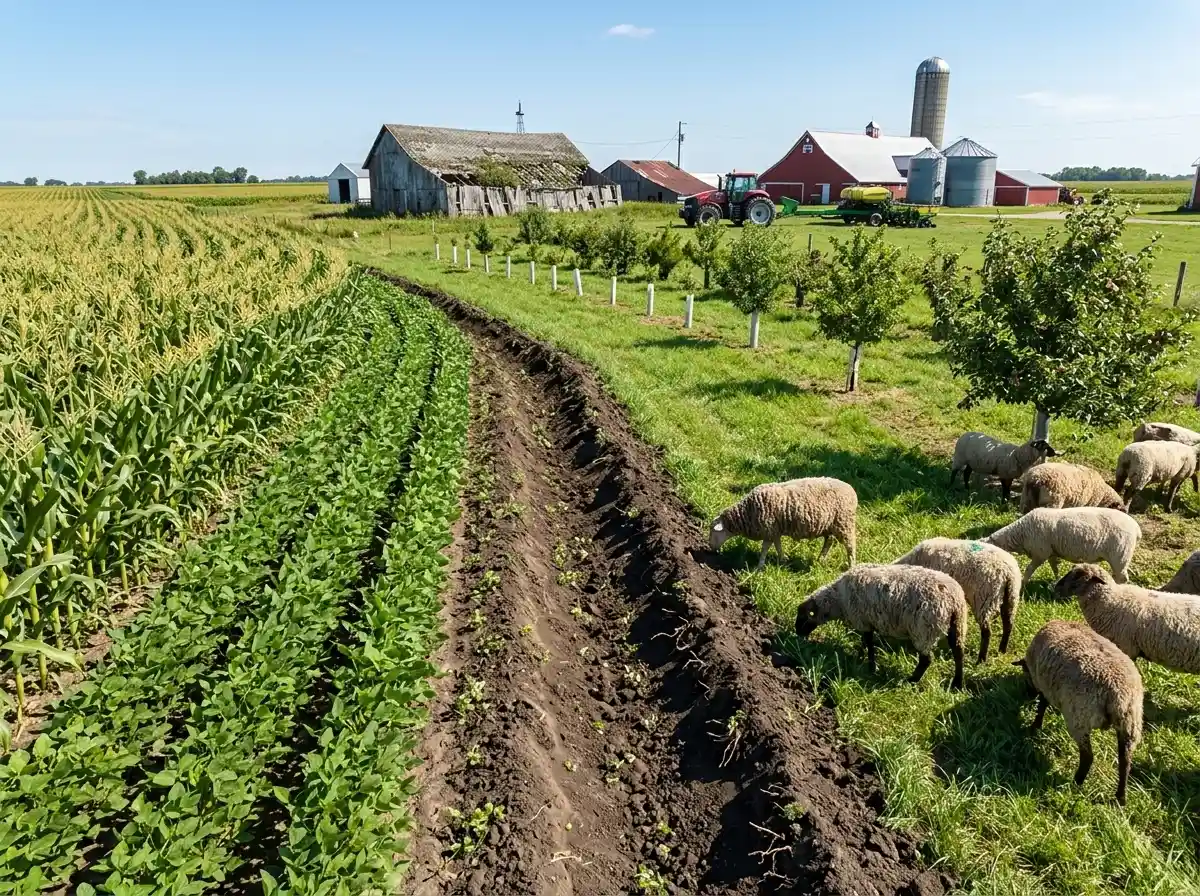
She and husband Johnny Rafkin started Jóia Food & Fiber Farm on 130 acres as a living lab. They raise Animal Welfare Approved sheep, cattle, pigs, chickens and turkeys, custom graze more cattle, grow certified organic grains and pasture, and plant fruit and nut trees. Meat, wool and flour move through a virtual farm store, buying clubs and food hubs. Wool goes into mattress toppers and bedding under a related brand.
- Expanded sheep to a grass-fed flock of roughly 125 ewes and lambs, plus pigs and poultry sold direct.
- Transitioned acres to organic rotation: oats, forage, corn, soybeans.
- Planted more than 6,000 fruit, nut and hardwood trees plus prairie strips and wetlands.
- Adopted 100 percent no-till and cover crops on the larger family acres, cutting some herbicide, tillage and nitrogen needs.
- Added Kernza perennial grain for deep roots that hold soil through drought and flood.
On the main Center View Farms operation of about 1,100 acres she co-manages with her father, they inserted small grains and soil-health years into the corn-soy rotation. Commercial phosphorus and potassium were largely dropped; nitrogen rates fell about 30 percent on some no-till cover-crop acres. Livestock manure and living roots feed soil biology. Jóia Food & Fiber Farm direct sales capture more of the consumer dollar than commodity channels.
Johnson has said the goal was simple: grow food for people, keep the land productive for the next generation, and avoid the debt spiral that wrecked so many operations she watched as a child.
Even Prepared Farms Feel the Squeeze
Those steps limited some exposure. Less reliance on commercial fertilizer and more direct margins help. Yet Johnson still estimates profits down by half. Input bills for fuel and remaining fertilizer rose fast. Commodity acres still face weak prices. Extreme weather has tested the system too: a 2023 drought that brought only 12 inches of rain for the year, then heavy rains the next season. Kernza and cover crops held soil better than bare ground, but overall cash flow tightened.
Other operators report the same pattern. Pam Johnson, a northern Iowa farmer and former National Corn Growers Association president (no relation), said the war created deep uncertainty and that projections show farmers making no money for the next two years. Nebraska Farmers Union president John Hansen called it the worst financial downturn since the 1980s. Chapter 12 farm bankruptcies rose 46 percent nationally in 2025, with Midwest filings up 70 percent.
I am afraid that we’re looking into the barrel of another farm crisis. And we all know historically what that did to our rural communities.
Wendy Johnson, fourth-generation Iowa farmer, The Washington Post
Crowd conversation on X notes the risk that higher diesel and fertilizer will push grocery prices next, and that political support for tariffs collides with the damage those same tariffs inflict on the farmers who backed them.
The 1980s Farm Crisis Left a Permanent Mark
The parallel Johnson and others draw is concrete. In the early 1980s high interest rates, falling land values and low crop prices after a boom of expansion crushed leveraged farms. Land prices that peaked near $2,147 an acre in 1981 collapsed. Interest payments exceeded net farm income for the first time. One-third of farmers held two-thirds of the debt.
Iowa lost about 14,000 farms between 1980 and 1989, dropping from 119,000 to 105,000. Nationally, estimates put 200,000 to 300,000 farmers into bankruptcy, foreclosure or forced restructuring. Small towns emptied as implement dealers and Main Street businesses closed. For every four farms that failed, one rural business often followed. Suicides and family stress rose. Iowa lost 14,000 farms in the 1980s according to contemporary tallies, accelerating consolidation that continues today.
Survivors who stayed often got bigger and more specialized in corn and soy. Livestock left many operations. That streamlining cut diversity just when later generations, including Johnson, tried to rebuild it.
- 1981: Farmland values peak; expansion loans peak.
- 1982-85: Interest rates spike, land values crash, foreclosures surge.
- 1985: Federal Reserve estimates one-third of farmers hold most of the debt; emergency measures begin.
- Late 1980s: Farm numbers stabilize at lower levels; survivors consolidate acres.
Conservation Dollars and Policy Tools Still Matter
Johnson has used USDA programs heavily: Conservation Stewardship Program for agroforestry and grazing, EQIP for pasture infrastructure, CRP for prairie strips. The Inflation Reduction Act added billions for working-lands conservation. She serves on Iowa’s Farm Service Agency State Technical Committee and hosts field days to show other farmers the options.
Those tools cut costs and built soil. Practical Farmers of Iowa, founded in the 1980s crisis years to help operators slash inputs, became a key network. She credits the group’s realist approach and on-farm trials. Regenerative steps such as no-till cover crops and Kernza rotation reduced some commercial fertilizer needs and improved drought tolerance.
Yet short-term cash flow still depends on commodity markets and fuel. Federal emergency aid packages of $10 billion then $11 billion-plus earlier in the cycle helped some balance sheets. A further request for more than $11 billion in 2026 aid has stalled in Congress, partly because it was linked to funding for the Iran conflict that itself raised energy costs. Farm groups split: some accept the package, others call the linkage counterproductive.
Rural Communities Carry the Longer Cost
When farms lose money for multiple years, the effects move beyond the field. Local implement dealers, seed suppliers, banks and schools feel it. Young people leave. The 1980s showed how quickly a county’s tax base and population can shrink. Today’s lower overall farm debt and wider crop insurance soften the blow compared with 40 years ago, yet successive years of losses still erode working capital.
Johnson’s model tries to reverse part of that by keeping more dollars local through direct sales and by restoring livestock and perennials that once defined mixed farms. She has said conservation itself grows her businesses and makes them more resilient. Field days draw people looking for different examples. Still, the scale of row-crop losses means many neighbors without her diversification face steeper choices about whether to plant next spring.
Midterm pressure is rising. Senators from farm states have warned there is little positive message for rural voters if aid remains stuck. China has resumed some soybean purchases, yet volumes stay well below pre-trade-war shares. Drought cut the latest corn yield forecast, lifting futures somewhat, but the rally does not erase multiyear red ink.
The Test Continues Into 2027
AFBF numbers show every major crop analyzed stays below break-even next year under current assumptions. Specialty crops face their own uncovered losses. Johnson keeps experimenting: more small grains, soil-health years that replace soybeans with grazed covers, possible new uses for soybean residue. Her father remains her main mentor. The family still runs the larger conventional acres alongside the regenerative 130-acre lab.
The 1980s crisis taught a generation that leverage plus low prices equals exit. Johnson’s answer was diversity, living roots, direct markets and low debt. Those choices bought her time and some margin protection. They did not fully shield her from a simultaneous spike in energy and fertilizer costs triggered by war and tariffs. The same combination is now testing thousands of other Midwest operations. How many can absorb another two years of projected losses will decide whether the next farm crisis stays a warning or becomes a repeat of the map of empty places left after the last one.


Iowa Farmer Built Resilience for 16 Years Then Tariffs Hit Hard

HHS Adds FDA Tech and Drugs Deputies to Lock In AI and Review Power

Nvidia Earnings Carry a Built-In Sell-the-News Trap

HP Licenses Huawei Wi-Fi Patents Despite the Entity List

Poland Named in $131B F-15 Deal Echoes Apache Path

Sewer Scavengers Near Penn Station Repeat a Decades-Old NYC Pattern

Second Muni Fatigue Crash Exposes Surface Line Gaps

Chick-fil-A Chicken and Waffles Closes Its 80-Year Loop

Musk Data Centers Leave a Mississippi Family’s Historic Land Empty

OpenAI Data Center Chief Exits as Stargate Strategy Shifts

Double Fine Cuts 23 Jobs Weeks After Xbox Independence

Day-One Big Walk Lifts PS Plus August Beyond Recycled AAA

John Hight Exits Wizards After Digital Reckoning Hits

Curtis Mead’s Red Sox Debut Ends With Fractured Wrist

Moesch and Dressel Rewrite Night One at 2026 U.S. Nationals

Red Sox Squander Hot Streak Chance in 4-3 Loss to Athletics

Boutte’s Quiet Camp Takeover Forces Patriots Receiver Choices

Take-Two CEO Pushes Netflix Subs for GTA 6 Extended Look

Halo Campaign Evolved Skulls Meet Death Barriers That Kill the Hunt

Wildlands Free Update Hands Players the Tools They Already Invented
-

 TECHNOLOGY3 years ago
How to Adjust a Bulova Watch Band – An Easy Guide
-

 News3 years ago
Fred Pentland: Athletic Bilbao’s English mentor who changed the essence of Spanish football
-

 FINANCE3 years ago
Tax Planning for Every Season: Guide to Maximizing Your Tax Benefits
-

 Education3 years ago
African Ministers New Education Plan
-

 BUSINESS3 years ago
What is Entrepreneurial Operating System? A Comprehensive Guide to EOS
-

 Education3 years ago
Innovate Your Learning Journey with Technology and Enhance Education
-

 News3 years ago
Russians formally out of World Athletics Championships
-

 BUSINESS3 years ago
Top 9 Most Expensive American Cities to Rent an Apartment