
News
OpenAI Data Center Chief Exits as Stargate Strategy Shifts
Chris Malone left OpenAI’s data center role last week after a reorg under Sachin Katti, as the company pivots Stargate builds toward leasing and faces $750.

Chris Malone left OpenAI last week after less than 18 months as head of data centers, the Wall Street Journal first reported and the company confirmed. He joined in March 2025 right after Stargate launched, coming from nearly five years leading data-center strategy at Meta and more than a decade at Google.
The timing lands inside a broader infrastructure reorganization and a string of senior exits as OpenAI targets a 2027 IPO and raises projected compute spending to roughly $750 billion through 2030.
Malone’s brief tenure spanned the full arc from White House announcement to multi-site execution. He arrived to run a pure-build vision and left after that vision had already given way to a leased and partnered model under new internal reporting lines.
The Reporting Line Changed First
Earlier in 2026 OpenAI reorganized its infrastructure organization. Malone stopped reporting directly to president Greg Brockman and began reporting to vice president Sachin Katti, who took overall leadership of the group after joining from Intel.
OpenAI told TechCrunch it had “recently reorganized” its “infrastructure organization to support the scale and pace of our work.” It added that a strong, deeply experienced data center team remains in place with clear leadership.
We have a strong, deeply experienced data center team in place, with clear leadership and the technical expertise to execute our plans.
OpenAI statement to TechCrunch
Several executives now share the load. Uday Ruddarraju leads the data center team and was elevated to chief technology officer of computing capacity. Brent Mayo, hired from xAI, runs build and delivery. Spas Lazarov oversees all data center engineering.
The single “head of data centers” seat effectively dissolved into a multi-lead structure under Katti. Malone’s exit followed that change.
The new split separates design, commercial partnerships and facility management. That arrangement fits a company that no longer treats every megawatt as a self-build project. It also means no one person owns the full physical stack the way Malone’s original title implied.
Katti’s arrival from Intel supplied a different operating background than the Meta and Google data-center path Malone brought. The reorganization placed commercial and partnership work alongside engineering rather than under a single build chief.
Stargate’s Real Shape Now
Stargate began in January 2025 as a joint effort with SoftBank, Oracle and others intending to invest $500 billion over the next four years in U.S. AI infrastructure, starting with immediate $100 billion deployment. SoftBank held financial responsibility; OpenAI held operational.
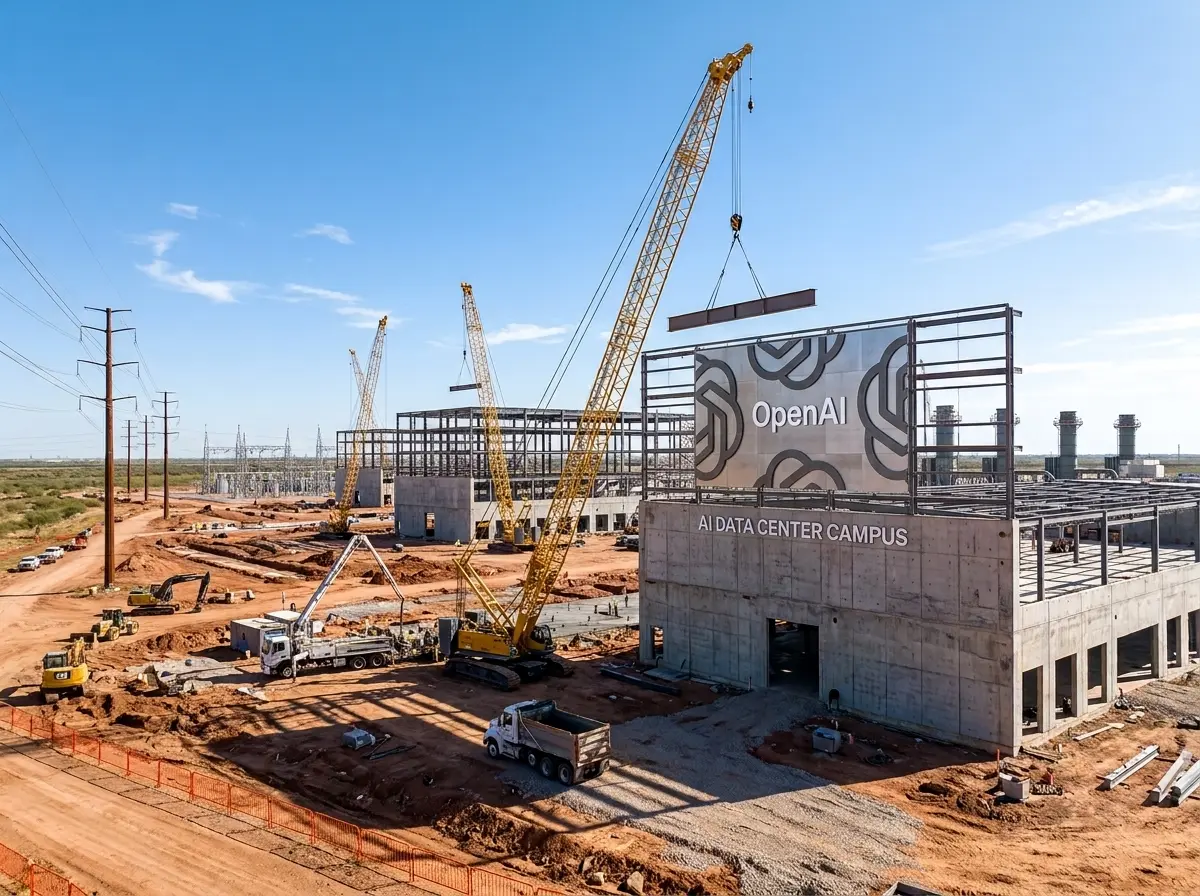
Reality has shifted. OpenAI now treats Stargate as an umbrella for a diversified mix of owned, leased and partnered capacity rather than pure self-build megacampuses. Abilene, Texas, remains the flagship. Independent trackers put current operational capacity there near 509k H100-equivalents of compute with 421 MW of IT power and roughly $15.9 billion capital cost so far, projecting higher by late 2026.
- $750 billion projected compute spend through 2030, up from earlier ~$600 billion figures
- ~$50 billion targeted for calendar 2026 alone, per earlier Brockman testimony
- ~7 GW active planned U.S. capacity across multiple sites as of mid-2026 tracking
- 1 GW Michigan campus known as The Barn already broken ground with partners
In June OpenAI broke ground on a 1GW data center campus in Saline, Michigan with Oracle, Related Digital and others, projecting thousands of construction and permanent jobs plus community investments. Ohio deals and additional Texas, New Mexico and Wisconsin sites fill out the map. Some Abilene expansion plans were later capped as capacity moved elsewhere.
The pivot includes more leasing of entire facilities and long-term cloud agreements. Design control stays with OpenAI in many cases while partners own and develop the shells. That model reduces capital intensity for OpenAI but raises coordination risk across Oracle, SoftBank Energy, Nvidia, Microsoft, CoreWeave and others.
The original $500 billion, four-year frame has been overtaken by the larger $750 billion figure through 2030. The near-term pressure sits in the roughly $50 billion targeted for 2026 alone. Meeting that annual run rate with a mixed ownership model requires faster partner handoffs than a single self-build pipeline would have demanded.
| Measure | Early Stargate Frame | Current Tracking |
|---|---|---|
| Headline capital scope | $500 billion over four years | $750 billion compute spend through 2030 |
| Immediate deployment | $100 billion at launch | ~$50 billion targeted for 2026 alone |
| Flagship site status | Abilene as pure-build centerpiece | 509k H100-equivalents, 421 MW, ~$15.9 billion in; some expansion capped |
| Capacity model | Self-build megacampuses | Owned, leased and partnered mix across ~7 GW planned |
Abilene still anchors the story in public trackers, yet capacity has already been redistributed toward Michigan, Ohio and other states. The umbrella label lets OpenAI keep the Stargate name while changing what the name covers.
How Stargate Moved From Announcement to Sites
- January 21, 2025: Stargate announced at the White House scale with SoftBank, Oracle, MGX and technology partners Nvidia and Microsoft.
- March 2025: Malone joins as head of data centers to execute the buildout.
- Late 2025-early 2026: Sachin Katti hired; infrastructure teams reorganized into design, commercial partnerships and facility management groups; some pure-build ambitions scaled back.
- June 1, 2026: Michigan 1 GW campus groundbreaking.
- August 2026: Additional large Ohio capacity deals with Nvidia guarantees reported; Malone departs.
Construction has faced delays and higher-than-expected power costs at some sites. Trackers note Abilene buildings lagging original schedules while grid-connected alternatives for rivals advanced faster in places.
The sequence shows the hire, the reorg and the exit as linked steps rather than separate events. Malone joined to execute the buildout two months after the announcement. By the time Michigan broke ground, the internal map had already been redrawn under Katti. The Ohio deals and Malone’s departure landed in the same month.
Power cost overruns and schedule slips at individual sites help explain why expansion was capped in one place and opened in another. Grid access became a practical filter on where capital could move next.
The 2026 Bench Has Thinned
Business Insider tallied 13 senior departures through mid-August. Malone makes at least 14. Many held central seats.
| Executive | Former Role | Approx. Exit | Noted Context |
|---|---|---|---|
| Fidji Simo | Applications CEO / No. 2 | July 2026 | Chronic illness; remains advisor |
| Brad Lightcap | COO (long-serving) | August 2026 | “Starting something new” |
| Denise Dresser | Chief revenue officer | August 2026 | ~8 months tenure; Dali Rajic succeeds |
| Kate Rouch | Chief marketing officer | April 2026 | Health recovery |
| Chloé Bakalar | Head of ethics | July 2026 | Role not immediately replaced |
| Chris Malone | Head of data centers | August 2026 | After reporting-line change |
Others include safety and systems leads Johannes Heidecke and Joshua Achiam, Sora head Bill Peebles after the project wound down, and hardware lead Caitlin Kalinowski over Pentagon-deal governance concerns. Brockman has said the company spotlight makes every departure look larger than it would elsewhere.
Crowd reaction on X framed the pattern as more than normal turnover. Several noted that data-center and revenue leaders walking near an IPO payday is unusual and that partners financing the build now carry more continuity risk.
The cluster of exits in July and August 2026 removed applications, operations, revenue and infrastructure voices in a short window. Health recoveries and project wind-downs account for some moves. Others left open questions about succession depth on the commercial and physical sides at once.
- Applications and No. 2 role: Fidji Simo exit, remains advisor
- Long-serving COO seat: Brad Lightcap departure
- Revenue leadership: Denise Dresser after roughly eight months, Dali Rajic succeeds
- Data center title: Malone after the reporting-line change, no single successor named
Brockman’s point about spotlight size is real for a company this visible. The counterpoint from outside observers is that infrastructure and revenue seats matter more when compute spend is climbing toward $750 billion and an IPO date sits on the 2027 calendar.
Partners Carry More of the Load
Oracle shares move on Stargate news. Nvidia has provided large guarantees on capacity deals. SoftBank remains the financial lead partner. Microsoft continues as legacy cloud provider while OpenAI diversifies to AWS, CoreWeave and others.
When the person who joined specifically to run the physical build leaves after a reorg that elevated commercial and design leads, the message to those partners is that OpenAI’s internal model has already changed. Leasing and multi-provider contracts become the default path to the multi-gigawatt targets. Execution speed now depends on how cleanly Katti’s structure, Ruddarraju’s capacity team and the delivery program under Mayo hand off between design control and partner construction.
OpenAI still projects tens of gigawatts of resilient supply chains, custom racks and global delivery. The remaining bench has deep résumés. The open question is whether the distributed leadership can keep the same pace Malone was hired to drive.
SoftBank’s financial lead role and Oracle’s build presence mean partner balance sheets and schedules now absorb more of the delivery risk. Nvidia guarantees on capacity deals further tie chip supply to site timelines. Microsoft’s legacy cloud position sits beside newer AWS and CoreWeave paths, so routing decisions span more contracts than at launch.
Delays and Power Costs Redirect Capacity
Trackers already flag Abilene buildings behind original schedules. Higher-than-expected power costs hit some sites. Rivals with grid-connected options moved faster in places. Those pressures show up in the decision to cap certain Abilene expansion plans and shift weight toward Michigan, Ohio, New Mexico and Wisconsin.
The Michigan campus known as The Barn broke ground with partners at 1 GW. Ohio deals arrived with Nvidia guarantees. Each new site spreads operational complexity even as it hedges against delay at any single location.
Under a leasing-first model, OpenAI can relocate design intent faster than it could relocate a fully self-funded megacampus. Partners still have to deliver land, power and shells on time. Coordination risk rises with every additional counterparty even when capital intensity on OpenAI’s books falls.
The ~7 GW of active planned U.S. capacity as of mid-2026 tracking is therefore a map of hedges as much as a map of ambition. Schedule slips and power pricing help decide which squares on that map darken next.
The IPO Clock Rewards Visible Continuity
OpenAI’s IPO, once discussed for 2026, is now pointed at 2027. Valuation conversations already weigh the gap between revenue growth and the size of the compute commitments. The step-up from earlier ~$600 billion figures to roughly $750 billion through 2030 widens that gap on paper before any new revenue line closes it.
Infrastructure leadership is one of the few places where outside investors can watch execution in physical units: megawatts energized, H100-equivalents online, campuses broken ground. A multi-lead structure can work. It has to show steady handoffs among Katti, Ruddarraju, Mayo and Lazarov for that confidence to hold.
Partners financing shells and guaranteeing capacity read the same signals. A reorg that dissolves the single head-of-data-centers seat and a subsequent exit from that seat both advertise that the operating model has changed. Continuity then rests on process, not on one résumé.
The 2026 spend target near $50 billion makes the next several quarters concrete. Missed energization dates or slow partner handoffs would show up quickly against that annual mark. Meeting it would quiet some of the turnover narrative heading into 2027.
What the Remaining Team Owns
Current public structure puts Katti over the broader infrastructure organization reporting to Brockman. Ruddarraju holds the CTO of computing capacity title. Mayo owns schedule for builds and delivery. Lazarov covers engineering. Commercial partnership work sits under the reorganized groups.
That split matches the leasing-first reality. Design IP stays in-house so leased shells meet OpenAI’s cluster, cooling and power needs. Partners supply land, power plants and construction crews. OpenAI pays for capacity and retains operational influence.
The company has not named a single successor to Malone’s former title. The statement emphasizes the team already in place. For a firm racing to match or exceed rivals on available compute while preparing financials for public markets, the continuity of that handoff is the concrete stake.
OpenAI’s IPO, once discussed for 2026, is now pointed at 2027. Valuation conversations already weigh the gap between revenue growth and the size of the compute commitments. Another senior exit from the infrastructure side does not create the gap. It simply makes the path to closing it more visible.
Malone’s less than 18 months captured the transition from announcement theater to distributed execution. The remaining leaders inherit the harder phase: turning partner schedules, power contracts and design control into the gigawatts the 2030 spend plan assumes.


Iowa Farmer Built Resilience for 16 Years Then Tariffs Hit Hard

HHS Adds FDA Tech and Drugs Deputies to Lock In AI and Review Power

Nvidia Earnings Carry a Built-In Sell-the-News Trap

HP Licenses Huawei Wi-Fi Patents Despite the Entity List

Poland Named in $131B F-15 Deal Echoes Apache Path

Sewer Scavengers Near Penn Station Repeat a Decades-Old NYC Pattern

Second Muni Fatigue Crash Exposes Surface Line Gaps

Chick-fil-A Chicken and Waffles Closes Its 80-Year Loop

Musk Data Centers Leave a Mississippi Family’s Historic Land Empty

OpenAI Data Center Chief Exits as Stargate Strategy Shifts

Double Fine Cuts 23 Jobs Weeks After Xbox Independence

Day-One Big Walk Lifts PS Plus August Beyond Recycled AAA

John Hight Exits Wizards After Digital Reckoning Hits

Curtis Mead’s Red Sox Debut Ends With Fractured Wrist

Moesch and Dressel Rewrite Night One at 2026 U.S. Nationals

Red Sox Squander Hot Streak Chance in 4-3 Loss to Athletics

Boutte’s Quiet Camp Takeover Forces Patriots Receiver Choices

Take-Two CEO Pushes Netflix Subs for GTA 6 Extended Look

Halo Campaign Evolved Skulls Meet Death Barriers That Kill the Hunt

Wildlands Free Update Hands Players the Tools They Already Invented
-

 TECHNOLOGY3 years ago
How to Adjust a Bulova Watch Band – An Easy Guide
-

 News3 years ago
Fred Pentland: Athletic Bilbao’s English mentor who changed the essence of Spanish football
-

 FINANCE3 years ago
Tax Planning for Every Season: Guide to Maximizing Your Tax Benefits
-

 Education3 years ago
African Ministers New Education Plan
-

 BUSINESS3 years ago
What is Entrepreneurial Operating System? A Comprehensive Guide to EOS
-

 Education3 years ago
Innovate Your Learning Journey with Technology and Enhance Education
-

 News3 years ago
Russians formally out of World Athletics Championships
-

 BUSINESS3 years ago
Top 9 Most Expensive American Cities to Rent an Apartment