
News
Poland Named in $131B F-15 Deal Echoes Apache Path
Poland appears on the U.S. F-15 Eagle Crest FMS list with a $131.23 billion ceiling while the ministry denies any buy; the Apache precedent keeps the door ajar.

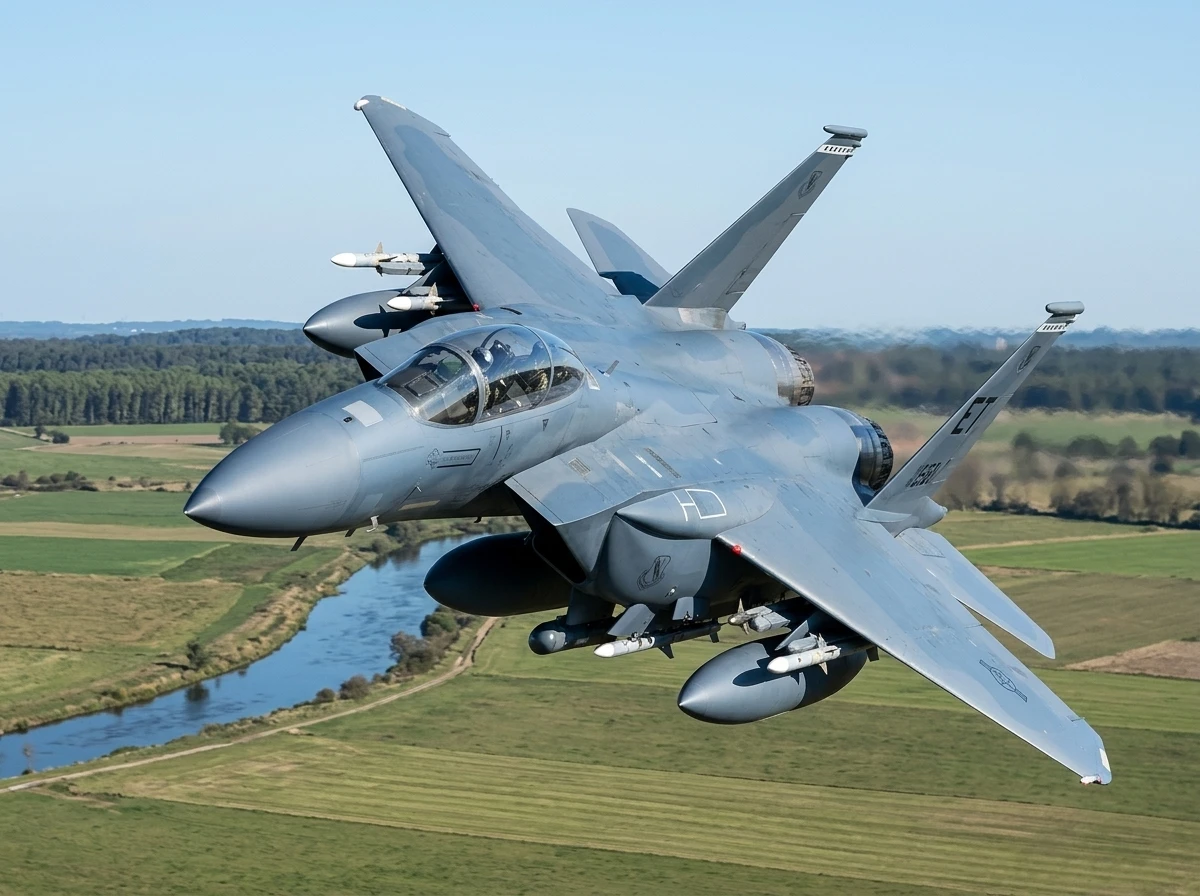
The U.S. Department of War awarded Boeing a $131.23 billion ceiling IDIQ contract for the F-15 Eagle Crest program on August 24, 2026, listing Poland among seven Foreign Military Sales customers. Poland’s Ministry of National Defence immediately stated the Polish Armed Forces do not plan to acquire F-15EX aircraft and that the listing starts no procurement process.
The ceiling covers production, upgrades, sustainment and depot maintenance through 2037. It is a framework, not a firm order. Only $343,740 was obligated at award. The Apache precedent shows how such listings can precede large Polish buys.
That gap between a ceiling figure and a tiny initial obligation is the core of an indefinite-delivery vehicle. The United States keeps a contracting path open for years. Partner nations keep political and fiscal room to decide later, or never.
A $131 Billion Framework Names Seven Buyers
The sole-source indefinite-delivery/indefinite-quantity award supports the F-15 program office. Work is based in St. Louis, Missouri. Ordering runs initially to August 24, 2031, with an option to 2036. Completion is expected by August 2037.
Foreign Military Sales customers named are Japan, Israel, Saudi Arabia, South Korea, Singapore, Indonesia and Poland. Several already fly earlier F-15 variants. Indonesia had pursued F-15EX jets but abandoned the effort earlier in 2026 after years of delay; its FMS case expired.
| Country | Current F-15 Status | Notes in Framework |
|---|---|---|
| Japan | Operator (F-15J upgrades) | Established FMS partner |
| Israel | Operator (F-15I/ variants) | Established FMS partner |
| Saudi Arabia | Operator (F-15SA) | Established FMS partner |
| South Korea | Operator (F-15K) | Established FMS partner |
| Singapore | Operator (F-15SG) | Established FMS partner |
| Indonesia | None | Prior EX interest abandoned 2026 |
| Poland | None | No formal plan announced |
The structure lets the United States place future task orders for any listed nation without restarting full competition each time.
Five of the seven names already operate earlier Eagles and treat the framework as a sustainment and upgrade path. Indonesia and Poland sit outside that group. One dropped a live case in 2026. The other has stated, on the record, that no acquisition plan exists.
The calendar itself is long. Initial ordering authority stretches five years from award. The option year and the 2037 completion date together cover multiple Polish budget cycles and at least one full F-35 induction wave.
Warsaw Says No Process Has Started
Poland’s Ministry of National Defence told Defence24 the Polish Armed Forces “do not plan to acquire F-15EX aircraft.” Inclusion in the American framework contract “does not mean a decision has been made or that a procurement process has begun.”
Siły Zbrojne RP nie planują pozyskania samolotów F-15EX. Wskazanie Polski w opublikowanym przez stronę amerykańską kontrakcie ramowym dotyczącym programu F-15 nie oznacza podjęcia decyzji ani uruchomienia procesu zakupu tych samolotów przez Polskę.
Polish Ministry of National Defence statement to Defence24, August 2026
Boeing told Janes aviation editor Gareth Jennings that Poland has not yet made a decision on the F-15EX. No Letter of Offer and Acceptance appears on Defense Security Cooperation Agency public notices for Polish Eagle IIs.
The ministry language is careful and complete. It rejects both a plan and the start of a process. That leaves marketing contacts, familiarization flights and framework listings in a separate category from formal procurement steps.
Absence of a public LOA is consistent with that stance. DSCA notices are the usual early signal once a government-to-government case moves. None has appeared for a Polish Eagle II buy.
The Apache Contract That Looked the Same in 2017
Gareth Jennings noted the parallel on X. In 2017 the U.S. Department of Defense denied that Poland had selected the AH-64 after the country appeared in a similar sensor-related contract. Warsaw later became the largest international Apache customer.
Apache sensor contract parallel posts drew tens of thousands of views within hours. Jennings wrote he was not claiming Poland had signed for the F-15, only that the earlier denial had not stopped a subsequent record order.
- 2017: Poland named in Apache-related sensor contract; DoD denies selection.
- 2022-2023: Letter of Request and State Department approval for up to 96 AH-64E Guardians plus weapons package valued near $12 billion.
- August 2024: Letter of Offer and Acceptance signed for 96 new-build AH-64E aircraft at roughly $10 billion, with interim leased AH-64Ds for training.
- 2025-2026: Offset agreements for Polish depot work; first new deliveries planned 2028-2032.
Poland now fields leased Apaches in public ceremonies and is building domestic maintenance capacity. The jump from denial to largest foreign operator took only a few years amid the post-2022 rearmament surge.
The sequence matters because each step was public and incremental. A sensor-contract listing did not equal selection. A later Letter of Request did. The LOA locked in airframes, weapons and training bridges. Offsets then pulled sustainment work into Poland.
Observers watching the F-15 listing are applying that same ladder. A name on a framework is the first rung. It is not the last.
How 29,500 Pounds of Payload Complements the Husarz
Poland already fields F-16s headed for major upgrades, 48 FA-50 light combat jets, and an initial 32 F-35A Husarz fighters that entered service in 2026. Officials have confirmed plans for another 32 F-35As, bringing the total to 64.
The F-15EX offers a different profile. Boeing lists a 29,500-pound payload capacity and the ability to carry up to 12 AMRAAMs or mixed large ordnance including cruise missiles. Twin engines, long range and open-mission systems let it serve as a high-volume missile truck that can operate with or behind stealth platforms.
- Payload: 29,500 lb (13,300 kg), more than internal F-35 loads.
- Air-to-air: unique capacity for a dozen AIM-120-class missiles.
- Role: complementary mass and standoff to fifth-generation aircraft.
- Growth: digital architecture ready for collaborative combat aircraft and future weapons.
In 2025 then-Inspector of the Polish Air Force Gen. Ireneusz Nowak flew an F-15EX at Boeing’s U.S. facilities. Boeing has pitched the jet to Warsaw since at least 2023, at times pairing it with the MQ-28 Ghost Bat concept.
The inventory mix already points to layered roles rather than a single type. Light jets handle training and lower-threat attack. Upgraded F-16s hold the fourth-generation line. The Husarz force supplies the stealth core. A heavy, twin-engine truck would sit beside that core, not replace it.
| Type | Polish Position | Primary Contribution |
|---|---|---|
| FA-50 | 48 in service | Light attack and training |
| F-16 | Fleet under major upgrades | Fourth-generation continuity |
| F-35A Husarz | 32 in service, 32 more planned | Stealth core to 64 |
| F-15EX | No plan announced | Payload and magazine depth if bought |
Payload figures drive the pitch. Internal F-35 loads favor low observability. An external-heavy Eagle trades that for volume, range and the option to haul large standoff weapons in numbers a stealth fighter does not match on a single sortie.
Boeing’s Pitch and the Double F-35 Order
Warsaw’s combat aircraft inventory is expanding on multiple tracks. The FA-50s provide light attack and training capacity. The F-16 fleet modernization keeps fourth-generation numbers relevant. The F-35 program is the stealth core. A large F-15EX buy would add long-range punch and magazine depth without competing directly for the same missions.
Polish officials have discussed a requirement for additional fourth-generation fighters. Numbers floated in earlier coverage have ranged around two or three squadrons. No formal request for information or offer has been made public for the Eagle II.
The new IDIQ simply means any future Polish order could move through an existing vehicle rather than requiring a fresh sole-source justification or full competition. That lowers administrative friction the same way earlier Apache contracting vehicles did.
Boeing’s familiarization effort is already several years old. The 2025 flight by the air force inspector put a senior Polish officer in the cockpit. Pairing talk with the MQ-28 concept framed the Eagle as a potential quarterback for uncrewed teammates, not only as a standalone bomber or interceptor.
None of that equals a requirement document. Floated squadron counts remain informal. Until a Letter of Request appears, the pitch and the framework are parallel tracks, not a single procurement path.
What a Long Ceiling Means for Sustainment
The Eagle Crest language covers more than new airframes. Production sits alongside upgrades, sustainment and depot maintenance through the 2037 horizon. That mix is what turns a fighter sale into a multi-decade industrial relationship.
Poland’s Apache path already shows the pattern. Offset agreements in 2025 and 2026 pulled depot work toward domestic capacity while leased aircraft covered the training gap. A future Eagle case, if one ever formed, would find similar hooks already written into the U.S. vehicle.
- Production: new-build F-15EX aircraft if ordered.
- Upgrades: continuous software and systems growth on an open architecture.
- Sustainment: parts, support equipment and contractor logistics.
- Depot maintenance: heavy repair work that can be shared or localized.
For a country already building Apache maintenance capacity, the depot clause is the industrial opening. It does not create work on its own. It keeps the option available if political leaders later want local jobs tied to any large airframe buy.
Indonesia’s expired case remains the counter-example. A listing and even years of pursuit can end without a single delivered jet. Framework language outlives individual campaigns. It does not force them to succeed.
How Post-2022 Buying Habits Shape the Reading
Poland’s recent record is a list of quiet interest that became firm LOAs once conditions aligned. Abrams and K2 tanks, HIMARS, Patriots, FA-50s, Apaches and F-35 growth all moved from discussion into multi-billion-dollar cases after 2022.
That pattern is why a single framework line draws attention even after a clear ministry denial. Analysts are not treating the denial as false. They are treating the country’s buying tempo as a separate data set that has repeatedly shortened the distance from “no process” to signed paperwork.
The F-35 double order already locks in a stealth backbone through the early 2030s. Any fourth-generation add-on would have to justify itself as magazine depth and standoff mass, not as a substitute for the Husarz force. Two or three squadrons is the informal band that has appeared in earlier coverage. It remains unconfirmed and unrequested in public FMS channels.
Fiscal space, pilot training pipelines and basing all sit outside the St. Louis contract text. Those constraints will decide timing more than the existence of an IDIQ vehicle.
What Changes for Future Polish Orders
The Eagle Crest framework runs long enough to cover multiple budget cycles and potential force-structure reviews after the current F-35 expansion. Depot-level maintenance language also opens industrial participation options if Warsaw ever seeks local sustainment work.
Indonesia’s expired case shows a listing is no guarantee. A firm Polish denial is on the record. Yet the country’s post-invasion buying pattern (Abrams and K2 tanks, HIMARS, Patriots, FA-50s, Apaches, F-35 growth) has repeatedly turned quiet interest into multi-billion-dollar LOAs once political and fiscal conditions aligned.
For now the contract is paperwork that keeps the option open. Boeing continues marketing. Polish pilots have already sampled the jet. The Apache path remains the clearest historical marker for how quickly a named-but-denied entry can become a headline order.
Whether that sequence repeats for the F-15EX will be decided in Warsaw, not in the St. Louis contract language.


Iowa Farmer Built Resilience for 16 Years Then Tariffs Hit Hard

HHS Adds FDA Tech and Drugs Deputies to Lock In AI and Review Power

Nvidia Earnings Carry a Built-In Sell-the-News Trap

HP Licenses Huawei Wi-Fi Patents Despite the Entity List

Poland Named in $131B F-15 Deal Echoes Apache Path

Sewer Scavengers Near Penn Station Repeat a Decades-Old NYC Pattern

Second Muni Fatigue Crash Exposes Surface Line Gaps

Chick-fil-A Chicken and Waffles Closes Its 80-Year Loop

Musk Data Centers Leave a Mississippi Family’s Historic Land Empty

OpenAI Data Center Chief Exits as Stargate Strategy Shifts

Double Fine Cuts 23 Jobs Weeks After Xbox Independence

Day-One Big Walk Lifts PS Plus August Beyond Recycled AAA

John Hight Exits Wizards After Digital Reckoning Hits

Curtis Mead’s Red Sox Debut Ends With Fractured Wrist

Moesch and Dressel Rewrite Night One at 2026 U.S. Nationals

Red Sox Squander Hot Streak Chance in 4-3 Loss to Athletics

Boutte’s Quiet Camp Takeover Forces Patriots Receiver Choices

Take-Two CEO Pushes Netflix Subs for GTA 6 Extended Look

Halo Campaign Evolved Skulls Meet Death Barriers That Kill the Hunt

Wildlands Free Update Hands Players the Tools They Already Invented
-

 TECHNOLOGY3 years ago
How to Adjust a Bulova Watch Band – An Easy Guide
-

 News3 years ago
Fred Pentland: Athletic Bilbao’s English mentor who changed the essence of Spanish football
-

 FINANCE3 years ago
Tax Planning for Every Season: Guide to Maximizing Your Tax Benefits
-

 Education3 years ago
African Ministers New Education Plan
-

 BUSINESS3 years ago
What is Entrepreneurial Operating System? A Comprehensive Guide to EOS
-

 Education3 years ago
Innovate Your Learning Journey with Technology and Enhance Education
-

 News3 years ago
Russians formally out of World Athletics Championships
-

 BUSINESS3 years ago
Top 9 Most Expensive American Cities to Rent an Apartment