
BUSINESS
PECO Workers Strike for First Time in 145 Years as Heat Wave Hits Philadelphia
About 1,600 PECO workers went on strike at 12:01 a.m. on July 4, 2026, the first walkout in the utility’s 145-year history, as Philadelphia baked under a heat wave.

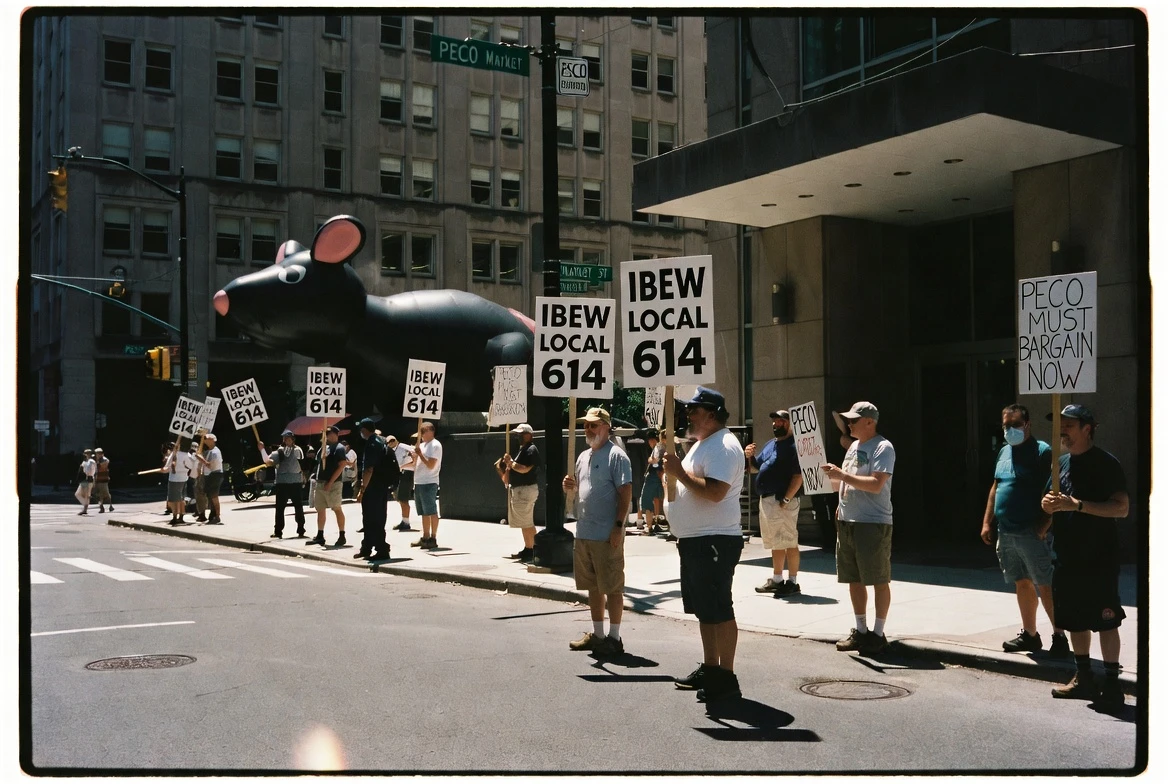
PECO workers went on strike at 12:01 a.m. Saturday, July 4, 2026, the first work stoppage in the Philadelphia utility’s 145-year history. About 1,600 members of International Brotherhood of Electrical Workers Local 614 walked off the job after negotiations on a new labor agreement collapsed, and picket lines went up outside the company’s headquarters at 23rd and Market streets as the region broiled under a heat wave. The union said PECO’s “lack of seriousness over six months of bargaining has forced us to this point,” and PECO said it was “extremely disappointed” workers chose to strike on a holiday weekend when air conditioners strain the grid.
A 145-Year-Old Company, A First Strike
PECO supplies electricity to 1.7 million ratepayers in Philadelphia and the surrounding Pennsylvania suburbs, and natural gas to about 550,000 suburban customers. The utility’s contract with IBEW Local 614 expired on March 31, 2026, though bargaining had been underway since January. The local represents linemen, gas odor responders, technicians, call center workers and other back-office employees, the crews who keep power flowing during storms and respond to gas leaks. Crossing the picket line is now off the table for union electrical workers across six states, a solidarity network the union described in a statement as part of why it is willing to absorb a holiday strike it has never had to absorb before.
The walkout began just after midnight, with about 1,600 union members on the picket line outside PECO facilities across five counties. Both sides say they want to continue talking. The talks had been grinding on for months, and union spokesperson Melissa McCleery said PECO “did not make any substantial changes to their offers until Wednesday of this week,” the final week before the strike deadline.
The Wage and Benefits Gap the Union Is Trying to Close
The union’s core pitch is simple: PECO employees earn about 30% less than their counterparts at nearby comparable companies, and the company’s last offer does not close that gap. McCleery said union members are also demanding pension and health benefits for about 600 workers hired after 2021, who were excluded from those plans. A third ask is a change to how retirement benefits are calculated, moving from a base-salary structure to one based on gross payroll so that overtime, a regular feature of life for line crews, counts toward retirement. The 6abc report on the strike noted that the union says they have not received a wage proposal in months.
PECO has publicly framed its offer differently. Spokesperson Greg T. Smore said management “presented a strong, market-competitive proposal that includes nearly a 20 percent wage increase over five years, along with significantly enhanced retirement and medical benefits that address the union’s long-standing priorities.” The company also pointed to its 2025 lineman compensation, reporting that the average PECO lineman salary in 2025 was $243,569 including overtime. The two sides disagree on whether those numbers amount to fair pay, and the strike is the first place that disagreement has produced a work stoppage.
| Issue | Union Position | PECO’s Offer |
|---|---|---|
| Wages | Catch up ~30% gap with comparable utilities | Nearly 20% wage increase over five years |
| Post-2021 hires | Pension and health benefits for ~600 workers hired after 2021 | Significantly enhanced retirement and medical benefits, terms not specified |
| Retirement calculation | Base benefits on gross payroll, which includes overtime | Current base-salary structure |
| Outsourcing | Keep jobs in Philadelphia and surrounding counties | Not addressed in public statements |
Union attorney and chief negotiator Stewart Davidson said workers are behind peers in nearby states. “Compared to the people who do what they do in NJ and other surrounding areas, they are way behind,” he said. “Nobody should have to endure that given the nature of the work they do and the conditions under which they do it.”
A Heat Wave Sets the Stage
The strike began as the Philadelphia region recorded its hottest stretch of the summer, a heat wave the Delco Times reported ended Saturday with the mercury again reaching 100 degrees and thunderstorms expected later. For PECO’s line crews, those are exactly the days the utility leans hardest on its workers. Striking linesman Joseph Vassallo described a normal heat-wave shift as 16 hours in protective gear, doing the work that keeps the power on. On Saturday morning he walked the picket line in a t-shirt and shorts.
It’s hard for me to sell the younger guys on what they’re going to be getting coming in here when I don’t even know myself. It’s a mixture of guys like me in the middle versus the guys in the beginning that we want to make sure that this stays beneficial for them and their families going forward.
Joy Rodriguez, a specialized consultant in PECO’s customer care center, said her concern is that the company will outsource the work she does. “We want to continue to bring the jobs to the city of Philadelphia and the surrounding counties that we service,” she said. PECO said it has “contingency plans in place” to keep electric and natural gas service running through the strike, comparing its preparations to storm readiness. State senators have publicly backed the workers, calling them critical to maintaining electricity and gas services.
The Picket Line Spreads Beyond Philadelphia
The strike is not contained to IBEW Local 614. According to the union, IBEW locals representing workers at utilities in Pennsylvania, New Jersey, Delaware, Maryland, Virginia and Georgia have directed their members not to accept calls, emergency work or side work from PECO. United Association Local 855, which represents gas and utility workers in New Jersey, is also honoring the picket line. That kind of cross-local coordination makes it harder for PECO to bring in substitute labor during a high-demand weekend.
- Pennsylvania, New Jersey, Delaware, Maryland, Virginia, Georgia: IBEW locals honoring the picket line
- United Association Local 855 (NJ gas and utility workers)
- Teamsters Local 107 business agent Shawn Dougherty, who accused PECO of an unfair labor practice
- Local contractors and utility workers across the region, per union reporting
Dougherty said “labor sticks with labor” and argued PECO has not bargained in good faith. “This chapter of the IBEW has been very, very tolerant,” he said. “Quite frankly, I don’t act that way.”
Allegations of Violence at the Picket Line
The dispute escalated off the bargaining table. IBEW alleges that three striking members have been assaulted in separate incidents since the walkout began. Two of those incidents happened at the Berwyn Yard in Tredyffrin Township, Chester County. Union leaders said a PECO security officer pushed a member to the ground at the utility’s Oregon Avenue facility in Philadelphia and that a PECO truck struck another member at the Berwyn Yard. In a separate incident, a third-party vehicle struck another union member at the Berwyn Yard, according to IBEW.
PECO spokesperson Smore rejected the allegations. “Based on our investigations, these accusations are completely false,” he said in a statement. IBEW Local 614 president and business manager Larry Anastasi called any violence against picketers unacceptable.
Our members are exercising their legal right to peacefully picket, and that is exactly what we expect them to continue doing. We are committed to conducting this strike safely and responsibly, and we expect PECO and everyone acting on their behalf to do the same.
Anastasi added that “the company has responsibility to ensure that interactions at its facilities remain safe and professional.”
Why the Parent Company’s $814 Million Year Won’t End the Strike
PECO is a subsidiary of Exelon, one of the largest utility holding companies in the United States. PECO made $814 million in 2025, and saw an increase in net income through the first quarter of 2026. Calvin Butler, the CEO of Exelon, received $24.6 million, including stocks, in total compensation last year. McCleery, the union spokesperson, said money from PECO’s recent rate increase is not flowing to workers. “There’s an enormous amount of waste and greed at PECO that’s a real problem,” she said.
A federal mediator has been assigned to help the two sides talk, though PECO said “the union has not agreed to participate.” The mediator’s presence does not by itself end a strike, and the two sides remain apart on wages, on post-2021 benefits, and on how retirement is calculated. Until those numbers move, the picket lines at 23rd and Market, at the Berwyn Yard, and at the Oregon Avenue facility stay up.
Frequently Asked Questions
How many PECO workers are on strike?
About 1,600 members of IBEW Local 614 walked off the job at 12:01 a.m. on Saturday, July 4, 2026. The local represents linemen, gas odor responders, technicians, call center workers, and other back-office employees.
Is this the first PECO strike ever?
Yes. It is the first work stoppage in PECO’s 145-year history. The previous contract between IBEW Local 614 and PECO expired on March 31, 2026, and bargaining had been underway since January.
What is the union’s main demand?
The union says PECO employees earn about 30% less than counterparts at comparable nearby utilities. It is also pushing for pension and health benefits for about 600 workers hired after 2021 and for retirement benefits to be calculated on gross payroll rather than base salary so that overtime counts.
What has PECO offered?
PECO says it has presented a market-competitive proposal that includes nearly a 20 percent wage increase over five years, along with significantly enhanced retirement and medical benefits. The company reported that the average PECO lineman salary in 2025 was $243,569 including overtime.
Will my power stay on during the strike?
PECO said it has contingency plans in place, similar to its storm preparations, to keep electric and natural gas service running. IBEW locals in six states and United Association Local 855 in New Jersey have directed members not to cross the picket line, which limits PECO’s ability to bring in outside line crews.





Spotify Running Mode hits Android and revives its old tempo experiment

Galaxy Tab S12 Ultra Renders Keep the Notch Fans Hate

Novato Spinning Round House Sells With Six Neighbors for $3.3 Million

Crop Tour Finds Indiana and Nebraska Corn Yields Lagging 2025

Best Buy 60th sale brings Android deals back to its roots

American Airlines reverses seatback screen bet years too late

Iran Hormuz Strikes Force Gulf Oil Onto Costlier Paths

Plague Tale Prequel Day One Joins Game Pass Wave 2 as Witcher Exits

NBA 2K27 opens The City to everyone and rewrites career eras

iOS 26.6.1 Patches 29 Flaws as AI Forces Faster Apple Updates

Guardians Rout Twins With Seven Homers, Leave Joe Ryan One Shy of Record

Caitlin Clark Skips the WNBA 3-Point Contest for a Third Straight Year

Rainout Gives Red Sox Two Shots at a Franchise-Record Win Streak

Double Fine Cuts 23 Jobs Weeks After Xbox Independence

John Hight Exits Wizards After Digital Reckoning Hits

Day-One Big Walk Lifts PS Plus August Beyond Recycled AAA

Curtis Mead’s Red Sox Debut Ends With Fractured Wrist

Moesch and Dressel Rewrite Night One at 2026 U.S. Nationals

Red Sox Squander Hot Streak Chance in 4-3 Loss to Athletics

Boutte’s Quiet Camp Takeover Forces Patriots Receiver Choices
-

 TECHNOLOGY3 years ago
How to Adjust a Bulova Watch Band – An Easy Guide
-

 News3 years ago
Fred Pentland: Athletic Bilbao’s English mentor who changed the essence of Spanish football
-

 FINANCE3 years ago
Tax Planning for Every Season: Guide to Maximizing Your Tax Benefits
-

 Education3 years ago
African Ministers New Education Plan
-

 BUSINESS3 years ago
What is Entrepreneurial Operating System? A Comprehensive Guide to EOS
-

 Education3 years ago
Innovate Your Learning Journey with Technology and Enhance Education
-

 BUSINESS3 years ago
Top 9 Most Expensive American Cities to Rent an Apartment
-

 News3 years ago
Russians formally out of World Athletics Championships