
News
Phantom Twist Drone Fools the Eye, Not Radar or Ears
Northwestern engineers built a drone that vanishes at 25 spins a second, but noise and radar signatures reveal real limits to its stealth trick.

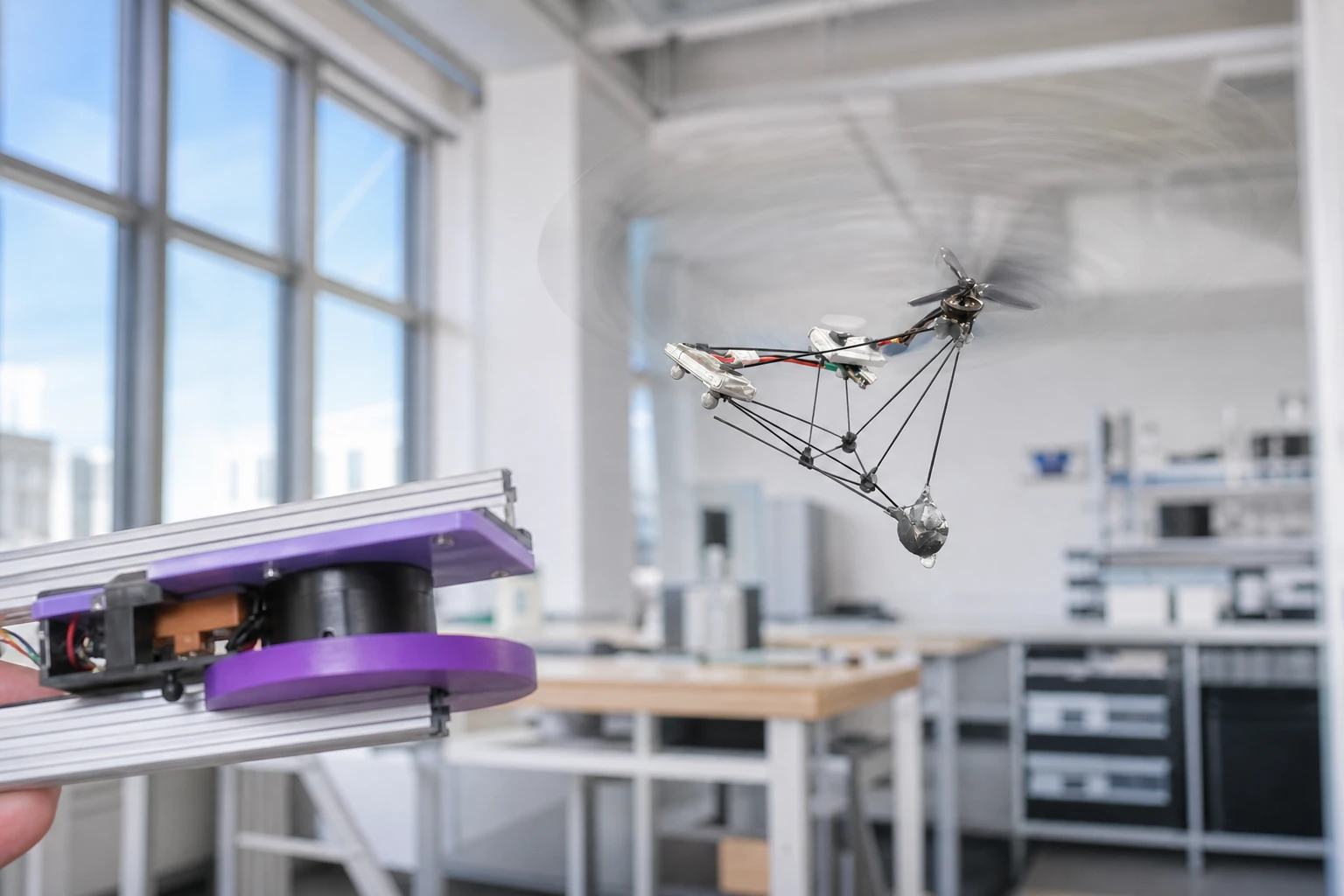
A drone built at Northwestern University can spin itself almost out of existence. Once it hits between 15 and 25 rotations per second, its frame blurs into the background. Engineers unveiled it July 16 at the Robotics: Science and Systems conference in Sydney, calling it Phantom Twist and reporting it is roughly ten times harder to spot than a standard quadcopter.
The same trick that erases the drone from view does nothing to quiet its propeller or hide it from radar. And the design drops the wing every earlier spinning drone relied on, trading stability for a machine that only holds together at full spin.
The Trick Is Motion Blur, Not Magic
Northwestern’s engineers built Phantom Twist around a single motor and a single propeller, not the four fixed rotors on a typical quadcopter. The propeller spins one direction. The drone’s entire body spins the other way, so nothing on the aircraft ever sits still in the air.
Michael Rubenstein, an associate professor who led the project, said, “For a typical quadrotor drone, the propellers are spinning, but the robot is stationary. So, you still see its body. For our drone, the whole thing is rotating, so there are no stationary parts.”
The science behind it is called persistence of vision. Human eyes need time, roughly 100 milliseconds by one estimate reported by IEEE Spectrum, to integrate a moving scene before the brain processes it. Spin an object faster than that window and the eye averages it into the scenery instead of tracking it as a shape.
Emma Alexander, an assistant professor of computer science and a co-author on the study, said, “The human eye takes time to accumulate signals, roughly analogous to the exposure time of a camera. When an object spins quickly, we perceive it as blurring out and losing distinct features.” Northwestern detailed the counter-rotating design in its own release on the project.
Twenty Thousand Virtual Drones Fought for One Design
Rubenstein’s team did not sketch this shape by hand. A computational pipeline generated thousands of candidate layouts, then let software fight over where every gram of hardware should sit.
- A model first generated roughly 20,000 drone layouts capable of stable flight, mixing a motor, propeller, circuit board, counterweight and batteries.
- An optimization algorithm repositioned each part so components never visually overlapped while spinning.
- Every design was simulated spinning against 100 real-world backgrounds and scored by a perceptual model built to mimic human vision, with a lower score meaning better camouflage.
- The 500 best-scoring layouts went through the optimizer a second time before engineers built a final prototype.
The National Science Foundation funded the work, detailed in the study’s paper posted on the RSS 2026 program and credited to lead author Jingxian Wang and colleagues.
From Yehudi Lights to Maple Seeds
Concealment through motion has a long history. The Northwestern paper traces it back decades, citing earlier attempts that either failed to spin fast enough or relied on a completely different sense trick.
- 1944: The National Defense Research Committee developed the Yehudi light, a counter-illumination system meant to hide Allied sea-search aircraft from enemy lookouts.
- 2006: A project nicknamed the Boomerang Drone, covered in a New York Times Magazine piece, tried a similar high-speed spin but could not rotate fast enough to trigger the same blur effect.
- 2009: University of Maryland engineers flew what they called the first controllable robotic samara monocopter, a single-wing aircraft modeled on a maple seed’s spinning fall.
- 2025: Researchers at the Singapore University of Technology and Design flew the SG60, a 32-gram single-rotor monocopter that hovered under full autonomous control for 26 minutes.
- 2026: Northwestern’s Phantom Twist drops the wing altogether, spinning its whole body to blur into the background instead.
Each generation of the idea solved one problem without solving the rest.
How Four Flying Machines Stack Up
Line up Phantom Twist next to its nearest relatives and the tradeoffs come into focus. Singapore’s wing-based SG60 built for 26 minutes of hover chased endurance, while Lockheed Martin’s earlier Samarai flyer chased reconnaissance under a DARPA program. Neither one tried to disappear.
| Aircraft | Motors | Lift Mechanism | Headline Result | Known Weak Point |
|---|---|---|---|---|
| Standard quadcopter | 4 | Four fixed rotors, stationary body | Simple control, easy payload scaling | Highly visible, loud body that never stops moving |
| SUTD SG60 monocopter | 1 | Samara-style wing autorotation | 26-minute hover on 32 grams | Built for endurance, not concealment |
| Lockheed Martin Samarai | 1 | Single wing with tip propeller | DARPA-funded surveillance flyer | Needs a full wing to generate lift |
| Northwestern Phantom Twist | 1 | Whole body counter-spins at 15 to 25 times per second | Roughly 10 times harder to see than a quadcopter | No wing, so balance is unforgiving |
The pattern across three generations of single-motor drones is simple. Drop complexity in one place, and it tends to reappear somewhere else.
Does Spinning Fast Enough Beat Radar Too?
No. The optical trick that blurs Phantom Twist from human view does nothing to its acoustic or radar footprint. Spinning rotor blades generate a distinctive frequency pattern known as a micro-Doppler signature, and counter-drone radar systems are built specifically to read it, no matter how the aircraft looks.
Northwestern’s own release lists the limits plainly. The propeller still makes audible noise at full spin, and the wires and support rods remain faintly visible up close, according to the university. Micro-Doppler radar reads the motion signature of spinning rotor blades, one radar maker explains, letting security systems tell a drone from a bird even when the aircraft is not transmitting anything. A body spinning fast enough to blur past human eyes is still a body spinning fast enough to register on that kind of radar.
The airframe raises a separate concern. Earlier single-motor spinning drones, from the maple-seed monocopters to Lockheed’s Samarai, always kept a wing or leaned on spin-induced lift called the Magnus effect to stay up. Phantom Twist skips the wing entirely, using an angled motor for lift and a high-speed control system to hold its course, which means the whole aircraft only behaves once it is already spinning at full speed. A hand launcher spins the device up before release, since there is no slow, wingless way to get it airborne.
What we know:
- Phantom Twist spins between 15 and 25 times per second and tested roughly 10 times harder to see than a standard quadcopter.
- The National Science Foundation funded the work, presented at the Robotics: Science and Systems conference in Sydney on July 16.
- The final shape came out of a computational pipeline that tested about 20,000 stable layouts against 100 real-world backgrounds.
What’s unconfirmed:
- The exact finished weight and dimensions of the flying prototype.
- How the aircraft lands once its flight ends, since public materials describe only the hand launch.
- Any timeline for a quieter, more transparent next-generation version.
Wildlife Surveys Are the Pitch, for Now
Every account close to the project points to the same intended use. Interesting Engineering reported that loud, obviously mechanical drones tend to spook nesting birds and disturb wildlife during surveys, which is part of why researchers frame Phantom Twist as an ecological and infrastructure tool.
The National Science Foundation funded this specific project, and Northwestern’s materials describe uses in ecology, environmental surveys and infrastructure inspection, not defense. The lineage the researchers cite in their own paper is mostly military. The Yehudi light was a 1944 military program, and Lockheed’s Samarai grew out of a Defense Advanced Research Projects Agency effort built around reconnaissance from the start.
Frequently Asked Questions
Is Phantom Twist being developed for the military?
No branch of the military is listed as a funder. The National Science Foundation backed the Northwestern project, and its public materials describe ecological surveys and infrastructure inspection as the intended uses, with no defense contract named for Phantom Twist itself.
Can you buy a Phantom Twist drone?
No. Phantom Twist exists as a hand-built research prototype tied to a single peer-reviewed paper, demonstrated at the RSS 2026 conference in Sydney. Northwestern has not announced a manufacturing partner or a release timeline for the design.
How does Phantom Twist steer without a wing or multiple rotors?
The single motor and propeller are the only control input available. By speeding up or slowing down the motor at a precise point in each rotation, the drone can push itself in a chosen direction, while overall motor thrust controls altitude and the constant spin keeps it passively stable.
What is next for the Phantom Twist project?
Rubenstein’s team plans to pursue quieter propulsion and more transparent materials in later prototypes, aiming to shrink the wires and support rods that remain faintly visible today. No public timeline has been announced for a next-generation build.
What is the Robotics: Science and Systems conference?
Robotics: Science and Systems, often shortened to RSS, is an annual peer-reviewed robotics research conference. The 2026 edition ran in Sydney, Australia, where Northwestern’s team presented the Phantom Twist paper on July 16 alongside other robotics research.


Walmart’s $50 Million Opioid Settlement Closes Case Without Admission

California Sues Over $120 Million Morro Bay Wind Lease Buyout

Gilead Bixlenvo FDA Nod Opens Single Pill Path for Complex HIV Cases

Meta’s $18B Kids Deal Forever Shields Data Used to Spot Under-13s

Lettuce Outbreak Drove Record Cyclospora Spike Across 20 States

Amazon Shaves $20 Off M6 Mac Mini Before It Even Ships

SpaceX Louisiana Port Tests Debt Markets on Orbital AI Scale

Microsoft High Lifts Indexes as Small Caps Crack Support

Apple Replays 2015 Saturday Midnight Preorder for iPhone 18 Pro

Updated COVID Shots Clear FDA but Access Friction Hits High-Risk Groups

Take-Two CEO Pushes Netflix Subs for GTA 6 Extended Look

Wildlands Free Update Hands Players the Tools They Already Invented

Destiny 2 Fans Unlock Vaulted Maps After Live Service Ends

Quake Gets 19 Free Maps From MachineGames Quake Club

Quordle Monday Delivers Gavel Crush Speed Ethos Cleanly

Stripe Bid Shows PayPal Moat Cracked After Years of Slide

Tyson’s Five-Year Utah Plant Falls to Cattle Shortage Reckoning

Silver Lake Workday Talks Signal Private Floor for Software

Kennedy Lewis Takes Majority Control of The Greenbrier in $500M Deal

Best Buy Marks 60 Years With Sale That Echoes Its Audio Shop Roots
-

 TECHNOLOGY3 years ago
How to Adjust a Bulova Watch Band – An Easy Guide
-

 News3 years ago
Fred Pentland: Athletic Bilbao’s English mentor who changed the essence of Spanish football
-

 FINANCE3 years ago
Tax Planning for Every Season: Guide to Maximizing Your Tax Benefits
-

 Education3 years ago
African Ministers New Education Plan
-

 BUSINESS3 years ago
What is Entrepreneurial Operating System? A Comprehensive Guide to EOS
-

 Education3 years ago
Innovate Your Learning Journey with Technology and Enhance Education
-

 News3 years ago
Russians formally out of World Athletics Championships
-

 BUSINESS3 years ago
Top 9 Most Expensive American Cities to Rent an Apartment