
News
Antonelli’s Perfect Throttle Lift Beats Verstappen and Leaves Russell Behind
Antonelli’s Spa pole lap beat Verstappen by three tenths, but the same throttle lift trick has Mercedes teammate Russell calling the gap impossible to close.

Kimi Antonelli beat Max Verstappen to pole position for Sunday’s Belgian Grand Prix by just 0.317 seconds. The margin came down to a single, rehearsed lift of the throttle just before the finish line, timed to the length of a blink.
That detail matters more than the pole itself. The same throttle lift deciding the gap to Verstappen also explains why Antonelli’s own Mercedes teammate, George Russell, says it currently feels impossible to race him at all.
Antonelli Beats Verstappen by Three Tenths at Spa
Antonelli’s final lap in Saturday’s Q3 covered Spa-Francorchamps in 1 minute 44.361 seconds. Verstappen could only manage 1 minute 44.678 seconds, even with a helping hand from his own teammate.
Isack Hadjar, Verstappen’s Red Bull teammate, towed him down the back straight between Blanchimont and the Bus Stop chicane on Verstappen’s first Q3 run, throwing away his own lap in the process. It cost Hadjar nothing; he already faced a back of the grid start for taking new power unit components. A red flag then halted the session so marshals could sweep gravel that Oscar Piastri had dragged onto the track at Stavelot. When the pair tried the move again, it worked better, the two cars meeting so smoothly that Verstappen swept past without lifting off.
“He did amazing,” Verstappen said. “I initially thought, ‘Oh my God it’s too close,’ but then actually it worked out well to the last corner. It was close, but I trusted him.”
The raw timing does not fully back the praise. Verstappen gained just a tenth of a second in that final sector compared with his own earlier lap, 28.185 seconds against 28.279 seconds.
Before the red flag, Lando Norris topped Q3 with a 1 minute 44.801 second lap, Antonelli second on 1 minute 44.840 seconds, Charles Leclerc third on 1 minute 44.893 seconds and Verstappen fourth on 1 minute 44.984 seconds. Norris was never really in the pole fight; a grid penalty of his own awaited him on Sunday. Everything hinged on the final runs.
| Driver | Sector 1 | Sector 2 | Sector 3 | Final Lap |
|---|---|---|---|---|
| Kimi Antonelli (Mercedes) | 30.160s | 46.059s | 28.142s | 1:44.361 |
| Max Verstappen (Red Bull) | 30.443s | 46.050s | 28.185s | 1:44.678 |
The numbers show where Antonelli’s advantage actually came from. Sector one gave him a few hundredths. The rest of the gap, and then some, was built in one place: the middle sector, through Spa’s fastest and least forgiving corners.
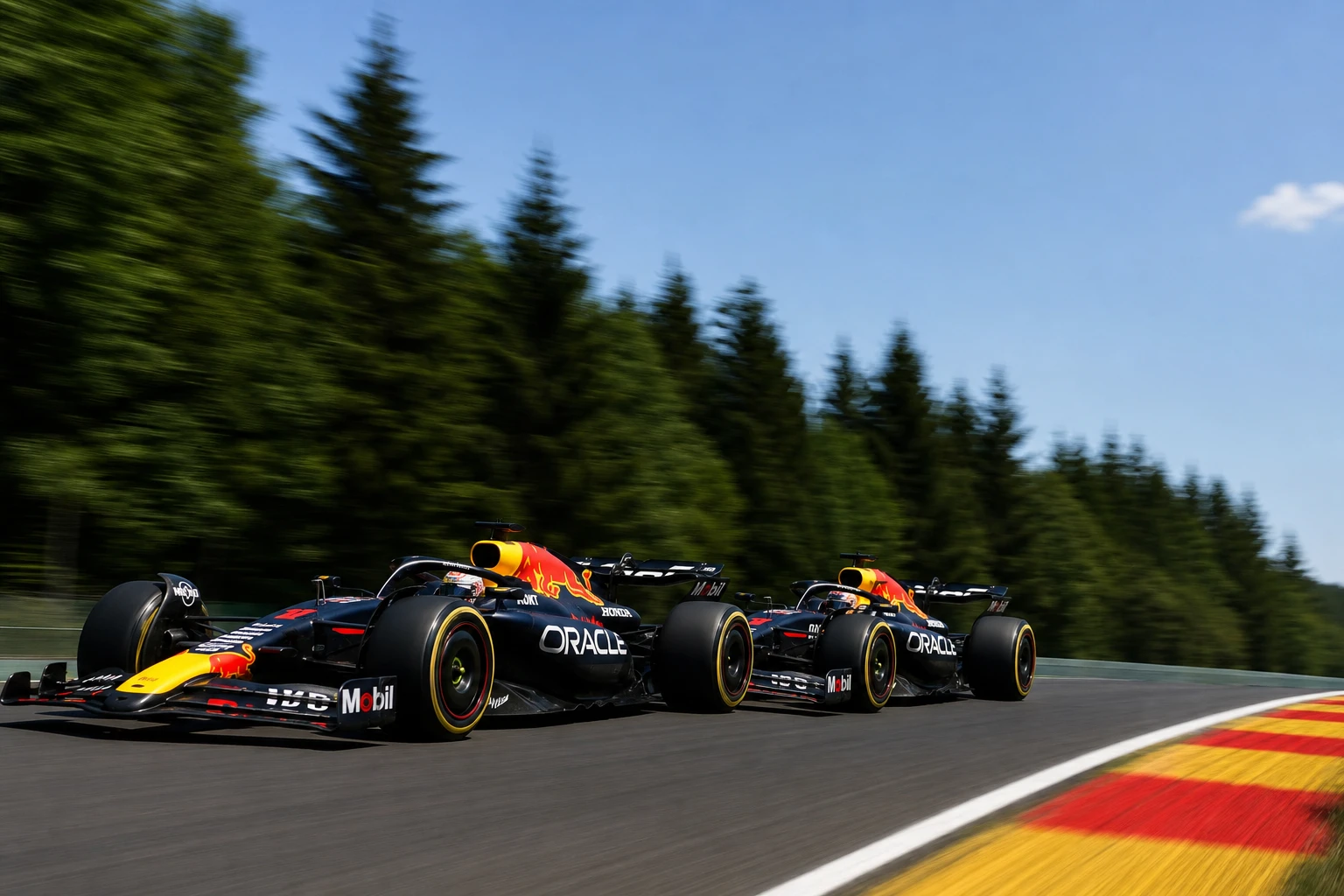
Where the Half Second Actually Came From
On their first Q3 runs, Verstappen crossed sector two in 46.185 seconds, second only to Norris. Antonelli’s opening effort was a more modest 46.534 seconds, putting him three tenths behind through what has usually been Red Bull’s strongest ground.
Antonelli erased that deficit and more on his final lap, going through in 46.059 seconds. Verstappen improved as well, but only fractionally, to 46.050 seconds. Antonelli should have lost time in that section. Instead he came out having lost only thousandths.
Much of it traces back to energy deployment rather than raw pace. Pouhon, once one of the most admired corners on the calendar, is now mostly a place where cars coast and recharge under the 2026 rules rather than attack. Antonelli’s onboard footage showed his car beginning to harvest energy halfway around the corner. Verstappen clawed back a couple of tenths on the run toward Fagnes as his own car clipped more aggressively, before the two converged again once he lifted early.
Red Bull’s combustion engine is rated the best of any manufacturer under the FIA’s own development scoring system. None of that shows up in a lap decided by where a driver chooses to lift.
Antonelli was unambiguous about where his gain came from. “Every corner,” he said, asked where he found the time. “I was just carrying a bit more speed. It was a bit hard to judge at times because super clipping was coming more and more, so it was changing the reference a little bit.”
“That was the tricky bit in qualifying,” he said. “But on the last lap, I just tried to carry a bit more speed everywhere, and the car stuck, so I’m happy with that.”
A Loophole the FIA Thought It Had Closed
The lift before the finish line is not new, and it is not even the first version of this trick this season. Formula 1’s hybrid rules require the MGU-K, the electric motor that also recovers braking energy, to phase out its power in stages once a lap is done, normally 50 kilowatts every second, so cars do not suddenly surge or slow in front of others still on a flying lap.
- MGU-K – the motor generator unit that harvests braking energy and can now produce up to 350 kilowatts under the 2026 rules, nearly three times its old output.
- Ramp down – the mandatory staged cut in that power, usually 50 kilowatts a second, meant to stop dangerous speed swings near the end of a lap.
Mercedes and Red Bull found a way around an earlier version of this rule back in March, cutting MGU-K power to zero in one go instead of stepping it down, exploiting an exemption meant for emergencies. It worked, but it also locked the motor out for 60 seconds afterward, leaving cars crawling back to the pits and, in Alex Albon’s case at Suzuka, stopped on track entirely.
Ferrari complained, and the FIA (the Fédération Internationale de l’Automobile, motorsport’s governing body) issued a technical directive restricting the trick to emergencies. That closed the instant shutdown version. It did not close the rehearsed throttle lift version now in use at Spa, which delays the ramp down calculation without ever triggering the emergency shutoff, because the driver’s power demand and the engine’s output both dip below zero at the same instant, satisfying the letter of the rule.
The MGU-K’s jump in output to 350 kilowatts this season is exactly why the stakes of getting this timing right have grown. Electric power now makes up roughly half of a 2026 car’s total output, so a driver who misjudges the lift by even a few metres gives away real, measurable speed.
The loophole is really a symptom of a wider argument over how much of that power should come from batteries at all.
- Max Verstappen wants the current 55-45 electric to combustion split ripped up in favor of something closer to 80-20 toward the engine, and has compared the racing to a video game.
- Lando Norris has gone further, telling reporters Formula 1 should eventually get rid of the battery altogether.
- The FIA has only gone as far as nudging the balance back toward combustion power and adding five Straight Mode zones at Spa alone to help cars cope.
Why Does Russell Call the Gap Impossible to Close?
Russell finished qualifying more than half a second behind Antonelli and called the deficit impossible to close. Both Mercedes drivers use the identical throttle lift before the line, but Friday’s practice data shows Russell lifts off roughly 70 metres earlier than his teammate, bleeding speed he never gets back by the finish.
Before the weekend even began, Russell had already made peace with where his season stood.
Whether the luck has balanced out or not, I’m not sure. However, based on my performances and based on his performances over the course of these nine races, I think probably a 25 point gap in his favor is probably correct. He has done a better job than me this year to this point, so he deserves to be ahead of me.
Russell said that four days before qualifying, in comments conceding a fair 25 point deficit to Antonelli. By Saturday afternoon, the tone had hardened. Russell called his issues “super frustrating” and said it is currently “impossible” to challenge his teammate, after ending the session more than half a second down.
Trackside data reviewed by motorsport analysts backs him up. Across Friday’s practice runs, Russell lifted off roughly 70 metres before Antonelli did, at a point where both cars’ batteries sat near empty. That earlier lift cost him heavily as the speed gap between the two Mercedes widened all the way to the line.
Sunday’s Grid Looks Nothing Like Saturday’s
Saturday’s times will not be Sunday’s starting grid. Four grid penalties are reshuffling the order before a single racing lap has been run.
- Isack Hadjar starts from the back after Red Bull fitted a fresh power unit, the same penalty that let him tow Verstappen for free.
- Lando Norris drops ten places for a fourth power electronics system, despite setting the pace before the first red flag.
- Fernando Alonso takes a twenty place penalty over power unit changes.
- Lance Stroll also serves a grid penalty this weekend.
Norris’s drop promotes Russell one place, to start directly behind Antonelli and Verstappen on Sunday, right where Saturday’s qualifying battle just played out.
What the Pole Means for the Title Fight
Antonelli arrives at Spa leading the drivers’ championship, but by a far smaller margin than he once held.
- 25 points now separate Antonelli from Russell, down from a lead once as wide as 68 points in June.
- 32 points covers the gap back to third placed Lewis Hamilton, seven behind Russell.
- Two races without scoring, at the Spanish and British Grands Prix, did most of the damage to Antonelli’s cushion.
Toto Wolff, Mercedes’ team principal, wants the recovery to continue. “We have a car capable of fighting at the front and scoring heavily, but we have not converted that potential into the best possible results,” he said this week. “Reliability issues have cost us points, and in a championship this competitive, that is something we cannot afford.”
Lights out at Spa-Francorchamps is set for 3pm local time on Sunday, 2pm in the UK, over the full 7.004 kilometre lap. Antonelli starts first, Verstappen second, and Russell third, close enough to try again.
Frequently Asked Questions
What is F1’s MGU-K ramp down rule?
The MGU-K is the motor generator that recovers energy under braking and can add up to 350 kilowatts of power under 2026 rules. Once a driver has used maximum deployment, the rules normally force that power to be phased out in steps of 50 kilowatts per second, rather than cut instantly, so cars do not suddenly slow in front of others still on a flying lap.
Why did Isack Hadjar get a grid penalty at the Belgian Grand Prix?
Red Bull fitted Hadjar’s car with a full set of new power unit components ahead of Spa, triggering an automatic back of the grid start under Formula 1’s parts allocation rules. That penalty is what let him sacrifice his own qualifying lap to tow Verstappen without any cost to his own grid slot.
What time does the Belgian Grand Prix start?
The race is scheduled for 3pm local time, 2pm in the UK, on Sunday, July 19, at the Circuit de Spa-Francorchamps, the longest track on the Formula 1 calendar at 7.004 kilometres.
How big is Kimi Antonelli’s championship lead?
Antonelli held a 25 point lead over Russell entering the Belgian Grand Prix weekend, down from as much as 68 points in June, after reliability problems cost him points at the Spanish and British Grands Prix.


Walmart’s $50 Million Opioid Settlement Closes Case Without Admission

California Sues Over $120 Million Morro Bay Wind Lease Buyout

Gilead Bixlenvo FDA Nod Opens Single Pill Path for Complex HIV Cases

Meta’s $18B Kids Deal Forever Shields Data Used to Spot Under-13s

Lettuce Outbreak Drove Record Cyclospora Spike Across 20 States

Amazon Shaves $20 Off M6 Mac Mini Before It Even Ships

SpaceX Louisiana Port Tests Debt Markets on Orbital AI Scale

Microsoft High Lifts Indexes as Small Caps Crack Support

Apple Replays 2015 Saturday Midnight Preorder for iPhone 18 Pro

Updated COVID Shots Clear FDA but Access Friction Hits High-Risk Groups

Take-Two CEO Pushes Netflix Subs for GTA 6 Extended Look

Wildlands Free Update Hands Players the Tools They Already Invented

Destiny 2 Fans Unlock Vaulted Maps After Live Service Ends

Quake Gets 19 Free Maps From MachineGames Quake Club

Quordle Monday Delivers Gavel Crush Speed Ethos Cleanly

Stripe Bid Shows PayPal Moat Cracked After Years of Slide

Tyson’s Five-Year Utah Plant Falls to Cattle Shortage Reckoning

Silver Lake Workday Talks Signal Private Floor for Software

Kennedy Lewis Takes Majority Control of The Greenbrier in $500M Deal

Best Buy Marks 60 Years With Sale That Echoes Its Audio Shop Roots
-

 TECHNOLOGY3 years ago
How to Adjust a Bulova Watch Band – An Easy Guide
-

 News3 years ago
Fred Pentland: Athletic Bilbao’s English mentor who changed the essence of Spanish football
-

 FINANCE3 years ago
Tax Planning for Every Season: Guide to Maximizing Your Tax Benefits
-

 Education3 years ago
African Ministers New Education Plan
-

 BUSINESS3 years ago
What is Entrepreneurial Operating System? A Comprehensive Guide to EOS
-

 Education3 years ago
Innovate Your Learning Journey with Technology and Enhance Education
-

 News3 years ago
Russians formally out of World Athletics Championships
-

 BUSINESS3 years ago
Top 9 Most Expensive American Cities to Rent an Apartment