
News
Hobbyist 3D-Prints Windows Space Cadet Pinball Where Deeproot Failed

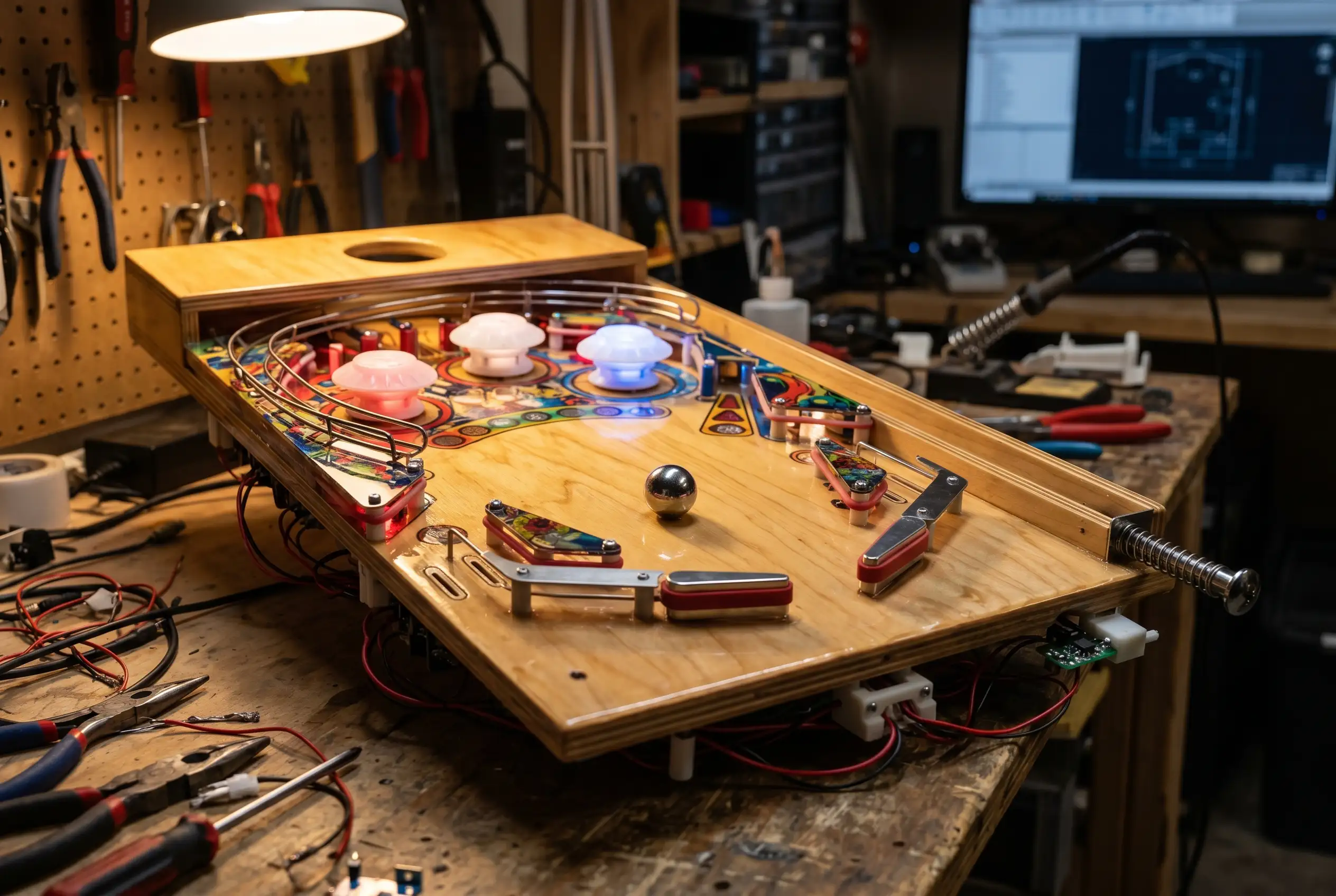
A YouTube builder going by CNCDan is 3D-printing a physical recreation of the freebie pinball table Microsoft bundled with Windows XP, and his version of the playfield measures just 56 centimeters across. The build already includes mechanical flippers, pop bumpers with embedded LEDs, slingshots, drop targets, and a raised upper playfield modeled on 3D Pinball for Windows: Space Cadet, the giveaway shipped with every Microsoft operating system from Windows NT 4.0 through XP.
Five years ago a venture-funded outfit called Deeproot Pinball had a reskinned Space Cadet layout queued for a 2021 release, before its parent company collapsed under Securities and Exchange Commission (SEC, the United States markets regulator) fraud charges totaling nearly $58 million. A hobbyist with a domestic printer is now clearing the obstacle a fund holding $46 million of investor money never finished.
The Build CNCDan Has Already Soldered Together
CNCDan documented the work in a video posted to his YouTube channel and a longer text writeup picked up by the Hackaday writeup on the Space Cadet build. By his account, he started with the perspective-shifted screen view of the original 1995 table and projected it flat onto a one-meter-tall cabinet. That scaling exercise produced a rectangular playfield 56 centimeters wide, near the lower bound of commercial pinball widths and well below anything stocked by a parts supplier.
Every flipper, slingshot, drop target, and pop bumper on the table is custom. CNCDan modelled and printed the mechanisms himself, including the translucent caps that house the bumper LEDs and the upper-deck delay mechanism that mimics the brief pause the virtual ball used to take when it dropped through a hole from the raised playfield back to the flippers below.
The Space Cadet table also has an extra-ball lock that holds the player’s progress between missions, and a kickback alley underneath the raised deck. CNCDan has tackled both of those in the printed-component pass.
That alone puts the build further along than any homebrew Space Cadet attempt that has surfaced publicly. An earlier WordPress-hosted worklog from a different builder, dating back to 2012, got as far as a 1,110 by 534 millimeter playfield on 12 millimeter MDF and standard-size pinballs, before the project quietly went dark.
| Spec | Virtual table (1995) | CNCDan physical build |
|---|---|---|
| Playfield width | Perspective-skewed pixels, no fixed unit | 56 cm rectangular |
| Cabinet height | Not applicable | 1 meter |
| Pop bumper diameter | Not applicable | 53 mm |
| Bumper sensors | Software collision check | Hall effect magnets |
| Upper-deck drop delay | Programmed pause | Custom mechanical mechanism |
| Playfield art | Pre-rendered 1995 sprites | Awaiting commissioned hand-drawn art |
Why a 56 cm Playfield Breaks the Pinball Parts Catalog
Commercial pinball pop bumpers sit around 70 to 75 millimeters across, the size Williams and Bally settled on decades ago and the size every aftermarket supplier still ships. The Space Cadet layout, scaled down to a cabinet a person can keep in a living room, asks for 53 millimeter bumpers, near a third smaller than the standard part.
That single dimensional gap cascades through almost every mechanism on the playfield:
- Pop bumper rings, caps, and skirts do not exist off the shelf at that diameter, so each one has to be designed and printed.
- The plastic microswitches that normally trigger the bumper coil are physically too large to fit under a 53 millimeter skirt without binding on the ball travel.
- Upper-playfield bumpers are smaller still, which compounds the switch problem and forces the kickback wiring to thread under them carefully so it does not block the return alley.
- Slingshot rubber bands and coil brackets sized for full-scale parts overhang the playfield boundary when dropped into the scaled layout.
- The drop targets and ball-lock saucer have to be reproportioned so the standard pinball still rolls cleanly past them.
The original Cinematronics designers, who built the table for Maxis under the Full Tilt! Pinball banner in 1995, never had to deal with any of this. A virtual table has no fasteners, no wire harness, no clearance under the playfield, and no commercial parts catalog telling it what it can and cannot be.
The Hall-Effect Fix and a Wiring Puzzle Under the Raised Deck
The microswitch problem was the first one CNCDan had to design around. Plastic switches at that scale were unreliable, occasionally registering ghost hits or missing real ones. He swapped them out for Hall effect sensors, small magnetic detectors that read the ball as it passes through a field rather than depending on a physical lever.
Hall sensors are common in industrial automation and have been creeping into hobbyist pinball builds for a few years, but they are unusual in a Space Cadet recreation because the original digital table did not need them. Software collision detection was the only sensor model the 1995 game had to honor, and that is the same model that later forced the title off 64-bit Windows entirely.
Then there was the kickback. The raised playfield on Space Cadet drops the ball through a hole back to the main flipper area after a mission completes. On screen, the ball simply vanishes and reappears at the bottom a half-second later. On the physical table, the ball has to actually fall, and the wiring loom for the upper bumpers has to be routed so it does not foul the kickback return alley underneath. CNCDan added a small mechanical delay mechanism that holds the ball briefly before releasing it, so the rhythm matches the muscle memory of anyone who played the original on a Windows 2000 office desktop.
Where Deeproot Pinball Burned Through $58 Million
The reason a hobbyist build is news at all is that the last serious attempt to ship a Space Cadet table came from a company that imploded. Deeproot Pinball, the sole operating subsidiary of San Antonio holding company Deeproot Tech, had a Space Cadet-styled prototype on its 2021 release slate before the SEC filed civil fraud charges against founder Robert Mueller.
The August 2021 complaint, posted on the regulator’s own document server at the SEC filing against Robert Mueller and Deeproot Tech, lays out the funding picture in detail:
- $46.18 million raised from 215 investors into the deeproot 575 Fund LLC between September 2015 and February 2021.
- $12.61 million raised from 81 investors into the deeproot Growth Runs Deep Fund over the same window.
- $820,000-plus in payments to earlier investors that the SEC characterized as Ponzi-like, sourced from new investor money.
- Funds used for the Deeproot founder’s daughter’s private school tuition, two weddings, a Kauai condominium, and jewelry, according to the complaint.
The trade publication Pinball News, which had been tracking Deeproot’s pre-release tours, summarized the moment in a piece titled “Game Over for Deeproot Pinball?” Several finished prototypes existed inside the San Antonio facility at the point of collapse, but the Space Cadet reskin never reached buyers, and Mueller is fighting the civil case rather than the criminal one (none was filed). The investor money is largely gone.
What CNCDan is doing in his garage costs a domestic 3D printer, spools of plastic, a 48-volt power supply, and a few hundred dollars of solenoids and LEDs.
Why Microsoft Quietly Killed Space Cadet After XP
For readers under 30, the table needs a footnote. Cinematronics built Full Tilt! Pinball for Maxis and shipped it in October 1995 with three tables: Space Cadet, Skulduggery, and Dragon’s Keep. Microsoft licensed a Space Cadet-only version into the Plus! add-on pack and then folded it into Windows NT 4.0, Windows 2000, Windows ME, and Windows XP, where it became the most-played pack-in game in the Windows back catalog.
Then it vanished. Microsoft’s Raymond Chen, a long-serving developer on the Windows team, explained on the Old New Thing blog entry on Space Cadet’s removal that during the early 64-bit Windows port a collision detection bug caused the ball to fall straight through the plunger and out of the bottom of the table, ending every game in a few seconds. The source code was a decade old, lightly documented, and the porting team had millions of lines of more important code to move; dropping the game was the path of least resistance. Microsoft’s broader pattern of legacy quirks surviving for years has been a recurring story, including Microsoft’s recent admission that crash-free third-party drivers had been quietly draining Windows 11 batteries.
What’s Still Missing Before the First Plunger Pull
The build is closer than any previous attempt, but it is not done. CNCDan has flagged three open items before the table can host a complete game.
- Flipper power. The first flipper prototype could not throw the ball with enough velocity to clear the upper-deck ramp, so the coil and linkage geometry are being redesigned before the cabinet goes together.
- Cabinet construction. The walls, leg assemblies, and backbox have not been built yet. CNCDan has signaled he will likely 3D-print most of the cabinet, consistent with the rest of the build philosophy.
- Playfield artwork. The 1995 game shipped with low-resolution sprite art that does not scale to a printed playfield. CNCDan is recruiting human artists rather than synthesizing the work, and he has been clear about why.
I’m sure AI can do it, but I’d much rather give this job to a real human being.
That stance, posted in his project notes, comes at a moment when generative tools are colonizing exactly this kind of nostalgic recreation work. CNCDan is offering free playtime on the finished table in exchange for hand-drawn art assets, which is the kind of trade that only makes sense if you assume the table actually gets finished. On current progress, that assumption is no longer ridiculous. If the flipper redesign passes its bench test and a willing artist surfaces in the next few months, the first plunger pull on a real-world Space Cadet table is closer than it has been since Maxis shipped the game thirty-one years ago; if either of those breaks down, the project joins the long queue of half-built homebrews on hobbyist hard drives.






Iowa Farmer Built Resilience for 16 Years Then Tariffs Hit Hard

HHS Adds FDA Tech and Drugs Deputies to Lock In AI and Review Power

Nvidia Earnings Carry a Built-In Sell-the-News Trap

HP Licenses Huawei Wi-Fi Patents Despite the Entity List

Poland Named in $131B F-15 Deal Echoes Apache Path

Sewer Scavengers Near Penn Station Repeat a Decades-Old NYC Pattern

Second Muni Fatigue Crash Exposes Surface Line Gaps

Chick-fil-A Chicken and Waffles Closes Its 80-Year Loop

Musk Data Centers Leave a Mississippi Family’s Historic Land Empty

OpenAI Data Center Chief Exits as Stargate Strategy Shifts

Double Fine Cuts 23 Jobs Weeks After Xbox Independence

Day-One Big Walk Lifts PS Plus August Beyond Recycled AAA

John Hight Exits Wizards After Digital Reckoning Hits

Curtis Mead’s Red Sox Debut Ends With Fractured Wrist

Moesch and Dressel Rewrite Night One at 2026 U.S. Nationals

Red Sox Squander Hot Streak Chance in 4-3 Loss to Athletics

Boutte’s Quiet Camp Takeover Forces Patriots Receiver Choices

Take-Two CEO Pushes Netflix Subs for GTA 6 Extended Look

Halo Campaign Evolved Skulls Meet Death Barriers That Kill the Hunt

Wildlands Free Update Hands Players the Tools They Already Invented
-

 TECHNOLOGY3 years ago
How to Adjust a Bulova Watch Band – An Easy Guide
-

 News3 years ago
Fred Pentland: Athletic Bilbao’s English mentor who changed the essence of Spanish football
-

 FINANCE3 years ago
Tax Planning for Every Season: Guide to Maximizing Your Tax Benefits
-

 Education3 years ago
African Ministers New Education Plan
-

 BUSINESS3 years ago
What is Entrepreneurial Operating System? A Comprehensive Guide to EOS
-

 Education3 years ago
Innovate Your Learning Journey with Technology and Enhance Education
-

 News3 years ago
Russians formally out of World Athletics Championships
-

 BUSINESS3 years ago
Top 9 Most Expensive American Cities to Rent an Apartment