
FINANCE
SpaceX IPO Filing Elevates Water to a Power-Level Risk

SpaceX has added water access to the risk factors in its initial public offering (IPO) filing, telling prospective investors that securing water to cool its data centers now matters as much as locking in power and processors. The amended registration statement, submitted June 1, frames water scarcity as a direct threat to how fast the company can scale its artificial intelligence business.
Buried in the risk-factors section, the change is easy to miss. It is also the clearest sign yet that the water needed to cool AI hardware has moved from an operational footnote to a financial concern worth flagging for Wall Street.
Water Joined Power in SpaceX’s Risk Ledger
The earlier version of the filing told investors that SpaceX’s data centers were mainly limited by access to “power at economically feasible prices,” plus long build times and material shortages. The revised text widens that constraint. Buildouts now hinge on the availability of power and water at economically feasible prices.
SpaceX, which absorbed Elon Musk’s AI company xAI earlier this year, went further in spelling out the danger.
Water scarcity, drought conditions, competition for local water resources, or regulatory restrictions on water use could limit our ability to obtain sufficient water for cooling, constrain data center cooling capacity, increase our costs, delay or limit expansion of our data center infrastructure, or require us to implement alternative cooling techniques that may be more costly or less available.
The company also told investors that water has become a “critical consideration in data center site selection, development and operations.” That phrasing matters, because it signals water is no longer just a running cost. It now helps decide where SpaceX can physically put its next cluster of servers.
Why Cooling Water Became a Filing-Worthy Threat
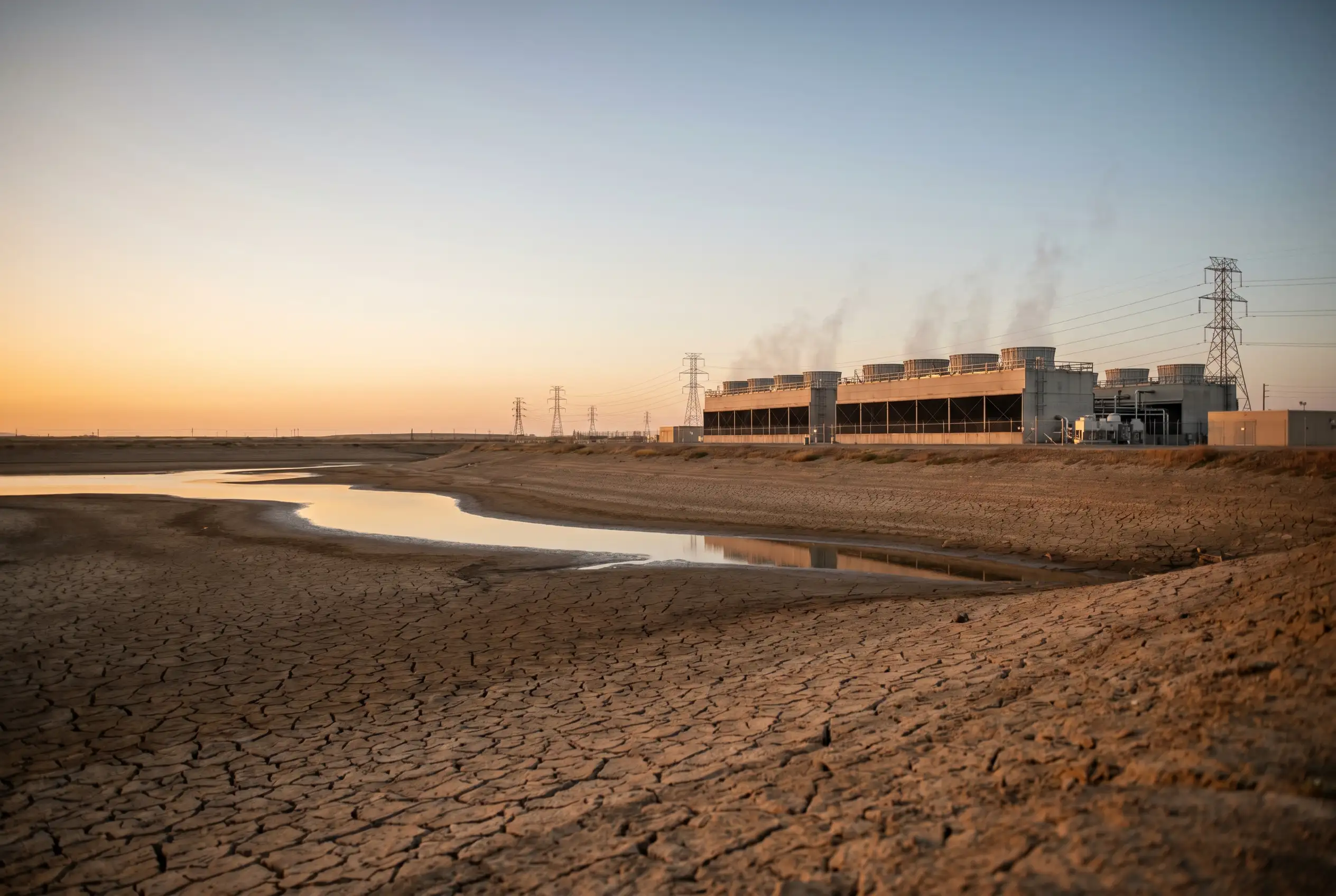
Cooling is where AI hardware drinks. Servers running large models throw off enormous heat, and many facilities still rely on evaporative cooling that consumes fresh water by the millions of gallons. Cooling alone accounts for 20% to 40% of a data center’s energy use, so the water and power problems feed each other.
The macro numbers explain why a single line in a risk section is worth reading closely.
- 560 billion liters: estimated global data-center water use per year, on track to reach 1.2 trillion liters by 2030, per an analysis of global data-center water exposure.
- 25%: share of existing data centers in regions projected to face greater water scarcity by 2050.
- 30%: share of facilities under construction sited in those same stressed regions.
Researchers have warned for years that the industry was building into a wall. A peer-reviewed study laying out four water-insecurity concerns about AI data centers showed how clustering thirsty facilities in dry areas pits server cooling against drinking-water supplies. The clash is already visible in the American West, where a Colorado River power plant went dark amid a deepening water crisis, exposing how electricity and water now compete for the same shrinking pool.
Memphis Shows the Bill Behind the Language
To see what the abstract wording means on the ground, look at Memphis. xAI’s Colossus supercomputer there is exactly the kind of facility the filing describes, and its short history is a catalogue of the frictions the document now warns about.
Gallons by the Million
Memphis Light, Gas and Water (MLGW, the city’s public utility) has said the Colossus site can draw up to 1,000,000 gallons of water a day from the local system to cool its servers. Reported usage has run lower in practice, with a peak of about 381,000 gallons a day during 2025, but the permitted ceiling shows the scale of demand a single AI campus can place on one municipal supply.
That draw lands in a region already under stress, the same dynamic the filing flags when it lists competition for local water resources as a risk.
Turbines, Permits, and a Senate Letter
The cooling-water fight sits next to a parallel fight over power. The campus has escalated along a clear sequence:
- xAI deployed up to 35 gas turbines at the first Colossus site, more than double the 15 it was permitted to run, before removing the excess units once a state permit was issued.
- On April 14, 2026, the Mississippi State Conference of the NAACP (National Association for the Advancement of Colored People) and a coalition of environmental groups filed a Clean Air Act lawsuit alleging 27 unpermitted gas turbines at the second Colossus site in Southaven, Mississippi.
- That action followed an earlier legal challenge over an unpermitted gas plant powering the data center, brought by the Southern Environmental Law Center in a city the American Lung Association has flagged for ozone pollution.
- Federal scrutiny arrived when Senator Sheldon Whitehouse, ranking member of the Senate Environment and Public Works Committee, pressed the company in a Senate inquiry into data-center gas plants.
None of this appears in SpaceX’s filing by name. But it is the lived version of “regulatory restrictions” and “competition for local water resources,” and it is now part of the company an IPO buyer would own.
The Anthropic Lease Behind the Thirst
Why does water suddenly rate a mention? Because demand on these facilities is exploding, and SpaceX’s own filing shows it. The document discloses that AI developer Anthropic agreed to rent capacity at the Colossus 1 data center for $1.25 billion per month through May 2029, a contract worth roughly $40 billion over its life.
The facility behind that deal packs 220,000 Nvidia GPUs (graphics processing units, the chips that train and run AI models) into 300 megawatts (MW) of power, and SpaceX says it was built in about 120 days. More chips and more power in one place means more heat, and more heat means more water for cooling. The Anthropic lease is, in effect, a water commitment as much as a compute commitment.
Either side can cancel the agreement with 90 days’ notice, so the revenue is less locked in than the headline number suggests. The water draw needed to honor it, though, is real for as long as the servers run.
The filing now treats power and water as twin constraints. The table below shows how SpaceX frames each.
| Constraint | How the Filing Frames It | Why It Binds |
|---|---|---|
| Power | Access at “economically feasible prices,” plus long lead times | Grid hookups and generation capacity cap how much compute can run |
| Water | “Critical consideration in site selection, development and operations” | Evaporative cooling needs fresh water that scarce regions may ration |
The Same Water Math Hits Every AI Builder
SpaceX is the loudest name to put water in a securities filing, yet the pressure runs across the whole industry. The operators chasing AI capacity are all siting huge campuses, and a growing share land in places where water is already contested.
Advocacy groups have been tracking the trend, with a Food & Water Watch report on AI’s energy and water footprint arguing that the buildout is outpacing the resources meant to support it. Three points frame how widely the strain spreads:
- Roughly one in three data centers under construction sits in a region heading toward greater water scarcity, per the global exposure figures.
- Hotspots include Chile, Brazil, Mexico, Turkey, and Australia, where rapid digital expansion meets rising climate stress.
- In the United States, prolonged drought across the West has already forced hard choices, with a severe Colorado drought squeezing rivers and state water supplies.
What is new is the venue. The constraint has now jumped from environmental reports and community lawsuits into the formal language of an IPO prospectus, where it sits in front of every institution sizing up the offering.
What the Filing Means for IPO Buyers
For investors weighing the SpaceX offering, the water language is a tell about where the risk now lives. The growth story rests on stacking ever more compute, and that story now carries a resource bottleneck the company felt obliged to name in print.
The same amended filing carried two other changes worth noting. SpaceX set aside up to 5% of the shares in the offering for employees and the friends and family of executives, a group not bound by the usual lock-up and free to sell at listing. It also warned that future stock issuance could be “significant,” wording widely read as leaving room for a possible combination with Tesla that would dilute existing holders.
The company remains in its pre-IPO quiet period, during which the SEC (Securities and Exchange Commission, the US markets regulator) has sent comment letters seeking more detail. Whether the water disclosure was prompted by those questions will not be clear until the letters are published after the offering.
If water keeps shaping where AI campuses can be built, the constraint SpaceX just disclosed will trail the company well past listing day. If cooling technology gets cheaper and less thirsty faster than the buildout, the line stays the boilerplate it looks like. Buyers are being asked to bet on which comes first.
Frequently Asked Questions
Why did SpaceX add water to its IPO risk factors?
SpaceX amended its filing on June 1 to warn that water needed to cool its data centers is now as important as power and chips. The company says water scarcity, drought, local competition, or regulatory limits could constrain cooling capacity, raise costs, and slow expansion of its AI infrastructure.
How much water does an AI data center use for cooling?
It varies by design, but the scale is large. xAI’s Colossus site in Memphis can draw up to 1,000,000 gallons a day under its utility arrangement, with reported peak use near 381,000 gallons a day in 2025. Globally, data centers use an estimated 560 billion liters of water a year.
What is the xAI Colossus water and power controversy?
The Memphis-area Colossus campuses have faced complaints over heavy water use and gas turbines run without full permits. In April 2026, the NAACP and environmental groups filed a Clean Air Act lawsuit over 27 unpermitted turbines at the Southaven site, and a US senator opened a separate inquiry.
When is the SpaceX IPO and can the public buy in?
SpaceX is still in its pre-IPO period after filing its registration statement on May 20, with no confirmed first trading date publicly set. Retail access to large IPOs is usually limited at the offer price, so most individual investors would buy shares on the open market after listing.
Disclaimer: This article is for informational purposes only and is not investment advice. Securities such as pre-IPO and newly listed shares carry significant risk, including loss of capital, and IPO terms can change before pricing. Consult a qualified financial professional before making any investment decision. Figures are accurate as of publication on June 2, 2026.






Iowa Farmer Built Resilience for 16 Years Then Tariffs Hit Hard

HHS Adds FDA Tech and Drugs Deputies to Lock In AI and Review Power

Nvidia Earnings Carry a Built-In Sell-the-News Trap

HP Licenses Huawei Wi-Fi Patents Despite the Entity List

Poland Named in $131B F-15 Deal Echoes Apache Path

Sewer Scavengers Near Penn Station Repeat a Decades-Old NYC Pattern

Second Muni Fatigue Crash Exposes Surface Line Gaps

Chick-fil-A Chicken and Waffles Closes Its 80-Year Loop

Musk Data Centers Leave a Mississippi Family’s Historic Land Empty

OpenAI Data Center Chief Exits as Stargate Strategy Shifts

Double Fine Cuts 23 Jobs Weeks After Xbox Independence

Day-One Big Walk Lifts PS Plus August Beyond Recycled AAA

Curtis Mead’s Red Sox Debut Ends With Fractured Wrist

John Hight Exits Wizards After Digital Reckoning Hits

Red Sox Squander Hot Streak Chance in 4-3 Loss to Athletics

Moesch and Dressel Rewrite Night One at 2026 U.S. Nationals

Boutte’s Quiet Camp Takeover Forces Patriots Receiver Choices

Take-Two CEO Pushes Netflix Subs for GTA 6 Extended Look

Halo Campaign Evolved Skulls Meet Death Barriers That Kill the Hunt

Wildlands Free Update Hands Players the Tools They Already Invented
-

 TECHNOLOGY3 years ago
How to Adjust a Bulova Watch Band – An Easy Guide
-

 News3 years ago
Fred Pentland: Athletic Bilbao’s English mentor who changed the essence of Spanish football
-

 FINANCE3 years ago
Tax Planning for Every Season: Guide to Maximizing Your Tax Benefits
-

 Education3 years ago
African Ministers New Education Plan
-

 BUSINESS3 years ago
What is Entrepreneurial Operating System? A Comprehensive Guide to EOS
-

 Education3 years ago
Innovate Your Learning Journey with Technology and Enhance Education
-

 News3 years ago
Russians formally out of World Athletics Championships
-

 BUSINESS3 years ago
Top 9 Most Expensive American Cities to Rent an Apartment