
BUSINESS
SpaceX Louisiana Port Tests Debt Markets on Orbital AI Scale
SpaceX’s $100 billion Starbase Louisiana plan equals just 2% of projected capex through 2035.

SpaceX will spend $100 billion through 2035 on Starbase Louisiana, a 125,000-acre Gulf Coast spaceport near Pecan Island in Vermilion Parish that targets first Starship launches in 2029 and thousands of flights a year. Morgan Stanley analyst Adam Jonas calls the figure just 2 percent of the company’s total projected capital spending over the period and says the firm will need roughly $80 billion a year in average net debt issuance to keep the wider plan moving.
The announcement, made Aug. 25 with Louisiana Gov. Jeff Landry, immediately revived investor questions about how a newly public company funds ambitions that now stretch from Starship factories to orbital AI data centers.
Five Complexes and a Self-Sustaining Port
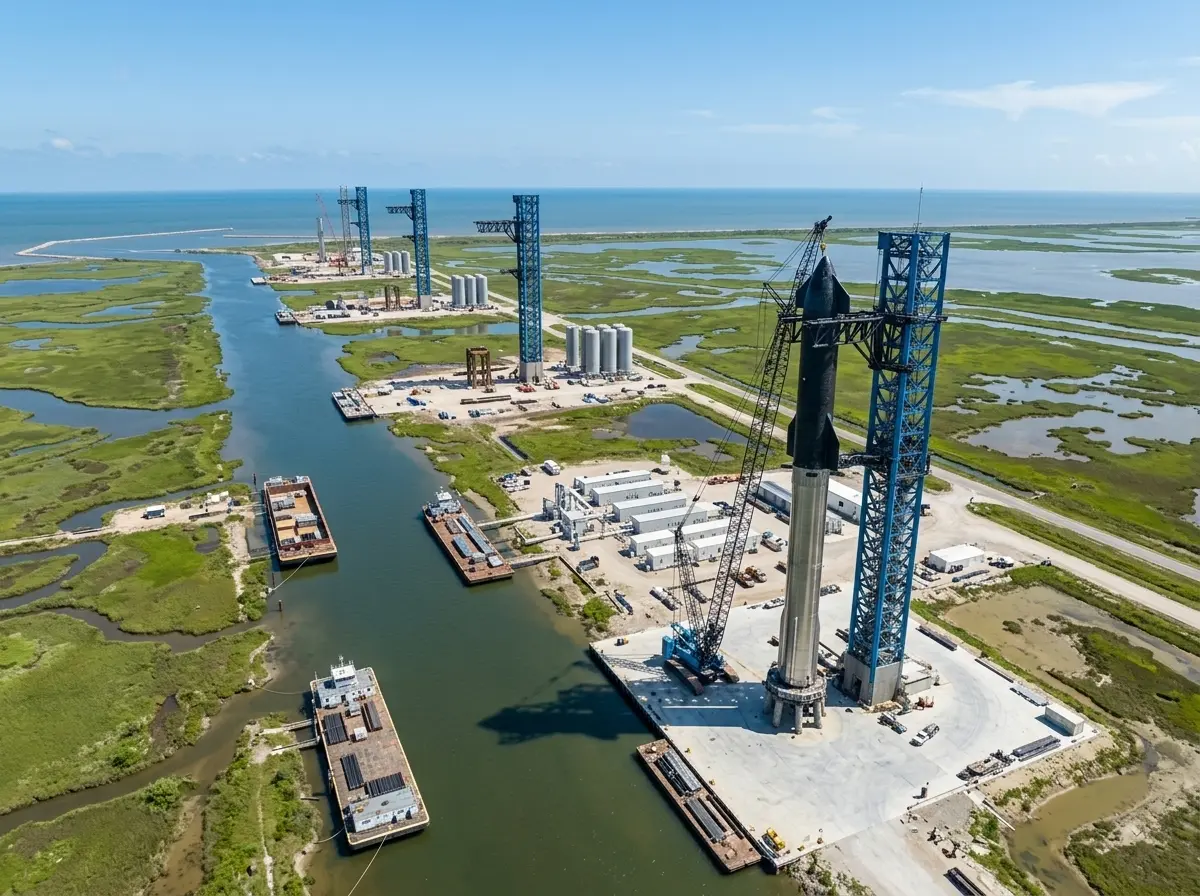
Starbase Louisiana is designed as SpaceX’s fourth and largest U.S. launch site. At full build-out it will contain five launch complexes, each with two pads and a propellant farm, for a total of 10 pads. Related infrastructure includes on-site methane production from local natural gas, power generation, vehicle processing, deep-water shipping access, employee housing and probably an airport.
- Construction targeted to begin in 2027
- First Starship launch from the site aimed for 2029
- Capacity for thousands of annual flights once mature
- Vehicles manufactured in Texas and Florida then barged in
- Only a fraction of the 125,000 acres developed; most left as wetlands
SpaceX president and COO Gwynne Shotwell told the Abbeville announcement crowd the site will be “a self-sustaining spaceport with its own propellant production, power generation, deep-water shipping capabilities, vehicle processing facilities, and probably an airport.” Elon Musk later posted that the finished complex will have “over a dozen launch towers, enabling more than 30 Starship flights per day and making it the biggest launch site on Earth.”
| Feature | Detail |
|---|---|
| Land | About 125,000 acres, former Exxon property sold via state settlement |
| Pads | 10 across five complexes |
| Jobs (state estimate) | 3,000 direct at $92,600 average salary; 8,100+ indirect |
| Timeline | Groundbreak 2027, first flight 2029 |
| Local cash | PILOT generating more than $820 million over 25 years |
The company already operates one Starship pad in South Texas and is building more in Florida. Louisiana gives it room Texas and Florida lack, plus southward trajectories suited to polar orbits for Starlink and future AI satellites.
Why the Gulf and Why This Month
Louisiana Economic Development said talks began with a SpaceX call on Feb. 5, 2026. The land became available after Exxon settled coastal lawsuits and donated the tract; the state sold it to SpaceX for about $100 million, with proceeds earmarked for coastal restoration. Natural gas proximity, deep-water access via the Intracoastal Waterway, and political willingness sealed the choice.
The timing sits against a fresh White House push. On Aug. 20 President Donald Trump signed a National Security Presidential Memorandum on space transportation that sets a national goal of supporting more than 1,000 launches and reentries each year by 2030. The U.S. handled 217 commercial launches in 2025. Air Force Secretary Troy Meink told Congress in May the country “probably” needs a new heavy-lift site. The Space Force fiscal 2027 request already includes $2.2 billion for launch infrastructure.
Stats snapshot
- 3,000 direct jobs promised, average pay 192 percent above Vermilion Parish levels
- $25 million annual PILOT payment escalating, plus $20 million upfront
- $25 million charitable donation to the Community Foundation of Acadiana
- 2 percent share of Jonas’s total SpaceX capex forecast that the port represents
Quilty Space analyst Kimberly Siversen Burke noted federal funding “seems more plausible” after the memo and that the Pentagon could designate the site a third national heavy-lift range, opening cost-sharing for range gear, roads and utilities.
The Funding Math Investors Face
Shortly after its June 2026 IPO that raised roughly $85.7 billion, SpaceX issued $25 billion of investment-grade bonds across five tranches maturing 2031-2056. Demand exceeded $85-90 billion in orders. Yet capex already runs far ahead of operating cash. In the second quarter the company spent $18.37 billion on capital projects against $7.81 billion revenue; first-half cash from operations covered only about 12 percent of build-out.
Jonas wrote that large capex numbers “are easy to announce on paper, but the growth needs to materialize for SpaceX and the debt markets to continue to justify it.” His model sees average net debt issuance near $80 billion annually through 2035 once AI compute and Starship factories are included. The Louisiana line item is essentially all of the firm’s modeled pure space capex for the decade yet still only a sliver of the total stack that now includes terrestrial and orbital AI.
| Item | Figure (Jonas / company filings) |
|---|---|
| Louisiana spaceport cumulative | $100 billion through 2035 |
| Share of total modeled capex | 2 percent |
| Average annual net debt needed | ~$80 billion |
| IPO proceeds (approx.) | $85.7 billion |
| Follow-on bond sale | $25 billion |
Micah Walter-Range, president of Caelus Partners, told MarketWatch he sees “no way around doing this” if SpaceX is to hit its cadence targets; the company currently has one operational Starship pad and four more under construction elsewhere.
Local Payments and the Jobs Bargain
Louisiana offered a competitive incentives package conditioned on capital investment, job creation and the $25 million donation. SpaceX will join the new Aerospace Facilities and Activities Rebate and High Impact Jobs program and receive LED FastStart recruitment help. Instead of conventional property taxes it signed a Payment in Lieu of Taxes deal with Vermilion Parish taxing bodies: $20 million upfront plus $25 million a year for 25 years with an escalator. LED says the structure will produce more than $820 million in direct local payments.
State officials project 3,000 direct jobs over 10 years at an average $92,600 salary. Musk and Shotwell have separately suggested the real headcount could approach 10,000, with 60-80 percent local hires mirroring Texas practice. Construction peak could support more than 34,000 temporary jobs. Highway 82 and other routes will need upgrades; the state may share some infrastructure costs.
Parish Police Jury President Chad Vallo called it “one of the best opportunities of a lifetime” that lets grandchildren stay home for work. Crowds on X immediately noted the trade-off: large tax expenditures and a PILOT that locks in fixed payments while wetlands continue to erode at 1-3 meters a year in places. SpaceX says it will partner on Louisiana’s Coastal Master Plan, including breakwaters, and keep most of the acreage undeveloped for wildlife.
Federal Cadence Push Meets Private Scale
The Trump memorandum directs agencies to incentivize private co-development of launch infrastructure, expedite permitting, identify new sites on federal land, and publish range schedules that maximize capacity. It also tells the Pentagon and NASA to prioritize investments that raise flexibility and economies of scale. Burke argued that third-site national-security status would justify public spending on tracking, communications and utilities of the kind the FAA is already soliciting public-private ideas for.
SpaceX’s own growth path already assumes Starship becomes the workhorse for Starlink expansion, NASA Artemis human landers (a $2.89 billion contract still active), and a planned constellation of AI processing satellites. Evercore ISI has called Starship the “keystone dependency.” Without more pads the cadence math fails; with Louisiana the company can point to a clean-sheet site free of the range conflicts that limit Florida and the beach-access constraints that limit Texas.
We’re preparing to build a spaceport that, until now, has only existed in science fiction. Starbase, Louisiana will unlock that future.
Elon Musk, SpaceX founder and CEO, announcement remarks and X post
What the Scale Is Meant to Unlock
Jonas’s long-term model still reaches multi-trillion revenue by 2040 even without full Louisiana build-out, requiring only eight pads at two launches per day. SpaceX is planning roughly 15 pads across sites. The excess capacity is the option on orbital data centers that could sidestep terrestrial power and permitting fights, plus the sheer volume needed for a multiplanetary logistics network.
Shotwell emphasized natural-gas feedstock for methane propellant and barge links back to the South Texas Starfactory. The site’s polar-orbit geometry shortens the overflight path for sun-synchronous AI and remote-sensing constellations. On X, high-engagement posts treated the $100 billion figure and the 30-flights-per-day claim as proof that the company is still thinking in orders of magnitude larger than Wall Street base cases.
Environmental voices on the platform countered with state land-loss maps showing large portions of the parish under water in medium sea-level scenarios within decades. SpaceX’s answer is the same coastal-protection partnership language it has used in Texas, plus the promise that most of the 125,000 acres stay marsh. Whether that holds once pads, tanks and housing appear will be tested after 2027 groundbreaking.
For now the debt markets have already absorbed one $25 billion bond deal and the IPO cash is still being spent. Jonas’s warning stands: growth has to show up on the income statement before the next $80 billion average annual raise looks automatic. Louisiana has locked in its PILOT and jobs numbers. Washington has set a 1,000-launch national target. The port itself is the piece that makes both the private stack and the public cadence goal look physically possible.
SpaceX holds unfettered access to about 125,000 acres that no other U.S. site can match. The money question is no longer whether the company will try to spend it. It is whether the launches, the AI payloads and the cash flows arrive on the schedule the debt model assumes.


Walmart’s $50 Million Opioid Settlement Closes Case Without Admission

California Sues Over $120 Million Morro Bay Wind Lease Buyout

Gilead Bixlenvo FDA Nod Opens Single Pill Path for Complex HIV Cases

Meta’s $18B Kids Deal Forever Shields Data Used to Spot Under-13s

Lettuce Outbreak Drove Record Cyclospora Spike Across 20 States

Amazon Shaves $20 Off M6 Mac Mini Before It Even Ships

SpaceX Louisiana Port Tests Debt Markets on Orbital AI Scale

Microsoft High Lifts Indexes as Small Caps Crack Support

Apple Replays 2015 Saturday Midnight Preorder for iPhone 18 Pro

Updated COVID Shots Clear FDA but Access Friction Hits High-Risk Groups

Take-Two CEO Pushes Netflix Subs for GTA 6 Extended Look

Halo Campaign Evolved Skulls Meet Death Barriers That Kill the Hunt

Wildlands Free Update Hands Players the Tools They Already Invented

Destiny 2 Fans Unlock Vaulted Maps After Live Service Ends

Quake Gets 19 Free Maps From MachineGames Quake Club

Quordle Monday Delivers Gavel Crush Speed Ethos Cleanly

Stripe Bid Shows PayPal Moat Cracked After Years of Slide

Tyson’s Five-Year Utah Plant Falls to Cattle Shortage Reckoning

Silver Lake Workday Talks Signal Private Floor for Software

Kennedy Lewis Takes Majority Control of The Greenbrier in $500M Deal
-

 TECHNOLOGY3 years ago
How to Adjust a Bulova Watch Band – An Easy Guide
-

 News3 years ago
Fred Pentland: Athletic Bilbao’s English mentor who changed the essence of Spanish football
-

 FINANCE3 years ago
Tax Planning for Every Season: Guide to Maximizing Your Tax Benefits
-

 Education3 years ago
African Ministers New Education Plan
-

 BUSINESS3 years ago
What is Entrepreneurial Operating System? A Comprehensive Guide to EOS
-

 Education3 years ago
Innovate Your Learning Journey with Technology and Enhance Education
-

 News3 years ago
Russians formally out of World Athletics Championships
-

 BUSINESS3 years ago
Top 9 Most Expensive American Cities to Rent an Apartment