
News
Valve Hikes Steam Deck OLED to $789 and $949 as Memory Crunch Bites

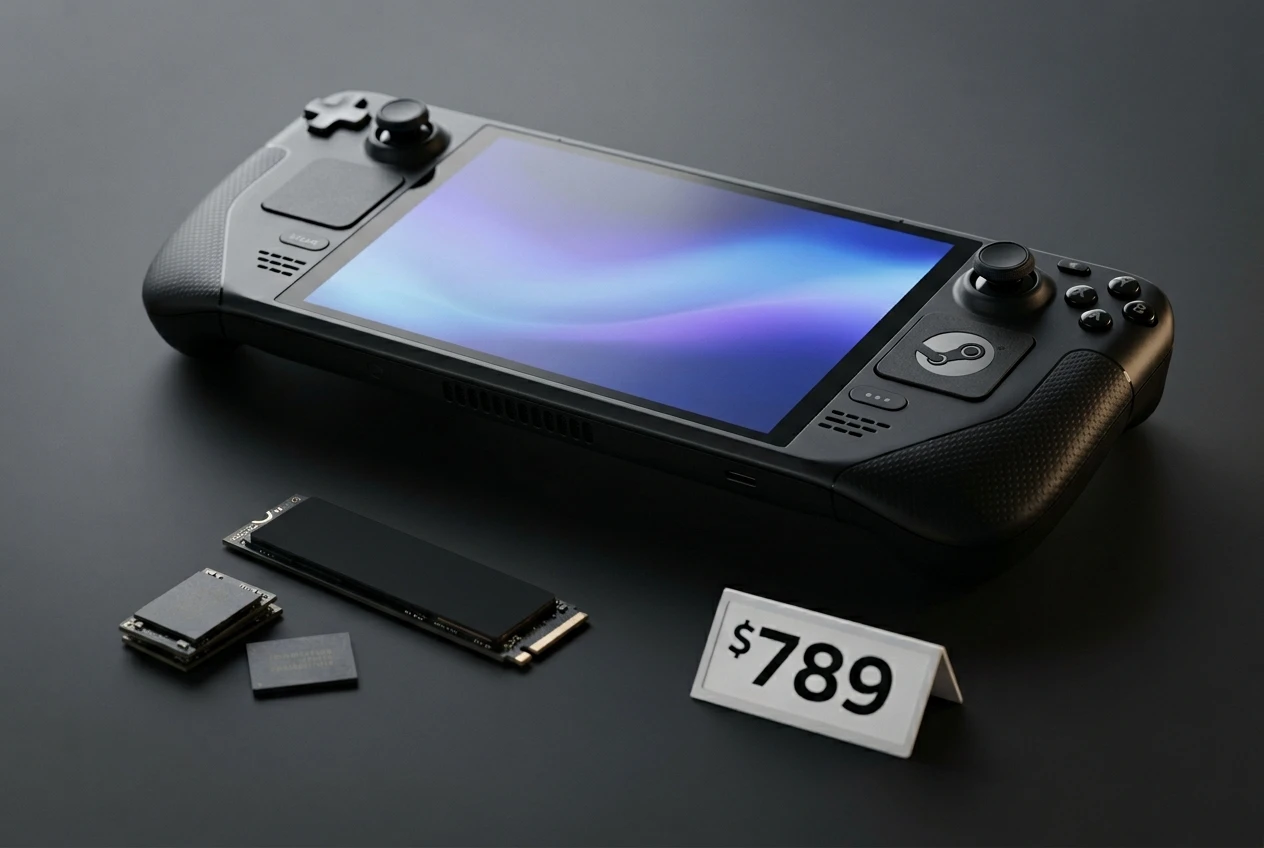
The 512GB Steam Deck OLED now costs $789. The 1TB version costs $949. Both numbers went live this week, replacing the $549 and $649 stickers that had defined Valve’s handheld since the OLED refresh shipped in late 2023.
Valve’s note on the price page does not blame tariffs or its own margins. It points at the memory market. “Steam Deck itself hasn’t changed,” the company wrote. “These new prices reflect the current state of component costs and other global logistical challenges across the industry as a whole.” That language matches what Sony, Microsoft, and Nintendo have been saying since the start of the year, and it lines up with what memory analysts have been forecasting since the AI-server build-out went vertical.
Valve’s New Price Tags, in Plain Numbers
The increase is steep in absolute dollars and steeper as a percentage. The 1TB OLED jumped 46% in a single update. The 512GB OLED jumped 44%. The discontinued LCD model is no longer in Valve’s lineup, though refurbished LCD stock still circulates on the secondary market.
Refurbished OLED units, sold directly by Valve, took a smaller bump. A factory-recertified 512GB now lists at $629, and the 1TB at $759. That is the cheapest first-party route into a current-spec Deck.
| Model | Old Price | New Price | Increase |
|---|---|---|---|
| Steam Deck OLED 512GB (new) | $549 | $789 | +$240 (44%) |
| Steam Deck OLED 1TB (new) | $649 | $949 | +$300 (46%) |
| Steam Deck OLED 512GB (refurbished) | $469 | $629 | +$160 |
| Steam Deck OLED 1TB (refurbished) | $569 | $759 | +$190 |
Both new SKUs are listed as back in stock with three-to-five business-day shipping, which is the first time since spring that buyers in North America have been able to add a 1TB Deck to cart without joining a waitlist.
The Memory Bill Behind the Sticker
The Steam Deck OLED ships with 16GB of LPDDR5 memory and a 512GB or 1TB NVMe solid-state drive. Both line items have been on a tear. TrendForce’s Q2 2026 memory outlook projects conventional DRAM contract prices climbing 58% to 63% quarter-over-quarter, with NAND flash up 70% to 75%. That follows a first quarter in which DRAM contracts moved as much as 95% in a single three-month window.
The driver is not consumer demand. It is hyperscaler procurement. Microsoft, Google, Meta, and Amazon have signed multi-year long-term agreements with Samsung, SK Hynix, and Micron to lock in supply for AI inference clusters. That has pulled fab capacity toward high-bandwidth memory and enterprise-grade DRAM, leaving the standard LPDDR5 and consumer NAND that powers handhelds, phones, and laptops competing for what is left.
- 58 to 63% projected Q2 2026 quarter-over-quarter DRAM contract price increase, per TrendForce
- 70 to 75% projected Q2 2026 NAND flash contract price increase
- ~70% share of high-end DRAM that AI data centers are forecast to consume this year
- 16% projected 2026 DRAM supply growth, below the 20 to 30% historical norm
None of that is going to ease quickly. IDC and TrendForce both put meaningful new fab capacity arriving in late 2027 at the earliest. Until then, every consumer device shipping with more than a token amount of RAM and storage is going to bleed margin or move its price, and Valve has now chosen the second option.
Sony, Microsoft, and Nintendo Got Here First
Valve is the last of the big four console makers to move. The pattern across the others is consistent enough that it now reads as an industry decision rather than a series of one-off events.
- Sony raised PlayStation 5 prices by up to $150 in March, pushing the PS5 Pro to $900 at US retail. Sony’s PlayStation Plus subscription pricing also moved up in May, with Essential climbing to $10.99 a month as the company pushed the memory bill into its services arm.
- Microsoft raised Xbox Series X and Series S prices last October, the second hike for the platform in six months. The Series X now sits at $650 and the Series S at $449.
- Nintendo confirmed the Switch 2 will rise from $450 to $500 in the United States on September 1, with corresponding moves already in force in Japan since late May.
Set against those numbers, the 1TB Steam Deck OLED at $949 is now more expensive than every shipping PlayStation 5 configuration except the Pro and more expensive than a Series X plus a year of Game Pass Ultimate. The Deck still offers a different value proposition, it runs an open Linux-based platform, plays a vast back catalog, and travels in a bag, but the entry-level math has shifted.
Where the Handheld Market Stands After the Hike
Valve’s price move resets the competitive frame for Windows-based handhelds. The Asus ROG Ally X, Lenovo’s Legion Go S, and MSI’s Claw 8 AI+ have spent eighteen months sitting awkwardly above the Deck’s $549 floor. With that floor gone, those devices now look priced in line with the category rather than at a premium.
The catch is that every one of those rivals uses the same DRAM and NAND pool Valve is now paying more for. Lenovo announced a Legion Go bump earlier this spring. ROG Ally pricing has crept up at retail without a formal Asus statement. The pressure is uniform across the handheld market, and consumers shopping the category are not going to find a structurally cheaper device by jumping to a competitor.
What changes is the calculus on used hardware. Steam Deck LCD units, especially the 256GB and 512GB SSD configurations, have spiked roughly 20% on resale marketplaces since the Valve announcement, according to seller activity tracked by handheld retailer ETA Prime and aggregator PricePulse. The secondary market always reacts faster than the primary one, and it is already pricing in scarcity.
The Steam Machine Question Just Got Sharper
The bigger problem in Valve’s calendar is the Steam Machine. Valve’s living-room console reboot was announced on November 12 last year, with a stated 2026 launch window. In February, Valve told developers the company needed to “revisit the cost” of the Steam Machine, blaming the same memory shortage now visible on the Deck’s price page.
What’s Inside the Box
The Steam Machine is configured with a six-core, twelve-thread AMD Zen 4 chip and 16GB of DDR5 memory delivered through replaceable SO-DIMM modules. Storage is a 512GB or 2TB NVMe drive, with a microSD slot for expansion. It is roughly the form factor of a Nintendo GameCube, hence the community nickname “GabeCube,” and it is designed to deliver native 4K gaming to a television.
The Pricing Bind
That spec sheet runs into the same memory market the Deck just got crushed by. A Steam Machine launching with double the RAM headroom and a larger SSD has to absorb worse component pricing than the handheld did. If Valve had been planning a $499 to $599 ladder when the device was revealed, every analyst note circulating among PC hardware retailers now suggests the floor has moved closer to $699, with a top configuration that could brush against the new $949 1TB Deck.
Steam Deck itself hasn’t changed; these new prices reflect the current state of component costs and other global logistical challenges across the industry as a whole.
That sentence appears on Valve’s storefront under the new Deck pricing, but it doubles as a forward-look for the Steam Machine. If the Deck needed a 44% adjustment to ship at all, a new device designed around 16GB of DDR5 and a 2TB SSD has a steeper hill. The Steam Controller, which Valve shipped on May 4 at $99, was the easy launch in the lineup precisely because it does not use the memory and storage components in shortage.
The Window That Matters
Valve has not committed to a more specific Steam Machine date than 2026. With Q4 2026 looking like the latest realistic window, the company has roughly six months to either swallow worse pricing, delay the device into a 2027 memory-cycle break, or trim the spec to hit a target number. Each of those paths costs something.
What Buyers Can Actually Do Now
For shoppers staring at the new tags, three paths remain reasonable.
- Buy refurbished from Valve. The $629 refurb 512GB OLED is the same hardware as the $789 new unit, ships with a one-year warranty, and undercuts the new price by $160. Stock has historically been thin, but inventory is rotating again.
- Watch the secondary market for LCD units. The original LCD Deck is no longer sold by Valve but remains a capable device for older catalogs. Used LCD prices are climbing, so the window for sub-$400 deals is closing fast.
- Wait through 2026 if you can. If you do not need a device today, the Q4 holiday window will tell you whether Valve is willing to discount, whether Steam Machine ships, and whether memory pricing has begun to soften. Buying at the top of a cost cycle is the worst time to commit.
Worth noting for SteamOS-curious buyers: regulatory drift is starting to shape the platform too. A new California age-verification carve-out for open-source operating systems kept SteamOS in a complicated bucket earlier this spring, which matters for any handheld or living-room device shipping on a Linux-based stack.
If memory contract prices ease in the fourth quarter as a handful of analysts still expect, Valve has room to walk back the Deck stickers and ship the Steam Machine at a number a mainstream buyer recognizes. If they don’t, the company has a $789 entry-level handheld and a Steam Machine that has to launch somewhere north of it. The next six months decide which version is real.






Spotify Running Mode hits Android and revives its old tempo experiment

Galaxy Tab S12 Ultra Renders Keep the Notch Fans Hate

Novato Spinning Round House Sells With Six Neighbors for $3.3 Million

Crop Tour Finds Indiana and Nebraska Corn Yields Lagging 2025

Best Buy 60th sale brings Android deals back to its roots

American Airlines reverses seatback screen bet years too late

Iran Hormuz Strikes Force Gulf Oil Onto Costlier Paths

Plague Tale Prequel Day One Joins Game Pass Wave 2 as Witcher Exits

NBA 2K27 opens The City to everyone and rewrites career eras

iOS 26.6.1 Patches 29 Flaws as AI Forces Faster Apple Updates

Double Fine Cuts 23 Jobs Weeks After Xbox Independence

Day-One Big Walk Lifts PS Plus August Beyond Recycled AAA

John Hight Exits Wizards After Digital Reckoning Hits

Curtis Mead’s Red Sox Debut Ends With Fractured Wrist

Moesch and Dressel Rewrite Night One at 2026 U.S. Nationals

Red Sox Squander Hot Streak Chance in 4-3 Loss to Athletics

Boutte’s Quiet Camp Takeover Forces Patriots Receiver Choices

Take-Two CEO Pushes Netflix Subs for GTA 6 Extended Look

Halo Campaign Evolved Skulls Meet Death Barriers That Kill the Hunt

Wildlands Free Update Hands Players the Tools They Already Invented
-

 TECHNOLOGY3 years ago
How to Adjust a Bulova Watch Band – An Easy Guide
-

 News3 years ago
Fred Pentland: Athletic Bilbao’s English mentor who changed the essence of Spanish football
-

 FINANCE3 years ago
Tax Planning for Every Season: Guide to Maximizing Your Tax Benefits
-

 Education3 years ago
African Ministers New Education Plan
-

 BUSINESS3 years ago
What is Entrepreneurial Operating System? A Comprehensive Guide to EOS
-

 Education3 years ago
Innovate Your Learning Journey with Technology and Enhance Education
-

 News3 years ago
Russians formally out of World Athletics Championships
-

 BUSINESS3 years ago
Top 9 Most Expensive American Cities to Rent an Apartment