
FINANCE
Tesla’s Regulatory Credit Windfall Runs Dry at the Worst Time
Tesla’s operating profit sank 57% as its decade-long regulatory credit windfall evaporated, even as Wall Street keeps betting on robotaxis and Optimus.

Tesla shares closed at $319.69 on Thursday, down 14.5% in a single session that erased more than $140 billion in market value. It was one of the steepest one-day drops in the company’s history as a public company. The trigger was a second quarter operating profit of just $398 million, less than a quarter of the roughly $1.7 billion Wall Street had penciled in, according to FactSet.
Revenue actually beat expectations, and deliveries hit a record. But buried in the numbers is a subsidy Tesla has leaned on for a decade that is now running out, right as the company needs cash more than ever for its robotaxi and Optimus robot programs. Wall Street trimmed price targets after the print. Almost none of the major banks pulled their buy ratings.
A Record Delivery Quarter That Still Lost Money
Tesla delivered 480,126 vehicles in the second quarter, a record, up 25% year over year and roughly 74,000 above analyst estimates, marking the company’s first year-over-year delivery growth in two years. Revenue climbed to $28.24 billion, comfortably ahead of Wall Street’s roughly $26.4 billion consensus.
None of it reached the bottom line. Operating income declined 57% to $398 million, reducing the operating margin to 1.4% from 4.1%, while automotive gross margin excluding regulatory credits came in at 16.3% compared with 15% a year earlier and 19.2% in the preceding quarter. Non-GAAP earnings per share landed at $0.33, badly missing the roughly $0.51 to $0.54 range analysts expected.
GAAP net income told a gentler story, falling just 5% to $1.11 billion. That cushion came largely from investment gains tied to Tesla’s stake in SpaceX, not the car business. Strip that out and the operating line is the one that actually describes how Tesla’s core business performed, and it cratered.
| Metric | Q2 2026 | Q2 2025 | Change |
|---|---|---|---|
| Revenue | $28.24 billion | $22.5 billion | +26% |
| Operating income | $398 million | $923 million | -57% |
| Operating margin | 1.4% | 4.1% | -2.7 pts |
| Non-GAAP EPS | $0.33 | $0.40 | -18% |
| Regulatory credit revenue | $146 million | $439 million | -67% |
| Free cash flow | -$1.09 billion | +$146 million | swing of $1.24B |
| Vehicle deliveries | 480,126 | ~384,100 | +25% |
The energy storage business was a genuine bright spot, deploying a record 13.5 gigawatt-hours and growing revenue 13% to $3.14 billion. Services and other revenue jumped 50% to $4.58 billion with record margins. Neither is close to large enough yet to offset what happened in the automotive column.
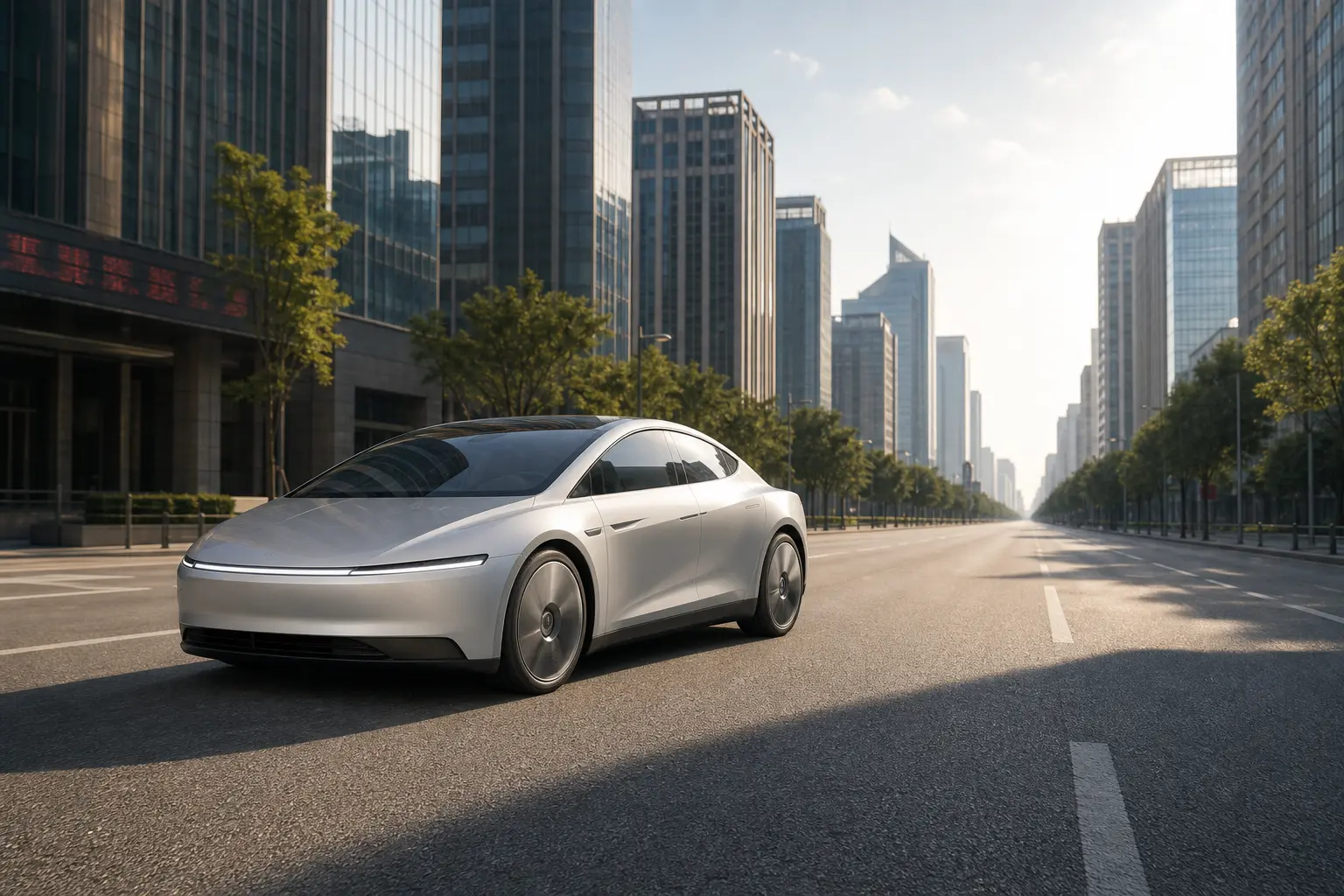
The Ten-Year Subsidy Runs Dry
Automotive gross margin missed estimates for a specific, traceable reason: the company’s gross margin dropped and missed estimates as average selling price per vehicle fell and regulatory credit revenue declined, sliding to 16.8% from 17.2% a year earlier against an analyst expectation of 19.4%.
Regulatory credits are the closest thing to free money Tesla has ever had. Legacy automakers that could not meet federal fuel economy rules bought Tesla’s surplus emissions credits to avoid fines, at close to pure profit for Tesla. Tesla has been the primary beneficiary of this system, generating over $11 billion in revenue solely from selling regulatory credits to legacy competitors over the past decade.
That machine is now shutting down on a legislative and regulatory timetable Tesla does not control. Regulatory credit revenue fell to just $146 million from $380 million in Q1 2026, a 62% drop, and from $439 million in Q2 2025, a 67% drop.
- 2024: Tesla reported a record $2.76 billion in credit revenue, the peak of the entire program.
- 2025: The figure dipped to $2 billion as other manufacturers ramped up their own compliance programs, while Congress passed a Republican tax and spending bill that eliminated the fuel economy penalties automakers were paying Tesla to help offset.
- February 2026: The Environmental Protection Agency finalized what the White House and Administrator Lee Zeldin described as the “single largest deregulatory action in United States history,” rescinding the 2009 Greenhouse Gas Endangerment Finding.
- Second quarter 2026: Tesla reports just $146 million in credit revenue for the quarter, on pace with William Blair’s estimate that the entire category would collapse toward zero.
William Blair’s analysts had warned the loss of that revenue would “result in a direct hit to profitability [for Tesla]” and anticipate demand to fall by around 75% in 2026 before completely disappearing in 2027. Tesla’s actual quarter is running almost exactly on that curve. The squeeze is not just domestic, either: Toyota and Stellantis have withdrawn from Tesla’s European CO2 pool for 2026, cutting off a source that has generated about $2 billion in annual revenue from these emissions pools in past years.
Tesla’s own regulatory filings acknowledge the shift plainly. Fluctuations in automotive regulatory credits are impacted by the company’s supply of credits, subject to changes in regulation, and recent governmental and regulatory actions have restricted certain regulatory credit programs tied to its products, according to a filing describing restrictions on its credit programs.
Tesla Bets Its Balance Sheet on Robots and Robotaxis
As the credit cushion vanishes, Tesla is spending like it has never spent before. Operating expenses jumped 47% to $4.35 billion as Tesla spent heavily on AI, the Optimus robot and robotaxi, plus stock-based compensation tied to the 2025 CEO pay package, while capital spending more than doubled to $5.8 billion, pushing free cash flow to negative $1.1 billion, Tesla’s first cash-burning quarter since early 2024.
Cash and short-term investments stood at $43.52 billion, down $1.2 billion from the prior quarter. Chief executive Elon Musk called 2026 a “massive capex year,” and chief financial officer Vaibhav Taneja confirmed the full-year capital budget at “more than $25 billion.” That is triple what Tesla spent in 2025.
On the earnings call, Musk described just how far the buildout reaches beyond Tesla’s own factories. He said suppliers including Samsung, TSMC, Panasonic and Micron are making major investments to support AI compute, batteries and other needs tied to Optimus and robotaxi. It is a familiar tension for Tesla watchers: the company’s mounting cash burn tied to Optimus and robotaxi has been building for several quarters, and this was the one where it finally showed up as a negative number.
There was one silver lining. The cash burn, while historic for Tesla, still came in lighter than some on Wall Street feared. Free cash flow swung to negative $1.09 billion, a burn, but this was meaningfully better than the negative $3.64 billion the Street had modeled.
Wall Street Trims Targets, Keeps the Faith
The reaction from analysts was uniform in shape even where the numbers differed. Almost everyone cut price targets. Almost no one downgraded the stock.
- Canaccord Genuity cut its target to $410 from $450 while keeping a Buy rating, citing stagnant margins and breakthrough promises on hard-to-model timelines.
- Cantor Fitzgerald trimmed its target to $485 from $510 and kept an Overweight rating, framing fiscal 2026 as transformational for autonomy, AI, robotics and chips.
- Morgan Stanley had already raised its target to $417 from $415 ahead of the report while holding an Equal Weight rating.
- BofA went into earnings with a Buy rating and a $391 target, its analysts telling clients their focus for earnings will remain on TSLA’s robotaxi deployments.
The math behind that patience is explicit. Barclays analysts wrote ahead of the report that Tesla’s core car business is “increasingly irrelevant” to how the market prices the stock, with investors instead fixated on the robotaxi, FSD and Optimus roadmap. Of 47 analysts tracked, 22 rate it Buy, 19 Hold and six Sell, with a consensus 12-month target implying meaningful upside from Thursday’s close.
Coming into the print, Tesla was already trading at 177 times forward earnings, the highest multiple among the Magnificent 7, leaving almost no room for disappointment. GuruFocus pegged the post-selloff price at a trailing price-to-earnings ratio of 296.01, versus its own five-year median of 107.37. Expensive before the drop, still expensive after it.
Does the Robotaxi Math Add Up Yet?
The bet Wall Street keeps renewing rests on Tesla’s autonomy programs eventually generating real revenue at scale. The current numbers are still early. Tesla’s robotaxi service now spans seven metro areas, and active FSD subscriptions reached 1.48 million, up 56% year over year, with more than 55% of new deliveries in North America including an FSD subscription.
Cybercab, the dedicated two-seat robotaxi Tesla unveiled to replace human-driven ride-hailing, began production this quarter, and the fleet has logged nearly 380,000 unsupervised miles without a serious incident, according to Tesla’s own investor materials. Yet coverage of the earnings call found the company offered few new concrete milestones on when robotaxi actually turns into meaningful revenue, and questions about execution pace persisted. Electrek’s review of Tesla’s own investor charts found the robotaxi network’s expansion has largely flatlined even as management describes it as growing, and separately noted the company still has no resolution for owners of older vehicles built with the discontinued Hardware 3 computer who were promised full self-driving capability years ago.
Musk also raised the idea of closer ties between Tesla and SpaceX on the call, without offering specifics, an idea that lands at an awkward moment. SpaceX, Musk’s other trillion-dollar company, has lost more than 40% of its value since its record market debut in June.
The Sell-Off Spreads to Rivian and Lucid
Thursday’s decline was not contained to Tesla. The S&P 500 fell 1.21% to 7,408.30 and the Nasdaq Composite dropped 2.15% to 25,138, while Rivian closed at $16.46, down 4.19%, and Lucid Group closed at $6.45, down 4.87%, reflecting pressure across EV names. Trading volume in Tesla shares hit 114.2 million shares, about 131% above its three-month average of 49.4 million shares.
The magnitude puts Thursday among Tesla’s worst days as a public company, though not its worst. The two largest single-day drops remain September 8, 2020, when shares fell 21.1%, and January 13, 2012, with a 19.3% plunge. Tesla had already been sliding into the print, down 17% for the year heading into Wednesday’s close.
Regulatory credit revenue is on pace to fall further before it disappears entirely by 2027, on the timeline Tesla’s own filings and William Blair’s forecasts both point to. Whether Optimus and robotaxi produce enough revenue to replace it is still an open question with no earnings date attached. Until then, Tesla’s stock price rests on how long Wall Street keeps extending credit of its own.


Stripe Bid Shows PayPal Moat Cracked After Years of Slide

FDA Class I Tag Hits Finished Egg Recall Weeks Later

Berkshire’s Alphabet Surge Marks Abel’s Cash Deployment Shift

Aston Martin Bets 150 Valen V12s Will Print the Cash

Walmart Took Most of the Recalled Lettuce Behind Cyclospora Wave

Silver Lake Workday Talks Signal Private Floor for Software

Zuckerberg’s AI Letter Joins a Wave of Tech Manifestos

Pixel 11 Takes Battery Edge as Galaxy S26 Keeps the Power Lead

Trump Economy Faces Reckoning as Sentiment and Sales Slide

Apple’s 15% External Cut Still Faces Its Own Zero Admission

ZA/UM Lays Off 32 Staff as Zero Parades Wins Reviews, Not Players

EA’s New In-Game Ad Platform Skips the Games That Need It Most

Mortgage Rates Climb to 6.55%, the Highest Level in Nearly a Year

Colby Covington Stuns Tsarukyan as Askren Retires in Tears at RAF 11

Spain’s Diaspora-Rooted Squad Wins Over New York Ahead of the Final

NHL’s Monday Matinee Push Puts Capitals Fans on the Clock

DeChambeau’s Two-Shot Penalty Rewrites the Open’s Weekend Draw

Guardians Rout Twins With Seven Homers, Leave Joe Ryan One Shy of Record

England Beats France 6-4 to Claim World Cup Bronze Medal

Rainout Gives Red Sox Two Shots at a Franchise-Record Win Streak
-

 TECHNOLOGY3 years ago
How to Adjust a Bulova Watch Band – An Easy Guide
-

 News3 years ago
Fred Pentland: Athletic Bilbao’s English mentor who changed the essence of Spanish football
-

 FINANCE3 years ago
Tax Planning for Every Season: Guide to Maximizing Your Tax Benefits
-

 Education3 years ago
African Ministers New Education Plan
-

 BUSINESS3 years ago
What is Entrepreneurial Operating System? A Comprehensive Guide to EOS
-

 Education3 years ago
Innovate Your Learning Journey with Technology and Enhance Education
-

 News3 years ago
Russians formally out of World Athletics Championships
-

 BUSINESS3 years ago
Top 9 Most Expensive American Cities to Rent an Apartment