
BUSINESS
Costco Q3 Sales Surge 11.6% as Gas Pumps Recruit New Members

Costco Wholesale’s third-quarter print landed Wednesday with the kind of numbers that make a wholesale club look recession-proof. Net sales climbed 11.6% to $69.15 billion for the 12 weeks ended May 10, net income reached $2.19 billion, diluted earnings came in at $4.93 a share, comparable sales grew 9.8%, and paid household members hit 82.9 million. Adjusted comparable sales rose 6.6% once gasoline inflation and foreign-exchange noise are stripped out.
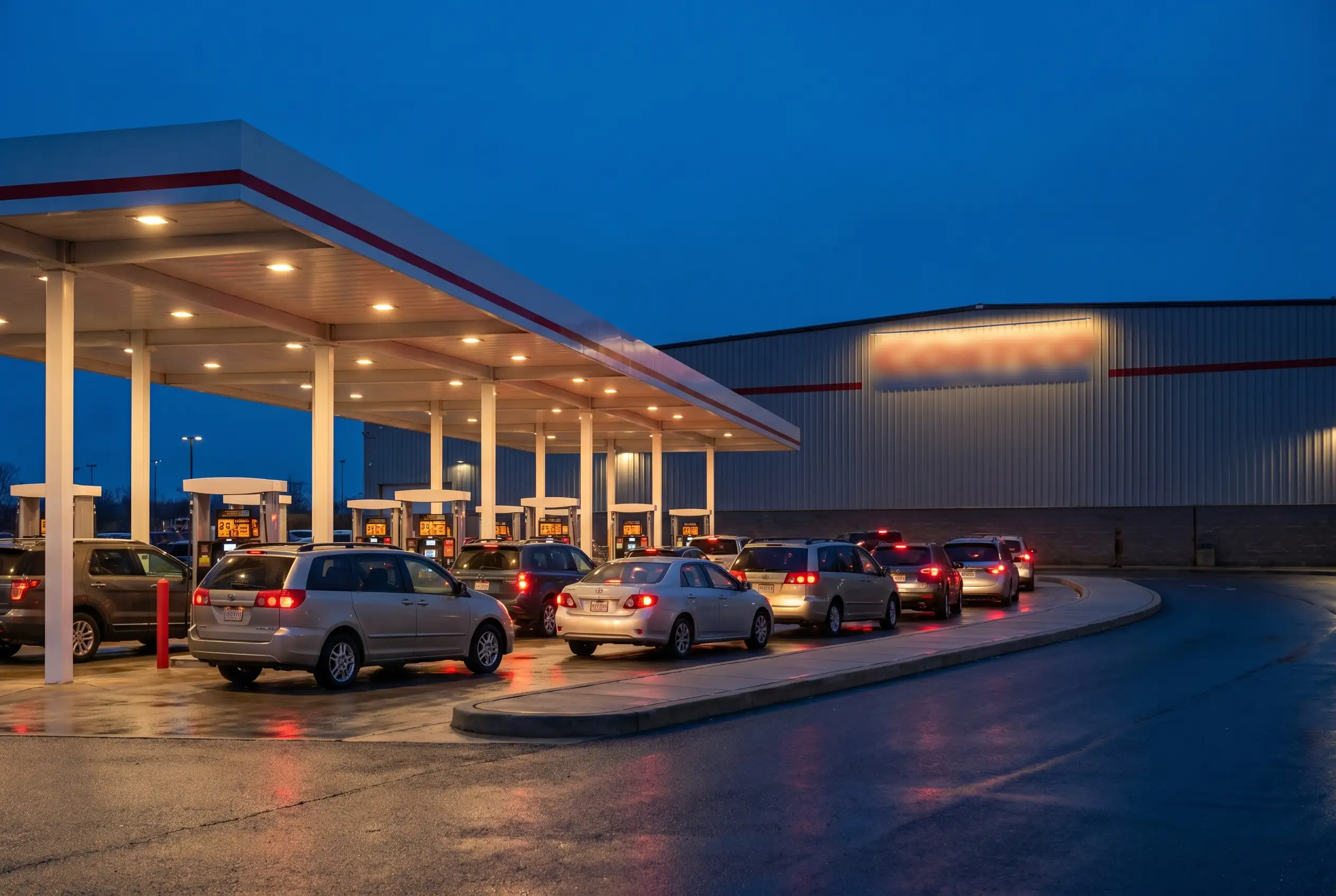
The quieter story sits at the fuel pump. Three consecutive four-week volume records stacked back to back, and the final five weeks of the quarter became the five biggest weeks in Costco’s gasoline history, pulling price-sensitive shoppers through warehouse doors they had not opened before.
The Numbers Behind the Beat
Adjusted comparable sales rose 9.8% on a headline basis, holding up across every reporting region. U.S. comps came in at 9.4%, Canada at 10.7%, and the rest of the international book at 11.2%. Digitally enabled comparable sales jumped 21.5%, with the foreign-exchange adjusted number at 20.8%, both well ahead of the in-warehouse pace.
Net income of $2.19 billion compares with $1.90 billion a year ago, a 15.2% lift that came in faster than the top line. Year-to-date sales over the first 36 weeks of fiscal 2026 sit at $203.37 billion, up 9.6% against the same stretch of fiscal 2025, and operating cash flow has run at $11.13 billion.
| Metric | Q3 FY2026 | Q3 FY2025 | Change |
|---|---|---|---|
| Net sales | $69.15B | $61.96B | +11.6% |
| Net income | $2.19B | $1.90B | +15.2% |
| Diluted EPS | $4.93 | $4.28 | +15.2% |
| Adjusted comparable sales | +6.6% | +6.6% | flat |
| Membership fee income | $1.37B | $1.24B | +10.7% |
| Paid household members | 82.9M | 79.6M | +4.1% |
The print beat consensus across the top three lines while leaving open questions about gross margin and renewal trends that surfaced on the call. Shares traded around $1,003 in the session after the release, drifting slightly lower as investors weighed margin compression against the volume story.
Gas Pumps Did the Acquisition Work
Ron Vachris, Costco’s president and chief executive, used the call to single out gasoline as the quarter’s standout. Each of the three four-week reporting periods that made up the quarter set a new all-time company volume record. The final five weeks of the quarter ranked as Costco’s top five gasoline weeks ever.
The trigger sat outside Costco’s control. Supply disruptions tied to Middle East tensions sent retail gasoline prices higher through April and into May, with regional averages in parts of the western United States jumping past $3.60 a gallon in single-week moves. Consumers responded by chasing the cheapest pump in their ZIP code, and for many shoppers, that pump sat in front of a Costco warehouse they had never crossed into.
Vachris told analysts that members who fill up at Costco gas stations typically spend more inside the warehouse, framing the fuel business as a recruiting channel rather than a margin event. That feedback loop matters most when it pulls in shoppers under cost-of-living pressure who would not normally pay $65 for a Gold Star membership.
The fuel-pump quarter in three data points:
- Three consecutive four-week periods set Costco gasoline volume records inside the quarter.
- Five weeks in April and early May became the top five gasoline volume weeks in company history.
- Higher consumer price sensitivity, in Vachris’s wording, brought many members to a Costco fuel station for the first time.
Membership Math Is Still the Quiet Engine
Membership fee income rose 10.7% to $1.37 billion in the quarter, with about a quarter of that growth still flowing through from the U.S. and Canada fee increase put through in September 2024. Total paid household members reached 82.9 million, total cardholders 149 million, and executive memberships, the higher tier that returns 2% on most spend, grew 9.6%.
Renewal Rates Slipped Slightly
The number that drew attention on the call was renewal. The U.S. and Canada renewal rate sat at 92.2% in the quarter, up 10 basis points from the prior quarter but down half a point from the 92.7% Costco printed in Q3 fiscal 2025. Worldwide renewal came in at 89.7%, against 90.2% a year ago.
Gary Millerchip, executive vice president and chief financial officer, told analysts membership health remains solid and that slower growth feels more like normalization than weakness. The board first lifted the U.S. Gold Star fee from $60 to $65, and the executive tier from $120 to $130, in September 2024, the company’s first fee increase in seven years.
Executive Tier Carries the Mix
Executive members now number 41.2 million across the system, a 9.6% gain that matters because executive households shop more often and spend more per visit than the base tier. The 2% reward cap rose to $1,250 a year when the fee changed, and the tier accounts for an outsized share of warehouse sales.
That mix is what makes membership the structural margin layer. Costco can run merchandise close to cost because the recurring fee carries the operating model, and the executive tier’s loyalty stickiness is what supports the renewal floor even as the headline rate drifts off its 2025 peak.
Margins Got Tighter Even as Sales Boomed
Costco’s reported gross margin came in at 11.04%, down 21 basis points year over year. Strip out gasoline distortion and gross margin was up just 1 basis point. The core-on-core margin, the metric management tracks internally, fell 9 basis points, with fresh foods and food and sundries taking the largest hits.
Selling, general and administrative (SG&A, the cost of running the warehouses and corporate overhead) expenses ran at 8.96% of sales, a 20 basis point improvement that mostly reflected gas-inflation leverage. Excluding gas, the SG&A rate improved 2 basis points.
Millerchip flagged further inflation ahead in several non-food categories as higher resin costs work through the supply chain, particularly in plastic packaging, household goods and toys. The implication for the next two quarters is straightforward: continued price-cut investments on everyday staples, with the recurring membership fee absorbing the margin compression.
The Tariff Refund Promise Becomes a Real Number
The other call moment that mattered to investors was Vachris’s update on tariff refunds. Costco has started filing refund claims under the International Emergency Economic Powers Act (IEEPA, the statute behind a set of tariffs that have been challenged in court) through U.S. Customs and Border Protection. The first approved refunds are expected on a rolling basis over the next two to three months.
Our goal is to be the first to lower prices and the last to raise them.
That line, from Vachris on the call, sits behind a more concrete commitment. Costco intends to return the share of refunded tariffs that were passed through to members in some form, with the amount and timing depending on actual refund receipts and the path of related litigation. The mechanism has not been spelled out, and the company did not put a dollar figure on the pool.
For the membership economy, the optics carry weight. A retailer that publicly promises to hand back recovered tariff dollars to its members reinforces the value proposition that supports the renewal rate, even when the actual refund pool turns out modest. It also gives investors a forward read on how management plans to defend the membership floor under tariff pressure.
The Wholesale Club Field Reprices Around 928 Warehouses
Costco opened four net new warehouses in the quarter, bringing the global footprint to 928 (the company reported 931 including Innovel and other locations). Management trimmed full-year fiscal 2026 openings to 26 from 28, with the two delayed builds pushed into fiscal 2027. One of those delays drew local attention earlier this year, when the Grand Junction, Colorado project went on hold over city budget questions.
Sam’s Club and BJ’s Wholesale Club are the only direct comparables at scale, and the field has tightened over the past year:
- Sam’s Club charges $50 for Club and $110 for Plus. A 150-item basket comparison published earlier this year found Sam’s running an average 8.2% cheaper than Costco on unit prices, with the lead concentrated in packaged goods.
- BJ’s Wholesale Club sits at $55 for Club and $110 for Club+, with up to 2% back at the higher tier, though it carries a tighter geographic footprint that remains largely concentrated on the U.S. East Coast.
- Costco kept the U.S. Gold Star fee at $65 and the executive fee at $130 through the quarter, with renewals so far holding above 92% in the U.S. and Canada.
The question for the back half of fiscal 2026 is whether Costco’s renewal floor holds as Sam’s Club’s price gap widens. If it does, the next two prints look a lot like this one, with membership fee income compounding into a margin cushion that absorbs continued price-cut investment. If renewal drifts another 30 basis points lower over the next two reports, the membership line gets harder to grow, the gross-margin compression already visible in fresh foods starts to matter more, and the gas-pump traffic flywheel becomes the only volume story left to lean on.





Mortgage Rates Climb to an 11-Month High, and Buyers Retreat Fast

FCC Sets August 6 Vote to Erase the 39% TV Ownership Cap

Netflix Heads Into Earnings With Its 2022 Playbook Already Spent

China’s Economy Grows Just 4.3% as Exports Boom and Households Retreat

United Airlines Beats Earnings Estimates Despite $6 Billion Fuel Hit

California’s Plastic Packaging Law Draws Fire From Every Side

xAI Sues a Grok User for CSAM Deepfakes It Struggled to Stop

US Stocks Edge Within 0.5% of a Record as Oil Climbs on War

BlackRock’s Private Markets Bet Pays Off With a Record $15 Trillion in Assets

Kalshi Traders See 93% Odds Gas Tops $4 as Iran Strikes Return

Halo Studios Reverses PS Plus for Halo: Campaign Evolved on PS5

Black Ops 1 and 2 PS5 Ports: $40 Price Tag Has Fans Uneasy

Matt Brown Dismisses Rousey and Paul’s MVP MMA Ratings Win Over UFC

Star Wars: Galactic Racer Is a Roguelite Racer With a Podracing Skin

Julius Randle Traded to Nets as Wolves Reclaim Cap Space for Dosunmu

Sega’s $49.99 Sonic Classic and Modern Bundles Hit Switch in October

Colombia Edge DR Congo as Muñoz Books World Cup Knockout Place

Douze Dixièmes Closes Five Months After MIO: Memories in Orbit

Warriors Take Yaxel Lendeborg, the Oldest Pick in the 2026 NBA Draft

Meta’s Muse Image Lets Anyone Use Your Instagram Photos in AI
-

 TECHNOLOGY3 years ago
How to Adjust a Bulova Watch Band – An Easy Guide
-

 News3 years ago
Fred Pentland: Athletic Bilbao’s English mentor who changed the essence of Spanish football
-

 FINANCE3 years ago
Tax Planning for Every Season: Guide to Maximizing Your Tax Benefits
-

 Education3 years ago
African Ministers New Education Plan
-

 BUSINESS3 years ago
What is Entrepreneurial Operating System? A Comprehensive Guide to EOS
-

 Education3 years ago
Innovate Your Learning Journey with Technology and Enhance Education
-

 News3 years ago
Russians formally out of World Athletics Championships
-

 BUSINESS3 years ago
Top 9 Most Expensive American Cities to Rent an Apartment