
News
Blue Origin New Glenn Blast Wrecks Its Only Moon-Ready Pad

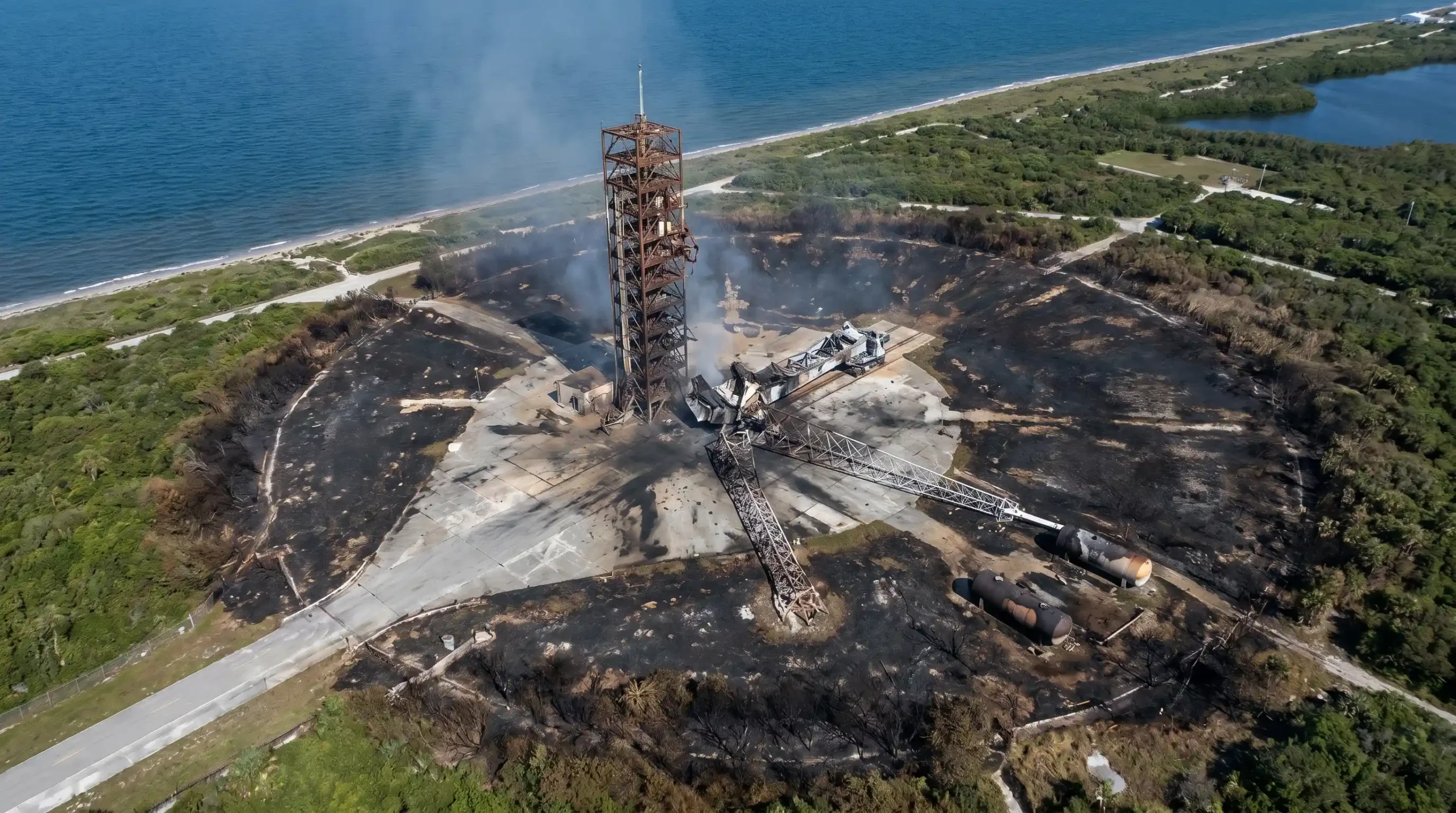
A Blue Origin New Glenn rocket exploded during a fueling test at Launch Complex 36 on May 28, and the wreckage is now visible from orbit. Satellite images captured May 31 by Planet Labs’ SkySat-C9 show charred ground spreading in nearly every direction around the half-mile-wide pad at Cape Canaveral. No one was hurt in the blast, which rattled windows up and down Florida’s Space Coast.
The harder problem sits underneath the soot. LC-36 (Launch Complex 36) is the only pad Blue Origin owns that can fly a rocket this big, and the last two times an American launch pad was wrecked this way, it stayed dark for well over a year.
What the SkySat Images Reveal About LC-36
The overhead view processed by analysis group SpaceFromSpace turned a company statement into a measurable fact. Charred vegetation rings the pad for roughly a kilometer, the ground darkened where the overpressure wave and burning methane swept outward. From that altitude, the damage reads as a single scorched circle with the launch structures sitting wounded in the middle.
On the ground, the inventory is worse than a quick repair job. Here is what reporting and imagery have established so far about the state of the facility:
- A lightning tower collapsed, one of the protective masts that ring the pad to channel strikes away from a fueled vehicle.
- The transporter-erector, the giant arm that raises the rocket vertical, was destroyed.
- The main launch tower is still standing but shows bent steel beams and structural damage.
- The flame trench and surrounding support systems took visible hits.
- The tank farm, where propellant is stored before loading, is likely facing major repair or full replacement.
Blue Origin leases the site from the U.S. Space Force at Cape Canaveral Space Force Station (CCSFS, the military range that hosts most East Coast launches). The company toured the ruins on May 30 and has not yet released a full damage assessment or a repair estimate.
One Pad, No Backup, for a Rocket This Big
New Glenn is a heavy-lift vehicle, taller than a 30-story building, and pads that can handle it are scarce. Blue Origin built its East Coast operation around LC-36, and there is no second New Glenn pad sitting idle as a spare. When the pad goes down, the rocket program goes down with it.
The test that destroyed the vehicle was a hotfire, a brief ignition of the seven methane-burning BE-4 engines on the first stage, meant to clear the way for New Glenn’s fourth flight. That mission was scheduled for early June and would have carried 49 satellites for Amazon’s broadband network. Instead of a launch campaign, Blue Origin now has a cleanup and a root-cause hunt.
That single-pad exposure is what separates a bad day from a lost year. A company with two operational pads can shift a manifest sideways and keep flying while engineers fix the damaged one. Blue Origin cannot. Every commercial customer, every NASA payload, and every internal milestone now queues behind one stretch of concrete at Cape Canaveral.
The Rebuild Clock Has a Template
Pad explosions are rare, but they are not unprecedented, and the recovery times tend to cluster in the same uncomfortable range. Two recent cases give Blue Origin a rough map of what comes next.
In October 2014, an Antares rocket failed seconds after liftoff and fell back onto its pad at NASA’s Wallops Flight Facility in Virginia. It took nearly two years before that pad supported another launch. In September 2016, a SpaceX Falcon 9 exploded during propellant loading at Space Launch Complex 40, the closest analog to the New Glenn accident. SpaceX spent roughly $50 million and the better part of a year and a half on repairs and upgrades before flying again in December 2017.
| Pad accident | Date | Site | Time until next launch |
|---|---|---|---|
| Antares launch failure | Oct 2014 | Wallops, Virginia | About 2 years |
| Falcon 9 Amos-6 fueling blast | Sep 2016 | SLC-40, Cape Canaveral | About 15 months |
| New Glenn fueling test blast | May 2026 | LC-36, Cape Canaveral | Not yet estimated |
The Falcon 9 case is the more useful guide because the failure mode rhymes: a fully fueled rocket lost during a ground test, not a flight. SpaceX got away relatively lightly because its damage, while serious, left core structures intact. The New Glenn images suggest deeper destruction, with a toppled tower and a likely tank-farm replacement, which points toward the longer end of that range rather than the shorter one.
What Slips on NASA’s Moon Timeline
The accident does not just dent a commercial schedule. It reaches into the heart of NASA’s plan to put astronauts back on the moon. Blue Origin’s Blue Moon lander is one of two vehicles the agency contracted to carry crews to the lunar surface, alongside SpaceX’s Starship, and Blue Moon needs New Glenn to reach space.
The cargo version, Blue Moon Mark 1 (MK1), was scheduled to launch this fall to deliver the first hardware for NASA’s Moon Base 1 phase. With LC-36 in ruins, that flight slips by months at least. The knock-on effects move down the schedule like falling dominoes:
- Blue Moon MK1 delay. The fall 2026 cargo demonstration, meant to prove the lander can reach and touch down on the moon, now waits on the pad rebuild.
- Artemis 3 pressure. NASA’s first crewed landing of the program, currently set for mid-2027, depends on Human Landing System (HLS, the lander that ferries astronauts from lunar orbit to the surface) hardware proving itself first.
- Blue Moon MK2 squeeze. The crewed lander targeted for Artemis 5 in 2030 needs flight heritage that the delayed MK1 was supposed to start building this year.
NASA administrator Jared Isaacman toured the damaged pad with Blue Origin leadership on May 30 and promised the agency’s full support for the investigation. That support matters, but it cannot pour concrete faster. You can read NASA’s own account of Blue Origin lunar lander testing milestones and its latest Moon Base and lander roadmap, both of which now carry an asterisk until the pad is back.
Amazon’s Starlink Race Loses Its Only Ride
The lost June flight was not headed to the moon. It was carrying broadband satellites for Amazon Leo, the constellation built to challenge SpaceX’s Starlink, and that race runs on a stopwatch. Amazon faces federal deadlines to deploy a set number of satellites, and every grounded New Glenn is a batch of satellites that does not reach orbit on schedule.
Amazon has hedged by buying rides on other rockets, including United Launch Alliance, and recently pushed 29 Amazon Leo satellites to orbit on a ULA launch as a regulatory clock ticked. But New Glenn was supposed to be the workhorse that let Amazon scale fast, and a heavy-lift vehicle that can loft dozens of satellites per flight is hard to replace at short notice.
Meanwhile the competition keeps launching. SpaceX flies Starlink batches on a near-weekly cadence and is heading toward a public listing, with its SpaceX IPO scheduled for mid-June. Every month New Glenn sits grounded, Starlink widens a subscriber lead that Amazon was already chasing from behind.
Where the Root-Cause Hunt Leaves Blue Origin
For now, Blue Origin is doing the only thing it can: clear the debris and find out what went wrong. CEO Dave Limp said the company will start clearing the pad soon and has a rebuild plan in place. Founder Jeff Bezos, who runs Blue Origin and built it on a motto of deliberate progress, struck a defiant note after touring the wreckage with NASA.
Thank you for being here today. We will get back to flight, and we will get to the moon. Gradatim Ferociter.
The Latin phrase, Blue Origin’s company motto, translates roughly to step by step, ferociously. It captures both the resolve and the trap. The company can rebuild ferociously, but pad reconstruction moves step by step whether anyone likes the pace, and the precedents say those steps add up to more than a year.
The investigation now governs everything else. If engineers find a clean, fixable cause and the tower and tank farm prove cheaper to restore than the satellite images suggest, Blue Origin could match the 15-month Falcon 9 recovery and keep the Blue Moon cargo flight inside a tolerable slip. If the root cause forces design changes to the rocket or the ground systems, the clock stretches toward the Antares two-year mark, and NASA’s mid-2027 landing target starts to look like a date the agency revisits before Blue Origin ever lights an engine at LC-36 again.






NFL Three-Strike Safety Fouls Now Pull Coaches and Clubs In

Browns Fans Tape Protest Signs to Jim Brown Statue Over Watson

Amazon Pixel 11 Deal Erases the $100 Hike for One More Day

Elden Ring on Switch 2 Turns Its Own Worst Label Into a Portable Win

Ternus Takes the Stage With Apple’s Foldable Debut

Ikea Xbox Yxstaby Turns Controller Thumbstick Into Home Furniture

Pokémon Center Turns Past Worlds Wins Into Bundles and a Pikachu Coin

NFL Scraps Pro Bowl Game to Restore Pure Player Honor

New Twitter.now Bets the Brand Musk Left Behind

Bella Mir’s Famous First Loss Meets the Accountant Who Won

Double Fine Cuts 23 Jobs Weeks After Xbox Independence

Day-One Big Walk Lifts PS Plus August Beyond Recycled AAA

John Hight Exits Wizards After Digital Reckoning Hits

Curtis Mead’s Red Sox Debut Ends With Fractured Wrist

Moesch and Dressel Rewrite Night One at 2026 U.S. Nationals

Red Sox Squander Hot Streak Chance in 4-3 Loss to Athletics

Boutte’s Quiet Camp Takeover Forces Patriots Receiver Choices

Take-Two CEO Pushes Netflix Subs for GTA 6 Extended Look

Halo Campaign Evolved Skulls Meet Death Barriers That Kill the Hunt

Wildlands Free Update Hands Players the Tools They Already Invented
-

 TECHNOLOGY3 years ago
How to Adjust a Bulova Watch Band – An Easy Guide
-

 News3 years ago
Fred Pentland: Athletic Bilbao’s English mentor who changed the essence of Spanish football
-

 FINANCE3 years ago
Tax Planning for Every Season: Guide to Maximizing Your Tax Benefits
-

 Education3 years ago
African Ministers New Education Plan
-

 BUSINESS3 years ago
What is Entrepreneurial Operating System? A Comprehensive Guide to EOS
-

 Education3 years ago
Innovate Your Learning Journey with Technology and Enhance Education
-

 News3 years ago
Russians formally out of World Athletics Championships
-

 BUSINESS3 years ago
Top 9 Most Expensive American Cities to Rent an Apartment