
LIFESTYLE
Why a Photographer Scrapped His Scotland Shoot Plan on Day One

Jason Row drove into the Scottish Highlands with a six-day plan: 5 a.m. sunrises, scouted viewpoints, content goals, and a quiet quota of frames to bring home. By the end of the first day he had thrown the whole thing out. The lesson he carried back cuts against most landscape photography advice, because the schedule turned out to be the problem, not the weather.
Row, the photographer behind the Rowtography channel and a long-time stock and print seller, makes a quietly contrarian case in a candid road-trip video. The pre-dawn alarms and the pressure to produce something sellable had followed him from his working week into a trip that was supposed to be a break. Letting all of it go did not make the trip less productive. It left him taking pictures he genuinely wanted to take.
The Schedule He Scrapped on Day One
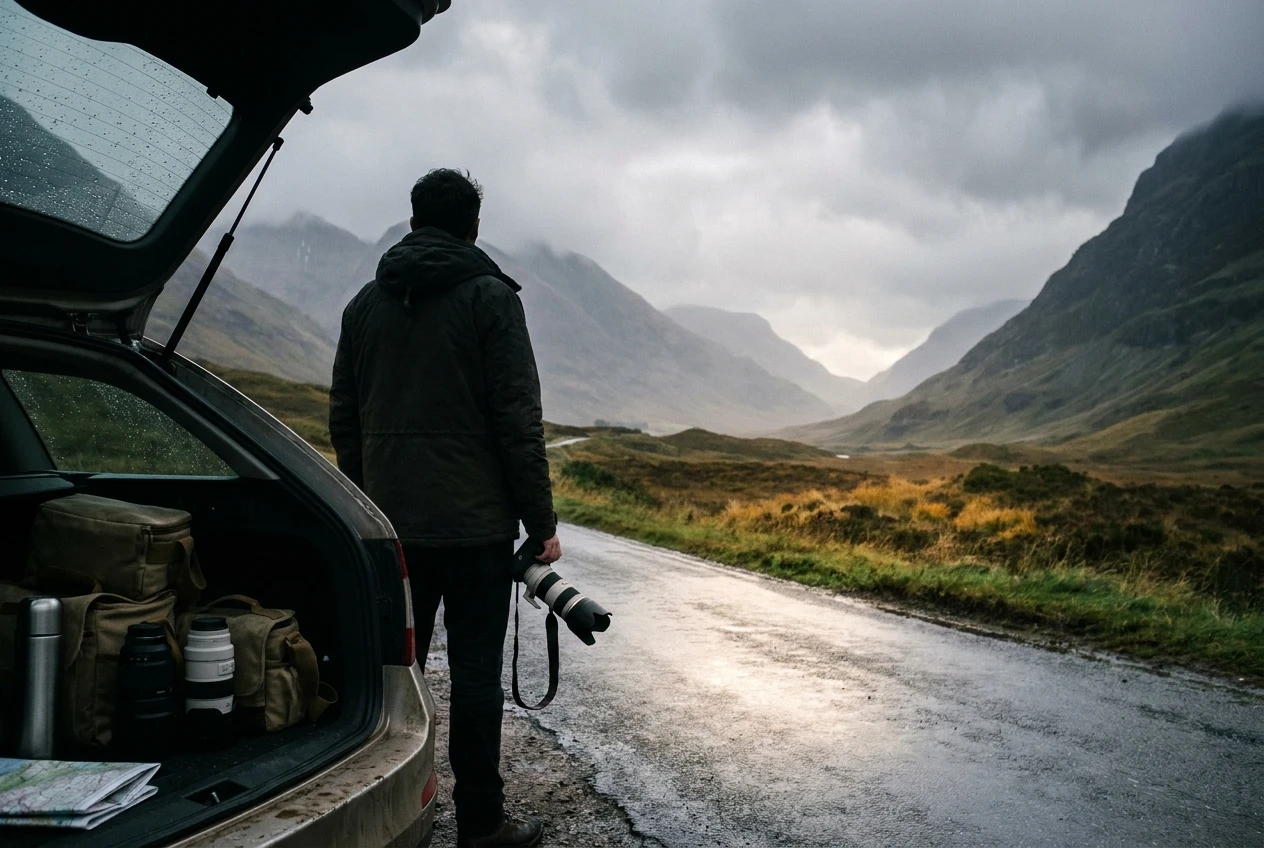
The route ran around Fort William and Glencoe, two of the most photographed corners of Scotland, in early autumn light that refuses to behave. Row arrived organized: locations pinned, sunrise times logged, a content checklist ready. He scrapped all of it on day one.
What replaced the plan was simpler. He drove, and when something stopped him, he pulled over and photographed it without waiting for the light to turn perfect, then moved on. No standing in the dark for an hour hoping a cloud would part. No guilt about the viewpoint he skipped. The trip stopped being a shoot and started being a drive with a camera always within reach.
That shift sounds small. For a working photographer it is closer to heresy, because the entire craft of landscape work is usually sold as a discipline of preparation.
- 6 days on the road between Fort William and Glencoe
- 24mm to 400mm of focal range covered by two Sony lenses
- 60 to 80 percent of his Sony shooting time spent on a single secondhand lens
- 6 capture devices riding in the boot, used when wanted and ignored when not
Why Familiarity Beats the Visitor’s Itinerary
Row built his whole approach around one honest admission: a local photographer who knows the Scottish mountains across every season and every kind of light will outshoot a visitor on a short trip, every time. The person who has watched the same glen under snow, in haar, at the back end of a storm, simply has more chances to be standing in the right place when the light does something rare.
Most photographers treat that gap as a challenge to close with planning. Row did the opposite. He accepted that the local will always outshoot the visitor and let the competitive pressure drain out of the trip entirely. Once you stop trying to win, you stop measuring every frame against an imaginary best version of it.
There is a real craft argument buried in that surrender. Chasing the postcard shot of Glencoe means competing with thousands of near-identical files already on every stock site and print wall. Responding to what is actually in front of you, a wet road, a stand of birch, a break in cloud over a ridge, tends to produce work that at least belongs to you. Familiarity is the visitor’s missing advantage, and the only honest substitute is attention.
The Hamster Wheel Behind the Camera
The reason a holiday needs rescuing in the first place is the shape of Row’s normal week. He describes it as a hamster wheel, and the list is exhausting on its own: shooting video and stills, submitting to stock agencies, preparing print files, running an Etsy shop, and marketing through his website, week after week without a real break.
Each of those is a legitimate income stream. Stacked together, they turn every outing into a supply run for several businesses at once. Even a planned holiday rarely breaks the loop, because the habit of shooting to sell and the guilt of not shooting are both hard to switch off. You can change the postcode and keep the wheel turning.
This is not a Row-specific failing. The World Health Organization classifies burnout in its ICD-11 definition of burnout as an occupational phenomenon, tied to chronic workplace stress that has not been managed, with exhaustion and reduced professional efficacy among its markers. For anyone whose passion is also their payroll, the workplace never closes. It rides in the passenger seat.
What Reward Psychology Says About Shooting for Money
There is a tidy piece of psychology that explains why Row’s stripped-back days felt better than his scheduled ones. It is called the overjustification effect, and it describes what happens when an external reward gets attached to something you already enjoy for its own sake.
The landmark demonstration came from Mark Lepper, David Greene, and Richard Nisbett in 1973. In a nursery-school field experiment, children who already loved drawing were split into groups; some were promised a reward for drawing, some were not. The finding, expanded in the team’s research on extrinsic rewards and intrinsic interest, was stark. The children who expected a reward later spent about 50% less time drawing during free play than the children who drew for nothing.
The reward had quietly rewritten why they were doing it. The brain stopped filing the activity under play and started filing it under work, and the pull faded the moment the payment stopped. Swap crayons for a camera and stock royalties for the reward, and you have a precise description of the creative hamster wheel. Once every shutter press is also a transaction, the part of you that pressed it for fun goes quiet. Pulling over for a birch tree that will never sell is one way to wake it up.
The Gear That Rode in the Boot
Because this was a driving trip, Row could carry far more than he would ever hike with, and the kit stayed in bags in the boot, available on demand and ignored without guilt. The standout was not the headline body but a lens he almost did not buy.
He had been unsure about a secondhand Sony 100-400mm telephoto from the G Master line (Sony’s premium optics tier). It ended up being the lens he reached for most, somewhere between 60 and 80 percent of his time with the Sony body, proof that the gear you hesitate over is sometimes the gear you needed. The whole rolling kit looked like this.
| Device | Role on the trip | Notable detail |
|---|---|---|
| Sony mirrorless body + 100-400mm | Primary stills, most-used setup | Secondhand telephoto, used 60 to 80 percent of Sony shots |
| Second Sony lens | Wider scenes | Pairs with the 100-400mm to cover 24mm to 400mm |
| Fujifilm X-T30 II | Lightweight backup body | 26.1-megapixel APS-C sensor, X-Processor 4 |
| DJI Pocket 3 | Filmed the road-trip video | 1-inch sensor, gimbal-stabilized, up to 4K capture |
| iPhone + 360 camera | Grab shots and in-car footage | 360 unit mounted inside the vehicle |
The point of the table is not the spec sheet. It is that having a low-friction option mattered more than having the best one. He shot the video itself on the DJI Osmo Pocket 3 camera specifications, a pocket gimbal small enough to grab from the door pocket, while the heavier Fujifilm X-T30 II mirrorless body sat ready for the moments that earned a proper stop.
How to Shoot for Yourself Without Quitting the Business
The trip is one photographer’s story, but the fix is portable, and you do not have to torch your income to use it. The trick is building small breaks from the reward loop into a working life that still pays.
- Leave the alarm off for one day of any trip and photograph only what physically stops you
- Carry the smallest capable camera you own so the cost of pulling over is almost zero
- Keep a personal folder that never goes to stock, print, or social, so some frames stay yours
- Stop scoring an outing by frame count or sales, and judge it by whether you enjoyed making the pictures
None of that requires closing the Etsy shop or skipping the next stock deadline. It just carves out a space where the camera is a toy again rather than a tool. For Row, that space was a wet road in the Highlands and a telephoto he nearly left in the shop.
Frequently Asked Questions
What Is the Overjustification Effect in Photography?
It is the well-documented tendency for external rewards to erode the enjoyment of something you already loved doing. When stock sales, prints, or likes become the reason you shoot, the brain reclassifies photography from play to work, and the intrinsic pull weakens. The 1973 Lepper, Greene, and Nisbett study found rewarded children later spent about half as much free time on a once-loved activity.
Do Local Photographers Really Outshoot Visitors?
On a short trip, usually yes. Row’s argument is that someone who knows a location across multiple seasons and light conditions gets far more chances to be present when rare conditions appear. A visitor on a fixed itinerary is gambling on a handful of mornings, which is why he stopped competing and shot for himself instead.
What Camera Did Jason Row Use to Film the Video?
He filmed the road-trip video on a DJI Pocket 3, a pocket-sized gimbal camera with a 1-inch sensor. Its small size meant he could grab it for in-car and roadside footage without the friction of setting up a larger rig, which fit the loose, respond-as-you-go spirit of the trip.
What Does Shooting for Yourself Actually Mean?
It means making images guided by what interests you in the moment rather than by what will sell, rank, or win approval. In practice that looks like photographing a subject without waiting for ideal light, skipping the must-have viewpoint, and accepting that some frames will never be published.
How Do You Avoid Photography Burnout?
Build deliberate gaps in the reward loop. Keep personal work that never gets monetized, reduce self-imposed quotas, and separate income-driven shooting from play. The World Health Organization frames burnout as the result of chronic, unmanaged work stress, so the fix is structural rather than a single rest day.
What Gear Did He Bring to Scotland?
A Sony mirrorless body with two lenses spanning 24mm to 400mm, including a secondhand 100-400mm telephoto, plus a Fujifilm X-T30 II, an iPhone, a 360 camera mounted in the car, and the DJI Pocket 3. Because he was driving, all of it stayed in the boot and came out only when he wanted it.





iPhone 18 Pro Price Hike Hands Wins to Memory Makers

Apple Lifts Trade-In Credits Ahead of Costly iPhone 18 Cycle

Hisense Ships Dolby Vision 2 First and the Brightness Catch

Quake Gets 19 Free Maps From MachineGames Quake Club

SpaceX Moon Factories Aim to Break Earth’s AI Limits

OpenAI Bets $300 Donut Speaker Can Beat Smart Home Economics

Marantz Cinema Series 2 Puts Dirac and FreeSync on Midrange Boxes

AirPods Pro 3 Hit $190 as Camera Models Loom Pricier

Ford Places Its $30K Fathom Bet on a New Production Era

Seiko Wraps Its Speedtimer in Edo Purple for 145 Years

Doom Studio id Software Cuts Half Its Staff in Xbox Layoffs

Nintendo Switch Online Adds Four Classics and One Japan-Only Title

Meta’s Muse Image Lets Anyone Use Your Instagram Photos in AI

Pink Bearista Cup Returns July 13 as Starbucks Pink Vibes Drops

Samsung Sets Galaxy Unpacked for July 22 in London With a Wider Fold

Marine Cloud Brightening Could Weaken Super El Niños, Study Says

US Trade Deficit Jumps to 14-Month High as AI Spending Lifts Imports

Micron Stock Just Entered a Bear Market. Is It Time to Buy?

Samsung’s $1,230 Galaxy Unpacked Deal: How It Stacks Up

Meta Tests ‘Super Sensing’ AI Glasses That Record Every Moment
-

 TECHNOLOGY3 years ago
How to Adjust a Bulova Watch Band – An Easy Guide
-

 News3 years ago
Fred Pentland: Athletic Bilbao’s English mentor who changed the essence of Spanish football
-

 FINANCE3 years ago
Tax Planning for Every Season: Guide to Maximizing Your Tax Benefits
-

 Education3 years ago
African Ministers New Education Plan
-

 BUSINESS3 years ago
What is Entrepreneurial Operating System? A Comprehensive Guide to EOS
-

 Education3 years ago
Innovate Your Learning Journey with Technology and Enhance Education
-

 News3 years ago
Russians formally out of World Athletics Championships
-

 BUSINESS3 years ago
Top 9 Most Expensive American Cities to Rent an Apartment