
BUSINESS
Macy’s Q1 Beats and Lifts Guidance, but One Banner Carries It
Macy’s posted its strongest first-quarter comp sales in four years and raised 2026 guidance, but Bloomingdale’s 10.2% jump and tax refunds drove the gain.

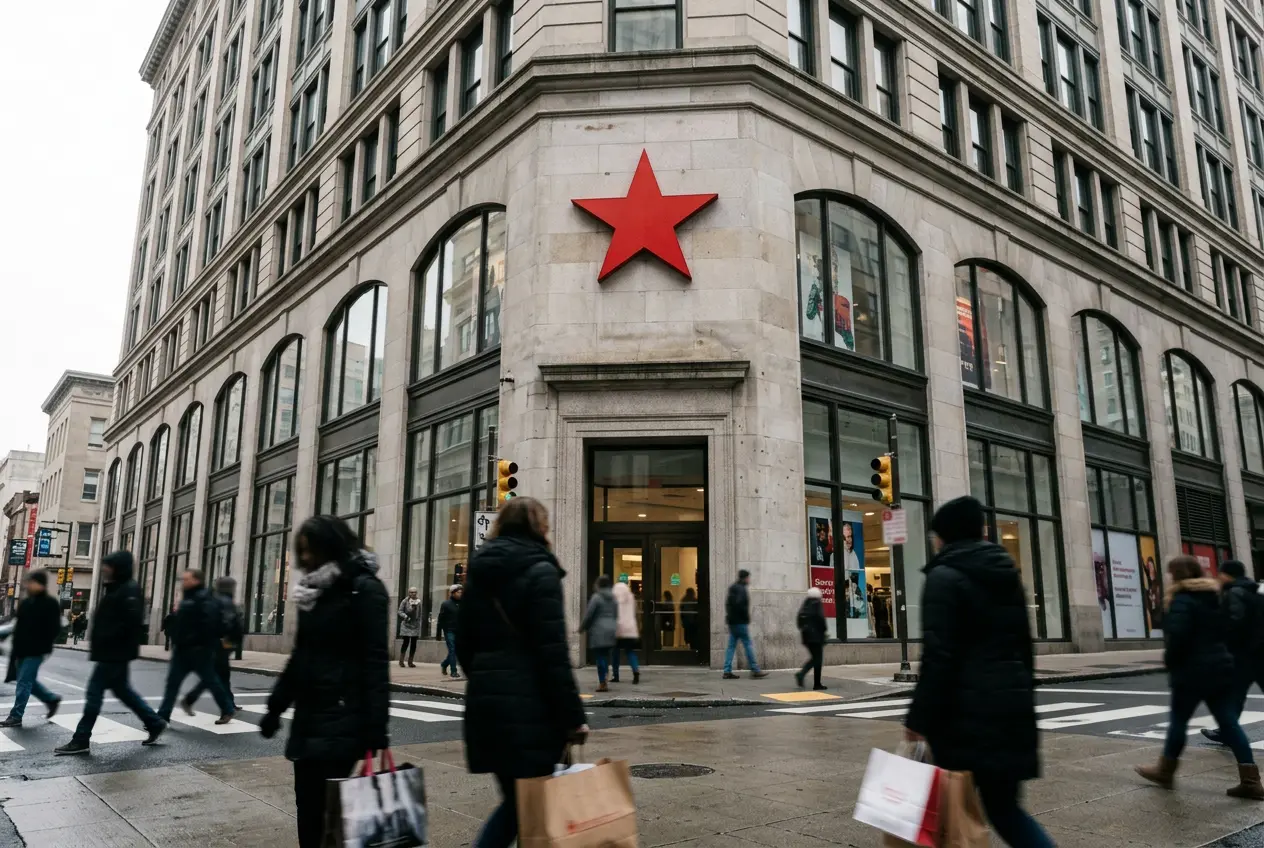
Macy’s posted its strongest first-quarter comparable-sales growth in four years on June 3, with company-wide comparable sales up 3% and net sales of $4.68 billion. The retailer raised its full-year guidance, yet the gain leaned heavily on Bloomingdale’s 10.2% jump and a tax-refund bump, while the namesake Macy’s banner rose just 1.6%.
That split is the story under the headline. The turnaround is working where Macy’s has spent money and attention; it is still slow where most of the revenue actually sits.
What Lifted the Comparable-Sales Line to 3%
For the quarter that ended May 2, Macy’s reported net sales of $4.68 billion, up about 2% from $4.60 billion a year earlier. Net income came in at $63 million, or 23 cents per share, against $38 million, or 13 cents, in the same period last year. Stripping out restructuring and one-time charges, adjusted earnings per share (EPS, profit per share after costs) landed at 13 cents, ahead of the company’s own guidance and the fifth straight quarter the retailer has beaten its plan.
The 3% comparable-sales figure covers owned, licensed and marketplace sales across all three nameplates. It reads well until you look at where it came from, which the company laid out in its first-quarter results filing with the U.S. Securities and Exchange Commission (SEC).
| Nameplate | Q1 comparable sales | Detail |
|---|---|---|
| Macy’s namesake | +1.6% | Reimagine 200 stores up 2.4% |
| Bloomingdale’s | +10.2% | Seven straight quarters of gains, record Q1 volume |
| Bluemercury | +6.4% | Beauty banner, continued growth |
| Company-wide | +3.0% | Strongest first quarter in four years |
Gross margin held at 38.9%. The number that carries the most weight for shoppers and for the stock, though, is the smallest one on the table.
The Namesake Banner Is Still the Slow Lane
The Macy’s nameplate is the bulk of the business, and it grew 1.6%. That is genuine improvement for a chain that spent years in decline, but it is a long way from the double-digit pace at Bloomingdale’s. When the biggest engine moves slowest, the blended 3% headline flatters the core.
Total net sales tell the same story from another angle. They rose only about 2% even with comps up 3%, because Macy’s keeps shutting underperforming locations. The company is roughly two years into a three-year plan, branded Bold New Chapter, that closes dead-mall stores and reinvests in the ones it keeps. Those closures clipped roughly $40 million from first-quarter sales and are set to weigh on the full year, part of a wind-down detailed in the company’s most recent annual report covering the plan to close about 150 stores.
So the namesake banner is doing two things at once. It is growing on a same-store basis and shrinking on a total-store basis. For the company that nets out to slow, steady progress, which is exactly what a turnaround is supposed to look like at this stage. It is also why a 1.6% print, not the 3% one, is the honest read on Macy’s core health right now.
How Saks’s Collapse Fed Bloomingdale’s
Bloomingdale’s was the quarter’s standout, up 10.2% and its highest first-quarter volume on record. Some of that is execution; the banner has posted seven consecutive quarters of growth. Some of it is a gift from a fallen rival.
Saks Global, the parent of Saks Fifth Avenue, filed for Chapter 11 in January after a $2.7 billion acquisition of Neiman Marcus left its balance sheet unworkable and vendors unpaid. That left a hole at the top of American luxury retail, and the most direct beneficiary is the upscale department store still standing in many of the same malls and cities. CEO Tony Spring, Macy’s chairman and chief executive, pointed to a “fun factor” he says is unique in the luxury landscape, and acknowledged the help from a rival’s bankruptcy filing without leaning on it.
Is the disruption in the marketplace helpful to us? Sure. Is it the primary reason we’re growing? No.
He’s right that Bloomingdale’s was growing before Saks stumbled. He’s also describing a tailwind that won’t last forever. A competitor’s collapse is a one-time event; once the displaced luxury shopper picks a new home, the comparison gets harder. The strength is real, but a chunk of it is borrowed from someone else’s failure.
Inside the Reimagine 200 Bet
The most durable part of the quarter sits inside the stores Macy’s has rebuilt. The cohort it calls Reimagine 200, locations upgraded with better staffing, cleaner layouts and sharper merchandising, posted comparable-sales growth of 2.4%, well above the 1.6% namesake average. The program started as 125 stores and added 75 more for this year.
The fix is unglamorous on purpose. Spring framed it as a return to retail basics rather than reinvention.
The reimagined-store playbook comes down to a few concrete moves:
- Staffing the floor so customers can find help and check out without a wait
- Keeping stores clean and pleasant enough that people want to linger
- Stocking the products shoppers actually came in to buy, in the sizes and brands they want
None of that is a slogan, and that’s the point. The reimagined cohort is the proof that when Macy’s spends on fundamentals, the same-store numbers respond, which is the engine the company is betting on as it expands the model and continues the broader Bold New Chapter reset it began with its return to annual comparable-sales growth. The risk is cost: upgrading hundreds of stores is expensive, and the payoff has to outrun the spending.
Tax Refunds Did Some of the Lifting
Macy’s was not alone in posting a strong fiscal first quarter. Many retailers got a lift from larger-than-usual tax refunds that put extra cash in shoppers’ pockets early in the year. The chief executive said refunds “definitely” helped, while insisting they weren’t the only reason for the growth.
That tailwind fades. Several retailers have warned that the current quarter could slow as refund money runs out and consumers pay more at the pump, with gas prices climbing on the war in the Middle East and the shifting patterns in department-store spending already visible over the holiday season. A shopper with a fatter refund check in March is not the same shopper in July.
Macy’s counter is that the trends held into the new quarter. Management said it saw “no significant change in the consumer approach” to its categories as the second quarter began, and that breadth across the three nameplates, not a single hot category, drove the start. If that holds, the refund question becomes noise. If it doesn’t, the second half gets harder.
The Raised Guidance and What It Assumes
The beat was strong enough that Macy’s lifted a forecast it had set cautiously earlier in the year. Here is what changed:
- Net sales: now $21.5 billion to $21.75 billion, mostly ahead of the $21.59 billion analysts expected, per data provider LSEG (London Stock Exchange Group)
- Comparable sales: now up 0.5% to 1.2%, versus a prior range of down 0.5% to up 0.5%
- Adjusted EPS: now $2.00 to $2.20, up from $1.90 to $2.10
The raise rests on two bets. The first is that the consumer holds up; management says it lifted the outlook “despite the macroeconomic and geopolitical uncertainty,” not because that uncertainty has cleared. The second is on tariffs. The guidance assumes the first half of the year carries a heavier tariff hit than the second, so the math improves as the year runs only if that timing holds. Either of those assumptions can move; the company chose to raise anyway because the second-quarter trends it can already see looked like the first-quarter ones.
The full-year guidance still implies comparable growth no higher than 1.2%. The fast quarter Macy’s just reported was built on a luxury rival’s bankruptcy and a refund season that won’t repeat, and the company’s own forecast says the underlying pace from here is modest.


Microsoft Launches ASSERT to Test AI Agents Before They Ship

Stuntman Hollywood Revives the PS5 Stunt Racer After 19 Years

Ace Combat 8: Wings of Theve Lands October 2 With a Big Online Bet

Galaxy Z Fold 8 ‘Wide’ Leaks at 201g, Lighter Than Slabs

Tomb Raider: Legacy of Atlantis Gets February 2027 Release

God of War Laufey Brings Back the Jump Button After 13 Years

Microsoft Revives Its Wearable Bet With an AI Badge

Palo Alto Earnings Beat the AI Cyber Doubters, Stock Still Falls

Blue Origin’s New Glenn Pad Rebuild Faces a 15-Month Clock

Control Resonant Lands September 24 as Remedy’s Big Bet

Subnautica 2 Studio Apologises, Holds Line on No-Kill Combat

Brent at $111 Hides the Hormuz Damage Hitting Fed and Asia

Mitchell Matches Kobe in Game 7 Rout, Cavaliers Reach East Finals

Shai Gilgeous-Alexander Wins Second Straight MVP With 83 of 100 First-Place Votes

Xperia 1 VIII Holds Price, Xiaomi 17 Max Loads Up: Week 20 Phone News

Rousey Finishes Carano in 17 Seconds and Hands Netflix Its MMA Opening

Colt Emerson Debuts, Mariners Get Swept by Padres in Vedder Cup

Samsung Strike Looms May 21 as Union Eyes SK Hynix Bonus Formula

LIRR Strike Hits Third Day as 250,000 Commuters Face a Tougher Manhattan Run

Jaylen Brown Calls Stephen A. Smith the Face of Clickbait Media
-

 TECHNOLOGY3 years ago
How to Adjust a Bulova Watch Band – An Easy Guide
-

 FINANCE3 years ago
Tax Planning for Every Season: Guide to Maximizing Your Tax Benefits
-

 News3 years ago
Fred Pentland: Athletic Bilbao’s English mentor who changed the essence of Spanish football
-

 BUSINESS3 years ago
What is Entrepreneurial Operating System? A Comprehensive Guide to EOS
-

 Education3 years ago
African Ministers New Education Plan
-

 Education3 years ago
Innovate Your Learning Journey with Technology and Enhance Education
-

 News3 years ago
Russians formally out of World Athletics Championships
-

 BUSINESS3 years ago
Top 9 Most Expensive American Cities to Rent an Apartment