
News
Microsoft Revives Its Wearable Bet With an AI Badge
Microsoft unveiled an AI wearable badge and desk hub at Build, with no price or ship date. Here is what the camera, pilots and its wearable history mean.

Microsoft used its annual Build developer conference to unveil two AI-enabled gadgets aimed at office workers: a wearable access badge that clips to a lanyard and a small desktop cube, both built to run AI agents rather than the apps that sit on a laptop today. Both devices carry no price and no release date, and Microsoft has not said whether it will ever sell them. A few hundred of its own employees are using them now.
The reveal arrives with a complication the company knows well. Microsoft has built and quietly killed wearable hardware twice in the past decade, and the badge’s standout feature, a small camera that points at whatever the wearer faces, drops it straight into the privacy fight now surrounding Meta’s camera glasses.
What Microsoft Showed at Build
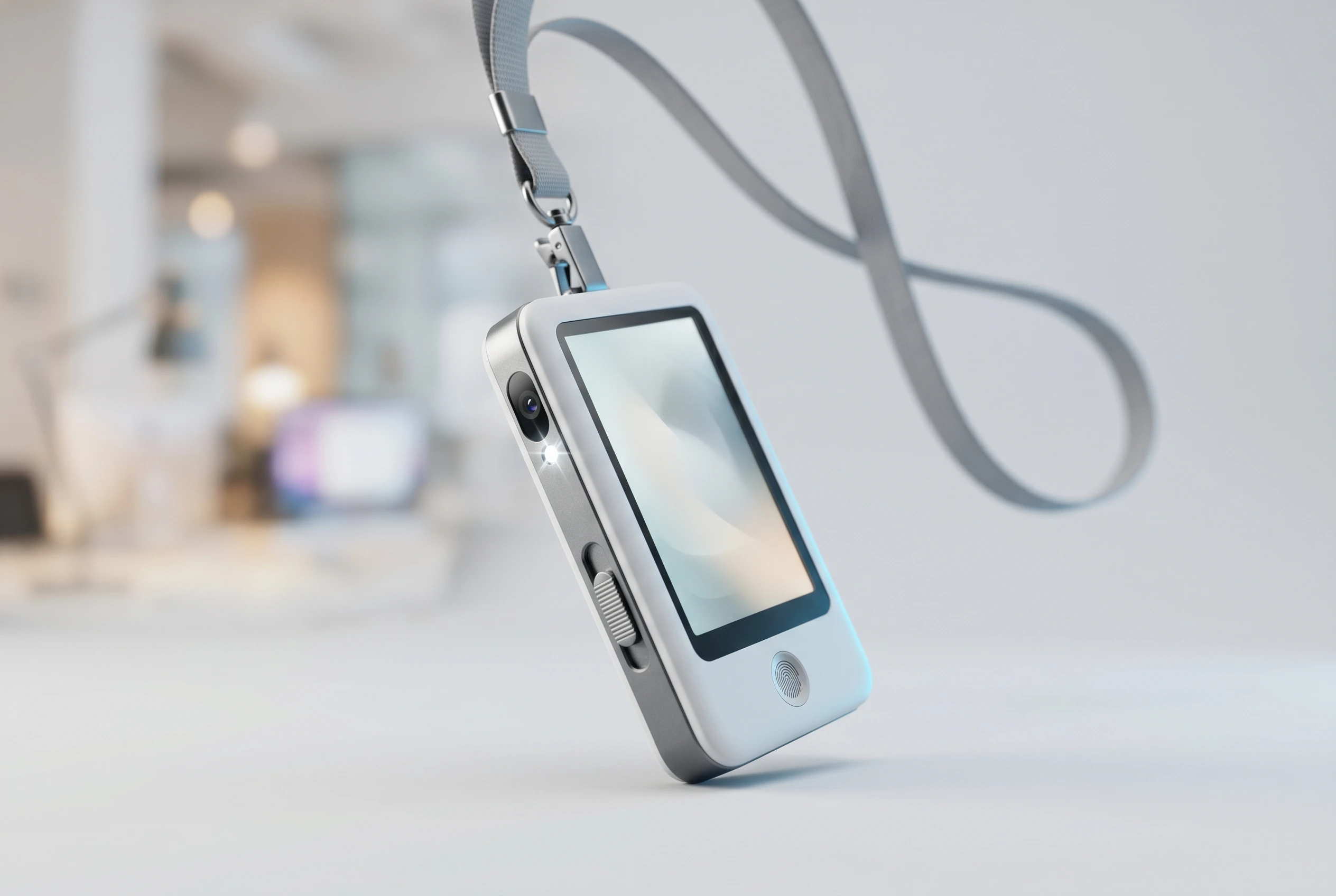
The first device is a clip-on badge meant to hang around the neck or off a belt loop, roughly where an office worker already wears an entry pass. It carries a touchscreen, a fingerprint sensor, a speaker, a privacy switch and a side-facing camera, with WiFi, Bluetooth and 5G packed inside. Steven Bathiche, a Microsoft technical fellow who leads the company’s Applied Sciences Group, demonstrated it on stage. He activated the badge with his fingerprint, pointed it at the audience, and told it to take photos of the crowd and send them to him. It did, he said.
The second device is a desk hub, a small cube with a touch- and voice-activated screen that pairs with a PC over Bluetooth and hands tasks back and forth. Both connect to Microsoft software so a worker can reach their AI agents, the bots that draft code or run tasks somewhat on their own, without opening a laptop. Bathiche said the badge “is lightweight and designed for agent interactions on the go.”
| Attribute | Wearable badge | Desk hub |
|---|---|---|
| Form | Clip-on, lanyard or belt loop | Small desktop cube |
| Silicon | Qualcomm wearable chip | MediaTek IoT chip |
| Key inputs | Touchscreen, fingerprint, camera, voice | Touch and voice screen |
| Connectivity | WiFi, Bluetooth, 5G | Bluetooth, pairs with a PC |
| Job | Reach agents while moving | Hand tasks between agent and PC |
Why Microsoft Built a Badge Around AI Agents
The hardware is the visible part. The bet underneath it is that AI agents, not apps, become the thing people interact with, and that those agents need a way to reach a worker who has stepped away from the keyboard. Microsoft framed both gadgets as part of Project Solara, a platform it announced at Build for running agent-driven experiences across devices.
What makes the move telling is what runs inside. The badge and hub are built on Android, not Windows, and they lean on Qualcomm and MediaTek chips instead of the Intel-and-Windows pairing that has defined Microsoft hardware for decades. Satya Nadella, the Microsoft chief executive, called the gadgets a “new form factor” for technology devices. The company says the current pilots will “inform how these form factors can be built” later, which is corporate language for a concept it is not ready to commit to.
A Camera Pointed at the Room
The camera is what makes the badge useful, and it is also what makes it a problem. In a Microsoft blog post, Bathiche wrote that the camera lets agents “better understand and help take action on the environment around them.” In practice that means a worker can show their AI assistant a shelf, a whiteboard or a face, and have it act on what it sees.
The On-Stage Demo
The crowd-photo demo was meant to look effortless. Tap the fingerprint, aim, speak, and the images land in your inbox. The trouble is that everyone in those photos was captured without being asked, which is the exact scenario privacy researchers have spent the past year flagging on rival hardware.
The Bystander Problem
Meta’s AI glasses have drawn intense scrutiny over when, why and how they record. The people at greatest risk are not the wearers but the bystanders, the ones being filmed and identified, a point the Electronic Frontier Foundation raised in urging caution over Meta’s Ray-Bans. Microsoft did include a hardware privacy switch on the badge, a more visible control than the small indicator light critics say is easy to cover on camera glasses. Whether a switch is enough to calm an office full of people who never agreed to be photographed is the question the pilots will test first.
Microsoft Has Quit Wearables Twice Before
This is where the history matters. Microsoft has launched wearable hardware to real buyers before, and then walked away from it, leaving early customers stranded. The pattern is recent enough that anyone signing up for a badge pilot can look it up.
From the Band to a Refund
The Microsoft Band, a fitness tracker, launched in October 2014 and sold out on its first day. By October 2016 Microsoft had stopped sales and development, around the time the Apple Watch and Fitbit were pulling away in the category. In 2019 the company shut down the Band’s companion app entirely and offered refunds to active users, a quiet end for a product people had paid for and worn daily.
HoloLens and the Army Exit
The bigger retreat was HoloLens, the mixed-reality headset Microsoft developed for nearly a decade and adapted for the US Army. After soldiers testing the military version reported eye strain, nausea and software faults, Microsoft said in 2024 it would stop producing the HoloLens 2. The Army’s Integrated Visual Augmentation System (IVAS, the program built on that headset), worth up to $22 billion over ten years, was handed to defense startup Anduril Industries in 2025, with Microsoft kept on only for cloud services.
- 2014: Microsoft Band launches and sells out on day one.
- 2016: Band sales and development stop.
- 2019: Band app shut down; refunds offered.
- 2024: HoloLens 2 production ends.
- 2025: The $22 billion Army headset program moves to Anduril.
A Crowded Race for the Post-Phone Gadget
Microsoft is not alone in chasing a device that replaces some of what a phone or laptop does. Google recently said it would try wearables again with smart glasses, more than a decade after the Google Glass flop made face-worn cameras a punchline. Meta has shipped camera glasses at volume and absorbed the backlash that came with them.
Every one of these attempts runs into the same wall: the feature that makes the device worth wearing, a camera and microphone aware of the world around it, is the feature that makes people nervous to be near it. In most US states, recording someone in public without telling them is legal, which is part of why legal analysts say smart-glasses footage sits in a gray zone. A workplace badge with a camera invites that same scrutiny, indoors, among colleagues.
Who Gets to Test It First
Microsoft is starting inside the enterprise, where a controlled rollout is easier to manage than a consumer launch. In the coming months, a set of named brands are expected to begin pilots based on the reference designs, putting the badge and hub in front of real workers rather than developers.
- AccuWeather
- Best Buy
- CVS Health
- Levi’s
- Target
For now the project sits at the concept stage, with a small internal user base and a handful of corporate partners.
- Two concept devices shown, neither with a price or release date.
- A few hundred Microsoft employees testing them today.
- Five outside brands lined up for pilots.
- Android and Qualcomm inside, not Windows and Intel.
Microsoft has not said when either device reaches a store, or whether it will. The pilots run in the coming months, and the company’s own track record is the reason early adopters will want to see how they end before they clip one on.






Spotify Running Mode hits Android and revives its old tempo experiment

Galaxy Tab S12 Ultra Renders Keep the Notch Fans Hate

Novato Spinning Round House Sells With Six Neighbors for $3.3 Million

Crop Tour Finds Indiana and Nebraska Corn Yields Lagging 2025

Best Buy 60th sale brings Android deals back to its roots

American Airlines reverses seatback screen bet years too late

Iran Hormuz Strikes Force Gulf Oil Onto Costlier Paths

Plague Tale Prequel Day One Joins Game Pass Wave 2 as Witcher Exits

NBA 2K27 opens The City to everyone and rewrites career eras

iOS 26.6.1 Patches 29 Flaws as AI Forces Faster Apple Updates

Double Fine Cuts 23 Jobs Weeks After Xbox Independence

Day-One Big Walk Lifts PS Plus August Beyond Recycled AAA

John Hight Exits Wizards After Digital Reckoning Hits

Curtis Mead’s Red Sox Debut Ends With Fractured Wrist

Red Sox Squander Hot Streak Chance in 4-3 Loss to Athletics

Moesch and Dressel Rewrite Night One at 2026 U.S. Nationals

Boutte’s Quiet Camp Takeover Forces Patriots Receiver Choices

Take-Two CEO Pushes Netflix Subs for GTA 6 Extended Look

Halo Campaign Evolved Skulls Meet Death Barriers That Kill the Hunt

Wildlands Free Update Hands Players the Tools They Already Invented
-

 TECHNOLOGY3 years ago
How to Adjust a Bulova Watch Band – An Easy Guide
-

 News3 years ago
Fred Pentland: Athletic Bilbao’s English mentor who changed the essence of Spanish football
-

 FINANCE3 years ago
Tax Planning for Every Season: Guide to Maximizing Your Tax Benefits
-

 Education3 years ago
African Ministers New Education Plan
-

 BUSINESS3 years ago
What is Entrepreneurial Operating System? A Comprehensive Guide to EOS
-

 Education3 years ago
Innovate Your Learning Journey with Technology and Enhance Education
-

 News3 years ago
Russians formally out of World Athletics Championships
-

 BUSINESS3 years ago
Top 9 Most Expensive American Cities to Rent an Apartment