
News
Meta’s 30-Minute Tracking Pause Leaves Its AI Surveillance Intact
Meta will let staff pause its keystroke tracking for 30 minutes, but the Model Capability Initiative keeps recording most employees all day to train its AI.

Meta will let employees pause its workplace tracking software for up to 30 minutes when they need to check something personal, the company told staff in an internal memo. The change applies to the Model Capability Initiative (MCI), a program that records keystrokes, mouse clicks and periodic screenshots on US work laptops to feed Meta’s AI models.
A small group of workers will also be allowed to opt out completely. For almost everyone else inside the company, the all-day monitoring stays exactly where it was.
Can Meta Workers Opt Out? Most Still Can’t
The opt-out is not open to anyone who simply dislikes being recorded. The memo, first detailed in a report by The Information, limits exemptions to three narrow groups, and each one carries a practical condition rather than a privacy objection.
- Remote workers with bandwidth concerns, where the software eats too much of their connection
- Employees who handle sensitive material as part of their daily job
- Staff who often work in places where they cannot keep a laptop plugged in, because the tool drains the battery
Notice what is missing from that list: a general right to say no. A designer who finds keystroke logging intrusive, or an engineer who would rather not be screenshotted, has no standing to request an exemption. Everyone outside the three buckets keeps the software running through the workday, with the half-hour window as the only relief on offer.
The tool captures mouse movements, clicks and keystrokes across hundreds of approved apps and websites, according to internal Meta memos describing the keystroke-capture program that Reuters reviewed in April. The stated goal is teaching AI agents how people actually navigate a computer, down to dropdown menus and keyboard shortcuts.
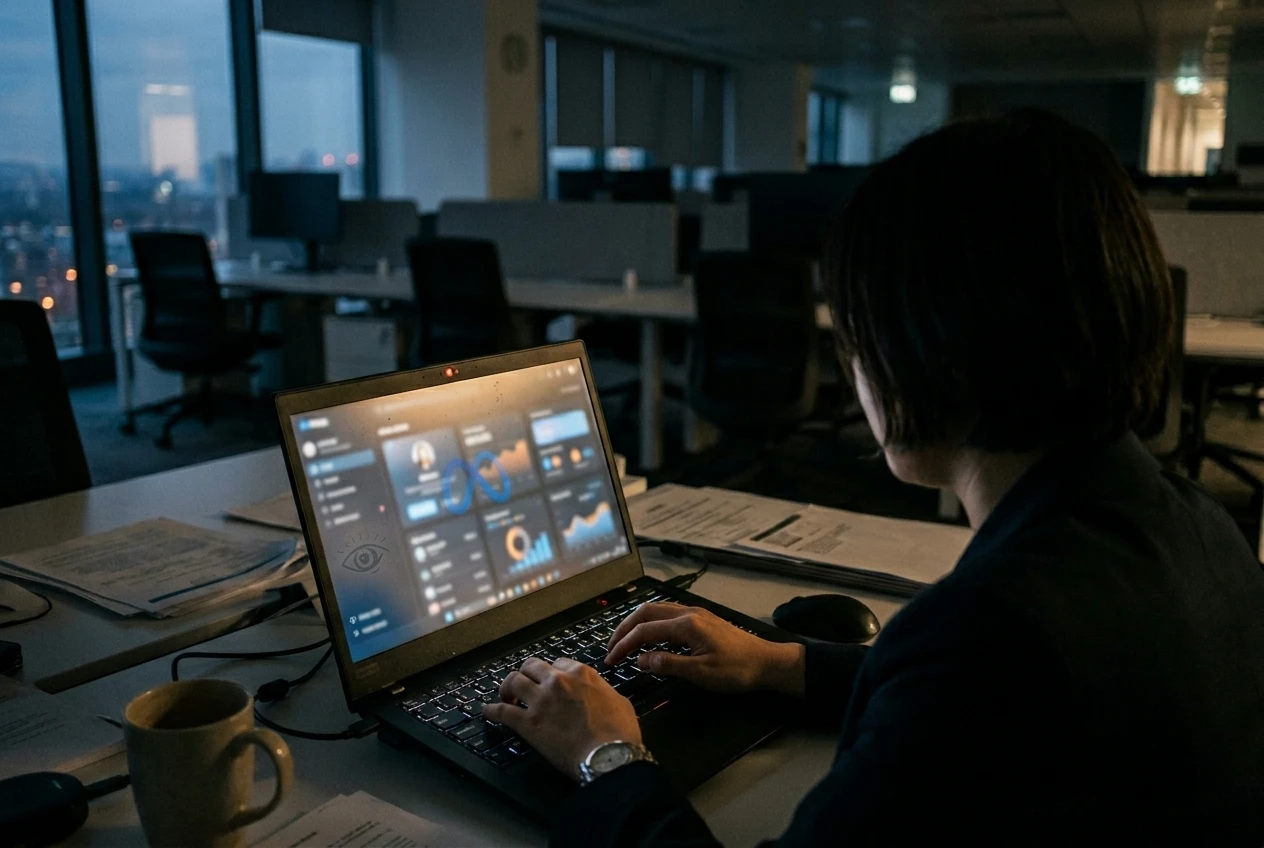
A Half-Hour Pause Leaves the Tracking Intact
The memo changes three things and leaves the rest alone. A side-by-side shows how little moved.
| Feature | Before the memo | After the memo |
|---|---|---|
| Pause for personal use | None | Up to half an hour |
| Right to opt out | None | Narrow group only |
| Battery and data load | Heavy, prompting complaints | Several optimizations promised |
| Keystroke, click and screenshot capture | On by default | On by default |
The bottom row is the one that matters. The pause, the exemptions and the battery fixes all sit around the edges, while the core capture stays on by default for the bulk of the workforce. Stephane Kasriel, a vice president at Meta’s Superintelligence Labs, told staff the team remains “confident in the privacy protections we put in place at launch,” and that it is shipping several optimizations after workers complained about data and battery use.
The Staff Revolt Behind the Climbdown
Meta did not soften the program on its own. The concessions followed weeks of internal pushback that spilled into the open.
- More than 1,000 employees signed an internal petition against the program
- 8,000 workers were laid off around the time it was announced, with thousands more shifted into AI roles
- UK-based staff opened a formal union organizing drive
Workers circulated petitions, taped flyers to conference-room walls and vending machines, and in one widely shared line called the company an “Employee Data Extraction Factory.” In the US, organizers leaned on federal protections for collective action over working conditions, which the National Labor Relations Board (NLRB, the agency that enforces US labor law) treats as covering petitions and leafleting.
The timing sharpened the anger. The tool arrived in the same stretch as the layoffs and a round of conspicuous spending, including the superyacht that docked near a Seattle office as local jobs were cut. Asking the people who kept their jobs to hand over their keystrokes did not land gently.
Zuckerberg Says the Data Isn’t Surveillance
Meta chief executive Mark Zuckerberg has defended the program straight to staff, arguing that recording skilled employees is the fastest way to make the models better.
None of the data is being used for, like, looking at what people are doing, or surveillance, or performance track[ing], or anything like that. It’s purely just, like, we are using this to feed a very large amount of content into the AI model, so that way it can learn how smart people use computers to accomplish tasks.
He made the comments in leaked audio from a company-wide meeting last month, telling employees that “watching really smart people do things” is the best route to rapid improvement and that the average intelligence at the company runs well above what you get from outside task workers. The pitch rests on a premise many staff find uncomfortable. The agents trained on their clicks and keystrokes are built to perform white-collar tasks on their own, the same work some of them are paid to do. An internal memo from the Superintelligence Labs unit, the division run by chief AI officer Alexandr Wang, even spelled out the need to capture “on-screen content as the context of what was being manipulated.” For the people signing the petitions, that is the deeper objection, well past the battery drain.
Workplace Surveillance Is Becoming the Default
Meta is an outlier in method, not in direction. Monitoring the people who work for you has quietly become standard corporate practice, and the tooling for it is a growing business in its own right.
The Numbers Behind Bossware
Roughly 78% of companies now run some form of employee monitoring, and among firms with remote staff the figure climbs to about 94%, well above the 62% seen at fully in-office workplaces. The market follows the habit. The employee surveillance and monitoring software market was valued near $3.89 billion in 2025 and is expected to reach about $4.59 billion in 2026, a compound annual growth rate (CAGR, the smoothed yearly pace) close to 16% through the rest of the decade, with North America holding the largest single share.
Why Meta’s Tool Goes Further
What sets MCI apart is the purpose. Most monitoring software exists to measure output or flag a security risk. Meta’s tool exists to copy how its workers think and click, so software can learn to do the same job. The cost of all this watching is already documented in survey data. Monitored employees are far likelier to walk, with about 42% saying they plan to leave within a year against 23% of their unmonitored peers. Build a system that records people and many of them start looking for the door.
The Signal in ‘We’ll Probably Do More’
The half-hour pause buys quiet without ending the program. Zuckerberg told staff that if the approach works, “we’ll probably do more things like it,” language that points toward wider collection later.
Little in US law stands in the way. Federal rules protect the right to organize over working conditions, but they say almost nothing about whether an employer can record what you type at your own desk. That gap is why the dispute has played out through petitions and union drives instead of lawsuits.
The same data ultimately serves Meta’s broader AI ambitions, the engine behind products like the company’s new paid assistant tiers. Better models mean more to sell, which is why the program is unlikely to vanish over a battery complaint.
For most of Meta’s staff, the workday is still recorded from login to logout, with half an hour set aside for whatever they would rather the model never see.






Halo Campaign Evolved Skulls Meet Death Barriers That Kill the Hunt

Spotify Running Mode Returns After the 2015 Experiment Failed

Amazon AWS Hits Fastest Growth in Years as AI Spend Pays Off

Amazon Bets Platform Beats Models in the AI Race

Apple C2 Modem Edges Into iPhone 18 Pro After Qualcomm Drop

Google Earth Adds Nano Banana 2 to Reimagine Real Places

Apple Upgrade Turns Phones Into Monthly Utility Bills

Asha Sharma Bets Xbox Growth on Console and Four C’s

MacBook Ultra Design Follows Apple’s Familiar Cascade Path

TAG Heuer Carrera x Team Ikuzawa Revives 1970s Roadmaster Stopwatch DNA

Doom Studio id Software Cuts Half Its Staff in Xbox Layoffs

Nintendo Switch Online Adds Four Classics and One Japan-Only Title

Meta’s Muse Image Lets Anyone Use Your Instagram Photos in AI

Pink Bearista Cup Returns July 13 as Starbucks Pink Vibes Drops

Samsung Sets Galaxy Unpacked for July 22 in London With a Wider Fold

Marine Cloud Brightening Could Weaken Super El Niños, Study Says

US Trade Deficit Jumps to 14-Month High as AI Spending Lifts Imports

Micron Stock Just Entered a Bear Market. Is It Time to Buy?

Samsung’s $1,230 Galaxy Unpacked Deal: How It Stacks Up

Meta Tests ‘Super Sensing’ AI Glasses That Record Every Moment
-

 TECHNOLOGY3 years ago
How to Adjust a Bulova Watch Band – An Easy Guide
-

 News3 years ago
Fred Pentland: Athletic Bilbao’s English mentor who changed the essence of Spanish football
-

 FINANCE3 years ago
Tax Planning for Every Season: Guide to Maximizing Your Tax Benefits
-

 Education3 years ago
African Ministers New Education Plan
-

 BUSINESS3 years ago
What is Entrepreneurial Operating System? A Comprehensive Guide to EOS
-

 Education3 years ago
Innovate Your Learning Journey with Technology and Enhance Education
-

 News3 years ago
Russians formally out of World Athletics Championships
-

 BUSINESS3 years ago
Top 9 Most Expensive American Cities to Rent an Apartment