
FINANCE
Micron Stock Just Entered a Bear Market. Is It Time to Buy?
Micron stock slid 4.71% to $938.38 on July 7, pushing shares 22% below the June 25 high. Yet analysts keep a Buy rating, and the AI memory trade is sold out.

Micron Technology stock closed at $938.38 on July 7, 2026, down 4.71% on the day and roughly 22% below its June 25 all-time high of $1,213.37. The move pushed the chipmaker formally into a technical bear market, the textbook threshold for a 20% decline from a recent peak. The trigger came from outside the semiconductor industry: oil spiked and global risk assets sold off after President Donald Trump declared the U.S.-Iran ceasefire over at a NATO summit in Ankara. The Micron stock bear market story would be straightforward if Wall Street had moved with the price. It hasn’t. The company printed $41.456 billion in fiscal Q3 revenue at the end of June, up 345.72% year over year, and has already sold every high-bandwidth-memory chip it can make this year. Thirty-eight analysts tracked by MarketBeat still carry a consensus Buy rating, with an average 12-month price target of $1,263.76, about 34.7% above where shares last closed.
Geopolitics Pushed Micron Past the 20% Bear-Market Line
The closing slide on Tuesday, July 8, 2026, was the headline. The premarket slide on Wednesday was the sequel. At 8:22 a.m. Eastern on July 8, Micron traded at $903.06 in extended hours, down another 3.76%, according to MarketBeat. The cause was laid out in the opening minutes of European trading: Trump’s statement at the NATO gathering that the ceasefire is finished, and a renewed flare-up around the Strait of Hormuz.
Oil followed the script. Brent crude futures jumped 5.1% to $77.93 a barrel and West Texas Intermediate climbed 5.2% to $74.12. South Korea’s KOSPI Composite slumped 5.4% in the overnight session, dragging Asia’s memory-heavy chip complex with it. Deutsche Bank analyst Jim Reid summed up the read for clients: “The developments have reignited concerns about energy supplies and geopolitical risk,” with “the most serious test yet for the ceasefire” now underway, per Barron’s live coverage of Trump’s statement that the Iran ceasefire is over.
Why does a memory-chip stock follow an oil headline? Because Micron sits at the leveraged end of two macro wires: global growth, which oil shocks bruise, and AI infrastructure spending, which is the swing variable for any name priced off hyperscaler capex. The link on July 8 was sentiment, not fundamentals. The fundamental story didn’t move at all.
- June 25, 2026: Micron closes at its all-time high of $1,213.37.
- June 29, 2026: Shares trade near $1,046.96, already off roughly 14% from the peak.
- Tuesday, July 7, 2026: Micron closes at $938.38, down 4.71% on the day and 22% below the June 25 high, formally entering a technical bear market.
- Wednesday, July 8, 2026, premarket: Shares fall to $903.06 after Trump says the Iran ceasefire is over.
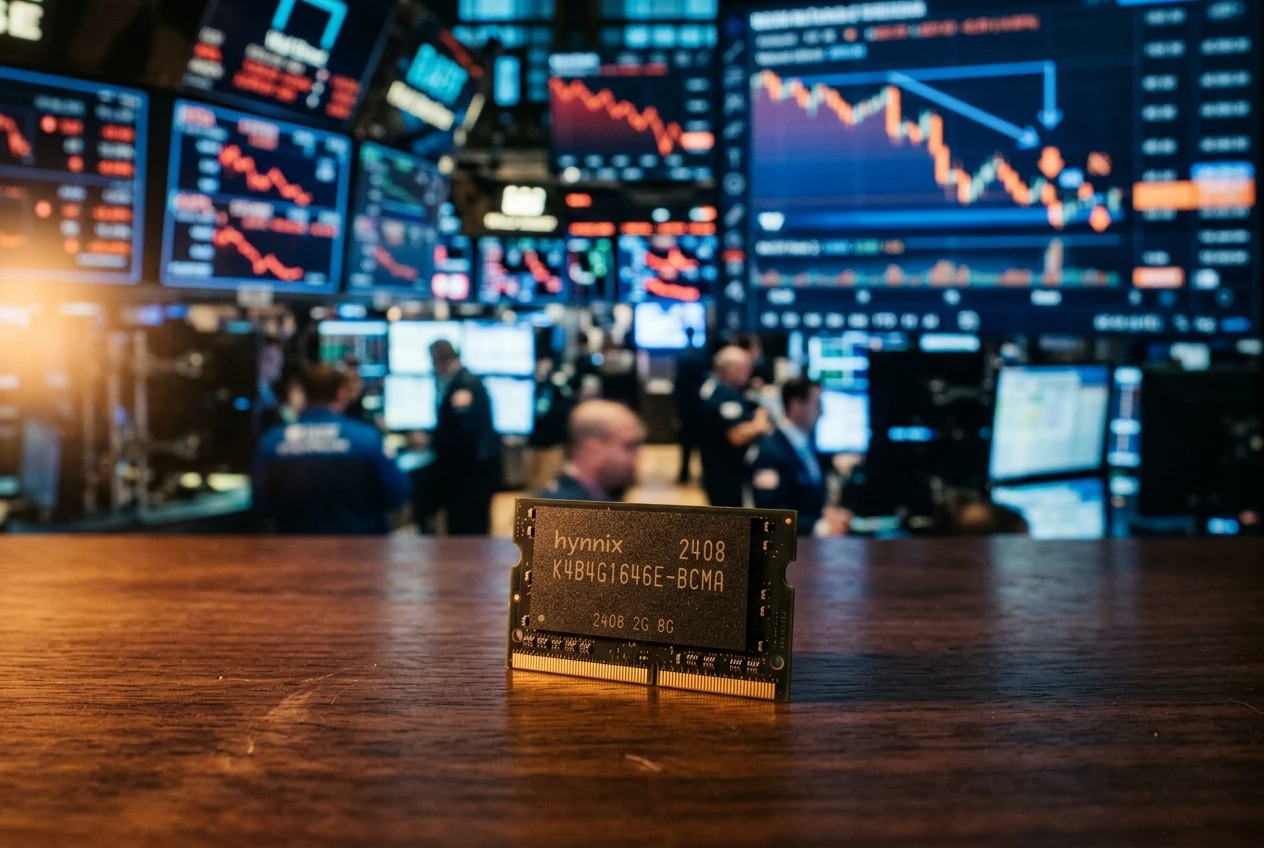
The Slide From $1,213.37 in Numbers
From the June 25 all-time high of $1,213.37 to the July 7 close of $938.38 is a drop of 22% below the peak, packed into eight trading sessions. The 52-week range runs from $103.38 to $1,255.00, the kind of span that captures both the memory-cycle bust of 2024 and the AI supercycle that has carried Micron back to a $1.06 trillion market cap. Per Macrotrends data, the stock is still up 228.97% year to date in 2026, even after the late-June reversal. The chart shape is not a structural break. It is a sharp pullback inside a long uptrend, the kind that resets positioning without rewriting the thesis.
Charles Schwab’s daily market update for July 7 captured the same dynamic on the way down. After Micron rallied into Monday’s close on news of a long-term Ford supply deal, the stock opened lower the next morning as traders waited on the Federal Reserve minutes due July 8, per the Schwab daily market update noting the early Tuesday chip decline. The bear-market label lands on a stock that has not lost its fundamental footing. Micron’s full stock price history and 52-week range shows the longer arc: a stock that has more than tripled this year so far, off a 52-week low that sits 89% below the current price.
- $938.38 – closing price July 7, 2026
- $1,213.37 – all-time closing high, June 25, 2026
- -4.71% – one-day move on July 7, 2026
- +228.97% – year-to-date 2026 change
- $1.06 trillion – market capitalization, July 7, 2026
Wall Street Hasn’t Moved Off Its Buy Rating
The bear market is real. The analyst rerating isn’t. MarketBeat’s tally of 38 covering analysts on Micron breaks down as 5 Strong Buy, 30 Buy, 3 Hold, and zero Sell. The average rating score is 3.05 of 4. The consensus 12-month price target sits at $1,263.76, which implies roughly 34.7% upside from the July 7 close.
The most bullish banks have moved up, not down, through the rally.
UBS tripled its price target in May, raising it from $535 to $1,625 on the same day Micron crossed a $1 trillion market cap for the first time. In its note, the bank argued that AI has structurally rewired memory and that the multiple deserves to expand as more details emerge. Susquehanna went further after the June 24 earnings print, lifting its target to $2,000 from $1,750 while keeping its Positive rating. Morgan Stanley raised its target on July 6 by 102%, from $520 to $1,050, maintaining an Overweight rating. Bank of America sits at $950. TheStreet and CNBC both captured the UBS and Morgan Stanley moves at the time, and CNBC’s May 26 piece detailed Micron hitting a $1 trillion market cap on UBS’s call.
The Street raised targets through the rally and has not trimmed them during the pullback. Either the consensus is late, or the Micron stock bear market is a sentiment event sitting inside an earnings story that hasn’t cracked.
| Bank | Stance and Price Target |
|---|---|
| UBS | $1,625 (raised May 26 from $535) |
| Susquehanna | $2,000 (raised post-Q3 from $1,750) |
| Morgan Stanley | $1,050 (raised July 6 from $520) |
| Bank of America | $950 |
| Goldman Sachs | ~$900 (bearish on margins) |
The AI Memory Trade That Built a Trillion-Dollar Chipmaker
Behind the consensus target is a supply story that almost no other chip sub-segment can match. Micron makes high-bandwidth memory, the HBM chips stacked next to Nvidia accelerators inside the AI training clusters built by every major hyperscaler. There are three HBM suppliers in volume anywhere in the world: Micron, South Korea’s SK Hynix, and Samsung.
Micron is sold out of HBM for the rest of 2026. The company has signed 16 strategic customer agreements with take-or-pay terms, representing roughly $100 billion in remaining performance obligations and projected $22 billion in customer cash deposits and related commitments, according to analysis of the late-June earnings call. CEO Sanjay Mehrotra framed the change in plain terms on the same call:
The memory industry has been structurally transformed by the proliferation of AI.
He added that HBM can fill only 50% to two-thirds of 2026 demand, a shortage the company has no near-term way to close. The fiscal Q3 numbers back the thesis. Revenue of $41.456 billion rose 345.72% year-over-year from $9.30 billion. Non-GAAP EPS of $25.11 beat the $21.39 consensus by $3.72. GAAP gross margin printed 84.6% against 37.7% a year earlier, with 84.6% gross margin in a single quarter that historically would have peaked near the mid-50s. Trailing P/E near 21x sits against a Computer and Technology sector average of 168x, per MarketBeat.
The Ford deal signed July 6 signals where the next leg of demand comes from. It is the same take-or-pay model applied to automotive memory and storage for next-generation vehicle production, not just cloud AI. The Micron stock bear market landed on a day when the deal pipeline was visibly expanding, not contracting. For the longer arc, including the case that a $3,000 price is even theoretically possible, the analysis of Micron’s path to a $3,000 share price walks through the math.
Where Bears Are Still Pushing Back
Goldman Sachs carries a target near $900 and has written the cleanest version of the bear case. The argument: near-85% gross margins represent a cycle peak, not a new floor. Micron, SK Hynix, and Samsung are all spending on capacity at the same time. Micron itself guided full-year FY2026 capex to roughly $27 billion, with the new Idaho fab ID1 on track for first wafer output in mid-calendar 2027 and ID2 in late-calendar 2028. When that bit supply lands, even strong AI demand compresses pricing power.
The CFO made the bear point himself. Mark Murphy told analysts on the late-June call:
we are at margin levels where incremental price yields less gross margin expansion.
That is a company officer conceding that today’s margin is the ceiling, not the floor. It is the cleanest bearish data point inside the bull thesis. The other risks cluster around concentration: lead-customer dependence on HBM4, public hyperscaler research into memory-compression techniques that could cut usage by up to 40x, and the historical track record of memory cycles ending in bust. Baird strategist Ross Mayfield has argued on CNBC that the memory boom will not last and margins will compress as hyperscalers seek alternatives.
What the September Quarter Has to Prove
Micron’s next earnings release is estimated for September 22, 2026, per MarketBeat’s company calendar. Bulls and bears have already drawn their lines.
The report is the first chance for either side to be proven right inside the bear market window. Bulls need confirmation that HBM pricing has held through Q4, that the 16 take-or-pay contracts are converting into recognized revenue, and that the Ford-style automotive expansion is adding material backlog. Bears need any sign of HBM price softening, customer pushback on take-or-pay renewals, or capex being pulled forward faster than demand. Last quarter’s Q4 guidance, $50 billion in revenue and $31.00 in non-GAAP EPS, is the bar. If the company clears it cleanly, the bear market looks like a sale. If it misses, Goldman and Baird look early, not wrong.
Frequently Asked Questions
Is Micron stock in a bear market right now?
Yes, on a technical basis. The July 7, 2026 close of $938.38 sits 22.7% below the June 25, 2026 all-time closing high of $1,213.37, which clears the textbook 20% threshold for a technical bear market.
Why is Micron stock falling in July 2026?
A risk-off move driven by oil prices spiking after Trump said the U.S.-Iran ceasefire is over, amplified by an Asia-led tech selloff that dragged South Korea’s KOSPI down 5.4%, plus a chip-stock rotation as investors awaited Federal Reserve minutes.
What is Wall Street’s price target for Micron?
The consensus 12-month price target across 38 analysts is $1,263.76, per MarketBeat. The bull case sits at UBS with $1,625 and Susquehanna with $2,000. Goldman Sachs is around $900 on a margin-compression thesis.
When does Micron report earnings next?
The next report is estimated for September 22, 2026, per MarketBeat’s company calendar, covering fiscal Q4.
Is Micron a good buy at current prices?
The contrarian read points to 34.7% implied upside to consensus, HBM sold out for the rest of 2026, and roughly $100 billion in take-or-pay revenue already contracted. The bear read points to a CFO who has publicly conceded that today’s margin is the ceiling.
Disclaimer: This article is for informational purposes only and does not constitute investment advice. Stock prices and analyst targets move quickly and may have changed since publication. Figures cited are accurate as of July 7-8, 2026, based on sources cited. Consult a qualified financial professional before making any investment decision.






Shelby’s $42.9 million Daytona Coupe cashes the bet that beat Ferrari

AI forces Apple into third security drop in three weeks

Lamborghini banks 2027 revenue with sold-out Revuelto SV

Apple’s Labor Day Habit Locks iPhone 18 Pro September Dates

Frogwares Ships Sinking City 2 After Years of Air Raids

AirTag 2 Hits Near Lows Just as Travel Season Peaks

McLaren Pop Art F1 GTR Hits $34.6 Million and Resets the Tier

Spotify Playlist Notes Bring Back Liner Notes for Streaming

AirPods Max 2 hit $429 and finally close the value gap

Star Citizen private demo of Siege of Orison still wiped the devs

Guardians Rout Twins With Seven Homers, Leave Joe Ryan One Shy of Record

Rainout Gives Red Sox Two Shots at a Franchise-Record Win Streak

Caitlin Clark Skips the WNBA 3-Point Contest for a Third Straight Year

Double Fine Cuts 23 Jobs Weeks After Xbox Independence

John Hight Exits Wizards After Digital Reckoning Hits

Day-One Big Walk Lifts PS Plus August Beyond Recycled AAA

Curtis Mead’s Red Sox Debut Ends With Fractured Wrist

Moesch and Dressel Rewrite Night One at 2026 U.S. Nationals

Red Sox Squander Hot Streak Chance in 4-3 Loss to Athletics

Boutte’s Quiet Camp Takeover Forces Patriots Receiver Choices
-

 TECHNOLOGY3 years ago
How to Adjust a Bulova Watch Band – An Easy Guide
-

 News3 years ago
Fred Pentland: Athletic Bilbao’s English mentor who changed the essence of Spanish football
-

 FINANCE3 years ago
Tax Planning for Every Season: Guide to Maximizing Your Tax Benefits
-

 Education3 years ago
African Ministers New Education Plan
-

 BUSINESS3 years ago
What is Entrepreneurial Operating System? A Comprehensive Guide to EOS
-

 Education3 years ago
Innovate Your Learning Journey with Technology and Enhance Education
-

 News3 years ago
Russians formally out of World Athletics Championships
-

 BUSINESS3 years ago
Top 9 Most Expensive American Cities to Rent an Apartment