
News
Hayabusa2 Skims Asteroid Torifune in Planetary Defense Test
Japan’s Hayabusa2 probe flew within 800 meters of asteroid Torifune on July 5, 2026, in a precision-trajectory test of planetary defense technology.

Japan’s Hayabusa2 probe skimmed past asteroid Torifune on July 5, 2026, in a precision-trajectory test designed to feed planetary defense work.
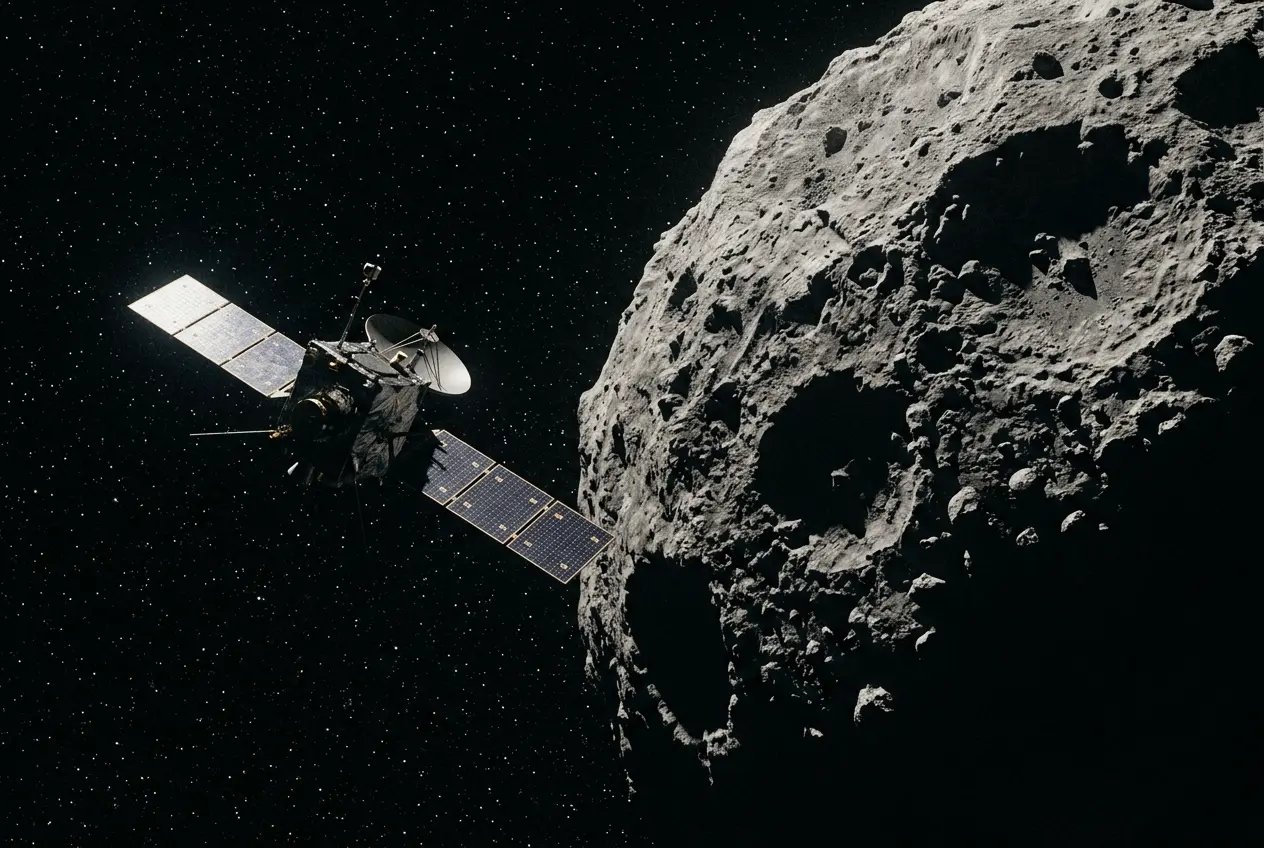
At 6:35 p.m. Japan time (0935 GMT) the JAXA spacecraft passed within 800 meters of Torifune at roughly 18,000 kilometers per hour, a JAXA spokeswoman told AFP. Footage from the agency showed scientists applauding in a control room as data confirmed the spacecraft is operating normally. Hayabusa2 was not designed to collide with Torifune; the probe was rehearsing the precise trajectory control a real deflection mission would require.
A Flyby Confirmed at 6:35 p.m. Japan Time
JAXA announced the encounter in a statement carried by AFP, putting the closest planned approach at 800 meters from Torifune. The asteroid is catalogued as (98943) 2001 CC21 and named Torifune after a creature from Japanese mythology. JAXA had not yet published the precise closest-approach distance; the agency said it would detail results at a Monday press conference in Japan.
The probe moved at roughly 5 kilometers per second, the closing speed JAXA had warned would complicate last-minute course corrections. JAXA flagged the maneuver as one targeted step in a broader program to test precision navigation near small bodies, not a standalone stunt. Detailed imagery from the flyby was to be released Monday or later in the week, NHK reported, depending on whether the cameras succeeded.
Why the 800-Meter Margin Was the Whole Point
The flyby was about trajectory control, not sightseeing. A kinetic impactor designed to shift an asteroid’s orbit must arrive within meters of its target, and small dark bodies like Torifune can only be imaged a few days before the closest pass. JAXA framed the exercise as a dress rehearsal for the guidance profile a real deflection mission would use.
Hayabusa2 was scheduled to image the surface, read its temperature, and check its texture on the way past, all while moving fast enough that any course correction would have to happen in minutes. The same logic underpins plans for the 2031 rendezvous with the much smaller asteroid 1998 KY26. If Hayabusa2 can hold a precise path past Torifune, JAXA’s argument goes, the same approach could one day steer a real impactor to a threatening body.
It’s as difficult as trying to shoot through a one-yen coin somewhere within the area stretching from Okinawa to Hokkaido.
Yuya Mimasu of JAXA said that before the flyby, naming Japan’s southernmost and northernmost islands as the scale of the problem. Mimasu’s framing captured the engineering point in one sentence: a probe at hypersonic closing speed has only minutes to lock on, compute, and adjust.
Built on NASA’s 2022 DART Impact
The Torifune pass lands in a year that has shifted planetary defense from theory into measured outcomes. NASA’s DART spacecraft slammed into asteroid Dimorphos in September 2022, the first time a human-made object measurably altered the path of a celestial body, NASA has said.
Subsequent ground tracking showed the impact also shifted the binary asteroid’s 770-day orbit around the sun by about 0.15 seconds, the agency has reported. Analysis of the 22 stellar occultations tracked by volunteer astronomers between October 2022 and March 2025 sharpened the picture still further, NASA said, and gave engineers a denser data set on what an impact does to a binary system.
Hayabusa2’s job at Torifune is different. The probe was designed to skim past, capturing imagery and physics data at speed, not collide. That makes the JAXA flyby a sister test of trajectory control rather than a replay of DART, and JAXA has set it up that way on purpose. Japan and the United States are running two complementary tests along the same learning curve for defending Earth.
The result would rank among the closest flybys of a near-Earth asteroid ever attempted, if JAXA confirms the under-800-meter approach. Patrick Michel, project scientist at the European Space Agency, said each new encounter is worthwhile on its own. The probe’s pre-flyby Torifune briefing page at JAXA confirms the same narrow-margin logic driving the encounter. JAXA’s published flight plan for the encounter tests the same logic NASA tested with DART, against a different class of target and on a different axis of the problem.
| Comparison Axis | NASA’s DART (Sept 2022) | Hayabusa2# at Torifune (July 2026) |
|---|---|---|
| What the test asked | Can a single impact measurably move an asteroid? | Can a probe hold a precise path past a small dark body at high speed? |
| Encounter style | Impact into Dimorphos | Skim past Torifune |
| Where the data lands | Refined binary dynamics and impact physics | JAXA release and analysis starting Monday |
| Reported result so far | Shortened Dimorphos’s 12-hour orbit around Didymos by 33 minutes | Mission completed; precise closest-approach pending |
Rock, Sand, or Boulder Field?
Cameras on Hayabusa2 were programmed to record surface features, texture, and temperature as the spacecraft screamed past. Patrick Michel, project scientist at the European Space Agency, said those measurements matter because the physics of deflection depends on what an asteroid is made of. A solid rock and a loose rubble pile respond very differently to a kinetic impactor.
Is the surface consisting of bare rock, or cover(ed) by boulder fields or sand beaches? Only images taken by a spacecraft can reveal this information.
Michel told AFP before the flyby that the implications for any future deflection mission are direct. "If we want to deflect an asteroid by an impact, the response is not the same if the asteroid is behaving like a sponge or if it behaves like a very solid material," he said. Hayabusa2’s flyby will return the first close-range visual evidence on Torifune’s surface.
Dimorphos is now thought to be a rubble pile, loosely bound material shed over time by its larger companion Didymos, according to NASA. That internal makeup is part of why DART’s impact threw out such a large cloud of debris, doubling the punch of the collision alone. Hayabusa2’s Torifune data will start filling in the same picture for a different size class of asteroid. Hayabusa2’s launch and extended-mission timeline lists the Torifune pass as one of three planned steps before the 2031 rendezvous.
A Probe With a Track Record at Ryugu
Hayabusa2 is no stranger to small bodies. JAXA launched the probe on December 3, 2014, from the Tanegashima Space Center and it arrived at the asteroid Ryugu on June 27, 2018. Over the next eighteen months it touched down twice on Ryugu’s surface, fired an impacter that blasted an artificial crater into the body, and gathered subsurface samples before riding home. The return capsule landed on December 6, 2020, packed with material that scientists have since read for clues about the early solar system.
JAXA named the asteroid Ryugu, "dragon palace" in Japanese, after a mythical underwater castle. Hayabusa2 returned the samples "providing scientists with clues about what the solar system was like at its birth some 4.6 billion years ago," AFP reported at the time. The Torifune flyby is now the next item on a list of small-body missions that did not exist a decade ago. The post-flyby success and follow-up plan from NHK confirms JAXA will publish full results at the Monday briefing.
- Hayabusa2 launch mass: about 600 kilograms
- Ryugu sampling distance: roughly 300 million kilometers from Earth
- 1998 KY26 rotation period: about 10 minutes
- 1998 KY26 diameter: several tens of meters
- Planned Earth swing-bys en route: 2027 and 2028
A Harder Target Waiting in 2031
Torifune is the waypoint, not the finish line. Hayabusa2’s final destination is asteroid 1998 KY26, which JAXA expects to reach in 2031. The body is unusually small for any asteroid mission and rotates once every 10 minutes, fast enough that centrifugal force at the equator outweighs the asteroid’s own gravity. Many asteroids of this size strike Earth on a cadence of every hundred to a thousand years, per JAXA, and ground-based telescopes cannot resolve their surfaces.
Close-range data from Torifune is meant to feed directly into how engineers operate near 1998 KY26, where conditions are even more extreme. NASA, separately, is building the Near-Earth Object Surveyor mission to find asteroids that current ground surveys miss, the agency has said. How DART altered Dimorphos’s orbit around the sun describes the second-order effect NASA pinned down from the same 2022 impact. A separate study published in 2025 also found 1998 KY26 to be smaller and rotating faster than previously thought, which tightens the engineering challenge Hayabusa2 will face in 2031.
Hayabusa2’s 2031 rendezvous will land in the middle of an active decade for small-body missions and planetary defense research, where measured tests of the hardware and software needed to move asteroids are still rare.
Frequently Asked Questions
Which asteroid did Hayabusa2 fly by on July 5, 2026?
Asteroid (98943) Torifune, also known by its earlier designation 2001 CC21. JAXA planned the closest approach at 800 meters from the asteroid’s center, with full confirmation of the precise distance pending a Monday press conference in Japan.
How does the Torifune flyby differ from NASA’s DART mission?
NASA’s DART spacecraft deliberately crashed into asteroid Dimorphos in September 2022 in what NASA has called the first time a human-made object measurably altered the path of a celestial body. JAXA’s Hayabusa2 was not designed to hit Torifune; it was engineered to skim past at 5 kilometers per second and capture imagery and surface data on the way.
What data is Hayabusa2 collecting during the flyby?
Hayabusa2 cameras are recording surface imagery, geographic features, texture, and temperature of the asteroid. ESA project scientist Patrick Michel told AFP that the data will tell engineers whether an asteroid behaves more like a "sponge" or a "very solid material," two very different responses that need different impactor designs.
What is Hayabusa2’s next destination after the flyby?
The probe is set to attempt a rendezvous with asteroid 1998 KY26 in 2031, with two Earth swing-bys planned in 2027 and 2028 on the way. JAXA launched Hayabusa2 in December 2014 from the Tanegashima Space Center.
Could Hayabusa2 deflect a real asteroid today?
No deflection mission is on the books against any actual threat, and the Torifune flyby is a rehearsal rather than a deployment. JAXA framed the encounter as one of the precision-trajectory steps needed before any future deflection mission could be attempted against a real target.






Spotify Running Mode hits Android and revives its old tempo experiment

Galaxy Tab S12 Ultra Renders Keep the Notch Fans Hate

Novato Spinning Round House Sells With Six Neighbors for $3.3 Million

Crop Tour Finds Indiana and Nebraska Corn Yields Lagging 2025

Best Buy 60th sale brings Android deals back to its roots

American Airlines reverses seatback screen bet years too late

Iran Hormuz Strikes Force Gulf Oil Onto Costlier Paths

Plague Tale Prequel Day One Joins Game Pass Wave 2 as Witcher Exits

NBA 2K27 opens The City to everyone and rewrites career eras

iOS 26.6.1 Patches 29 Flaws as AI Forces Faster Apple Updates

Double Fine Cuts 23 Jobs Weeks After Xbox Independence

John Hight Exits Wizards After Digital Reckoning Hits

Day-One Big Walk Lifts PS Plus August Beyond Recycled AAA

Curtis Mead’s Red Sox Debut Ends With Fractured Wrist

Moesch and Dressel Rewrite Night One at 2026 U.S. Nationals

Red Sox Squander Hot Streak Chance in 4-3 Loss to Athletics

Boutte’s Quiet Camp Takeover Forces Patriots Receiver Choices

Take-Two CEO Pushes Netflix Subs for GTA 6 Extended Look

Halo Campaign Evolved Skulls Meet Death Barriers That Kill the Hunt

Wildlands Free Update Hands Players the Tools They Already Invented
-

 TECHNOLOGY3 years ago
How to Adjust a Bulova Watch Band – An Easy Guide
-

 News3 years ago
Fred Pentland: Athletic Bilbao’s English mentor who changed the essence of Spanish football
-

 FINANCE3 years ago
Tax Planning for Every Season: Guide to Maximizing Your Tax Benefits
-

 Education3 years ago
African Ministers New Education Plan
-

 BUSINESS3 years ago
What is Entrepreneurial Operating System? A Comprehensive Guide to EOS
-

 Education3 years ago
Innovate Your Learning Journey with Technology and Enhance Education
-

 BUSINESS3 years ago
Top 9 Most Expensive American Cities to Rent an Apartment
-

 News3 years ago
Russians formally out of World Athletics Championships